Oregon Spark Arrester Requirements on Trails
A spark arrester is a small exhaust component with a big job: keeping hot particles from leaving your machine and starting a fire. If you ride Oregon trails, it is easy to confuse the arrester with a muffler or assume a stock exhaust is automatically compliant. Here’s how to understand the requirement, check your machine and avoid a preventable problem at a trailhead.
What Oregon’s spark arrester requirement means
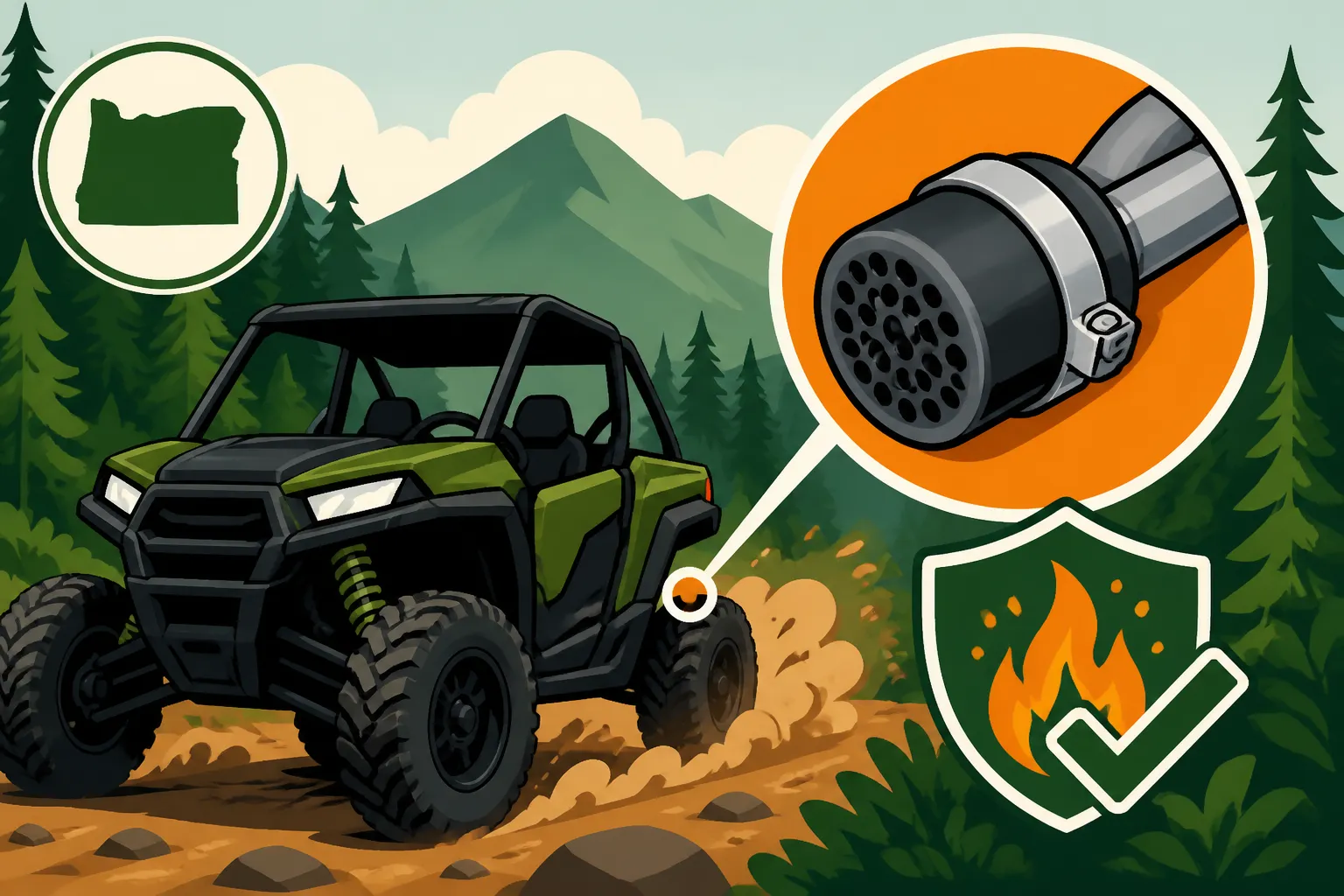
For off-highway vehicle riding on public land in Oregon, plan on having a spark arrester that meets U.S. Forest Service standards and is in good working order. The arrester helps keep sparks or glowing carbon particles from escaping through the exhaust. That matters especially in dry vegetation, where one hot particle can create a serious fire risk.
The requirement is about the exhaust system’s ability to stop sparks. A muffler’s main job is reducing exhaust noise. Many machines have both components integrated into the exhaust, but one does not automatically prove the other is present or functioning. A quiet machine may still lack a compliant arrester; a machine with a spark arrester may still be too loud under applicable sound rules.
The practical rule is straightforward: before riding a public OHV trail, confirm that your machine has an approved arrester and that it has not been removed, damaged or altered. This applies to common off-road machines, including quads, dirt bikes, side-by-sides and other OHVs. The details of a land manager’s rules can vary, so check the rules for the specific riding area as well.
Spark arresters are part of a broader set of requirements that may apply to an OHV. A machine may also need a current operating permit, and riders may have to follow sound limits, fire restrictions and area-specific closures. Those requirements are separate: having a permit does not make a missing arrester acceptable, and an arrester does not substitute for a permit. For the wider picture, see Oregon Spark Arrester and Sound Rules and [Oregon ATV Permits Explained].
| Question | Practical answer |
|---|---|
| What does the arrester do? | Helps prevent sparks or hot particles from escaping the exhaust. |
| Is it the same as a muffler? | No. A muffler reduces noise; a spark arrester reduces the risk of sparks escaping. |
| Does a stock exhaust guarantee compliance? | Not necessarily. Check the equipment, identification and condition. |
| Is it separate from the OHV permit? | Yes. Permit and equipment requirements are different. |
| Where should you confirm the rule? | Check the riding area’s current rules and the responsible land manager. |
A factory-installed arrester may be compliant when the machine is new, but that does not settle the question for a used or modified machine. Exhaust parts can be replaced, removed, damaged or clogged over time. Check the actual equipment rather than relying on the machine’s model name, age or seller’s assurance.
How to tell whether your machine has a compliant arrester
Start by identifying the exhaust system currently installed on the machine. Look for a manufacturer’s marking, part number or documentation that identifies the spark arrester and its rating. A stamped marking can be useful, but it is not enough if you cannot match it to the installed part or if the exhaust has been altered since the marking was applied.
The most reliable route is to compare the part with the machine or exhaust manufacturer’s documentation. Check the owner’s manual, parts information or installation instructions for the exhaust assembly. If the exhaust is aftermarket, look up the exact model and confirm that the manufacturer identifies it as meeting the applicable Forest Service spark-arrester standard. A seller’s broad statement that an exhaust is “trail legal” may not answer whether it meets the specific requirement for the area where you plan to ride.
A screen or mesh insert may be part of a spark-arresting system, but appearance alone does not establish compliance. A homemade screen, an unmarked insert or a part that simply looks similar to the original may not meet the relevant standard. Avoid relying on guesswork, especially if the part has no identification and no documentation.
A sensible check before a ride looks like this:
- Find the make and model of the installed muffler or exhaust assembly.
- Locate the manufacturer’s documentation for that exact part.
- Confirm that the documentation identifies a spark arrester meeting the required standard.
- Inspect the part for damage, missing pieces, looseness or signs of modification.
- Check the destination’s rules for any additional equipment or inspection requirements.
If you are buying a replacement, verify the exact fitment and rating before ordering. Listings on Amazon or other marketplaces can be useful for comparing parts, but a product description or customer review is not proof that a particular part is approved. Check the manufacturer’s documentation and the requirements for your machine and riding area. Choosing a Forest Service Rated Spark Arrester covers the selection process in more detail.
Do not assume every removable insert is an arrester. Some exhausts use a removable component that is required for spark control, while other removable parts are intended for sound tuning or performance. If you remove an insert for cleaning or maintenance, consult the manufacturer’s instructions before riding. Operating without a part that is required for the arrester’s function can leave the machine noncompliant even if the rest of the exhaust is intact.
A dealer or qualified repair shop can help identify an unknown exhaust. Bring the machine or clear photographs of the exhaust markings and part numbers. Ask a specific question: does this installed system include a spark arrester that meets the standard required for Oregon public OHV riding? That is more useful than asking only whether the exhaust is “legal.”
Keep the arrester in working condition
A compliant part can become ineffective if it is clogged, broken, loose or removed. Regular inspection is a simple way to catch problems before you reach the trailhead. The maintenance procedure depends on the design: some arresters are serviceable, while others are part of a sealed exhaust assembly. Follow the manufacturer’s directions rather than forcing a part apart or cleaning it with a method that could damage it.
Before riding, look over the visible exhaust components. Check that the outlet and any retaining hardware are secure, the exhaust has no obvious holes or cracks, and any specified insert is present. A missing bolt, a damaged screen or evidence of an improvised repair deserves attention before the machine is used on public land.
Carbon buildup can affect performance and may restrict exhaust flow. If the manufacturer provides a cleaning procedure, follow it at the stated service interval or when inspection indicates it is needed. Let the exhaust cool completely first. Wear appropriate eye and hand protection, and do not use a tool or chemical that could tear, deform or corrode the arrester. If the part is damaged or its condition is uncertain, replace it with the correct approved component rather than trying to make a questionable one work.
Be especially careful after exhaust work. A repair that changes the outlet, removes an insert, substitutes a nonmatching part or leaves a gap can affect both spark control and noise. Ask the shop to confirm that the completed system still has a functioning arrester and that the part is installed as intended. Keep the receipt or parts documentation with your maintenance records.
A quick pre-ride routine can be added to the checks you already do for tires, controls and fluid leaks:
- Confirm the arrester component is present and properly secured.
- Look for cracks, holes, loose joints or unusual exhaust residue.
- Check that no recent repair or modification has removed a required part.
- Listen for a sudden change in exhaust sound, which can indicate damage or a loose connection.
- Inspect again after a hard ride, impact or exhaust repair.
If the exhaust becomes louder without an intentional change, do not treat that as only a noise issue. A damaged exhaust may also have a spark-control problem. Resolve the source before riding again, and check any separate sound rules that apply to the site. Oregon’s sound requirements are not interchangeable with its spark-arrester requirements; see Oregon Sound Limits and Where They Apply.
A dirty arrester is not necessarily the same as a failed one, but the machine should not be ridden if the component is damaged or cannot be confirmed to be functioning. If you find a burned-out, cracked or missing part, stop and repair the system before continuing. Replacing a Burned-Out Arrester explains what to check when replacement is needed.
Rules can depend on where you ride
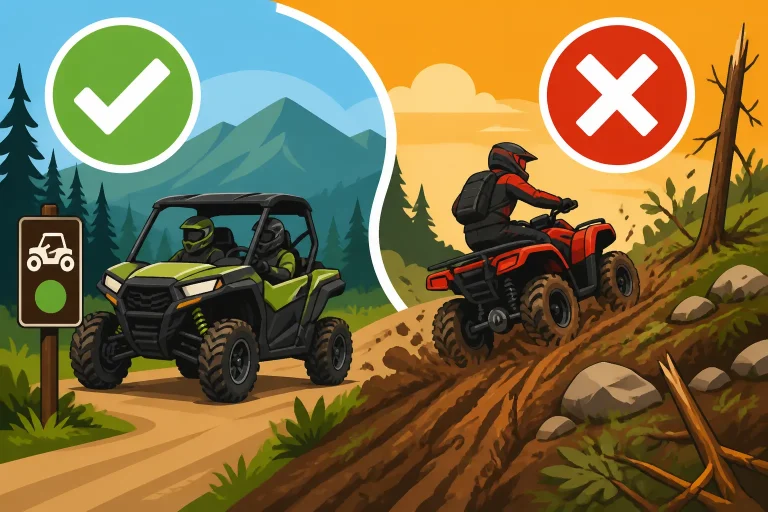
Oregon’s equipment requirement is only one layer of trail access. Public OHV areas may be managed by different agencies, and an area can have rules beyond the statewide baseline. A trail can also be temporarily closed because of fire danger, habitat protection, maintenance or other conditions. Do not assume a trail is open just because it appears on an older map or you rode it previously.
Check the rules for the land manager responsible for your destination. State forest, Bureau of Land Management and National Forest land may each have site-specific notices and restrictions. The machine still needs to meet applicable statewide requirements, but the destination’s current instructions may also tell you about seasonal closures, designated routes, fire precautions or other equipment expectations. Relevant starting points include [Oregon Rules for Riding State Forest Land], [Oregon Rules for Riding BLM Land] and [Oregon Rules for Riding a National Forest].
Private land is not automatically an exception to every rule. The landowner may set conditions for access, and separate laws or fire restrictions can still apply. If a trail crosses land under more than one manager, check each section rather than treating the entire route as one uniform area.
Before leaving home, verify:
- Which agency or owner manages the area and the specific route.
- Whether the route is currently open to your class of OHV.
- Whether there are additional equipment, sound or fire restrictions.
- Whether the area requires a permit, day-use payment or other access authorization.
- Whether a closure notice or weather-related restriction has changed the plan.
Current signs at an entrance, staging area or trail junction matter. If a posted sign conflicts with an old map or a remembered route, do not ride past it on the assumption that the map is right. When the rule is unclear, contact the responsible office or choose a route whose status is clear. Oregon Trail Closures to Check First can help you make closure checks part of trip planning.
Fire conditions deserve particular attention. A spark arrester reduces the chance of an ignition from the exhaust; it does not make riding safe or lawful during every fire restriction. Managers can limit access or prohibit specific activities when conditions warrant. An approved arrester is not permission to ride through a closure, ignore a fire warning or operate carelessly near dry vegetation.
For a larger checklist of equipment and trail rules, see Oregon Spark Arrester and Sound Rules. Keeping permits and the machine’s compliance in order is useful, but always check the destination itself. Rules can be different from one riding area to another, and temporary notices can change access even when your machine is properly equipped.
Common mistakes and how to avoid them
The most common mistake is treating “muffler,” “quiet exhaust” and “spark arrester” as interchangeable terms. They are not. A muffler can reduce noise without providing an approved spark-arresting function. A spark arrester can be present while the exhaust still exceeds a site’s noise limit. Check both issues independently.
Another mistake is assuming the machine’s original equipment is still installed. A previous owner may have fitted a different exhaust, removed an insert or made a repair that changed the system. A machine can look stock from a distance while its internal components have been changed. If you bought it used, inspect the exhaust and confirm what is installed.
A third mistake is trusting a generic product label. Words such as “off-road,” “race,” “quiet” or “universal” do not by themselves establish that the component meets the required standard. Verify the exact product and fitment through the manufacturer. If you cannot identify the part, do not count on it being compliant.
It is also easy to forget that maintenance changes compliance. A previously correct system may no longer be acceptable after a crash, repair, modification or missing hardware. Recheck the exhaust after any work that could affect it. If a mechanic has serviced the machine, ask whether the arrester remained in place and is functioning.
Finally, riders sometimes think a permit or safety card resolves every equipment question. It does not. Permits, rider education, spark arresters, sound limits and access rules have different purposes. Carry out each check on its own terms. A good pre-trip routine is more dependable than trying to sort out requirements at the staging area.
| Mistake | Better approach |
|---|---|
| Assuming a quiet machine has an arrester | Verify the arrester component and its documentation separately. |
| Trusting a stock appearance | Check the actual installed exhaust, especially on a used machine. |
| Buying a part based only on a listing title | Confirm the exact model, fitment and manufacturer’s rating. |
| Riding with a damaged or missing insert | Repair the exhaust before using public trails. |
| Treating an approved arrester as permission to ride anywhere | Check closures, fire restrictions and site-specific rules. |
| Assuming a permit covers equipment | Treat permits, sound rules and equipment requirements as separate checks. |
When in doubt, pause the ride until you have a clear answer. Replacing or identifying a part at home is usually easier than discovering the problem after hauling the machine to a staging area. If you are already at the trailhead and cannot verify the equipment, do not ride on the assumption that it will pass inspection.
Frequently Asked Questions
Do all Oregon ATV and UTV riders need a spark arrester?
For riding OHVs on public land, expect to need a spark arrester that meets the applicable Forest Service standard and is in working order. Check the specific area’s rules, since land managers may have additional requirements.
Is the spark arrester part of the muffler?
It may be built into the muffler or exhaust assembly, but it has a different function. The muffler reduces noise; the arrester helps keep sparks from escaping. Confirm both compliance and condition rather than relying on the name of the part.
Can I ride if the arrester is clogged or damaged?
Do not ride on public trails if the arrester is damaged, missing or cannot be confirmed to work. Follow the manufacturer’s maintenance instructions or replace the part with the correct component before riding.
Does a permit mean my machine is ready for the trail?
No. A permit does not replace equipment requirements, sound limits, safety rules or access restrictions. Check each requirement separately and confirm the current rules for your destination.
Disclaimer
This article is for general informational purposes only and does not constitute professional advice. Laws, prices and regulations vary by location and change over time. Consult a qualified professional for guidance on your specific situation.