Day Use Fees at Oregon Federal Sites
A day-use fee at an Oregon federal recreation site can be easy to mistake for an ATV permit, especially when both come up at the staging area. They cover different things. This guide explains what a site fee generally pays for, how passes may apply, and what to check before towing your ATV or UTV to the coast, forest, or high desert.
What a day-use fee covers at Oregon federal sites
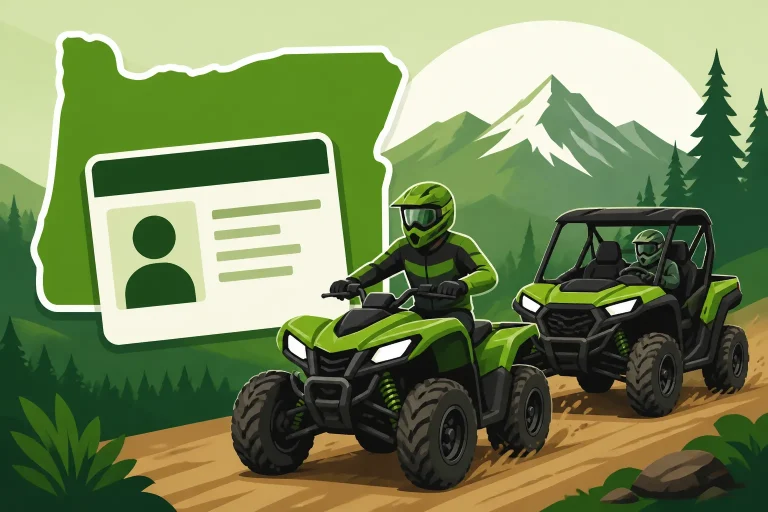
A site fee is not an ATV operating permit
A day-use fee is generally connected to using a particular developed recreation site, such as a parking or staging area. Depending on the location, it may help support facilities and services such as parking, restrooms, trash collection, or site maintenance. The fee applies to the site and its rules, not automatically to every public road or trail in the surrounding area.
An Oregon ATV operating permit serves a different purpose. It applies to the off-highway vehicle under Oregon’s rules and is separate from the fee for using a federal recreation site. A machine with the required permit may still need to pay a day-use fee where one is charged. And paying a parking or day-use fee does not, by itself, authorize an ATV or UTV to ride on a route where it is otherwise prohibited.
That distinction matters when a group arrives at a staging area and sees a fee station. One person may assume their ATV permit covers the whole visit, while another may think paying the fee replaces the permit decal. Neither assumption is safe. Check both requirements separately: the rules for the machine and the rules for the site. For more on the distinction, see Oregon Day Use Fees Explained and [Oregon ATV Permits Explained].
Federal land does not mean every site has the same fee
“Oregon federal site” covers recreation areas and facilities managed by different federal agencies. A day-use fee, accepted pass, payment method, and enforcement approach can vary by location. Even two sites in the same broad recreation area may have different facilities and fee arrangements.
The Oregon coast gives riders a useful example. Sites associated with the Oregon Dunes National Recreation Area include different staging and access points, such as South Jetty, Spinreel, Hauser, and Horsfall. Their facilities, access arrangements, and posted fee instructions may not be identical. A fee that applies at one developed site should not be assumed to cover another site down the road.
The same caution applies away from the coast. BLM recreation areas around Millican Valley and Christmas Valley have their own access information, while a Forest Service site may have another fee system. Before a trip, identify the exact staging area or recreation site you plan to use, then read the current posted or official site instructions for that location. A general search for “Oregon federal day-use fee” may not answer the question for the actual parking lot you will use.
Which costs to plan for on an ATV or UTV trip
Keep permit, parking, and camping costs separate
A useful way to plan is to treat the trip as several separate requirements rather than one all-in fee. The machine may need an Oregon operating permit. The recreation site may charge for day use or parking. Camping may require a separate reservation or fee. A rider could also encounter other site-specific charges, such as fees tied to a special activity or facility.
These costs do not necessarily come from the same agency or cover the same period. A permit for the ATV does not automatically pay for parking. A day-use payment at a staging area does not necessarily cover overnight camping. A campsite reservation does not necessarily take care of the machine’s permit. If the trip includes more than one stop, each location may also have separate access requirements.
| Item | What it generally applies to | What to check |
|---|---|---|
| Oregon ATV operating permit | The qualifying off-highway vehicle under Oregon rules | Machine class, permit status, decal placement, and any visitor reciprocity rules |
| Federal site day-use fee | Use of a specific fee site or developed recreation area | Exact site, fee instructions, payment options, and accepted passes |
| Camping fee or reservation | An overnight campsite or camping facility | Reservation requirements, dates, facilities, and whether day use is included |
| Special activity or access charge | A particular activity, facility, or access arrangement | Whether it applies to your planned use and whether it is separate from other fees |
Before leaving home, write down the name of the staging area, the kind of pass or payment you plan to use, and any separate camping arrangements. This simple check is especially helpful when a group is meeting at the coast and different vehicles are arriving from different directions. It avoids the frustrating discovery that one person has the right permit but the wrong site pass—or has paid for parking but still needs to handle a separate requirement.
Fees can depend on the exact place you park
Riders often think in terms of the riding area: “We’re going to the dunes” or “We’re riding Millican.” Fee instructions, however, may be tied to a particular parking area, trailhead, or developed access point. A fee paid at one location may not cover parking at another, even if both are used to reach the same broader recreation area.
That can complicate a day with several stops. Imagine a family begins at a coastal staging area, takes a break elsewhere, then drives to a different access point to meet friends. The group should not assume the first payment carries over. Look for language specifying whether the payment is valid for one site, a day, a particular vehicle, or participating locations. If the instructions are unclear, ask the site contact or follow the posted signs rather than guessing.
On the coast, riders may also encounter recreation locations that are close together but have different operators or facilities. A nearby campground, beach access, or day-use parking area might not use the same fee arrangement as the OHV staging area. For a broader breakdown of the federal-side costs riders can encounter, see Oregon Federal Site Fees for Riders. To understand why the operating permit and parking payment should be kept distinct, see Why the Permit Does Not Cover Parking.
How passes may work at Oregon federal recreation sites
A Northwest Forest Pass is not a universal Oregon pass
A Northwest Forest Pass is associated with participating Forest Service recreation sites. It may be a useful option for a rider who visits eligible sites, but it should not be treated as a pass for every federal land manager or every Oregon recreation area. A site’s own posted instructions determine whether a particular pass is accepted there.
This is where assumptions can become expensive or inconvenient. A rider may buy or bring a pass because it worked at a Forest Service trailhead on an earlier trip, then discover that the next parking area is managed under a different arrangement. A pass can be valid in one setting without covering a BLM site, a state-managed facility, a campground, or an activity-specific charge elsewhere.
Check the pass details against the exact site name before traveling. The question is not simply “Do I have a Forest pass?” It is “Does this site accept this pass for this use, and does it cover the vehicle or visit in the way I need?” The distinctions are discussed in [The Northwest Forest Pass and Oregon Sites] and A Northwest Forest Pass Instead of the Day Fee.
Interagency passes can have limits too
Interagency recreation passes are designed to provide access or cover certain fees at participating federal recreation sites. They can be convenient for people who visit federal lands often, but they do not erase every fee everywhere. Some charges may be outside the pass’s coverage, and rules can depend on the managing agency, the site, and the type of use.
For ATV and UTV riders, the most important step is to confirm whether the pass applies to the specific day-use charge at the planned staging area. Do not assume that a pass accepted at a national park or another Forest Service location must also be accepted at a coastal OHV site. Likewise, do not assume a pass covers camping, a special use, or a separate vehicle-related charge unless the site’s rules say so.
If you own a pass, keep it accessible and read its terms before the trip. If you are considering buying one because you visit multiple Oregon recreation sites, compare the participating locations you actually use with the pass’s stated coverage. The practical details are covered in Using an Interagency Pass on the Oregon Coast and Which Annual Pass Covers Oregon’s Coastal Dune Sites.
A pass only helps when it is displayed or presented correctly
Even a valid pass may not help if it is left in the tow vehicle at home, hidden under gear, or displayed in a way that site staff cannot inspect. Follow the instructions for that pass and location. Some sites may direct visitors to display a pass in a vehicle; others may use a different process. Use the posted directions rather than relying on what happened at another recreation area.
This can be a real pain point for riders with trailers. The tow rig may be parked in one place while the ATV or UTV is unloaded at a staging area, and a pass may need to be visible in the vehicle associated with the parking space. If the pass must be displayed, make sure it is readable from outside and not blocked by a sunshade, paperwork, or bags on the dashboard.
A small waterproof document pouch can help keep a printed confirmation or pass readable after a wet or sandy drive. Some riders use a clear holder bought through Amazon, while others keep the pass in a glove compartment until they reach the site and then follow the display instructions. The tool is less important than making sure the pass is easy to find, legible, and displayed as required.
Paying a day-use fee at a staging area
Read the sign before unloading
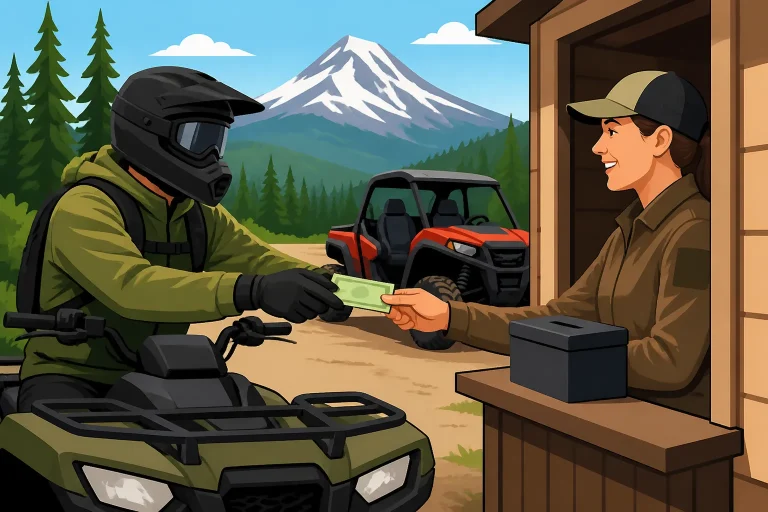
When you pull into a staging lot, pause before unloading the machine. Look for signs at the entrance, fee kiosks, payment envelopes, QR instructions, or other directions. The signs may explain which fee applies, how to pay, whether a pass is accepted, and where proof of payment should go.
It is tempting to follow the vehicle ahead, especially when the lot is busy and everyone is trying to get to the sand or trail. But another visitor may have a different pass, may be using a different facility, or may already have handled payment online. Take a minute to confirm the instructions for your own vehicle and visit. If there is a fee station and it is unclear whether it applies, do not assume it is optional just because no one is standing nearby.
Keep proof of payment where it can be retrieved during the visit. A photo of a confirmation may be useful as a backup, but it should not replace any physical display requirement specified by the site. If the site requires a receipt on the dashboard, place it there. If it provides another method, follow that method instead.
Carry a simple backup for wet, sandy, or busy days
Coastal conditions can turn a tidy paper receipt into a damp, curled scrap surprisingly quickly. Wind, fog, wet gear, and sandy hands make paperwork harder to manage than it seems at home. Before leaving the staging lot, make sure any receipt or permit documentation is protected and still readable.
A small clear pouch can keep papers together with your keys or vehicle documents. Riders sometimes use holders ordered through Amazon, but a resealable bag or a dry compartment in the tow vehicle can work too. Avoid placing important papers where they can blow away when a door opens or get buried under helmets and gloves. If you rely on a phone confirmation, make sure you can access it even if reception is poor.
A backup plan matters most when several people are traveling together. Decide who has the payment receipt, who is carrying the machine permit information, and where each item will be kept. That way, a ranger or site employee asking for proof does not turn into a group rummaging through wet jackets and toolboxes. For more on the payment process, see Paying the Day Use Fee at a Staging Area.
Be prepared for limited connectivity
Some recreation sites have weak or inconsistent mobile reception. That can make it difficult to open a payment page, retrieve a confirmation email, or look up site rules after you arrive. If the fee process depends on a phone, check whether you can complete it before reaching the lot and save the confirmation where it is available offline.
Do not rely entirely on a web page loading at the entrance. If you are unsure whether a location has reception or what payment options it offers, check the site’s instructions before the trip. A screenshot of a relevant confirmation can be a practical backup, but it does not override a site’s requirement to display a receipt or use a particular payment method.
For the same reason, write down the staging area’s name and location before leaving a town with reliable service. “The dunes” is not always enough to identify the right facility when there are multiple access points and signs. Being able to name the site makes it easier to follow the correct fee instructions and ask for help if something is unclear.
Planning by riding region
Oregon Dunes and coastal staging areas
The Oregon Dunes are a popular destination, but “going to the dunes” can mean several different staging areas and access points. South Jetty, Spinreel, Hauser, Horsfall, and other coastal locations can have different practical arrangements. Before setting out, choose the precise location, review its day-use instructions, and confirm whether any pass you hold is accepted there.
Coastal trips also involve costs that are easy to mix up. The ATV permit applies to the machine, while a site fee may apply to the vehicle using a developed parking or staging facility. Camping, beach access, or other nearby services can involve separate rules. A day-use payment should not be treated as a general pass to every dune access point or every activity along the coast.
The coast adds weather and timing challenges. Fog can make signs harder to read, a busy weekend can create a line at a kiosk, and wet sand can make it unpleasant to dig through a bag for paperwork. Handle payment before unloading when possible, keep proof accessible, and confirm that your planned riding area is open. These checks make a smoother start, especially if you have children or multiple machines in tow. For a focused look at the coastal fee question, see The $5 Day Use Fee on Oregon Dunes.
Forest and high-desert destinations
Forest Service recreation sites and BLM riding areas can have different management and fee systems. A pass that works at one Forest Service site may not cover a BLM location, and a familiar routine from the coast may not apply in the high desert. Confirm the managing agency and the specific site rather than assuming the same fee rules follow you across Oregon.
Before a ride near Millican Valley, Christmas Valley, or another inland area, check the exact access point and any current closures or restrictions. Even where no day-use fee is required at a particular location, riders still need to follow the land manager’s access rules, trail designations, and fire or seasonal restrictions. “No day-use fee” does not mean “no rules,” and it does not mean an ATV permit is unnecessary.
A good pre-trip checklist is short but specific: confirm the route is open, identify the staging area, check whether a site fee applies, determine which passes are accepted, and make sure each machine meets Oregon’s permit requirements. That approach is more reliable than asking whether the whole region is “free” or “fee-based,” because access conditions can vary from one facility to another.
Common fee mistakes and how to avoid them
Assuming one payment covers the whole trip
One of the most common mistakes is treating a payment as a blanket charge for everything. A rider pays at a staging area and assumes the ATV permit is covered, or buys an operating permit and assumes parking is included. Others pay for camping and believe the payment includes day use at a separate trailhead.
Make a list of each thing you need: vehicle permit, site access or parking, camping, and any additional activity fee. Then match each item to the agency or facility responsible for it. This sounds fussy, but it takes far less time than trying to resolve a fee question at a crowded entrance with a trailer behind you.
A printed checklist can help when the trip includes several machines or multiple stops. Keep it with the trip details, not in a folder that stays at home. If you use a phone note, consider saving the key information offline. The goal is to know what each payment covers rather than relying on a vague memory of what you paid last summer.
Assuming a familiar pass is accepted everywhere
A pass can be valid and still not apply to the site in front of you. This is especially easy to misunderstand when a rider has visited several federal recreation areas, because signs, agencies, and payment systems may look similar. A pass accepted at one Forest Service site does not necessarily apply at a neighboring facility managed under another arrangement.
Check the exact location and the pass terms before the drive. If a site lists accepted passes, compare that list with the name printed on your pass. If the instructions are unclear, contact the managing office or follow the payment directions at the site. Do not rely on an old receipt or a friend’s experience unless it matches the same location and use.
It also helps to distinguish the pass itself from a receipt. A receipt may document a one-time payment, while a pass may provide access under its own terms. Both may need to be displayed or presented differently. Keep them separate so you do not mistakenly show a day-use receipt when staff are asking for a machine permit, or vice versa.
Leaving proof buried or unreadable
A payment may have been made, but if the receipt cannot be seen or produced, the visit can become stressful. A slip left on the seat may be covered by a jacket. A pass tucked in a glove box may be difficult to find when asked for. A phone confirmation may be inaccessible if the battery is dead or reception is weak.
Choose a consistent place for each document. Keep vehicle-related proof with the tow rig’s paperwork, machine permit information with the machine or rider documents, and camping confirmations in a separate folder. Protect paper from moisture and sand, but do not store it so securely that you cannot retrieve it quickly.
A clear holder—whether one already on hand or bought through Amazon—can make a displayed receipt easier to read and less likely to blow away. It is a small organizational aid, not a substitute for the actual payment or the site’s display instructions. If using a holder, check that it does not obscure important information and that the receipt remains visible from outside when required.
A practical pre-trip checklist for riders
The day before you leave
Start with the exact destination, not only the general riding region. Confirm which staging area you are using and review its current directions for fees, passes, parking, and site access. If you plan to visit more than one location, check each one separately; do not assume payment at the first lot carries over.
Next, check the machines. Confirm that each ATV or UTV has the appropriate Oregon operating permit or qualifies under the rules that apply to the rider’s circumstances. Make sure the decal is properly placed and that necessary documentation is available. Visitors should also check whether their out-of-state permit or registration is recognized for the intended visit and whether any time limits or other conditions apply.
Finally, prepare the practical items: payment method, pass if applicable, receipt storage, camping confirmation, and a phone or printed copy of the site details. A document pouch from Amazon is one option for keeping papers together, but a sealed bag or vehicle document pocket is just as useful if it keeps everything dry and findable. The point is to avoid sorting paperwork at the entrance.
At the site and when plans change
On arrival, read the signs before unloading. Confirm that you are in the intended staging area, follow its payment instructions, and display or retain proof as directed. If a kiosk is out of order or the instructions conflict, avoid guessing; use any posted alternative directions or contact the site operator if possible.
If you change plans and move to a different access point, reassess the fee. The first payment may not apply at the new location. Similarly, a sudden closure, weather change, or full parking lot may send you elsewhere, where the rules could differ. Keep the site information handy so that a last-minute decision does not become an avoidable citation or an awkward conversation.
After the ride, store the receipt and relevant trip details until you are sure there is no unresolved issue. If you frequently ride in Oregon, keep a simple record of which passes and facilities you used. That makes future planning easier and prevents relying on a memory that blends together different staging areas, seasons, and fee systems.
Disclaimer
This article is for general informational purposes only and does not constitute professional advice. Laws, prices and regulations vary by location and change over time. Consult a qualified professional for guidance on your specific situation.