Oregon Rules for Crossing Private Timberland
Oregon’s timber country can make a short ride between public areas look straightforward, but a connecting road may cross private land or be closed to recreational vehicles. The key is to verify both access permission and the road’s current status before riding. An ATV permit, a map line, or a gate left open does not by itself authorize travel across private timberland.
First establish who controls the land and route
Timberland is not all managed the same way. A road may cross private industrial forest, public forest, or a patchwork of ownerships. Even when a route appears continuous, each segment can have different access rules. A road used by log trucks or shown on a map is not automatically open for recreational ATV or UTV use.
Start by identifying the landowner or manager for the specific area and route. Then confirm whether your planned ride is allowed on the date you intend to go. Permission for one road, trail, or destination may not cover neighboring roads or a different kind of vehicle. If the route crosses several properties, check access for every private segment rather than assuming one landowner’s approval covers the whole trip.
This matters when public lands are separated by a narrow strip of private property. A route that looks like the easiest connection on a map could require you to cross land where you have no permission. Private Land Between Two Public Parcels explains why that small gap can determine whether a route is usable.
| What you see | What it tells you | What to verify |
|---|---|---|
| A road on a public map | A road or route may exist | Whether recreational riding is currently allowed |
| An open gate | The gate is open at that moment | Whether access is authorized and whether the road is closed farther ahead |
| A timber truck using the road | The road may serve active work | Whether public recreational use is permitted and safe |
| A trail connecting two public areas | The route may appear continuous | Whether every segment is open and authorized |
| A permit decal on your machine | The machine may meet a permit requirement | Whether the landowner allows access and the road is open |
Maps are useful for planning, but they are not proof of permission. Online maps may show a road without showing who owns it, whether the road is open to motorized recreation, or whether a temporary closure is in effect. Signs, gates, and current information from the landowner or managing agency can be more relevant than an old map layer.
For routes on a timber company’s property, contact the company or its designated access program directly. Ask about the exact route, dates, machine type, and any conditions that apply. A general statement that a company sometimes allows recreation is not necessarily authorization for the route you want to ride. See Getting a Riding Permit From a Timber Company for more on seeking permission.
Permission, signs, gates, and closures
The safest practical rule is simple: do not enter private timberland for recreation unless you have clear permission or the route is clearly authorized for public use. Permission can come with limits, such as staying on specified roads, avoiding active operations, or leaving when a closure is posted. Follow those conditions; permission to travel through an area does not mean permission to explore side roads or trails.
Signs can communicate that access is restricted, that a road is closed, or that particular activities are not allowed. Take them seriously, even if the road looks passable or you have seen other riders use it. A sign may apply to a particular road, a larger area, or a temporary operating condition. If the message is unclear, stop and verify rather than guessing.
A gate deserves the same care. An open gate does not necessarily mean the road is open to recreational riding. It may have been left open for work traffic, or it may mark the entrance to land where access requires permission. A closed or locked gate is a clear reason not to continue past it. Do not bypass it by going around, through a gap, or onto an adjoining route. Gates on Industrial Forest Land covers why a gate’s position should not be treated as a permission signal.
Closures can change with work activity, fire risk, weather, road conditions, or other land-management needs. A route that was open on a previous visit may not be open now. Check current notices before departure and pay attention to signs encountered on the ride. If you discover a closure after entering an area, turn around safely and follow the posted directions. Do not continue in the hope that the road will reopen farther ahead.
Private timber roads can also be active work sites. Logging trucks and other industrial traffic may use roads that are narrow, dusty, steep, or difficult to see around. Even where recreational access is allowed, riders may need to yield, keep clear of work zones, and follow any site-specific instructions. If the landowner has not confirmed that recreation is permitted, the presence of work traffic is not a reason to assume the road is public.
For a fuller look at access and trespass concerns, see Oregon Trespass Rules for Riders. When in doubt, get permission before the ride rather than trying to resolve an access dispute at a gate or roadside.
Distinguish private roads from public routes
A road can be physically accessible without being legally open to public recreational riding. It may be privately owned, maintained for timber operations, or subject to restrictions that are not obvious from the road surface. Conversely, a public road may pass through private property, but that does not necessarily authorize riding off the road or entering nearby land.
Before using a route, work out what kind of road it is and who controls it. Roads on private industrial land should be treated as private unless reliable current information says otherwise. Roads on public land also have their own rules: an open route on one type of public land may not follow the same restrictions as a road on another. BLM Roads Versus Forest Service Roads offers context for checking who manages a route, while [Oregon Rules for Riding State Forest Land] addresses a different category of public land.
If a road is open to the public for ordinary travel, do not assume that it is also open to ATVs or UTVs. Road access can depend on vehicle rules, route designation, local restrictions, and signs. Likewise, permission to use a road does not automatically allow riding on adjacent timberland, cutting across a switchback, or taking an unsigned spur. Check the rules for the exact route and machine.
A useful planning sequence is:
- Mark the route you intend to ride, including every connection between public areas.
- Identify the owner or manager for each segment, using current land or access information.
- Confirm that recreational motorized travel is allowed on each private segment and on the planned dates.
- Check for route-specific limits, closures, gates, work activity, and machine restrictions.
- Carry the landowner’s permission or access information if it is available in writing.
- Turn around if signs, closures, or conditions on the ground contradict your plan.
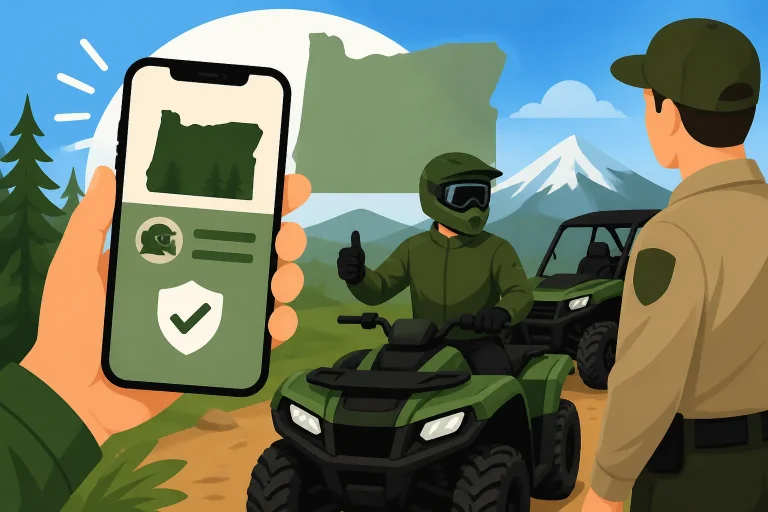
Written permission is especially helpful when access is conditional or when several people are riding together. It can record the approved route and any limits, making it easier to avoid misunderstandings. A phone call may be enough for some arrangements, but ask the landowner how permission is issued and what proof riders should carry.
Do not rely on an old route description, a past ride, or another rider’s claim that a road is “usually open.” Access conditions can change, and a route that is permitted for a local club or a particular event may not be open to everyone. Oregon Rules for Riding a Timber Company Road provides related guidance on the distinction between using a timber road and having authorization to use it.
Permits and preparation do not replace access permission
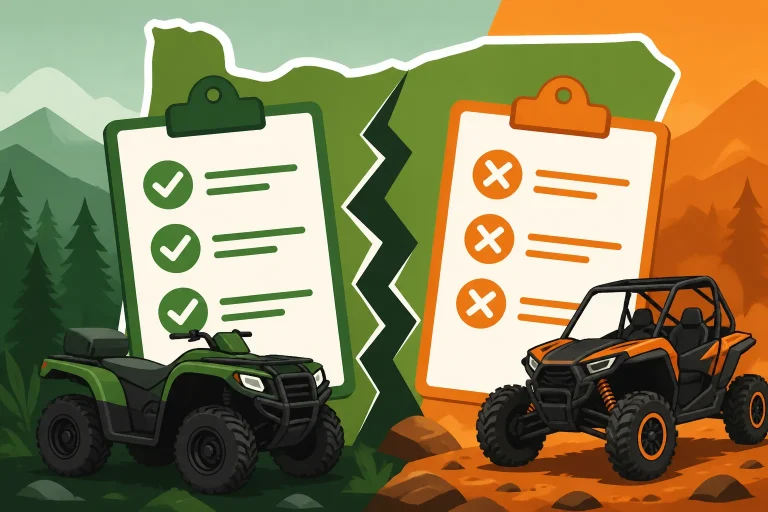
Oregon’s ATV operating permit, safety requirements, and land-access rules are separate issues. Having the required permit or decal for your machine does not give you permission to cross private property. Nor does it make a closed road open. Check the requirements that apply to your machine and ride, but treat them as separate from the landowner’s access decision. Oregon’s ATV Operating Permit explains the permit side of that picture.
The same separation applies to an ATV safety card. A rider can meet safety-card requirements and still lack permission to ride a particular private road. Before setting out, confirm both that the rider and machine meet applicable requirements and that the planned route is open to them.
For a better chance of avoiding problems, plan the route conservatively. Use roads and trails with confirmed access, avoid private spurs unless specifically authorized, and leave room in the itinerary to turn around. Tell your group that each rider must follow the same access conditions; one person’s permission should not be assumed to cover other riders unless the landowner says so.
It also helps to keep a simple record of what you checked: the route, the source of permission, any date limits, and the landowner’s conditions. This is particularly useful if the route involves several private parcels or a temporary access arrangement. If the information you find conflicts with a gate or closure sign on the ground, do not treat your earlier research as permission to ignore the sign. Stop, verify, and choose another route if you cannot confirm access.
Crossing private timberland can be part of a ride only when the access is authorized and the route is open. Confirm the land status and conditions before you go, obey closures and gates, and never use a permit or map as a substitute for the landowner’s permission. When authorization is uncertain, take a route you can verify.
Disclaimer
This article is for general informational purposes only and does not constitute professional advice. Laws, prices and regulations vary by location and change over time. Consult a qualified professional for guidance on your specific situation.