Oregon Rules for Hunting From an ATV
An ATV can make it easier to reach a hunting area, but it does not automatically let you hunt, shoot, or drive wherever you want. Oregon’s rules depend on what you are doing, where you are riding, and whether you have the required permits. The key distinction is between using an ATV for access and hunting from the machine itself.
Accessing a hunting area is different from hunting from an ATV
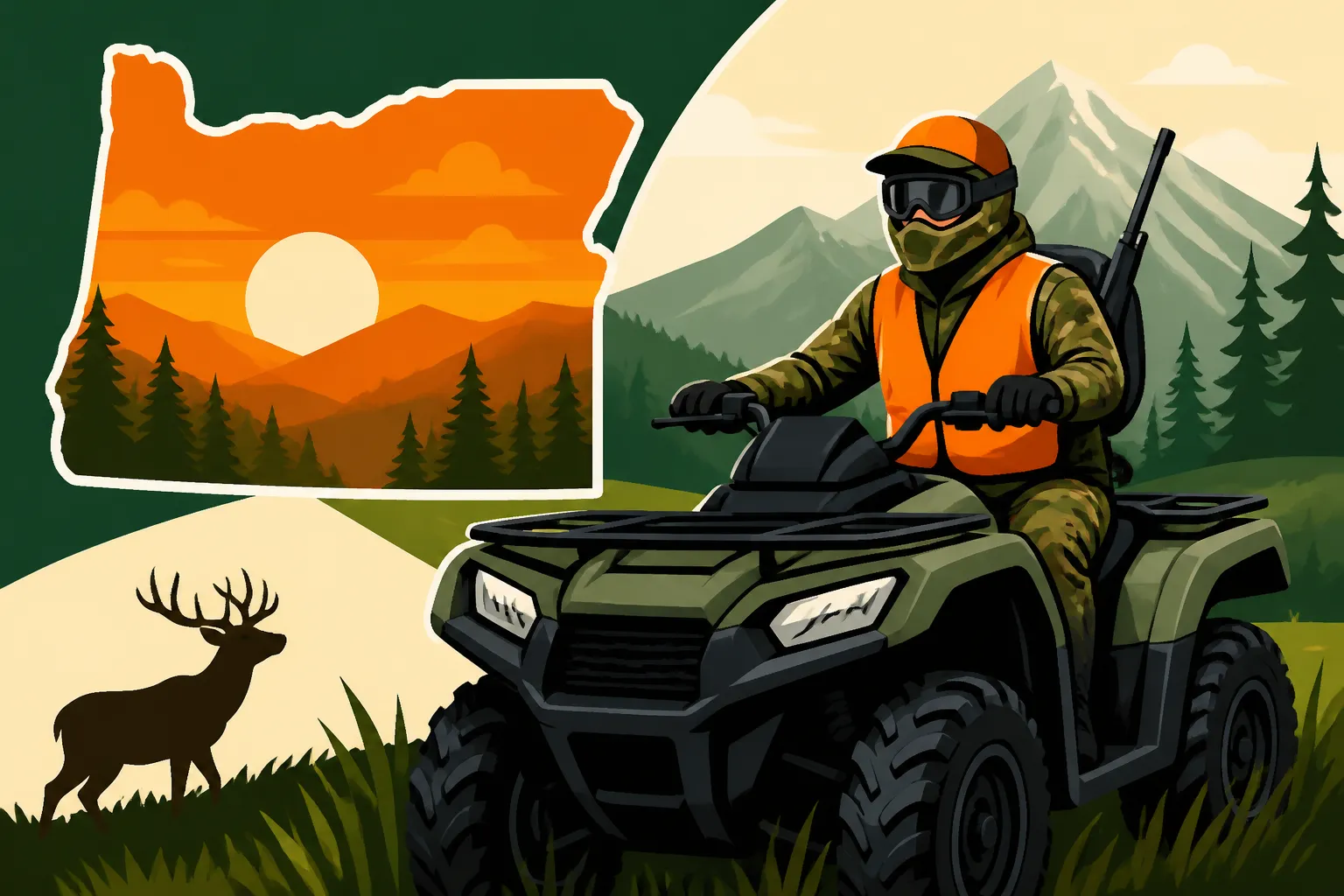
You may use an ATV to travel to a place where hunting is allowed, provided both the land manager’s access rules and Oregon’s ATV requirements permit the ride. That does not mean you can pursue or take wildlife from the ATV. Oregon generally prohibits hunting game birds or mammals from a motor vehicle, and hunters should treat an ATV as a motor vehicle for this purpose.
In practice, use the ATV for lawful transportation, then stop and follow the hunting rules that apply to your location and species. Do not shoot from the ATV, drive alongside wildlife to pursue it, or use the machine to push animals toward another hunter. The fact that the ATV is stopped, moving slowly, or on an established route does not by itself make hunting from it lawful.
There may be exceptions or accommodations for hunters with disabilities, but they are not a general permission to hunt from a vehicle. If you believe an accommodation applies, confirm the specific terms with the Oregon Department of Fish and Wildlife before the hunt. Check what the authorization allows, where it applies, and what documentation you must carry. An ATV operating permit and a hunting-related accommodation are separate matters.
A useful way to think about the distinction is:
| Activity | What to check |
|---|---|
| Riding to a hunting area | ATV permit, safety requirements, land access, route status and seasonal closures |
| Parking and walking away to hunt | Whether parking is allowed and whether the location is open to hunting |
| Shooting from an ATV | Generally prohibited for game hunting unless a specific, valid exception applies |
| Driving to pursue or flush wildlife | Do not assume this is allowed; vehicle use can still count as hunting or pursuit |
| Retrieving harvested game | Confirm the land manager’s vehicle-access rules; do not leave an open route without permission |
| Riding across private property | Get the landowner’s permission and follow any conditions |
The hunting rules and the land-access rules work together. A valid hunting license does not give you permission to ride a closed road or cross private land. Likewise, a valid ATV permit does not authorize hunting from the machine or taking wildlife from a place where hunting is restricted.
Before setting out, identify the exact land you plan to use and check its current rules. Public land can have different requirements depending on whether it is managed by the Forest Service, Bureau of Land Management, Oregon Department of Forestry, or another owner. For background on riding in two common federal land settings, see Oregon Rules for Riding a National Forest and [Oregon Rules for Riding BLM Land].
Check the route, land access and vehicle requirements
An ATV permit covers the machine’s operation under Oregon’s OHV system; it is not a hunting license and is not an all-access pass. Oregon’s permit, safety-card and equipment requirements can depend on the machine’s class and the rider. Review Oregon ATV Safety Card Requirements and Oregon ATV Permit Decal Placement before the trip, and check Riding Oregon With an Out-of-State Permit if you are visiting with a machine permitted elsewhere.
Then check whether the intended route is open to your type of vehicle. A road visible on a map may be closed to motorized use, restricted to certain vehicle types, or subject to a seasonal closure. A hunting season being open does not override a land manager’s travel restrictions. Follow posted signs and current land-manager maps, not just an old GPS track or a line someone shared online.
Do not ride off a designated route to reach a hunting spot unless the land manager explicitly allows that travel. Going around a gate, cutting across an open-looking meadow, or following a game trail can still be unauthorized motorized use. If a route is closed, do not assume you can use it because you are carrying hunting gear or retrieving an animal. Review Oregon Rules for Riding a Closed Trail and the current rules for the specific property.
Private land needs separate attention. A route that crosses private property does not become available because it connects two public areas. Get the landowner’s permission before riding onto or across the property, and clarify whether permission covers parking, hunting, and game retrieval as well as travel. Oregon’s ATV and hunting permissions are not interchangeable; Oregon ATV Permit for a Machine on Private Land explains why the machine’s permit does not settle the land-access question.
Before leaving home, make a short route plan:
- Identify the landowner or managing agency for the hunting area and the route in.
- Check current motorized-access maps, closures and any area-specific restrictions.
- Confirm the ATV’s class and that its permit and required decal are in order.
- Check the rider’s safety-card requirements and carry the necessary proof.
- Ask for permission where any part of the route or hunting area is private.
- Choose a legal place to park, and plan to reach the hunting location on foot unless motorized access is specifically allowed.
Rules can change with fire danger, wildlife protection measures, road conditions, logging activity or other temporary closures. Recheck them close to the trip, especially if your plan depends on a particular spur road or remote staging point. For more on changing access conditions, see Oregon Rules for Riding During Fire Season.
Transport firearms and harvested game carefully
Plan how firearms, bows and other hunting equipment will be carried before you load the ATV. Keep gear secured so it cannot fall, snag controls, interfere with the rider, or become a hazard if the machine tips. Firearm transport rules can depend on the firearm, the vehicle, the location and whether the firearm is loaded. Check current Oregon law and any applicable land-manager rules rather than relying on a general assumption about what is allowed.
A conservative approach is to transport firearms unloaded and secured, and to handle them only when stopped in a safe place. Keep the muzzle pointed in a safe direction, keep fingers away from the trigger, and make sure everyone in the group knows when a firearm is being handled. These precautions do not replace legal requirements, but they reduce avoidable risks when people and machines are moving around a hunting camp.
Game retrieval takes planning too. Do not assume an ATV may leave an established route to reach an animal. Some areas prohibit off-route travel even when the purpose is to recover harvested game. If retrieval access is not clearly allowed, ask the land manager before the hunt and consider how you will pack the animal out on foot. See Oregon Rules for Packing Out Game for related considerations.
If motorized retrieval is allowed, keep the route and the machine within the rules for that area. Avoid damaging vegetation, crossing sensitive ground, or blocking a road other users need. Do not use an ATV to drag game in a way that creates a public-safety hazard or damages the animal. If the route has become impassable or closed, stop and find a lawful alternative rather than improvising an off-route path.
A practical pre-trip checklist helps avoid confusion in the field:
- Carry the required hunting documents and proof of any ATV permit or safety qualification.
- Keep firearms and other equipment secured during travel.
- Carry a current map that distinguishes open motorized routes from closed or restricted areas.
- Agree on where the group will park and where riders will dismount before hunting on foot.
- Have a retrieval plan that does not depend on crossing a closed route or private land without permission.
- Check equipment requirements that may apply to the ATV, including any applicable spark-arrester rule; see Oregon Spark Arrester Requirements on Trails.
Avoid the common mistakes that turn access into a violation
The most common mistake is treating “I’m only using the ATV to hunt” as a single legal category. It is not. Riding to a lawful access point, hunting on foot, and retrieving game are different activities, and each may be governed by different rules. A permit for the machine does not answer whether the route is open or whether a particular hunting method is allowed.
Another mistake is assuming that a road is open because other vehicles use it. A worn track can be private, closed seasonally, or unauthorized. A gate may indicate a restriction even when the route continues beyond it. If signs and maps appear to conflict, do not guess. Contact the agency or landowner responsible for the area and get a clear answer before riding through.
It is also risky to assume that stopping the ATV makes shooting from it acceptable. The general rule against hunting from a motor vehicle is not limited to a vehicle moving at speed. If you need a disability-related accommodation, get confirmation of the exact authorization in advance instead of relying on a verbal understanding or an unrelated permit.
Finally, do not let the hunt distract from basic riding safety. Keep a safe distance between machines, use a legal route, and avoid riding beyond visibility on narrow or dusty roads. If a group separates, agree on a meeting point and communication plan before leaving the staging area. Hunters often carry extra equipment and may be traveling in low light or unfamiliar terrain, so a route that seems easy on a map can take longer than expected.
When in doubt, separate the questions: Is the hunt lawful here? Is this route open to my ATV? Is the machine properly permitted? Is this method of taking wildlife allowed? Checking each one independently is more reliable than assuming that permission in one area covers the rest.
Disclaimer
This article is for general informational purposes only and does not constitute professional advice. Laws, prices and regulations vary by location and change over time. Consult a qualified professional for guidance on your specific situation.