Gates on Industrial Forest Land
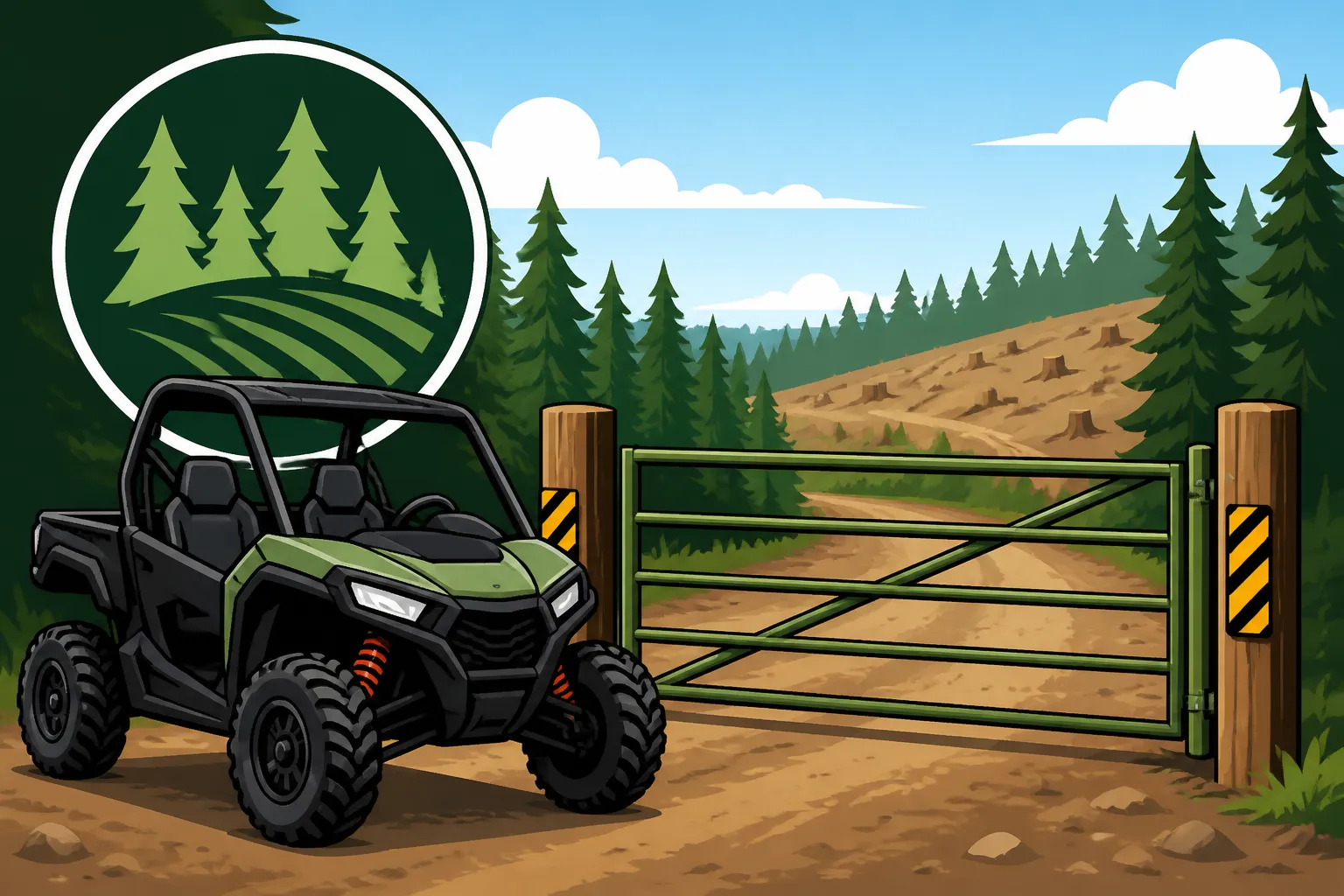
A gate on an industrial forest road can make an otherwise familiar route suddenly uncertain. It may mark a temporary work closure, a boundary, or a private road where public riding is not allowed. An Oregon ATV permit does not grant access through it. Here’s how to assess the situation without guessing or putting yourself in conflict with a landowner or road crew.
What a Gate on Industrial Forest Land Can Mean
Industrial forest land is managed for timber production, and its roads may cross private property or land subject to specific access arrangements. A gate is a physical barrier, but it does not always tell you the full legal status of the road. It might be there to control traffic during logging, protect a work site, reduce fire risk, or restrict access to private land. Sometimes a road is open under certain conditions and closed at other times.
The important point is that you cannot determine permission from the gate alone. An open gate does not automatically mean the road is open to the public, and a closed gate is not an invitation to ride around it. The presence of tire tracks, a familiar route on an old map, or other riders’ use does not establish that access is currently allowed.
A gate also does not necessarily change the road’s underlying ownership or status. A road may be on private timberland, on public land, or cross parcels with different owners and managers. There may be an easement or other access arrangement, but its terms can be limited. It may allow certain users, apply only to specific sections, or be subject to temporary closures. If you are unsure who controls a road, read Who Owns the Road You Are Riding and Private Land Between Two Public Parcels.
| What you see | What it may indicate | Safer response |
|---|---|---|
| Closed gate with a closure or no-entry sign | Access is restricted, possibly for work or safety | Stop and do not go around it; look for current information from the responsible manager |
| Closed gate without a clear sign | The road’s status is uncertain | Do not assume riding is allowed; verify the owner, manager, or access rules |
| Open gate | The gate may have been left open, or access may be allowed under conditions | Check signs and current access information before proceeding |
| Gate with logging or road-work activity nearby | Active work or a changing hazard may be present | Keep clear and use another route until access is confirmed |
| Gate on a route shown as open on an older map | The map may not reflect a temporary closure or changed access | Check a current map and the information posted at the site |
Industrial forest roads can look similar to public roads, but appearance is not a reliable guide. A wide gravel surface, road number, or connection to a public route does not by itself mean an ATV or UTV may use it. An Oregon permit is required for covered off-highway use, but it is not permission to enter private land or travel on a closed road. For the separate permit rules, see [Oregon ATV Permits Explained]. For access rules on timber roads, Oregon Rules for Riding a Timber Company Road is also relevant.
How to Decide Whether You May Proceed
Treat a gate as a reason to pause and verify, not as a minor obstacle. First, stop in a safe place before reaching the gate. Avoid blocking the road or parking where a truck or equipment operator might need to pass. Read every sign carefully, including smaller notices that may identify a closure, a work area, a private road, or permitted users.
Next, identify who manages the land or road. The controlling party may be a timber company, a public land agency, or another landowner. A road can also cross more than one parcel, so permission from one owner may not cover the entire route. Use current official maps or posted information where available, and contact the responsible land manager if the status remains unclear. An old map, an online route trace, or a riding app may help you locate a road, but should not be treated as proof that access is currently authorized.
Look for specific wording. Signs such as “road closed,” “no entry,” or notices restricting public access should be taken seriously. A sign may also explain that a road is open only to certain users or during certain conditions. If the wording is unclear, do not decide that the most permissive interpretation applies. Verify the rule before riding farther.
A simple decision process helps:
- Stop before the gate and read all posted signs.
- Check whether the road is identified as open to your type of use, rather than merely shown on a map.
- Confirm who controls the road and whether any access permission applies to your route.
- Check for temporary closures, active logging, road work, fire restrictions, or other current hazards.
- If permission is not clear, turn around and choose a route you can confirm is open.
Do not open, move, climb over, or bypass a locked gate unless the responsible authority has clearly authorized that action. Riding around a gate on the shoulder or through the woods can take you onto private land, damage vegetation, or put you into an active work zone. It can also defeat the purpose of a closure even if the road itself looks quiet.
A gate may be open when you arrive and closed behind you later, or a road may be closed after you have started a ride. Do not assume you can pass simply because you entered earlier. If a closure appears during your trip, follow posted directions and use an authorized way out. If there is no safe, clearly permitted exit, contact the land manager or local authority rather than forcing a route.
Temporary Closures, Logging, and Changing Conditions
Industrial forest roads are working roads, not just recreation routes. Timber hauling, road maintenance, equipment movement, and other operations can change the safety and access conditions quickly. A route that was open on a previous visit may be closed today. Work may also be active without being obvious from the staging area or trail entrance.
Logging vehicles can be large, heavy, and difficult to stop or maneuver around. Blind corners, dust, narrow road shoulders, and loose gravel can make it hard for a rider and a truck operator to see each other in time. If you encounter active work, do not ride past equipment or enter a marked work zone. Follow signs and directions from authorized workers, and turn around if the route is not clearly safe and open. For more on sharing these roads, see Sharing a Gravel Road With Log Trucks and Dust and Blind Corners on a Logging Road.
Closures can also be related to fire danger, road damage, weather, or land-management needs. A gate may be part of a temporary restriction, and its status can change after a storm or during a work project. Do not rely on a previous visit, a friend’s report, or a map that does not show when its access information was last updated. Check current notices from the land manager before leaving and again at the site.
The right alternative is not to find a way around the gate. It is to choose a route with confirmed access. If you need help interpreting the difference between a designated public route and a road that is merely visible or passable, see Riding a Road Open to the Public but Unmaintained. When a road is specifically posted or identified as closed, Oregon Rules for Riding a Closed Trail offers related guidance.
Planning a Ride Without Relying on a Gate
Before a ride, plan a route that does not depend on slipping through an uncertain access point. Confirm the road’s status with the organization or landowner responsible for it, and check for temporary notices close to your travel date. Bring a current map or route information that helps you identify public roads and authorized riding areas, but treat the signs on the ground as important information too.
It can help to have a turnaround point in mind. If a gate or closure blocks the planned route, turn around rather than improvising a detour through a neighboring parcel. A nearby road may belong to a different owner or have a different access rule. Riding through a gap between public parcels does not automatically make the connecting road public; Private Land Between Two Public Parcels explains why that distinction matters.
Keep your machine and permit requirements separate from land-access permission. A valid Oregon permit, an out-of-state permit recognized under applicable reciprocity rules, or a safety card addresses specific requirements for riding. None of these documents gives blanket permission to use every forest road. Likewise, a road’s apparent public character does not replace the permit or safety requirements that apply to the machine and rider.
If you encounter a gate you did not expect:
- Stop without crowding the entrance or blocking other traffic.
- Read the sign and note any owner, manager, closure dates, or contact information.
- Do not move the gate, cross a barrier, or ride around it.
- Check current official access information before deciding whether the road is open.
- Turn around if permission cannot be confirmed.
This approach may cost time or mean changing the day’s route, but it avoids trespass, unsafe encounters with work vehicles, and damage to access arrangements that riders may rely on elsewhere. If you need direct permission for a private timber road, Getting a Riding Permit From a Timber Company is a useful next step. Respecting a closure and checking before riding are the practical choices when the status of a gate is uncertain.
Disclaimer
This article is for general informational purposes only and does not constitute professional advice. Laws, prices and regulations vary by location and change over time. Consult a qualified professional for guidance on your specific situation.