Mud Season in the Coast Range
Mud season in Oregon’s Coast Range can turn a fun ride into a slick, exhausting slog—or leave you facing a closed trail and a long, muddy tow back. Rain, saturated soil, standing water, and changing access conditions all matter. This guide explains how to judge when to ride, where to check before leaving, and how to protect yourself, your machine, and the trails.
What mud season means in the Coast Range
Expect more than muddy tires
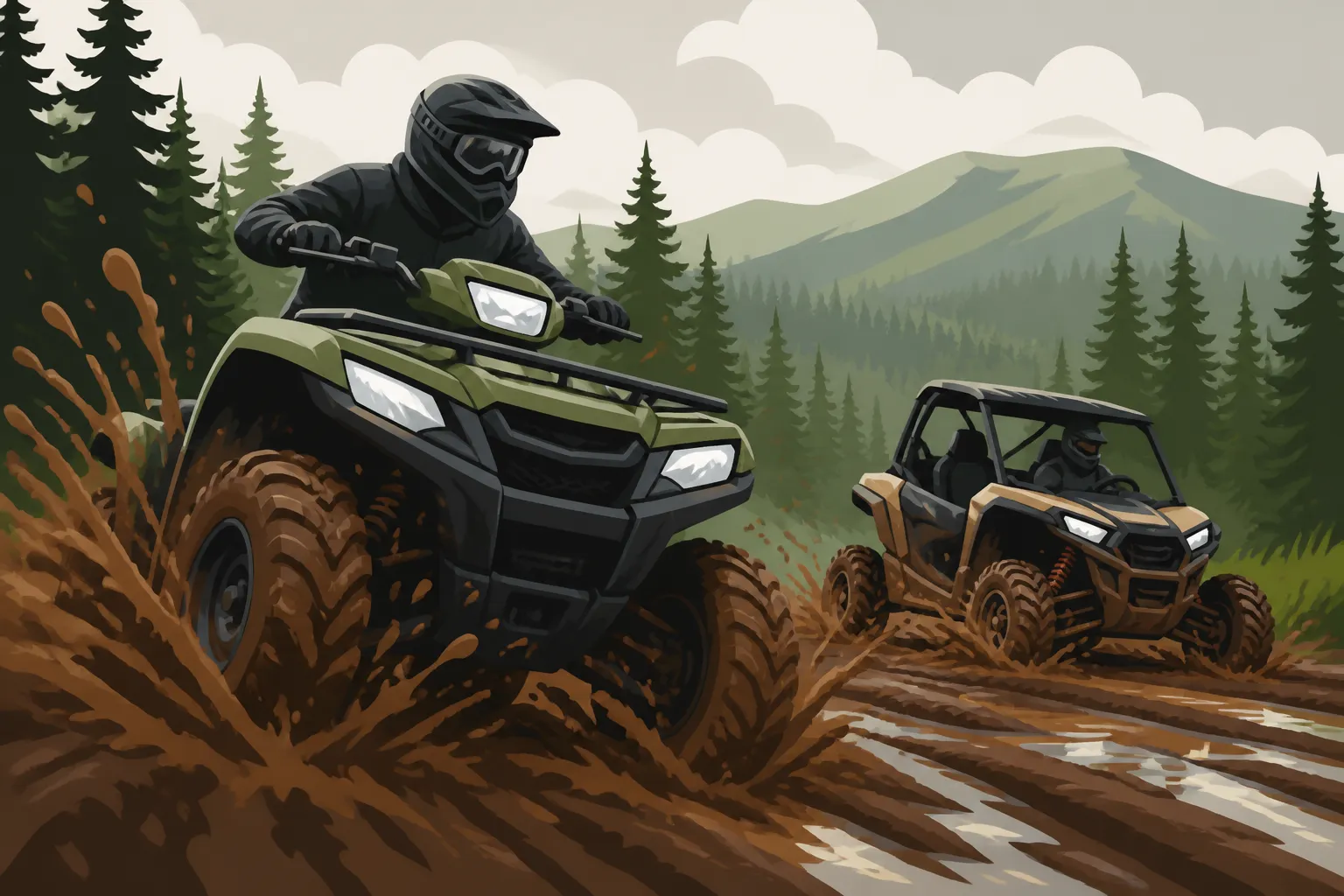
In the Coast Range, wet-season riding is not just a matter of getting splashed. Rain can soften trail surfaces, fill ruts with water, hide rocks and roots, and make steep slopes harder to climb or descend. A route that felt easy during a dry visit may become slow and tiring after repeated storms.
Conditions can also change over the course of one ride. A shaded section may stay slick while a more exposed stretch drains quickly. A shallow puddle can cover a deeper rut, and loose gravel on a forest road can shift under the tires. In places such as Tillamook State Forest, the mix of forest cover, elevation, and heavy rainfall means one trail system can have several different kinds of traction in a single day.
The main question is not simply, “Is there mud?” It is, “Can I ride this route without making the damage worse or putting myself in a bad situation?” If your tires are digging deep trenches, the machine is sliding off the intended line, or you need repeated hard acceleration to get through soft ground, conditions may be too wet for responsible riding.
Why trail conditions and closures can change quickly
Rain can affect both the ride itself and access to the riding area. A trail may be passable in the morning but deteriorate after more rainfall, while a road or trail may be closed to protect the surface or address a hazard. Storm damage can also bring down branches, move debris, or create washouts that are difficult to see from a vehicle.
Before heading toward Browns Camp, Jordan Creek, or another Tillamook-area riding spot, check the latest information from the land manager. A map on your phone can help with orientation, but it should not be treated as proof that a route is open. Use [Oregon Trail Closures After Heavy Rain] as a reminder to check for changing conditions, and review [Rain Season West of the Cascades] when planning a ride during the wet months.
When you check a map in onX Offroad or another mapping tool, compare it with current official notices and any signs at the trailhead. Apps are useful for organizing a route and understanding where you are, but trail status can change faster than a saved map. Download or save what you need before losing cell service, and keep a second way to navigate.
Choose a ride that matches the conditions
A short loop near a staging area is often a better wet-weather plan than a long route that depends on several connecting trails. If you discover that a section is too slick, you want a practical way to turn around without getting far from help. Leave room in your plan for delays, and avoid building the day around reaching a distant destination.
| Conditions you see | A sensible response |
|---|---|
| Damp surface with firm ground underneath | Ride cautiously, stay on the designated route, and watch for slick corners |
| Shallow standing water with a visible bottom | Proceed only if the route is open and you can avoid widening or damaging the trail |
| Deep ruts, pooled water, or a soft trail edge | Turn around or choose a firmer route |
| Tires spin or slide with light throttle | Stop before repeated attempts dig up the trail |
| Fresh debris, washout, or a closure sign | Do not continue through or around the obstruction |
A useful pre-ride check is to ask whether you would still be comfortable with the route if the weather worsened or one section became impassable. If the answer is no, choose a shorter outing or wait for better ground conditions.
Planning a responsible wet-weather ride
Check access, weather, and route details before driving
Start with the official trail or recreation-area information, then check the forecast for the riding area rather than relying only on conditions in town. A dry morning in Portland does not necessarily mean trails in the Coast Range are dry, and a brief break in the rain does not guarantee that saturated soil has firmed up.
Look for notices about temporary closures, maintenance, storm damage, and seasonal restrictions. Check both the riding area and the roads you need to reach it; heavy rain can affect access routes as well as trails. If you use onX Offroad to review your planned route, treat it as one planning layer alongside official land-manager updates, posted signs, and local conditions at the staging area.
Carry a map that you can use without a reliable signal. [Oregon Trail Maps Worth Carrying] offers a useful starting point for thinking about navigation, while [Oregon's Tillamook State Forest Trails] can help you understand the broader area. Before you leave home, note your turnaround point, likely fuel needs, and the route back to the trailer or staging lot.
Pick a route that avoids unnecessary damage
Wet soil is especially vulnerable to repeated wheelspin and off-trail detours. Stay on designated routes, avoid cutting around puddles, and do not create a wider path to bypass a muddy patch. Going around an obstacle may seem harmless in the moment, but repeated detours can damage vegetation and turn a narrow trail into a broad, churned-up area.
If the route is too soft to cross without spinning, turn around rather than trying to power through. On a side-by-side, extra weight and tire size can make a soft section harder to cross without rutting it. On a quad, a rider may be tempted to use momentum; in slick conditions, that can make steering and braking less predictable. The goal is controlled progress, not proving the machine can get through.
A practical rule is to stop if you find yourself repeatedly making new attempts at the same obstacle. Ask whether backing out is safe and whether another route is available. If not, contact your riding group or follow the area’s procedures for getting assistance. Avoid pulling a stuck machine across vegetation or into an area that is not an authorized route.
Make a backup plan for a shorter day
Build flexibility into the schedule. Tell someone where you plan to ride, when you expect to return, and what you will do if the area is closed or conditions deteriorate. Agree on a turnaround time with your group so that a slow, muddy section does not leave everyone rushing back in poor light.
For a first wet-season visit, keep the route conservative and close to the staging area. If the trail is firmer than expected, you can extend the ride after checking conditions. It is much harder to shorten a route once your group is deep into a slick network with limited daylight or a machine that is beginning to have trouble.
A second route on a map is not automatically a safe fallback. Verify that it is open, suitable for your machine, and accessible from your location. If the only alternative involves riding around a closure or using an unmarked path, it is not a good backup.
Preparing your ATV or UTV for muddy trails
Inspect the machine before the trip
Mud can hide small problems until they become inconvenient ones. Before loading up, check tires for damage and appropriate pressure for your machine and riding conditions, and make sure the wheels are secure. Look over the brakes, throttle, steering, lights, and any guards or protective components. A sticky throttle or weak brake is a much bigger concern on a slick descent than it is in a dry parking lot.
Check the air intake and other areas where mud and water could collect, following the manufacturer’s maintenance instructions for your machine. Bring basic tools, a tire repair kit appropriate to your tires, and recovery equipment that you know how to use. A winch or tow strap is only helpful if it is compatible with the machines involved and attached to an appropriate recovery point.
A post-ride inspection matters, too. Rinse mud from the machine without directing high-pressure water at sensitive seals, bearings, electrical connections, or other components where water could cause damage. Check for packed mud around moving parts, inspect the tires and undercarriage, and address anything that looks loose or damaged before the next ride.
Pack for wet, cool, and changing weather
Coastal and forest weather can feel colder once you are moving slowly or stopping to help someone. Wear layers that still work when damp, and use gloves that let you operate the controls. A dry change of clothes stored in a sealed bag can make the drive home much more comfortable.
Pack drinking water, food, a first-aid kit, a flashlight or headlamp, and a charged phone. A small battery pack can be useful, but do not rely on cell service for navigation or emergency communication. Keep paper documents and essential items protected from moisture. A waterproof bag or dry box can prevent a soggy map, permit, or phone from becoming another problem halfway through the day.
If you ride in a group, make sure every rider understands the plan and knows how to regroup if visibility drops or the group gets separated. Agree on signals before you start, especially if helmets and engine noise make conversation difficult. Keep enough space between machines to avoid spraying the rider ahead and to leave room for controlled stops on slick ground.
Follow equipment and rider requirements
Wet conditions do not change the need to use the required permit, safety equipment, and riding practices for your machine and location. Check the rules that apply to your class of ATV or UTV and the area you plan to visit. If you are uncertain about the training-card requirement, see [Oregon ATV Safety Card Requirements].
Also check equipment rules that may apply to the trail system. Spark arresters and sound requirements are worth verifying before you travel; [Oregon Spark Arrester Requirements on Trails] and [Oregon Sound Limits and Where They Apply] cover those topics. Carry what you need in a way that will not be lost or damaged by rain, mud, or vibration.
Riding technique for slippery Coast Range trails
Use smooth inputs and leave more room
On mud, abrupt steering, throttle, and braking can quickly overwhelm traction. Ease into the throttle, look ahead, and make small steering corrections rather than jerking the handlebars or wheel. Leave more distance between machines because stopping can take longer, especially on a downhill or a trail covered in wet leaves.
Do not assume that more speed solves a traction problem. A little momentum can help on a suitable, open section, but rushing through a rut or blind turn reduces your time to react. Keep your speed low enough that you can stop within the visible trail, and slow down before corners rather than braking hard while turning.
If the rear of the machine begins to slide, avoid making a sudden correction that could send you farther off line. Ease off the throttle and steer in a controlled way that matches the machine and the terrain. If you cannot regain stable control, stop where it is safe to do so and reassess the route instead of continuing into a steeper or more technical section.
Read puddles, ruts, and slopes carefully
A puddle can conceal a hole, a rock, or a rut deep enough to catch a wheel. Do not enter water if you cannot judge its depth or see a safe line through it. If the trail surface is uncertain, stop before the obstacle and look for a clear, authorized route. Avoid driving around the edge and widening the trail.
Ruts can pull the tires in different directions, especially where water has washed soil away. Cross or follow them only when you can do so with control and without climbing out across vegetation. On a slope, choose a line that does not force a sudden turn on slick ground. If a climb looks likely to require repeated acceleration or a descent looks difficult to control, turn around while you still have room.
The same caution applies to bridges, culverts, and narrow trail features. Mud can make them slippery, and standing water can obscure the surface. Approach slowly, keep the machine centered where appropriate, and do not attempt a crossing if the feature looks damaged or unsafe.
Know when to call the ride
A successful ride is not measured by how many miles you cover. Turn back if the trail is deteriorating, your group is getting cold or tired, a machine is showing signs of trouble, or the route is taking longer than planned. A sensible early turnaround is far better than trying to recover a stuck machine in worsening weather or fading light.
If someone becomes stuck, pause and assess before applying more throttle. Repeated wheelspin can deepen the hole and make recovery harder. Keep bystanders clear of tensioned straps and moving machines, and use recovery equipment only as intended. If the situation is beyond the group’s skill or equipment, seek appropriate help rather than improvising a risky pull.
For planning ideas closer to the Portland area, [Oregon OHV Areas Near Portland] can help you compare options, while [Riding Tillamook in the Rain] focuses on the special considerations of wet-weather riding in the forest. Check current access information before choosing a destination, and be willing to postpone the trip if the ground or trail status is not right.
Disclaimer
This article is for general informational purposes only and does not constitute professional advice. Laws, prices and regulations vary by location and change over time. Consult a qualified professional for guidance on your specific situation.