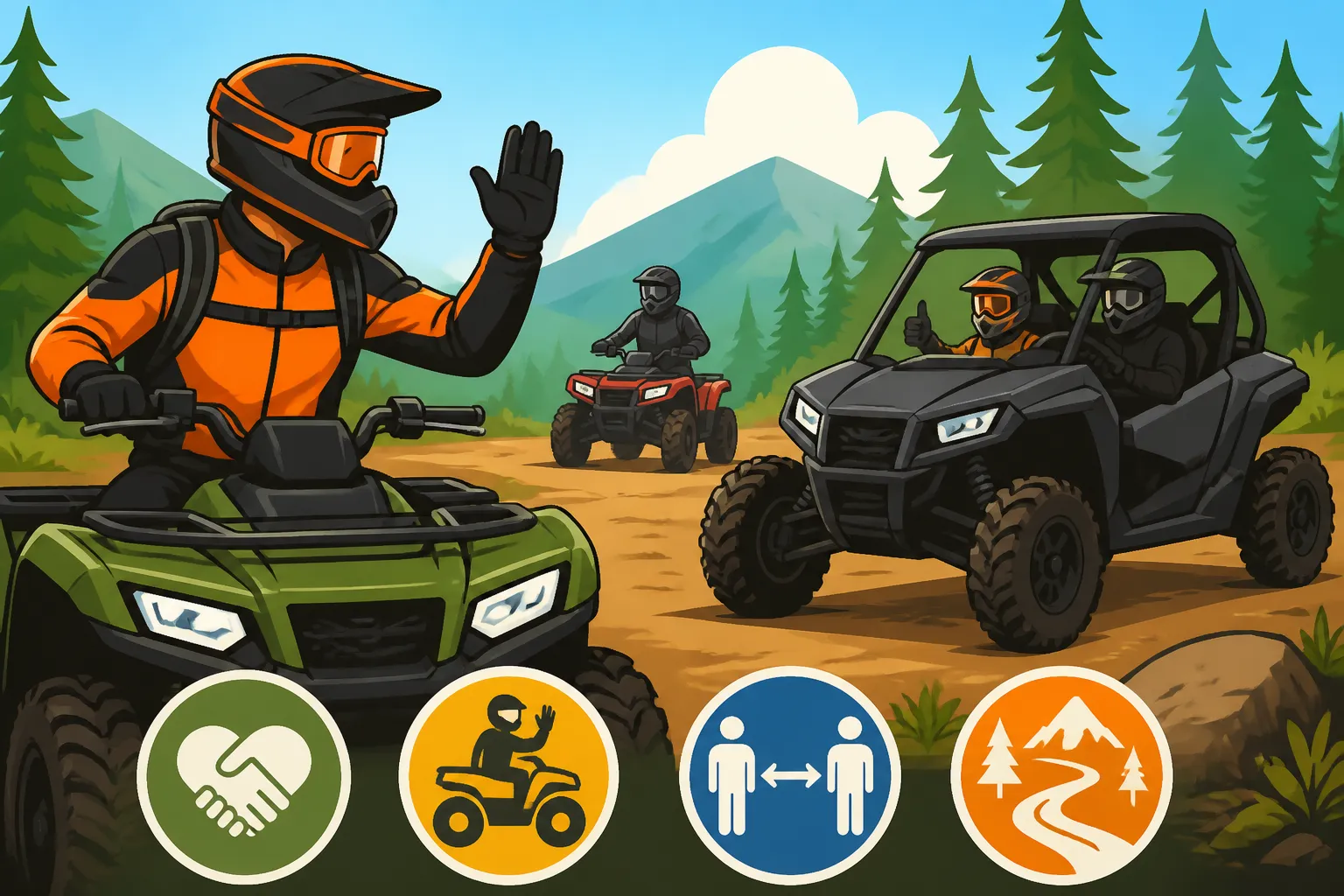
Riding Etiquette on a Busy Staging Day
A crowded staging area can turn an exciting Oregon ride into a stressful one: trailers are backing up, machines are unloading, and everyone is trying to reach the trail at once. Good staging-area etiquette keeps people safer and helps the day start smoothly. This guide covers practical ways to park, unload, communicate, and share busy ATV and UTV riding areas.
Before you arrive at a busy staging area
A little preparation at home can prevent a lot of confusion in a crowded lot. Busy weekends at places such as the Oregon Dunes, Browns Camp, or Millican Valley often mean narrow driving lanes, limited parking, and riders moving around on foot. Arriving ready to unload makes the space easier for everyone to use.
Check access, conditions, and requirements
Before leaving, check the riding area’s current access information, closures, and posted rules. A trail or staging area that was open on your last visit may have a seasonal closure, storm damage, fire restriction, or other change. Do not assume a route is open just because it appears on a map or a friend rode it recently. Follow the signs at the site and respect barriers and closures.
Plan for the practical requirements, too. Make sure each machine has the permit or other documentation required for the place you intend to ride, and confirm that riders have any required safety credentials. If you are bringing a visitor or riding a machine registered outside Oregon, review Oregon Permit Reciprocity List and Oregon ATV Safety Card Requirements before your trip.
A map app such as onX Offroad can help you review a planned area and discuss a route before the group arrives. Treat any digital map as a planning aid, not permission to travel. A marked route does not override a gate, closure notice, posted restriction, or direction from an official on site. Keep a paper or downloaded backup if you expect unreliable phone service.
Prepare your vehicle and gear before entering the lot
Put helmets, goggles, gloves, water, tools, and anything else you will need where you can reach them without unpacking half the tow vehicle. Secure loose items before driving into the staging area. A strap, cooler, or ramp that shifts while you maneuver can create a hazard for people walking nearby.
If possible, fuel and inspect your machine before arriving. Check tires, controls, lights, brakes, and any required safety equipment. For a group, agree on a simple plan: who is leading, who is sweeping, where everyone will regroup, and what to do if someone becomes separated. That conversation is easier to have at home or at a quiet pullout than in the middle of a busy lot.
Consider using onX Offroad or another navigation tool to identify a broad destination and possible regrouping points before the ride. Avoid choosing a route solely because it looks short on a screen. Terrain, access restrictions, rider experience, and changing conditions matter more than the line between two points.
Parking and unloading without creating a bottleneck
At a busy staging area, the biggest courtesy is often giving other people room to move. A vehicle and trailer take up more space than a parked car, and a few poorly positioned rigs can block the path for everyone behind them. Pause long enough to read the layout, then park where signs or staff direct you.
Leave travel lanes and access points clear
Do not stop in the entrance, exit, a marked lane, or the space needed for another trailer to turn. If you are unsure where to park, move slowly and ask an attendant or another person only when it is safe to do so. Avoid waving someone into a spot if you cannot see the full maneuvering area.
Park with unloading in mind. Leave enough room for your ramps and for people to walk around your trailer without stepping into moving traffic. Do not claim extra spaces with cones, chairs, or gear when the lot is crowded. If a marked space is too tight for your vehicle and trailer, look for an appropriate alternative rather than blocking neighboring users.
| Situation | Considerate approach | Avoid |
|---|---|---|
| Arriving with a trailer | Follow the lot layout and park fully out of travel lanes | Stopping at the entrance while deciding where to go |
| Unloading a machine | Keep ramps and gear within your space as much as possible | Spreading tools or equipment across adjacent spaces |
| Leaving the lot | Check for pedestrians and moving machines before pulling out | Reversing quickly or assuming others can see you |
| Waiting for your group | Choose a safe place that does not block access | Gathering in a lane or at the top of a ramp |
Unload at a steady pace
Unload deliberately, but do not let an avoidable delay hold up a line of arriving vehicles. Before lowering a ramp, check that the ground behind it is clear of people, machines, and loose gear. Use a spotter when visibility is limited, especially when backing a long trailer or moving a machine down a ramp.
Keep children and pets close and away from vehicles that are moving. A staging area can look calm while still having blind spots around tow rigs and trailers. Tell children where they should wait, and do not let them run between parked vehicles or play near ramps.
When your machine is off the trailer, move it to an appropriate place before organizing equipment or waiting for friends. Do not start a long gear adjustment in the lane where people are trying to unload. If you discover a mechanical problem, move out of the flow of traffic if it is safe, then troubleshoot.
For more on selecting a suitable place to leave your rig, see Where to Park a Trailer at a Staging Lot. If a site requires a pass or has a fee, sort that out without holding up other vehicles; Paying the Day Use Fee at a Staging Area explains why access charges and riding permits are separate considerations.
Sharing the staging area with riders on foot and on machines
Staging areas mix people moving at walking speed with machines that may be starting, turning, or preparing to leave. The safest habit is to assume that a driver may not see you. Make eye contact when possible, stay out of blind spots, and never dart behind a vehicle or between machines.
Keep speeds low and movements predictable
Ride only as quickly as the space and posted rules allow, and keep your speed low around parked vehicles, pedestrians, and staging activity. Avoid unnecessary revving, wheelies, donuts, or rapid acceleration in the lot. Even if you are eager to reach the trail, a noisy or abrupt departure can startle someone walking nearby or make it harder to hear a spotter.
Signal what you intend to do. If you are crossing a lane, turn your head and check both directions rather than assuming other riders will yield. Do not weave between trailers or cut across a parking area to save a few seconds. Follow designated routes from the parking area to the riding area, and do not create your own shortcut across vegetation or a closed section.
If the lot has staff or volunteers directing traffic, follow their instructions even if you have parked there before. Their directions may reflect current congestion, equipment movement, or a temporary site arrangement that is not obvious from your vehicle.
Make room for different kinds of riders
Not everyone at the staging area has the same experience. A new rider may need time to check controls, adjust a helmet, or ask a basic question. An experienced group may be organizing a larger ride. Give people time and space without crowding them or making them feel rushed.
Parents should keep young riders close and help them understand where they can safely wait. If a child is operating a machine, confirm that the rider is prepared and that the machine is being handled in a suitable area. Keep children away from moving trailers, ramps, and machines starting up.
Be mindful of noise, dust, and exhaust. Pointing an idling machine toward a group of people or leaving it running for an extended time can make an already crowded lot unpleasant. If you need to warm up a machine, do so without directing exhaust toward others, and avoid unnecessary throttle blips.
Good riding behavior continues after you leave the lot. Follow area signs, give other trail users space, and do not assume that a wide trail means you can take up the entire route. Oregon Trail Maps Worth Carrying can help you plan, while Oregon Rules for a Group Ride is useful if you are coordinating a larger outing.
Leaving the lot and ending the day well
The departure rush can be just as crowded as arrival. Some riders return at the same time, while others are still unloading or preparing to head out. Take a moment to check your surroundings before starting, loading, or backing your rig.
Depart in order and communicate clearly
Before pulling away, check for people, machines, and trailers around you. Use a spotter when reversing if the view is obstructed. Agree on a hand signal or clear words before the maneuver begins; vague gestures can be misunderstood in a noisy lot.
If your group is leaving together, do not block a lane while waiting for everyone to line up. Move to a suitable open area if one is available, or agree to meet at a clearly identified place outside the busiest part of the lot. The same principle applies to a group returning from a ride: move out of the traffic flow before stopping to discuss the route or take a break.
If someone in your group is delayed, avoid sending riders back and forth through the crowded staging area to look for them. Use the regrouping plan you discussed before the ride, and keep any search or communication activity away from moving vehicles.
Load carefully and leave the space clean
When loading, check that no one is standing behind the trailer or beside a ramp where a tire could slip. Secure the machine and put tools away before moving the vehicle. Do not leave fuel containers, straps, trash, or broken parts behind. Pack out what you brought in, including small items that can be easy to miss in sand or gravel.
Before you leave, take a quick look around your parking space. Confirm that the trailer is secure, the machine is tied down, and no gear is sitting near another vehicle’s tires. If you notice a spill, damaged sign, or unsafe condition, alert site staff when available rather than assuming someone else will handle it.
A considerate departure matters because the next rider may be arriving just as you leave. Clearing your space promptly, without rushing or blocking the lane, helps the lot keep moving. Whether you are at a coastal dune staging area or a forest trailhead, these habits make a busy day safer and less frustrating for everyone.
Disclaimer
This article is for general informational purposes only and does not constitute professional advice. Laws, prices and regulations vary by location and change over time. Consult a qualified professional for guidance on your specific situation.