Oregon Riding in Coastal Fog
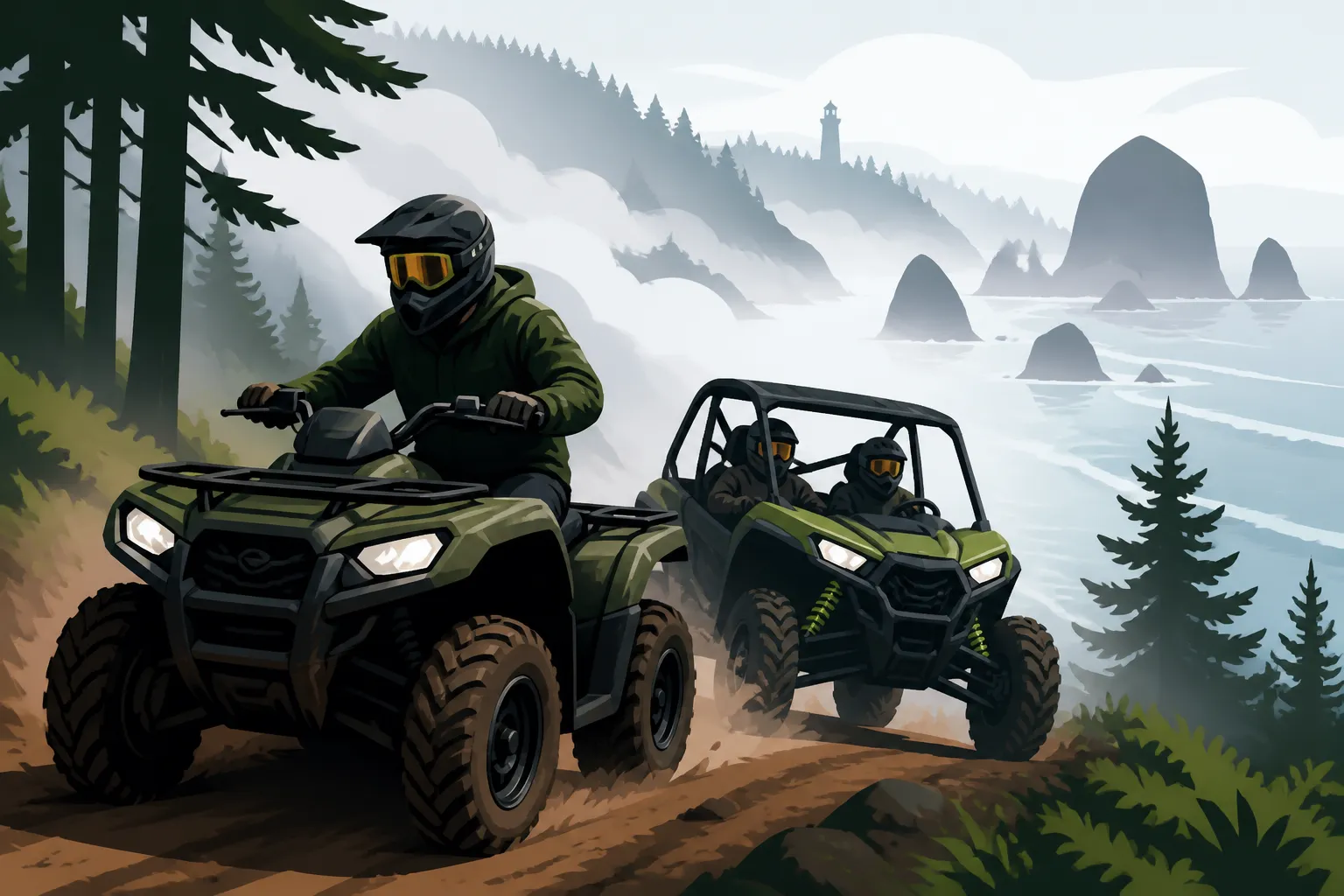
Coastal fog can turn a familiar Oregon ride into a disorienting one: dune crests disappear, other machines seem to appear from nowhere, and a trail that looked obvious on the way out can be hard to recognize on the return. This guide explains how to judge conditions, prepare your ATV or UTV, choose a conservative route, and know when it’s safer to stop or turn back.
Why coastal fog changes an Oregon ride
Fog makes dunes and trail features harder to read
On the Oregon coast, fog can roll in quickly and soften the contrast between sand, sky, and the surrounding landscape. At the Oregon Dunes National Recreation Area, that can make the next ridge difficult to judge and hide the shape of a dip or slope. Even if you know the area, familiar features may look different when the horizon disappears.
The challenge isn’t only reduced visibility. Fog can flatten depth perception. A dune that appears gentle may be steeper than it looks, while a distant rider can seem much closer—or farther away—than they are. That uncertainty matters when you’re approaching a crest, merging onto a busy route, or following another group through open sand.
Fog also changes how you navigate. A distinctive treeline, staging area, or far-off landmark may be obscured, so it’s easier to lose your bearings while moving. Before setting out, review [Fog and Visibility on the Dunes] alongside local riding-area information, and make a plan that doesn’t depend on seeing one particular landmark from far away.
People and machines can be difficult to see
A machine may be visible only when it is close, especially if its lights are dim, partly blocked, or pointed away from you. On a busy riding day, that creates a real risk at intersections, near staging areas, and where faster open-sand riding meets slower travel routes. It’s also harder to tell whether a rider ahead is slowing, turning, or stopped.
A whip and flag can help make a machine easier to notice over dune terrain, but they don’t make fog riding automatically safe. A flag may disappear behind a ridge, and another rider may not see it through thick haze. Review the local requirements and practical guidance in [Oregon Dune Flags and Whips], then treat visibility equipment as one layer of caution—not permission to ride faster.
Sound can be misleading, too. Wind and terrain may make an approaching engine seem to come from the wrong direction or hide it altogether. Keep your speed low enough to respond to a machine you didn’t see coming, and don’t assume that because you can hear a group, they know you’re there.
Conditions can vary across a short distance
Fog is not always uniform. One part of the coast may be socked in while a nearby staging area has clearer conditions. At Florence, for example, visibility can feel very different between a sheltered spot and an exposed section of the dunes. A ride that starts under a patch of blue sky can also become harder as moist coastal air moves inland.
That variability makes a single glance at the weather less useful than checking conditions as you prepare to ride and continuing to assess them once you’re out. Ask other riders or staff what they’ve observed, look for signs of a changing marine layer, and be willing to revise your plan. The forecast is a planning aid, not a promise about visibility on a particular dune.
If conditions are already poor at the staging area, don’t assume they’ll improve once you’re moving. Consider delaying your ride, staying on a familiar and lower-risk route, or choosing a different activity. The most useful decision is often the one made before anyone has a helmet on and a machine loaded.
Decide whether the ride should go ahead
Use a practical visibility check before leaving
There isn’t one simple visibility distance that makes every foggy ride safe. The right decision depends on the terrain, traffic, your experience, the machine, and whether your group can stop or turn around without creating a hazard. Rather than relying on a number, ask whether you can clearly see the next section of your route and stop within the space you can see.
| What you notice | Safer choice |
|---|---|
| You can see familiar landmarks and the next section of your route | Ride cautiously, keep the route simple, and reassess often |
| Dune crests or trail junctions appear and disappear in haze | Slow down, avoid unfamiliar terrain, and consider turning back |
| You cannot see a safe stopping area ahead | Stop in a safe place if possible and do not continue blindly |
| Your group is becoming separated or losing track of one another | Regroup in a safe location before deciding what to do |
| Visibility is worsening quickly or you feel uncertain about the route | End the ride or wait for conditions to improve |
A check like this is more useful than trying to prove you can push through. If you can’t see enough to react to a person, machine, drop, or route change, the ride has moved beyond a comfortable margin. You don’t need to wait for a near miss to call it.
Also consider how the least-experienced person in your group is handling the conditions. A confident rider on a familiar machine may be comfortable in haze that overwhelms a new rider, a child, or someone who has never navigated dunes in low visibility. Set the plan for the group’s actual ability, not the most experienced rider’s preference.
Match the route to the conditions and your experience
A familiar route is generally easier to manage in fog than an exploratory ride, but familiarity alone doesn’t remove the risk. Stick to routes you know, avoid unnecessary detours, and leave enough time to return without rushing. If the visibility deteriorates, a shorter loop is a better plan than continuing toward a destination because it was the original goal.
This is especially important when riding in broad, open dune areas where multiple tracks can look alike. A route that feels obvious in clear weather can become confusing when the horizon and landmarks disappear. Review [Oregon Dunes Staging Areas From North to South] and the details for your chosen area before traveling, so you understand where you’re starting and what options you have to return.
New riders may be better off postponing a foggy dune ride or joining a group with someone who knows the area well. A guided outing can be useful for learning basic terrain awareness, but it doesn’t remove the need to follow instructions and stay within conditions that feel safe. If you are uncertain about route choice, take that uncertainty seriously instead of treating it as something you’ll solve once you’re moving.
Know when to stop, wait, or turn back
If fog thickens while you’re riding, avoid continuing simply because the staging area is close on the map. The shortest route may require crossing open sand, climbing a ridge, or negotiating an area you can no longer see clearly. Instead, slow down and look for a safe place to stop that is away from active riding lines and visible to others as much as conditions allow.
Once stopped, regroup and decide whether to wait, return along a known route, or seek assistance. Don’t split up to “find the way” unless there’s an immediate safety reason and a clear plan. If your group has radios or phones, use them to confirm that everyone is accounted for; however, don’t assume you’ll have reliable cellular service everywhere.
Turning back is a sound decision, not a failed trip. If you’re unsure which route is safe, can’t see enough to cross a ridge, or have lost contact with other riders, pause rather than making a guess. A ride can be rescheduled. A collision or getting stranded in unfamiliar terrain is much harder to undo.
Prepare your machine and group for low visibility
Check lights, tires, and basic equipment
Before leaving, confirm that the machine’s lights work and are clean. Sand, moisture, and road grime can reduce the useful output of a headlight, while a damaged lens or loose connection may go unnoticed in bright daylight. If you’re riding a UTV, check that lights aren’t blocked by accessories, cargo, or an improperly secured windshield.
Low-beam lighting is usually more useful than high beams in fog because high beams can reflect off moisture and create glare. Use the equipment your machine has appropriately, and don’t rely on headlights to make it safe to ride at a speed that exceeds what you can see. A headlight helps others notice you, but it doesn’t reveal every slope, rut, or machine ahead.
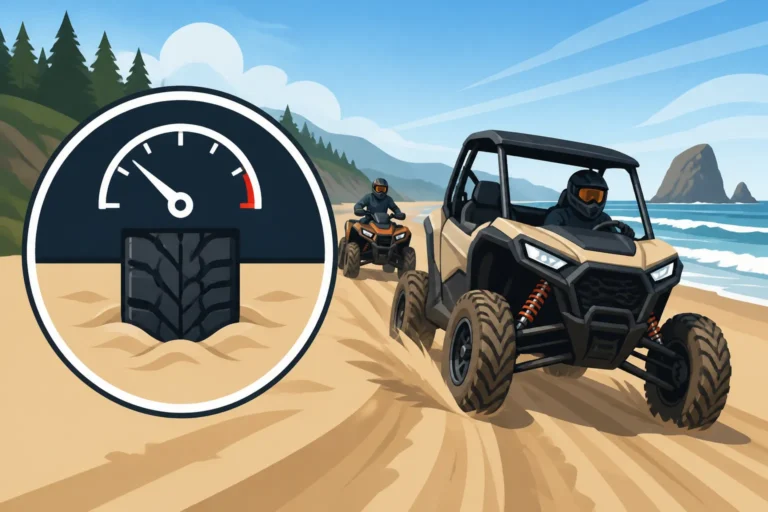
Tires and recovery basics matter as well. Soft sand can be difficult to navigate if you’re already working hard to keep the machine moving, and a stuck machine can complicate a foggy ride. Review [Soft Sand and Tire Pressure on the Coast] before heading out, and carry the recovery gear appropriate to your vehicle and experience. Avoid making a tire adjustment based on a generic number without considering the machine, load, terrain, and manufacturer guidance.
Pack for a longer return than you expect
Coastal weather can feel colder and damper than riders anticipate, especially when they’re moving slowly or stopped. Wear layers that handle wind and moisture, and bring gloves that still give you a secure grip. A spare layer stored in a dry bag is useful if you get wet from fog, spray, or a recovery effort.
Carry water, basic first aid supplies, a charged phone, and any machine-specific tools you may need. If the ride is taking place away from a developed area, consider what you’d need to wait safely if a machine develops a problem. Keep the load secured so nothing shifts or interferes with steering, visibility, or passenger space.
A paper or offline map can be valuable if you lose reception or a device battery runs low. If you use onX Offroad for route planning, download the map information you’ll need before leaving a reliable connection, and make sure everyone in the group understands the route rather than assuming one person’s phone will solve every navigation problem. Digital maps are useful aids, but they don’t override posted signs, closures, or conditions on the ground.
Agree on a group plan before the first turn
A group ride can feel reassuring, but only if everyone knows how it will work. Decide who leads and who brings up the rear, agree on a pace, and identify safe places to regroup. Make sure riders know what to do if they lose sight of the group: slow down, stop somewhere safe, and use the agreed communication method rather than chasing blindly.
Keep the group close enough to stay connected without riding so tightly that one person’s sudden stop causes a collision. Leave space between machines, especially near dune crests and junctions. The leader should avoid sudden turns, and the rear rider should alert the group if someone falls behind or has a mechanical issue.
For families or mixed-experience groups, explain the plan in plain language before starting. A child or new rider may not know whether to keep moving, turn around, or wait if they lose sight of the adults. A quick conversation at the staging area can prevent panic later. Check helmet fit, secure passengers appropriately, and follow the rules that apply to the machine and riding area.
Navigate conservatively through fog
Keep the route simple and easy to retrace
A good fog-day route is one you can explain without relying on distant visual cues. Note your starting point, the main route you intend to follow, and a straightforward way back. Keep the trip shorter than you might choose on a clear day, and avoid adding extra loops because the group is “already out there.”
Use a map as a planning tool, not as proof that a route is open or safe. Conditions, closures, and access can change; check signs and local notices before riding. [Oregon Trail Maps Worth Carrying] is a useful companion when deciding what information to bring, while [Oregon Trail Closures to Check First] can help you remember that route access deserves a fresh check before the trip.
If you use onX Offroad or another digital mapping tool, orient yourself before setting off and confirm that the map covers the area you plan to ride. Keep the phone protected from moisture and impact, and make sure you can access the map without depending on continuous cell service. A screen is difficult to consult while moving, so stop in a safe place before checking it.
Slow down where visibility and terrain combine
Reduce speed before approaching a crest, turn, junction, or crowded area—not after you have reached it. In fog, the key question is whether you can stop or change direction safely within the space you can see. If not, slow down further or stop somewhere safe. Riding quickly because the sand looks smooth can be especially risky when the far side of a ridge is hidden.
Avoid cresting a dune at speed or cutting across a slope you can’t fully assess. Another rider may be approaching from the other side, or the terrain may drop more sharply than it appears. On a UTV, passengers can also be thrown around by a sudden change in direction or a hidden dip, so smooth inputs and conservative lines matter for everyone in the vehicle.
Give other machines extra room and make your movements predictable. Don’t stop in a blind area or on a busy line if you can safely move to a visible, out-of-the-way spot. Follow local riding etiquette, and review [Riding Etiquette on a Busy Staging Day] if your trip coincides with a crowded weekend. Congestion and poor visibility are a particularly demanding combination.
Choose stopping points with care
If you need to regroup, avoid stopping just beyond a crest, in the middle of a travel route, or where an approaching rider has little room to react. Move to a location that is as visible and clear of traffic as possible. If there is no safe place to stop where you are, move slowly to a better location rather than braking abruptly in a blind spot.
When stopped, keep riders and passengers close to the machines and out of active travel lines. Make sure the group is accounted for before anyone starts moving again. If you’re dealing with a mechanical issue, don’t let one person work alone while the rest of the group disappears into the fog. Keep communication clear and agree on what each person is doing.
If visibility continues to deteriorate, waiting may help—but only if the stopping place is safe and the group has enough supplies to remain there comfortably. If conditions are unsafe or someone is injured, use the appropriate emergency services and share your location as accurately as possible. A map reference, known staging area, or clear description of landmarks can help when visual cues are limited.
Make a coastal ride plan that can change
Check local access and conditions before driving to the coast
Coastal riding involves more than fog. Access can vary by location and season, and closures may affect where you can ride. Before leaving home, check the rules and conditions for the specific area, including staging access, riding boundaries, and any posted restrictions. The Oregon coast has several distinct riding areas, so information for one site should not be assumed to apply to another.
For example, a trip to Spinreel or Hauser has different access and staging considerations from a ride near Sand Lake. If you’re planning a Florence-area outing, read [Spinreel and Hauser on the Oregon Coast] and the information for your intended staging area rather than treating the whole coast as one interchangeable destination. [Oregon Riding Seasons by Area] can also help with broader seasonal planning.
Fog should be one factor in the decision, not the only one. Consider road conditions for the tow vehicle, the time needed to travel home, daylight, expected wind and rain, and whether the group has the right equipment. If the forecast and the conditions you see at the coast do not match, trust what you observe at the site and adjust the plan.
Keep a flexible schedule and a clear turnaround point
A flexible schedule helps prevent pressure to keep riding when visibility is poor. If the group has to be back at camp or on the road at a fixed time, people may feel tempted to push through instead of turning around. Build in enough time for a slower ride, a weather delay, or a decision to stop early.
Set a turnaround point before leaving. It might be a familiar junction, a planned loop boundary, or a specific time when the group will head back regardless of how much terrain remains. The point is not to force the group onward; it is to make the return decision easier when everyone is focused on changing conditions.
If the fog clears, keep reassessing rather than immediately returning to a high-speed pace. Visibility may improve in one area and remain limited in another. Conversely, if conditions worsen, don’t feel obligated to reach the planned destination. A conservative ride that ends early is still a successful outing if everyone and every machine return safely.
Learn from the ride without normalizing risk
After the trip, talk about what worked and what caused uncertainty. Did the group stay together? Was the route easy to retrace? Did everyone have enough warm, dry gear? Were the lights visible, and were the planned stopping points actually safe? These questions can make the next ride more organized.
Keep notes about the specific area and conditions, but don’t treat one successful foggy ride as proof that the same conditions will always be manageable. Fog density, wind, traffic, terrain, and rider experience change from day to day. A familiar area can still present a new hazard when visibility shifts.
Most importantly, agree that anyone in the group can call for a pause or a return. Riders are more likely to speak up when they know they won’t be mocked for being cautious or accused of ruining the day. Coastal fog is part of the environment, not a challenge that needs to be beaten. Respecting it is what lets you enjoy Oregon’s riding areas again on a clearer day.
Disclaimer
This article is for general informational purposes only and does not constitute professional advice. Laws, prices and regulations vary by location and change over time. Consult a qualified professional for guidance on your specific situation.