What Oregon Requires After an Out-of-State Purchase
Bringing home a shiny new-to-you ATV or UTV that you bought across state lines can be incredibly exciting, but the paperwork part often feels like navigating a dense, overgrown trail without a map. Many riders find themselves scratching their heads, wondering if Oregon's rules for an out-of-state machine are the same as for one bought right here. This guide is designed to cut through that confusion, giving you a clear, actionable path to get your machine legal and ready for Oregon's fantastic riding opportunities.
Navigating Oregon's Unique ATV/UTV Landscape
You've just invested in a new off-road machine, and maybe you found a fantastic deal in Washington, Idaho, or even further afield. Now, the natural question pops up: "What do I need to do to make this legal in Oregon?" If your first thought was heading to the DMV to register it, you're not alone! Many states handle ATVs and UTVs through their Department of Motor Vehicles, much like cars. However, Oregon has a distinctly different approach that often catches newcomers and even seasoned riders from other states by surprise.
The Oregon Difference: Permits, Not Registrations
Here in Oregon, our state doesn't register off-highway vehicles (OHVs) with the Department of Motor Vehicles in the traditional sense, at least not for their primary off-road use. This is a fundamental distinction that can throw a wrench into what you might expect. Instead of a title that needs to be registered annually for road use, like a car or motorcycle, Oregon focuses on an operating permit system for ATVs and UTVs when they are used on public lands. This means you won't be getting a traditional license plate or yearly registration tags from the DMV for your dirt-slinging machine. [Why Oregon's DMV Does Not Register ATVs]
The logic behind this system stems from the fact that most ATVs and UTVs are designed and used exclusively for off-road recreation. Rather than treating them like road-going vehicles, Oregon has crafted a system specifically for their intended purpose. The Oregon Parks and Recreation Department (OPRD) oversees this program, ensuring that funds generated by permits go directly back into maintaining and expanding our incredible trail systems and riding areas. So, while it might feel a bit unconventional if you're used to DMV processes, it's all designed to support the riding community.
Essential Operating Permits for Your "New-to-Oregon" Machine
Regardless of where your ATV or UTV originally came from, if you plan to ride it on any public land in Oregon—be it the Oregon Dunes, the Tillamook State Forest, Millican Valley, or any other designated OHV area—you absolutely need an [Oregon's ATV Operating Permit]. There are no exceptions for machines purchased out-of-state. Think of this permit as your machine's passport to Oregon's trails and dunes.
The permit is valid for two years from the month of purchase, giving you a good long stretch before you need to think about renewal. [Why Oregon's Permit Lasts Two Years] It’s a physical decal that you affix to your machine, serving as visible proof that you've contributed to the upkeep of our riding areas. Without this permit, you could face fines and an unwelcome end to your ride if encountered by a ranger or law enforcement officer. It's truly a non-negotiable step to take as soon as your out-of-state machine lands in Oregon. The good news is, getting one is usually quite straightforward, which we'll cover next.
Your Action Plan: Permitting and Proving Ownership
So, you've brought your new (to Oregon) machine home. The excitement is palpable, and you're dreaming of sandy dunes or muddy forest trails. But before you hit the throttle, there are a few essential steps to take. The first and most critical is obtaining that Oregon ATV Operating Permit, and the second is considering how you'll prove ownership, which is especially important for out-of-state purchases.
How to Get Your Oregon ATV Operating Permit
Getting your permit is relatively simple, and Oregon offers a few convenient ways to do it. You can purchase your permit [Buying an Oregon Permit Online] through the Oregon Parks and Recreation Department's website, or you can visit one of the many authorized [Oregon Permit Agents You Can Walk Into] located across the state. These agents are often dealerships, sporting goods stores, or even some small-town general stores near popular riding areas.
When you purchase your permit, whether online or in person, you'll need some basic information about your machine, including its Vehicle Identification Number (VIN), make, model, and year. The permit itself costs the same for all classes of ATVs and UTVs, so you don't have to worry about differing prices for a small youth quad versus a large side-by-side. Once purchased, you'll receive a physical decal to apply to your machine. If you buy online, you'll often get a temporary 30-day permit via email that you can print out and carry with you, allowing you to ride immediately while you wait for your official decal to arrive in the mail. This can be a lifesaver if you're eager to get out on the trails! [Oregon's Thirty-Day Temporary Permit]
Decal Placement: Your Machine's Visible "License Plate"
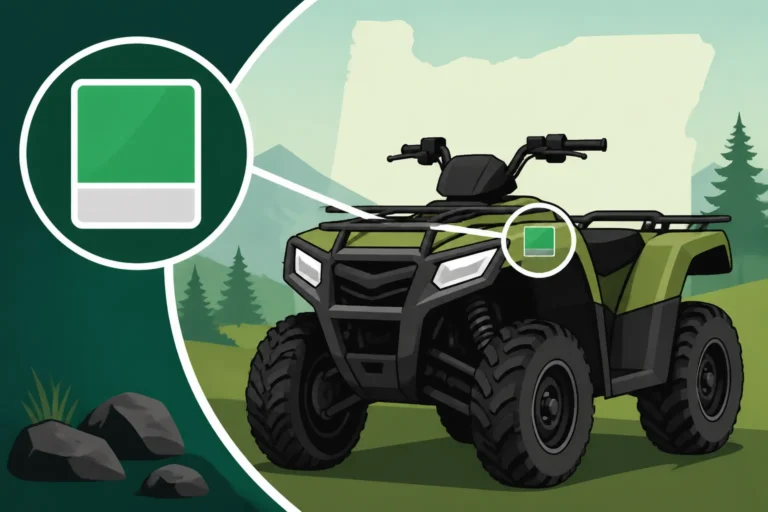
Once your permit decal arrives, placing it correctly is crucial. This isn't just a suggestion; it's a legal requirement that helps enforcement officers quickly verify your compliance without having to stop you unnecessarily. The decal must be clearly visible and permanently affixed to your machine. [Oregon Permit Decals and Where They Go]
For most Class I ATVs (quads), the decal should be placed on the right-hand side of the machine, typically on the front fender or side panel. For larger Class IV machines, such as side-by-sides, it goes on the right-hand side, often on the bodywork or frame, or even on a roll bar, as long as it's visible. Off-road motorcycles (Class III) have specific placement requirements too, usually on the right fork tube or fender. [Decal Placement on a Quad's Right Side] [Decal Placement on a Class IV Machine] [Decal Placement on an Off-Road Motorcycle] The key is that it must be readable and unobstructed. Avoid placing it where it might be easily scraped off by brush, mud, or during washing. A faded or missing decal is just as problematic as not having one at all.
Optional Titling: Why It's Still a Smart Move
Here's another point where Oregon deviates: for off-road-only machines, titling is [Titling an ATV in Oregon Is Optional]. This means you aren't legally required to get an Oregon title for your ATV or UTV if it's solely used off-road. However, just because it's optional doesn't mean it's not a good idea. In fact, for an out-of-state purchase, getting an Oregon title is highly recommended. [Why an Oregon Title Is Worth Having Anyway]
A title serves as official proof of ownership. If you ever need to sell your machine, transfer it to an heir, or if it's stolen, having a state-issued title makes proving ownership significantly easier. When you purchase a machine from another state, especially from a private seller, you might receive their state's title or simply a bill of sale. To get an Oregon title, you'll typically need your previous state's title (if they had one) and a comprehensive [Oregon Bill of Sale for an ATV] from the seller. This is where a resource like LawDepot can be invaluable. Even if the seller from out-of-state provides their own informal document, using LawDepot to create a robust, legally sound bill of sale that includes all the necessary details like the VIN, purchase price, and contact information for both buyer and seller, can provide an extra layer of protection and streamline the Oregon titling process. It ensures all the crucial information Oregon might need is present, making your journey from out-of-state owner to official Oregon owner much smoother.
Beyond the Permit: Safety and Equipment Essentials
Getting your permit and considering a title are significant steps, but Oregon has a few more requirements designed to keep everyone safe and preserve our natural riding environments. These cover everything from rider education to the equipment on your machine.
The Oregon ATV Safety Education Card for Every Rider
Safety is paramount on Oregon's trails, and that's why the state requires an [Oregon ATV Safety Card Requirements] for every rider, regardless of age or experience. Yes, even if you've been riding for decades, you still need this card to operate an OHV on public lands. This is another area where out-of-state riders often get confused, thinking their years of experience or another state's certification might suffice.
Oregon does have [Does Oregon Accept an Out-of-State Safety Card?], honoring safety education cards from 18 other states. However, this reciprocity often comes with a significant caveat: it typically applies to non-residents for a limited period, usually 60 consecutive days. If you've just moved to Oregon, or if you plan to ride here for an extended period, you will need to get an Oregon ATV Safety Education Card. The good news is that the online course for the Oregon card is often free, making it accessible to everyone. It covers essential safety practices, environmental awareness, and specific Oregon regulations, ensuring all riders are on the same page when it comes to responsible OHV operation.
Sound and Spark Arrestors: Keeping Oregon Green and Quiet
Our beautiful forests and dunes are treasures we all want to protect, and that includes minimizing fire risk and noise pollution. Oregon has strict rules regarding both: every OHV operating on public land must be equipped with a U.S. Forest Service approved [Oregon Spark Arrester Requirement]. This device prevents hot carbon particles from escaping the exhaust and potentially igniting dry vegetation. It's a non-negotiable safety feature, especially during our dry summer months. Check your exhaust system to ensure it has one, or install an approved aftermarket one if it doesn't.
In addition to spark arresters, Oregon also enforces [Oregon Sound Limits for ATVs]. While these limits can vary slightly depending on the riding area, the general idea is to keep noise levels down to prevent disturbing wildlife and other recreationists. Aftermarket exhausts can sometimes exceed these limits, leading to potential fines. If you've purchased an out-of-state machine with a modified exhaust, it's wise to have it checked or consider returning it to stock to ensure compliance with Oregon's sound regulations.
Helmets and Passengers: Riding Safely and Legally
Oregon's helmet law is straightforward: [Oregon Helmet Law for ATV Riders] requires all riders of Class I and Class III ATVs (quads and dirt bikes) to wear a helmet, regardless of age. For Class IV machines (side-by-sides), helmets are mandatory for all occupants under 18 years of age. While adults in a side-by-side with a roll cage and seatbelts may not be legally required to wear a helmet, it's always the safest practice to do so. A good quality, DOT-approved helmet can be the difference between a minor bump and a serious injury.
[Oregon Passenger Rules on a Quad] also dictate how passengers can be carried. On a quad, passengers are only allowed if the machine is specifically designed by the manufacturer to carry more than one person and has dedicated footrests and seating for the passenger. Riding double on a single-seat quad is dangerous and illegal. In a side-by-side, passengers must sit in designated seats, wear seatbelts, and have their feet within the vehicle's passenger compartment. Understanding and adhering to these rules is not just about avoiding a citation; it's about ensuring the safety of everyone on board.
Special Considerations for Out-of-State Transactions
Bringing an ATV or UTV into Oregon from another state adds a few extra layers of consideration to the process. You'll need to pay close attention to the documentation you receive from the seller and understand how Oregon's rules interact with the previous state's regulations.
Paperwork from Your Out-of-State Seller
When you purchase an ATV or UTV out-of-state, the paperwork you receive is absolutely crucial. You'll want to gather as much documentation as possible. This typically includes the previous state's title (if the machine was titled there), a comprehensive bill of sale, and any maintenance records. A good [Oregon Paperwork for a Machine Bought Out of State] will clearly identify the machine by its VIN, list the buyer and seller's full information, state the purchase price, and be dated and signed by both parties.
This bill of sale is particularly important for an out-of-state machine because it serves as your initial proof of ownership. If you choose to apply for an Oregon title (which, as discussed, is a smart move), this document, along with the previous state's title, will be essential. If the seller doesn't have a formal bill of sale, or if the one they offer is very basic, consider using a template from a service like LawDepot. A well-crafted bill of sale from LawDepot can fill in any gaps, provide clear terms of sale, and ensure all necessary information (like the crucial VIN) is captured, which will be invaluable for establishing your ownership in Oregon. It can help prevent headaches down the road, especially if any questions arise about the machine's history or ownership transfer.
Understanding Reciprocity Limitations
Oregon has some reciprocity agreements with other states, but it's vital to understand what these agreements cover and, more importantly, what they don't. For example, while Oregon recognizes safety education cards from a list of other states, this generally applies to non-residents visiting for a limited time. [Oregon Rules for an Out-of-State Machine] If you've just moved to Oregon, or if your plan is to use your machine extensively here, relying solely on an out-of-state safety card may not be sufficient in the long run.
Similarly, an out-of-state registration or operating permit does not exempt you from Oregon's permit requirement. If you're bringing a machine from, say, Washington or Idaho, you'll still need to obtain an Oregon ATV Operating Permit once it's primarily used in Oregon. While a non-resident might be able to ride for up to [How Long a Visitor Can Ride Oregon] on their home state's permit or registration, this exception is for visitors, not new residents or machines primarily kept in Oregon. The takeaway here is: don't assume your out-of-state paperwork will cover you indefinitely in Oregon. When in doubt, it's always best to get the Oregon-specific permit and safety card.
What if You Bought from a State Without Titles?
It's not uncommon for ATVs and UTVs to be sold without titles in some states, particularly older models or those from regions where off-road vehicle titling isn't standard practice. This situation can add a layer of complexity when you bring the machine to Oregon, even though Oregon's titling is optional for off-road use. If you're coming from a state that doesn't issue titles for ATVs, proving ownership becomes even more reliant on your bill of sale. [Proving Ownership Without a Title]
In these scenarios, a highly detailed and legally robust bill of sale is your absolute best friend. This is another prime opportunity to leverage a resource like LawDepot. By using their templates, you can create a professional, comprehensive bill of sale that includes all relevant details: the full names and addresses of buyer and seller, the exact purchase date and price, a detailed description of the ATV/UTV (make, model, year, color), and critically, the full Vehicle Identification Number (VIN). Having this solid documentation, signed by both parties and perhaps even notarized, will be essential for establishing your ownership in Oregon, especially if you ever decide to get an Oregon title or need to address any legal questions about your machine. Without a prior title, this bill of sale acts as your primary legal document of acquisition.
Here’s a quick checklist to help you ensure you’ve covered all your bases after buying an ATV/UTV out-of-state and bringing it to Oregon:
| Requirement | Action | Notes |
|---|---|---|
| Oregon ATV Operating Permit | Purchase online or from an authorized agent. | Absolutely mandatory for riding on public lands. Comes with a two-year decal. |
| Permit Decal Placement | Affix the decal clearly on the right side of your machine. | Ensures compliance and visibility for enforcement. Placement varies by machine class. |
| Oregon ATV Safety Education Card | Complete the online course or ensure your out-of-state card is reciprocated (and for how long). | Required for all riders. Reciprocity for visitors is often limited to 60 days. |
| Spark Arrester | Verify your machine has a USFS-approved spark arrester. | Mandatory for fire prevention on public lands. |
| Sound Limits Compliance | Check your exhaust system for compliance with Oregon's sound limits. | Avoids fines and reduces noise pollution. |
| Helmet Compliance | Ensure all riders (especially under 18) wear DOT-approved helmets. | Mandatory for Class I/III riders, and under 18 in Class IV. Always recommended for everyone. |
| Passenger Rules | Understand and adhere to rules for carrying passengers based on your machine type. | No riding double on single-seat quads. Passengers in UTVs need proper seating and restraints. |
| Bill of Sale (from seller) | Obtain a detailed bill of sale from the out-of-state seller, including VIN and all party info. | Crucial for proving ownership, especially if previous state had no title. Consider using a template from LawDepot for robust documentation. |
| Previous State's Title (if applicable) | Collect the original title from the seller if the machine was titled in its previous state. | Essential if you plan to get an Oregon title. |
| Oregon Title (Optional but Recommended) | Apply for an Oregon title with OPRD using your bill of sale and previous title (if any). | Highly recommended for proving ownership, particularly for resale or in case of theft. |
Navigating these requirements might seem like a lot, but taking the time to ensure everything is in order will save you potential headaches and allow you to fully enjoy all the incredible off-road riding Oregon has to offer. Welcome your new machine to its new home, and happy trails!
Disclaimer
This article is for general informational purposes only and does not constitute professional advice. Laws, prices and regulations vary by location and change over time. Consult a qualified professional for guidance on your specific situation.