Riding Where Timber Is Being Cut
Riding where timber is being cut in Oregon calls for more than checking whether a road appears on a map. You need to confirm that the route is open to your machine, respect closures and private-land rules, and stay well clear of logging operations. Here’s how to make those checks and avoid turning a ride into a safety or access problem.
Confirm the road is open to you
A road that looks rideable is not automatically open to ATVs or UTVs. It may cross private timberland, public forestland, or a mix of ownerships, and each section can have different access rules. Even a road open to the public in one season may be temporarily closed when crews are working.
Start by identifying who manages the land and road. A county road, a Forest Service road, a state forest road, a BLM road and a private timber-company road are not interchangeable. Their access rules, closure notices and maps can come from different sources. For background on one type of route, see Oregon Rules for Riding a Timber Company Road. Other useful overviews include Oregon Rules for Riding a National Forest, Oregon Rules for Riding State Forest Land and [Oregon Rules for Riding BLM Land].
Before you unload, check the current information from the land manager or road owner. Look for notices about timber sales, hauling, road closures, seasonal restrictions and any limitations on motorized use. If the road crosses several parcels, check each manager’s information rather than assuming one open segment means the full route is open.
Pay attention to signs and barriers when you arrive. A gate, closure sign or posted notice may reflect a restriction that is newer or more specific than a map. Do not go around a locked gate, move a barrier or treat an unsigned detour as permission to continue. If you cannot tell whether a road is open, stop and verify with the responsible manager or landowner before riding it.
| What you find | What to do |
|---|---|
| A current closure notice or closed gate | Do not enter or ride around the barrier. Find another route. |
| A road marked open, with no active-work warning | Confirm the route is open to your vehicle class and check for new notices at the entrance. |
| A private timber road with unclear access | Contact the owner or manager; do not assume public access. |
| A map that conflicts with a sign or gate | Follow the on-site restriction and confirm with the manager. |
| Logging trucks, equipment or workers ahead | Stop in a safe place, stay clear, and follow any direction from the operator or crew. |
Access and permits are separate questions. An Oregon ATV operating permit, an out-of-state permit or a reciprocal permit arrangement does not grant permission to ride on private land or override a road closure. Reciprocity concerns whether a qualifying visitor’s permit is recognized for riding in Oregon; it does not decide who owns a road or whether that road is open. See Oregon Permit Reciprocity List and Riding Oregon With an Out-of-State Permit for the permit side of the question.
Likewise, a road shown on a map as open may not be open to every type of vehicle. Check that the route allows your class of ATV or UTV, and do not assume that a route suitable for a passenger vehicle is automatically approved for off-highway vehicle use. A permit is part of being ready to ride, not a substitute for checking access.
Treat active logging as a work zone
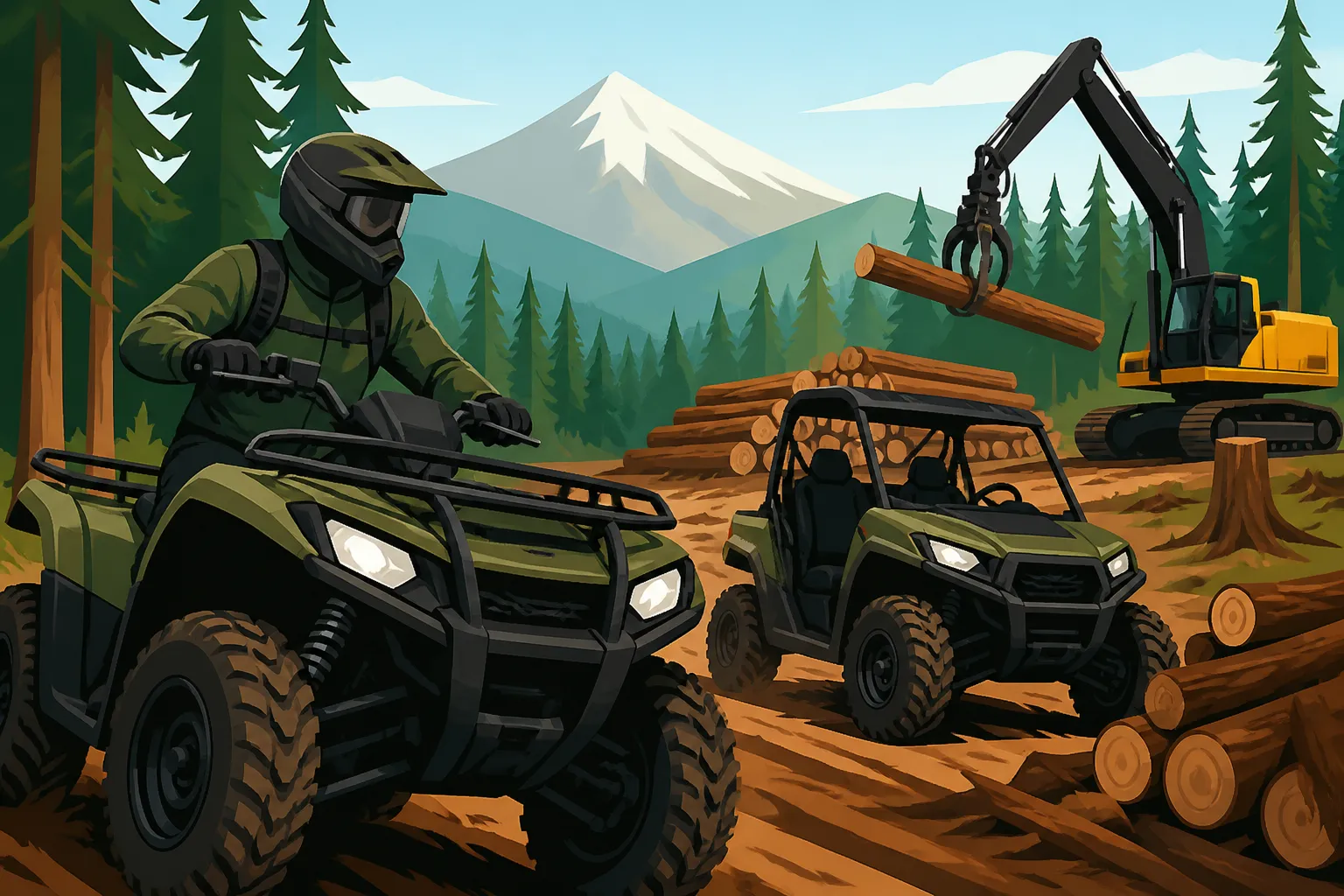
Timber work can change a road quickly. Trucks may be hauling logs, loaders or other machinery may be crossing the route, and crews may be working beyond a blind corner. Conditions can also include loose gravel, mud, dust, debris or limited sight distance. The people operating large equipment may not see a smaller ATV or UTV in time to avoid it.
The safest choice is to avoid riding through an active work area. If the route is officially closed, turn around before entering it. If you encounter work on a road that appears open, do not try to squeeze past machinery or assume that a driver has noticed you. Stop well away from the work, out of the travel path, and wait for clear instructions from the crew or road manager. If no safe way to proceed is available, turn back.
Haul roads require particular caution. Log trucks need room to turn, brake and maneuver, and their loads can make stopping distances and visibility less predictable. A truck approaching from behind may not be able to stop as quickly as a smaller vehicle. On a narrow road, do not race ahead to beat a truck to a passing spot, pull into a blind turnout, or stop where a driver cannot see you.
If you meet a truck, give it as much room as possible. Move to a safe, visible place only if there is one, and avoid the edge of soft shoulders or steep drop-offs. Do not pass a stopped truck or equipment unless the operator clearly signals that it is safe and the route is open. On a shared gravel road, the practical rule is to expect heavy traffic and make space early. Sharing a Gravel Road With Log Trucks covers that situation in more detail.
Dust can make a road unsafe even when traffic is light. A truck or machine may create a cloud that hides people, vehicles, signs and road edges. Slow down before entering dust, increase your following distance and be ready to stop. If you cannot see far enough to ride safely, pull off only where you are visible and well clear of traffic, then wait for visibility to improve. Avoid following a truck closely through a dust cloud.
A quiet stretch of road is not proof that work has stopped. Logging activity may be intermittent, and a truck can appear after a lull. Keep your speed conservative, stay alert for equipment and workers, and do not park where you block a gate, turnout, loading area or access road. For more on limited sight distance, see Dust and Blind Corners on a Logging Road.
Handle gates, closures and changing conditions correctly
Gates and closure signs are practical signals that access may be restricted, not obstacles to work around. A gate can serve several purposes: controlling public access, protecting an active work area, or preventing traffic from entering a road that is temporarily unsafe. The reason may not be obvious from the road.
Never follow another rider through a gate just because it is open when you arrive. It may have been opened for a landowner, contractor or authorized vehicle, and it may need to be closed again. If a gate is closed, do not ride around it or use a nearby track to bypass it. See Gates on Industrial Forest Land for more on why a gate’s status matters.
A closure may apply to a particular road segment, a whole timber sale area or a broader part of the riding area. Read the posted notice carefully, including dates or any route details, but do not treat an unclear notice as permission to enter. Contact the land manager or owner if you need clarification. If you discover an unmarked work area, do not ride deeper into it to look for another way through. Turn around where it is safe and report the issue to the appropriate manager if needed.
Maps and signs can differ because conditions change after a map is published. A route may have been closed for work, weather damage or another safety concern. When the on-site sign conflicts with your printed map or downloaded route, take the more restrictive information seriously until you verify the current status. Maps That Disagree With Signs explains why it is important to resolve those discrepancies before continuing.
Do not assume that you can get permission from a crew member to ride a closed road. The person operating equipment may not be responsible for public access decisions. If access to a private road is unclear, ask the landowner or company contact responsible for permissions. A verbal “go ahead” from someone whose authority is uncertain may not be enough to establish that the route is open. Getting a Riding Permit From a Timber Company is a useful next step when you are seeking access to private timberland.
Conditions can change during the day. A route open in the morning may become busy with hauling or be closed while crews work. If you return to a road and find a new sign, gate or active operation, reassess the route rather than relying on what you saw earlier. Keep an alternate route in mind, and leave enough time and fuel to turn back without pressure.
Prepare before you ride and know when to turn around
A short pre-ride check can prevent confusion at a trailhead or a dangerous encounter on a narrow road. Confirm who manages the route, check current closures, and make sure your ATV or UTV is allowed. If a route includes private timberland, verify permission with the owner or manager instead of relying on another rider’s account or an old map.
Use this checklist before heading out:
- Identify the land manager and road owner. If the route crosses different ownerships, check the rules for each segment.
- Look for current access notices. Check for closures, timber activity, hauling schedules and seasonal restrictions.
- Confirm vehicle eligibility. Make sure the specific road is open to your machine and not limited to another vehicle type.
- Carry the right permit and documents. Confirm your Oregon permit or eligible out-of-state status, while remembering that permits do not grant land access.
- Plan an alternate route. A closure or active work zone may mean turning back, so avoid a plan that depends on one road staying open.
- Keep your group together and visible. Leave space between machines, avoid dust clouds and stop only where other road users can see you.
- Turn around when the route is uncertain or unsafe. Do not test a gate, follow equipment into a work area or continue through poor visibility.
If you are already on a road when logging traffic appears, stay calm and make your next move deliberate. Do not stop in the middle of the road or make a sudden turn into an unsafe shoulder. Move to a clearly visible location only when you can do so without entering the equipment’s path. If you cannot safely pass or wait, retreat along the route you came from when the road is clear.
The safest decision is often to choose a different riding area. That can be frustrating after trailering a machine and planning a route, but a timber operation is a workplace with heavy vehicles and changing hazards. A closure is not a challenge to solve by finding a way around it; it is a reason to stop, confirm the rules and ride somewhere else.
Disclaimer
This article is for general informational purposes only and does not constitute professional advice. Laws, prices and regulations vary by location and change over time. Consult a qualified professional for guidance on your specific situation.