Oregon Rules for Renting to a Teenager
Renting an ATV or UTV for a teenager in Oregon takes more than checking the rental company’s minimum age. The rules depend on the vehicle class, the rider’s age, safety education and supervision, and where the machine will be used. Here’s how to sort out those requirements before booking, so you can ask the rental agency the right questions and avoid surprises at pickup.
Start with the vehicle class and the teenager’s age
Oregon groups off-highway vehicles into four classes. A quad, dirt bike, sand rail, truck, or side-by-side may have different age and credential requirements, so identify the vehicle class before relying on a general statement like “teenagers can ride here.” The Oregon Department of Transportation says the classes are defined in Oregon law; the Oregon Parks and Recreation Department (OPRD) sets out the operating and safety requirements.
| Vehicle class and common example | Relevant age and credential rule | What to confirm with the rental agency |
|---|---|---|
| Class I, such as a quad or three-wheeler | OPRD says there is no minimum operating age, but the rider must meet physical fit requirements and have an ATV Safety Education Card. A rider under 16 must meet the youth training requirements and ride under adult supervision. | Ask whether the machine fits the teen and how the rental agency handles the safety credential and training rules. |
| Class II, such as a sand rail, truck, or SUV | OPRD requires an operator to be at least 15 and have driving privileges, such as a driver license or instruction driver permit. | Confirm the teen’s driving document is accepted and that the operator meets the age rule. |
| Class III, an off-road motorcycle | OPRD sets the minimum age at 7 and requires an ATV Safety Education Card. Riders 15 and younger must also complete the required hands-on course as well as the online course. | Confirm that the rider’s size, experience, training, and credential meet the rules and the rental company’s own policy. |
| Class IV, such as a side-by-side | OPRD says operators under 16 need an ATV Safety Education Card unless they have an instruction driver permit, and they must meet the manufacturer’s age recommendations. | Ask for the machine’s manufacturer age recommendations and the rental company’s policy for a teen driver and passengers. |
The age rules are not a guarantee that a rental company will rent to a teenager. A company can set its own rental conditions, and the vehicle manufacturer’s age guidance may be more restrictive than the basic state rule. Ask about both before putting down a deposit.
Class matters for another reason: a side-by-side is not simply a larger quad. Oregon’s Oregon’s Four ATV Classes Explained outlines the distinctions, while Oregon Rental Age and License Rules is useful if you need to compare a rental company’s minimum age policy with the state’s operator requirements.
A teen’s exact age also matters. A rider who is under 16 falls under Oregon’s youth supervision rules. A rider who is 16 or 17 is still under 18 for helmet requirements, but the under-16 supervision rule does not apply based on age alone. Class-specific requirements still apply to both groups. For example, OPRD requires an ATV Safety Education Card for Class I and Class III riders of all ages.
Ask about safety education and the rental checklist
Oregon requires safety education for ATV operation on public land. OPRD offers a free online ATV safety course, but for young riders, completing the online course may not be the end of the process. OPRD says operators under 16 must complete a hands-on course in addition to the online course within six months. Riders 15 and younger on Class I or Class III vehicles must complete both the online course and hands-on training or evaluation.
Rental agencies have a separate process for providing a temporary safety credential. According to OPRD, renters receive a 30-day temporary card from the rental agency after reading and signing an ATV Rental Safety Checklist. For a rider under 16, OPRD says an ATV Safety Education Card or the rental agent’s temporary checklist is required, along with adult supervision. Do not assume that signing the checklist automatically settles every training requirement: ask the agency how it applies to the teen’s vehicle class and confirm whether the teen must complete the online and hands-on training before riding.
A useful pre-booking conversation covers these points:
- Which class is the rental? A company may use everyday terms such as “quad,” “buggy,” or “side-by-side,” but the state rules use vehicle classes.
- What credential must the teen bring? Ask whether the teen needs a permanent ATV Safety Education Card, an instruction driver permit, or the rental agency’s temporary card.
- Does the teen need to complete training before pickup? This is especially important for a rider under 16 using a Class I or Class III machine.
- What age and fit limits apply to this exact machine? For a Class IV side-by-side, OPRD requires operators under 16 to meet the manufacturer’s age recommendations. The rental company may also have its own limits.
- What does the rental checklist cover? Ask whether the teen must complete it at the counter, whether a parent or guardian needs to sign anything, and what proof of completion the rider receives.
The rental checklist is not the same thing as the ATV operating permit for the machine. Safety credentials concern the operator; the operating permit concerns the vehicle. OPRD requires an ATV operating permit for machines used on lands open to ATV use, and says permits last two years. Ask the rental agency whether the machine already has the required permit for the location you plan to ride. A rental agreement or safety checklist should not be treated as proof that the vehicle permit is in order.
For more detail on the temporary credential, see Oregon’s 30-Day Rental Safety Card Explained and Oregon Rental Safety Checklists. For the broader education rules, Oregon ATV Safety Card Requirements explains which riders need a card and what training may be required.
Plan for supervision, helmets, and rider fit
OPRD requires adult supervision for youth operators under 16. The supervisor must be at least 18, hold a valid ATV Safety Education Card, and be able to provide immediate direction and assistance. That last part matters in practice: the supervisor should be close enough to intervene and help, not simply somewhere else at the riding area.
Before the ride, agree on who will supervise the teen and how that person will stay in a position to help. If the teen is operating a separate machine, make sure the adult supervisor can keep the rider in view and respond promptly. If the teen will drive a side-by-side, check the rental company’s rules for supervision, seating, and passengers rather than assuming that riding in the same vehicle automatically meets every requirement.
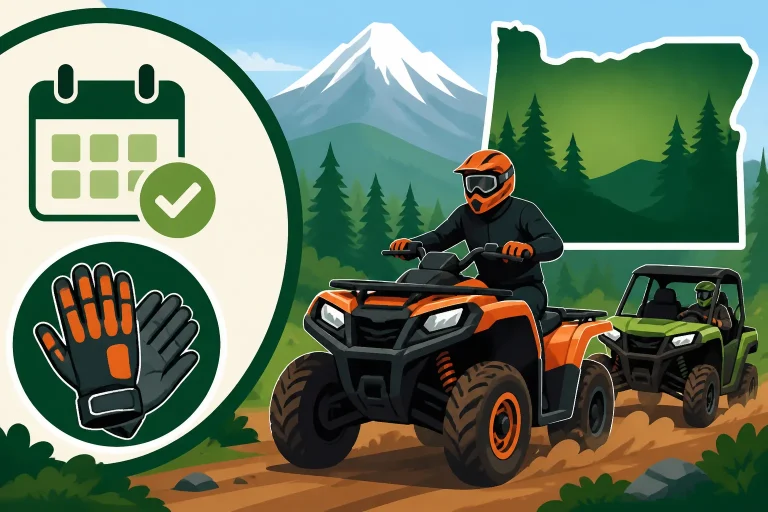
Protective equipment is another essential pickup check. OPRD requires riders under 18 to wear a DOT-approved helmet, with the chin strap fastened. The department also says youth under 16 must wear a seat belt and follow rules for highway use of child-restraint seats. For a side-by-side, make sure the teen can sit correctly and use the restraint system provided. OPRD says operators under 16 must meet the manufacturer’s age recommendations for Class IV machines, so check those recommendations for the specific model.
A rental company may provide safety gear, but confirm what is included and whether it fits the teenager. A helmet that is available at the counter is not automatically a suitable fit. If you choose to bring a helmet, check for the required DOT approval and make sure it fits securely; Amazon is one place to compare options, but the marketplace listing alone does not establish that a helmet is appropriate or properly fitted.
Rider fit is also part of the legal picture for Class I machines. OPRD says there is no minimum age for operating a Class I ATV, but a young rider must meet fit requirements. That means the question is not only whether the teen can reach the controls while seated. The rider should be able to operate the machine safely and follow the rental company’s instructions. If the teen cannot comfortably control the vehicle, choose another activity or a more suitable machine rather than treating a lack of a minimum age as permission to ride any quad.
For a rider who is 16 or 17, remember that some youth requirements remain in place. OPRD requires helmets for riders under 18, and the safety-card rules for Class I and Class III apply regardless of age. To check rules specific to age, see Oregon Rules for Riders Under 16 and Oregon Rules for a Rider Aged 16.
Confirm where the rental can be ridden and who handles the permit
A rental may be approved for one riding area or type of terrain but not another. Before setting off, ask the rental company which trails or riding areas are permitted, whether the machine has an Oregon ATV operating permit, and whether any local restrictions apply. OPRD says a permit is required on lands open to ATV use; it also says that operating an off-road vehicle in a designated off-road area without a permit is a Class C traffic violation.
Do not confuse an Oregon safety credential with an out-of-state permit or registration. Visitors using Class I or Class III vehicles in Oregon generally need to complete the online safety course and carry an ATV Safety Education Card unless exempt, according to OPRD. Oregon has permit reciprocity with some states, but permit recognition and safety-card acceptance are separate questions. If your teen is visiting from out of state, ask the rental agency what documents it requires and review Oregon Permit Reciprocity List and Does Oregon Accept an Out-of-State Safety Card?.
For a rental, have the agency explain exactly what it provides: the vehicle’s permit, the rider’s temporary safety card, and any required safety equipment. Those are separate items, and having one does not establish that the others are covered. If you are unsure whether the rental’s decal is valid for the planned ride, ask the rental agency before leaving the counter. Oregon ATV Permit for a Rented Machine covers the permit question in more detail.
A quick check before booking can prevent a stressful pickup:
- Get the vehicle’s Oregon class and model.
- Give the company the teen’s exact age and ask whether it will rent that model to them.
- Confirm the required license, instruction permit, safety card, temporary rental card, and training.
- Ask whether the teen needs a supervisor and what the agency expects that adult to do.
- Confirm helmet, seat belt, fit, and manufacturer age requirements.
- Ask whether the rental machine has the required operating permit and where it may be ridden.
If the answers are vague, ask for clarification before paying or traveling to the rental location. The key is to check the requirements for the specific vehicle and the teenager who will operate it, rather than relying on a broad promise that a rental is “teen friendly.”
Sources
- Oregon Parks and Recreation Department — Oregon Parks and Recreation : ATV Permits : Ride ATVs : State of Oregon (checked November 3, 2026)
- Oregon Parks and Recreation Department — Oregon Parks and Recreation : ATV Permits : Ride ATVs : State of Oregon (checked November 3, 2026)
- Oregon Parks and Recreation Department — Oregon Parks and Recreation : ATV Safety Card : Ride ATVs : State of Oregon (checked November 3, 2026)
- Oregon Parks and Recreation Department — Oregon Parks and Recreation : ATV Safety Card : Ride ATVs : State of Oregon (checked November 3, 2026)
- Oregon Parks and Recreation Department — Oregon Parks and Recreation : All-Terrain Vehicles In Oregon : Ride ATVs : State of Oregon (checked November 3, 2026)
- Oregon Parks and Recreation Department — Oregon Parks and Recreation : Places to Ride : Ride ATVs : State of Oregon (checked November 3, 2026)
- Oregon Parks and Recreation Department — Oregon Parks and Recreation : Places to Ride : Ride ATVs : State of Oregon (checked November 3, 2026)
- Oregon Parks and Recreation Department — Oregon Parks and Recreation : ATV Permits : Ride ATVs : State of Oregon (checked November 3, 2026)
- DEPARTMENT OF TRANSPORTATION DRIVER AND MOTOR VEHICLE SERVICES — 463.pdf (checked November 3, 2026)
- Oregon Parks and Recreation Department — Oregon Parks and Recreation : All-Terrain Vehicles In Oregon : Ride ATVs : State of Oregon (checked November 3, 2026)
- Oregon Parks and Recreation Department — Oregon Parks and Recreation : ATV Safety Card : Ride ATVs : State of Oregon (checked November 3, 2026)
- Oregon Parks and Recreation — Oregon Parks and Recreation : Youth Riders : Ride ATVs : State of Oregon (checked November 3, 2026)
- Oregon Parks and Recreation Department — Oregon Parks and Recreation : Types of ATVs : Ride ATVs : State of Oregon (checked November 3, 2026)
- Oregon Parks and Recreation Department — Oregon Parks and Recreation : Need to Know : Ride ATVs : State of Oregon (checked November 3, 2026)
- Oregon Parks and Recreation Department — Oregon Parks and Recreation : FAQ : Ride ATVs : State of Oregon (checked November 3, 2026)
- Oregon Parks and Recreation Department — Oregon Parks and Recreation : All-Terrain Vehicle Grant Program : Grants : State of Oregon (checked November 3, 2026)
- Oregon Parks and Recreation Department — Youth Riders : Ride ATVs (checked November 3, 2026)
Disclaimer
This article is for general informational purposes only and does not constitute professional advice. Laws, prices and regulations vary by location and change over time. Consult a qualified professional for guidance on your specific situation.