Where a Jeep Fits in the Class System
It can be incredibly confusing to figure out where your beloved Jeep, or any similarly capable 4×4 vehicle, actually fits into Oregon's off-road vehicle classification system. You’ve got this powerful, rugged machine, clearly designed for tackling tough trails, but then you hear about ATV permits and different classes, and suddenly you’re left wondering if you need to jump through similar hoops or if your Jeep is treated entirely differently. This guide will cut through the uncertainty, explaining Oregon’s specific definitions and how they apply to your Jeep, so you can hit the trails with confidence and stay on the right side of the rules.
The Initial Confusion: Is My Jeep an ATV in Oregon?
The term "ATV" often conjures images of four-wheeled quads, dirt bikes, or even side-by-sides. But when you own a vehicle like a Jeep, designed for serious off-road adventure, it’s natural to wonder if it somehow falls under the umbrella of "All-Terrain Vehicle" in the eyes of Oregon law. This isn't just a matter of semantics; it has real implications for how you operate your vehicle on public lands, what permits you might need, and what equipment is required. The rules can feel like a labyrinth, especially when you just want to enjoy the great outdoors.
Why the Definition Matters for Off-Roaders
Understanding whether your Jeep is legally considered an ATV, or a specific class of off-highway vehicle (OHV), dictates everything from the type of permit you need (or don't need) to where you can legally drive. If your Jeep were an ATV, you'd be looking at specific requirements for an [Oregon's ATV Operating Permit], safety education cards, and adherence to specific ATV rules. However, if it's considered a conventional highway vehicle capable of off-road use, it operates under a different set of regulations entirely, often tied more closely to its street-legal status. This distinction is crucial for avoiding fines, ensuring compliance, and most importantly, enjoying your time on the trails without unnecessary stress.
The Broad Spectrum of "Off-Highway Vehicles"
Oregon law uses the umbrella term "off-highway vehicle" (OHV) which encompasses a wide range of machines, but then it breaks these down into very specific classes. While a Jeep is undeniably an OHV in common parlance, the legal definitions are much narrower. This is where the confusion often begins, because what feels like an ATV to a casual observer isn't necessarily what the Oregon Revised Statutes define as one. The state has meticulously crafted definitions for Class I, II, III, and IV ATVs, each with distinct characteristics regarding width, dry weight, seating, and steering. These precise details are what ultimately determine whether your machine needs an Oregon ATV operating permit or if it simply uses the existing state registration and titling it already has as a street-legal vehicle.
Deciphering Oregon's ATV Classes for Larger Vehicles
Oregon defines its ATV classes with very specific criteria, and it's these minute details that determine if your vehicle, like a Jeep, fits. Most conventional 4x4s, including Jeeps, will quickly find themselves outside these definitions, which is often a relief for owners who don't want to deal with additional permitting for a vehicle that's already street legal. Let’s break down [Oregon's Four ATV Classes Explained] and see where a Jeep might – or might not – fit.
Class I: The Traditional Quad That a Jeep Isn't
Class I ATVs are what most people picture when they hear "quad." These are machines 50 inches or less in width, with a dry weight of 1,200 pounds or less, designed to be ridden with the operator straddling the seat. They usually have handlebars for steering. The key here is [The 50-Inch Limit That Defines a Class I]. A standard Jeep Wrangler, even a smaller one, is considerably wider than 50 inches and typically weighs well over 1,200 pounds dry. It also has a steering wheel and bench or bucket seats, not a straddle seat. So, right off the bat, a Jeep is never going to be a Class I ATV in Oregon. This class is strictly for machines like traditional sport quads or utility ATVs.
Class III: Off-Road Motorcycles (Again, Not a Jeep)
Class III ATVs are essentially off-road motorcycles, commonly known as dirt bikes. They are designed to be ridden with the operator straddling the seat and steering with handlebars, and they have two wheels. This definition clearly excludes a Jeep, which has four wheels, a steering wheel, and car-like seating. There’s no ambiguity here; your Jeep simply doesn't fit the Class III description, which is reserved for machines like a Kawasaki KX or a Honda CRF that are purely designed for tearing up dirt trails.
Class IV: Side-by-Sides and the Critical Width Limit
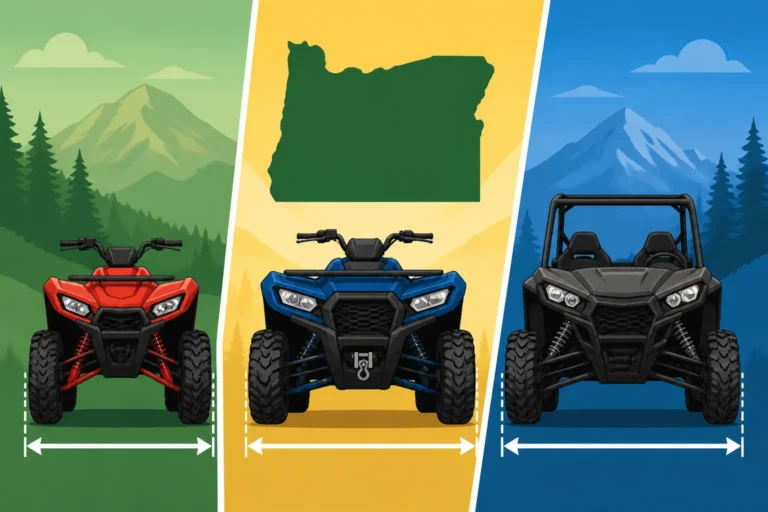
This is often where Jeep owners start to wonder, because some side-by-sides (UTVs) can look a bit like miniature Jeeps with their roll cages and steering wheels. [Oregon's Class IV Side-by-Sides Under 75 Inches] are designed to be operated with non-straddle seating, a steering wheel, and are 75 inches or less in width, with a dry weight of 3,500 pounds or less. While a Jeep has non-straddle seating and a steering wheel, its width is almost always the disqualifier. Most modern Jeeps, even two-door Wranglers, exceed the 75-inch width limit, especially with aftermarket tires or fender flares. Think about a Jeep Rubicon; its factory width can be around 74 inches, but add even slightly wider tires, and you're over the limit. Furthermore, many Jeeps will also exceed the 3,500-pound dry weight limit. Therefore, a typical Jeep, even a smaller model, generally doesn't fit into the Class IV definition, which is designed for machines like a Polaris RZR or a Can-Am Maverick. This is also why you'd refer to [Oregon ATV Permit for a Dune Buggy] or [Where a Sand Rail Fits in the Class System] when considering other non-traditional OHVs.
The Curious Case of Class II: Street-Legal OHVs
Oregon's Class II ATVs, defined under [Oregon's Class II Under ORS 801.193], are unique. These are off-highway vehicles that are wider than 50 inches and have a dry weight of 800 pounds or less. They are also designed to be operated with a straddle seat and handlebars, but here's the kicker: they are also authorized for highway use. These are very specific types of vehicles, like certain modified vintage military jeeps or custom-built dune buggies, that meet both the weight and width criteria AND have been made street-legal and registered with the DMV. However, the requirement for a straddle seat and handlebars means that a modern Jeep, with its steering wheel and bench/bucket seats, won't fit this definition either. For these unique machines, registration with the DMV and proof of insurance is mandatory, a sharp contrast to other ATV classes where [Oregon's DMV Does Not Register ATVs].
Where a Stock Jeep Typically Lands (or Doesn't)
After looking at the specific definitions, it becomes clear that a conventional Jeep, whether a Wrangler, Cherokee, or Gladiator, does not fit neatly into any of Oregon's defined ATV classes. This is a critical point for Jeep owners to understand, as it significantly impacts how and where they can legally operate their vehicles off-road.
Weight and Width: The Primary Disqualifiers for Most Classes
The most common reasons a Jeep won't qualify as an ATV in Oregon come down to its sheer size. As we discussed, Class I machines have a maximum width of 50 inches and a dry weight of 1,200 pounds. Class IV machines, while closer in concept to a UTV, are capped at 75 inches wide and 3,500 pounds dry weight. A stock Jeep Wrangler, for example, can be around 74-75 inches wide and weigh anywhere from 4,000 to 5,000 pounds or more, far exceeding both the width and weight limits for either Class I or Class IV. Even smaller, older Jeeps or highly modified lightweight builds would struggle to meet these narrow criteria. These stringent limits are designed to categorize smaller, purpose-built off-highway machines, not larger, street-legal vehicles.
Steering Wheel and Bench Seats: Not Always an ATV Trait
Another defining characteristic of Oregon's ATV classes is the operator interface. Class I and Class III ATVs (quads and dirt bikes) are designed with a straddle seat and handlebars. Class IV side-by-sides have non-straddle seating and a steering wheel, similar to a car. While a Jeep shares the steering wheel and non-straddle seating with a Class IV, the width and weight limits almost universally exclude it. The distinction is crucial because the design intent of an ATV is often tied to safety standards and operational characteristics distinct from a conventional motor vehicle. In essence, a Jeep's design, from its control layout to its passenger capacity and chassis, firmly places it outside the intended scope of Oregon's ATV classifications.
The 'Non-Exclusive' Exemption: When a Jeep is Just a Car
So, if your Jeep isn't a Class I, II, III, or IV ATV, what is it when you take it off-road? In Oregon, a conventional motor vehicle, like a Jeep, retains its status as such, even when driven on unpaved surfaces. It's simply a registered, titled vehicle that happens to be capable of off-road travel. This means you won't need an Oregon ATV operating permit. Instead, you'll rely on your standard vehicle registration and driver's license. This is a significant distinction that simplifies things for Jeep owners. They don't need to purchase separate permits or decals for their vehicle when using it on designated off-highway routes or roads where conventional vehicles are allowed.
Permitting, Titling, and Legally Riding Your Jeep Off-Road in Oregon
Understanding that your Jeep doesn't fit into Oregon's ATV classes actually makes operating it off-road much simpler in many respects. You don't need the specialized ATV permits, but you still need to adhere to rules for motor vehicles on unpaved roads and trails. This section will clarify what you do need to know.
What If My Jeep Doesn't Fit an ATV Class?
If your Jeep doesn't fit into any of Oregon's ATV classes, it operates as a standard motor vehicle. This is usually the case for most Jeeps. You will not need an [Oregon's ATV Operating Permit], nor will you need an ATV safety education card, because those are specifically for Class I, II, III, and IV ATVs. Your Jeep's existing state registration (from the DMV, not Oregon Parks and Recreation Department) and your valid driver's license are your primary documents. This means no special decals, no two-year permit cycle to track, and no worries about [Oregon Permit Decals and Where They Go]. For general vehicle ownership, you may have used services like LawDepot for a bill of sale or other documentation when you purchased your Jeep, which is separate from ATV-specific paperwork.
Navigating Road Access for Your Conventional 4×4
The good news for Jeep owners is that because your vehicle is considered a conventional motor vehicle, you have broader access to many unpaved roads that are off-limits to unpermitted ATVs. This includes countless miles of Forest Service roads, Bureau of Land Management (BLM) roads, and many county gravel roads. However, there are still rules to follow. You must abide by posted speed limits, drive on designated routes, and respect any closures due to weather, fire danger, or resource protection. [Oregon Rules for Riding Forest and County Roads] generally apply, meaning you must be street-legal, licensed, and insured, just as you would be on a paved road. It’s vital to check with the specific land management agency (e.g., U.S. Forest Service, BLM) for current conditions and regulations in the area you plan to visit. While some areas are designated "OHV parks" primarily for ATVs, many other public lands are open to street-legal vehicles on their designated road systems.
Essential Documentation: Beyond Just the Title
While [Titling an ATV in Oregon Is Optional], titling a conventional vehicle like a Jeep is mandatory and done through the DMV. When you're out exploring, always carry your driver's license, vehicle registration, and proof of insurance. These are the documents a law enforcement officer or forest ranger will ask for if you're stopped on a public road, paved or unpaved. If you ever buy or sell your Jeep, having proper documentation like a bill of sale is crucial. While not specific to ATVs, a template from a service like LawDepot could be useful to ensure you have all the necessary details for any vehicle transaction. Always ensure your vehicle meets all state equipment requirements for street legality, including working headlights, taillights, turn signals, and properly functioning brakes, even if you spend most of your time off-road.
| Feature | Oregon Class I ATV | Oregon Class IV ATV | Typical Stock Jeep (e.g., Wrangler) |
|---|---|---|---|
| Max Width | 50 inches | 75 inches | 70-75+ inches |
| Max Dry Weight | 1,200 lbs | 3,500 lbs | 4,000-5,500+ lbs |
| Seating Type | Straddle | Non-straddle (bench/bucket) | Non-straddle (bench/bucket) |
| Steering Type | Handlebars | Steering wheel | Steering wheel |
| Legal Status | OHV, requires permit | OHV, requires permit | Street-legal motor vehicle |
| Permit Required? | Yes, Oregon ATV permit | Yes, Oregon ATV permit | No, standard vehicle registration |
| Title Type | [Titling an ATV in Oregon Is Optional] (through Parks & Rec) | [Titling an ATV in Oregon Is Optional] (through Parks & Rec) | Mandatory (through DMV) |
Disclaimer
This article is for general informational purposes only and does not constitute professional advice. Laws, prices and regulations vary by location and change over time. Consult a qualified professional for guidance on your specific situation.