Foot Pegs and Oregon’s Passenger Rule
It's easy to assume that if you can physically fit another person on your ATV or UTV, you can take them along for the ride. But in Oregon, especially when it comes to those crucial foot pegs and designated seating, the rules are far more specific than simply having enough room. This guide will cut through the confusion and explain Oregon's passenger regulations, helping you understand when, where, and how you can legally and safely bring a passenger along on your off-road adventures.
Understanding Oregon's ATV Passenger Regulations
Oregon's rules for carrying passengers on All-Terrain Vehicles (ATVs) and Utility Terrain Vehicles (UTVs) are designed first and foremost for safety, which means they focus heavily on how the machine was originally manufactured. It's not just about common sense; it's about specific design criteria that prevent riders from being in unsafe positions.
The 'Designed by the Manufacturer' Standard
The foundational principle for carrying a passenger in Oregon is whether the machine was explicitly "designed by the manufacturer" to carry more than one person. This isn't a suggestion; it's a legal requirement. If your quad rolled off the assembly line with only one seat and a set of foot pegs for the operator, then that's its intended capacity, regardless of how much space you think you have behind you.
This standard avoids the dangers of improvisation. Manufacturers put extensive research and testing into ensuring a machine can safely handle the weight, balance, and stress of multiple occupants. An aftermarket seat or an extra cushion doesn't magically confer that design integrity or stability. It's about engineering, not just a place to sit.
For many riders, this can be a point of frustration, especially when a child desperately wants to join in the fun. However, the rule is clear: if the factory didn't build it for two, then Oregon's trails are a single-rider experience for that machine.
The Importance of Designated Seating and Footrests
Beyond just being "designed for" multiple occupants, Oregon law further specifies what constitutes proper accommodation. For a passenger to be legally and safely carried, there must be a designated passenger seat and proper footrests. This isn't just about comfort; it's crucial for the passenger's stability and ability to react to the terrain.
On a multi-passenger ATV, this means an extended seat or a clearly separate seat section behind the operator, coupled with foot pegs or floorboards that are securely mounted and designed for the passenger to use. These footrests must allow the passenger to keep their feet firmly planted, preventing them from dragging, bouncing off, or interfering with the operator's control. Without these specific features, a passenger lacks the necessary support and stability, making them vulnerable to injury, particularly during turns, bumps, or unexpected maneuvers.
Think about the difference between a sport quad and a purpose-built two-up model. The two-up model has a longer, often stepped seat, and distinct passenger footrests set further back and sometimes lower than the operator's. This ensures both riders have a stable platform and can maintain their balance independently as the machine traverses challenging terrain.
Age and Licensing for Passengers
While Oregon's primary focus for passengers is the machine's design, it's also important to remember the broader safety context. While a passenger doesn't need an ATV Safety Education Card, the operator certainly does. Moreover, specific rules apply to [Oregon Helmet Law for Riders Under 18], requiring all riders under 18 to wear a DOT-compliant helmet.
The age and size of a passenger are also practical considerations, even if they're not always explicitly codified for every machine type. A small child might not be able to reach even factory-installed foot pegs, which creates a dangerous situation. The operator is responsible for ensuring their passenger can safely reach and utilize all designated safety features, including footrests and handholds, throughout the entire ride.
For specific operator requirements, remember that anyone operating an ATV or UTV on public lands in Oregon needs an [Oregon ATV Safety Education Card]. While this doesn't directly apply to the passenger, it underscores the importance of a knowledgeable and responsible operator when carrying others.
Specifics for Quads (Class I ATVs)
Most traditional four-wheel ATVs, often referred to as "quads," fall under Oregon's Class I ATV definition. These machines are a particular area of confusion when it comes to passenger rules, as many riders mistakenly believe they can carry a passenger on a quad designed for one.
Factory-Equipped Two-Up Quads
There are, in fact, specific Class I ATVs that are genuinely designed to carry two people, often called "two-up" quads. These machines are distinctly different from their single-rider counterparts. They feature a significantly longer, often stepped or tiered seat that provides ample space for both the operator and a passenger. Crucially, they also come equipped with a separate set of passenger foot pegs or floorboards, specifically located to provide secure footing for the second rider.
These two-up quads are manufactured with a longer wheelbase and a more robust suspension system to handle the increased weight and different center of gravity that comes with two occupants. If your quad is a factory two-up model, then you're legally permitted to carry a passenger, provided all other safety requirements (like helmets) are met and the passenger can use the designated footrests. It's important to differentiate these purpose-built machines from a standard quad with an aftermarket rear seat pad strapped on.
Always check your machine's owner's manual or manufacturer specifications to confirm its intended passenger capacity. This is the definitive source for determining if your quad is a genuine two-up model.
The Single-Rider Standard for Most Quads
The vast majority of Class I ATVs are designed and manufactured for a single operator only. This includes most sport quads, utility quads, and youth models. These machines have a single, long seat designed for the operator to shift their weight for balance and control, and only one set of foot pegs or floorboards, intended for the operator.
Trying to squeeze a passenger, even a small child, onto a single-rider quad creates a hazardous situation. The passenger has no secure place for their feet, often leading them to dangle or to place them precariously on the operator's pegs or even on the rear fender. This not only puts the passenger at extreme risk of injury from their feet getting caught or dragged but also severely compromises the operator's ability to control the machine by restricting their movement and altering the balance.
A common scenario is a parent wanting to take their child for a slow ride. While the intent is often good, the risks are substantial, and the act is illegal on a single-rider machine in Oregon. The design of these quads is simply not equipped to handle the added weight and balance requirements of a second person. [Oregon Passenger Rules on a Quad] are very clear on this point: if it's not a factory two-up, it's a single-rider machine.
Why Aftermarket Seats Alone Aren't Enough
Many riders look to aftermarket solutions, such as bolt-on rear seats or padded cargo boxes, to accommodate a passenger on a single-rider quad. While these products might seem like a practical solution, they do not magically change the manufacturer's original design intent, nor do they satisfy Oregon's legal requirements for passenger transport. The law specifically looks for a machine "designed by the manufacturer" for two.
Even if an aftermarket seat provides a comfortable place for a passenger, it rarely comes with dedicated, securely mounted passenger foot pegs that integrate into the machine's frame as a factory-designed two-up model would. Without those secure footrests, the passenger is left without proper support, balance, and protection. Moreover, simply adding weight to the rear of a single-rider quad can significantly alter its handling characteristics, making it more prone to tipping or losing traction, especially on uneven terrain or during turns.
While reputable companies like SuperATV offer a wide range of high-quality aftermarket accessories that enhance the utility and performance of your ATV or UTV, these products are generally designed to augment the machine within its existing classification and capacity. Adding a storage box or even a padded seat from an aftermarket provider, no matter how well-made, does not change the fundamental legal classification of your quad from a single-rider to a two-up machine if it wasn't built that way from the factory. Oregon law prioritizes the original engineering for rider safety over aftermarket modifications that might appear to add seating.
Passenger Rules for Side-by-Sides (Class IV Machines)
Side-by-sides, also known as UTVs, are generally much more accommodating for passengers due to their design. These machines fall under Oregon's Class IV ATV definition and are built with multiple occupants in mind, offering a different set of rules and safety considerations.
Bench Seats and Multiple Riders
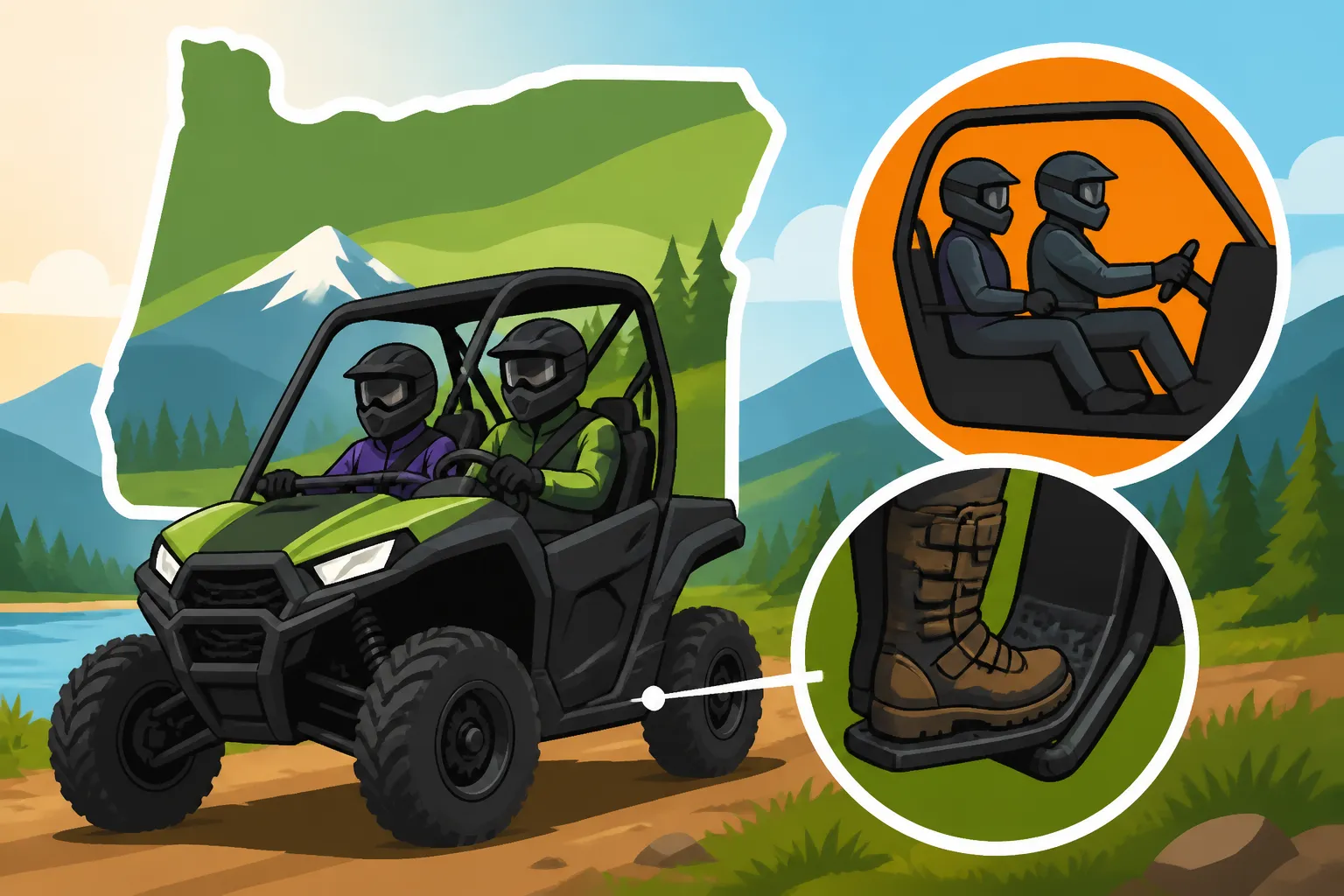
Unlike most quads, side-by-sides are inherently designed to carry multiple passengers, typically with bench seats or individual bucket seats. This design is what fundamentally differentiates them from most Class I ATVs in terms of passenger capacity. If your side-by-side has a bench seat, it's usually rated for two or three passengers, depending on its width and the manufacturer's specifications. Machines with individual bucket seats are designed for the exact number of seats provided, often two, four, or even six.
The critical aspect here is that these seating arrangements are part of the original factory design, complete with integrated floorboards or footwells for all occupants. This means passengers have a secure place for their feet within the vehicle's structure, enhancing their safety and stability. The enclosed cab (even if open-air) and roll cage also offer a level of protection not found on a traditional quad.
This design makes side-by-sides a popular choice for families and groups who want to explore Oregon's trails together. Whether you're headed to the dunes or tackling some of Tillamook State Forest's wider trails, a side-by-side allows for a more social riding experience.
Seatbelt and Restraint Requirements
One of the most significant safety features, and a mandatory requirement for all occupants in a side-by-side in Oregon, is the use of seatbelts. Every passenger and the operator must be properly secured with the manufacturer-installed seatbelt at all times while the machine is in operation. This is a non-negotiable safety rule and a crucial distinction from quads.
The seatbelt system is an integral part of the side-by-side's design to protect occupants in the event of a roll-over or impact. This includes children, who must be able to properly fit into the seatbelt system. If a child is too small for the factory seatbelt, alternative child restraint systems might be needed, provided they are securely installed and appropriate for the vehicle.
Neglecting to use seatbelts is not only incredibly dangerous but also a direct violation of Oregon's regulations, which can result in citations. Always ensure every person in your side-by-side is buckled up before starting your engine.
Capacity Limits and Manufacturer Guidelines
Even though side-by-sides are built for multiple passengers, they still have strict capacity limits. You can only carry as many passengers as the machine was originally designed for by the manufacturer. This capacity is typically determined by the number of designated seating positions, each equipped with a seatbelt. So, if your side-by-side has two bucket seats, you can carry one passenger. If it has a three-person bench seat, you can carry two passengers, and so on.
Overloading a side-by-side beyond its manufacturer's recommended capacity is extremely dangerous. It can compromise the machine's stability, braking performance, and handling, making it difficult to control, especially on challenging terrain. It also puts undue stress on the suspension and frame components, potentially leading to mechanical failure.
Always refer to your side-by-side's owner's manual for its exact passenger capacity and Gross Vehicle Weight Rating (GVWR). Adhering to these manufacturer guidelines is paramount for the safety of all occupants and for staying compliant with Oregon's regulations. When considering [Oregon's Class IV Side-by-Sides Under 75 Inches], remember that even within that class, capacity varies widely.
Off-Road Motorcycles (Class III) and Passengers
Off-road motorcycles, commonly known as dirt bikes, fall under Oregon's Class III ATV designation. When it comes to carrying passengers on these machines, the rules are much more restrictive, primarily due to the inherent design and operational characteristics of dirt bikes.
The 'No Passenger' Rule for Most Dirt Bikes
For the vast majority of Class III off-road motorcycles, the rule is simple and absolute: no passengers are allowed. Dirt bikes are explicitly designed for a single operator who uses their body weight, lean, and foot placement to control the bike over often extreme and unpredictable terrain. There is typically no designated passenger seat, nor are there any passenger foot pegs.
Attempting to carry a passenger on a single-rider dirt bike is incredibly dangerous. The passenger has no secure place to sit or rest their feet, making them highly unstable. Their presence severely hinders the operator's ability to balance, maneuver, and react quickly to obstacles or changes in terrain. This can easily lead to a loss of control, resulting in serious injury for both the operator and the passenger.
Oregon law aligns with this safety principle, making it generally illegal to carry a passenger on an off-road motorcycle unless it's a specific, rare model explicitly designed by the manufacturer for two riders. This is very uncommon in dedicated off-road machines.
Rare Exceptions: Dual-Sport Motorcycles
While rare, some motorcycles are manufactured as "dual-sport" bikes, meaning they are designed to be street-legal but also capable of off-road use. These machines may come equipped from the factory with a longer seat and passenger foot pegs, making them legally capable of carrying a passenger on public roads where allowed.
However, even if a dual-sport bike has passenger pegs, the context changes significantly when you take it off-road onto designated trails. Most off-road trails are designed for the agility and maneuverability of a single rider. Riding a dual-sport bike with a passenger on challenging dirt trails or singletrack can still be incredibly difficult and dangerous, even if the bike technically has the capacity. The suspension, tires, and overall handling characteristics might not be suitable for aggressive off-road riding with a second person.
If you plan to ride a dual-sport motorcycle with a passenger, you must ensure it is street-legal, properly registered (if required for road use), and that the passenger can safely use the designated footrests and handholds. Even then, exercise extreme caution and stick to very mild, well-maintained dirt roads rather than technical trails. For most genuine off-road experiences, [Class III Off-Road Motorcycles in Oregon] are strictly single-rider machines.
The Role of Foot Pegs and Footrests in Passenger Safety
When we talk about Oregon's passenger rules, foot pegs and footrests are not just minor details; they are fundamental safety components. Their presence, design, and proper use are critical for ensuring a passenger's well-being and contributing to the overall stability and control of the off-road vehicle.
Why Proper Foot Support is Critical
Imagine riding a bucking bronco without stirrups – that's essentially what a passenger experiences without proper foot support on an ATV or UTV. Foot pegs or floorboards provide a stable platform that allows the passenger to maintain their balance, absorb shocks from bumps, and shift their weight in coordination with the operator. This support is absolutely critical for several reasons:
First, it prevents the passenger's feet from dragging on the ground, which can lead to severe injuries, entanglement, or being pulled under the vehicle. Second, it gives the passenger a secure point of contact with the machine, allowing them to brace themselves during acceleration, braking, and turns. This significantly reduces the risk of being thrown off the machine unexpectedly. Third, proper foot support allows the passenger to remain independent of the operator's movements, preventing them from hindering the operator's ability to maintain control and maneuver the vehicle.
Without dedicated, secure footrests, a passenger is merely along for the ride, passively reacting to forces rather than actively participating in their own stability, which is a recipe for disaster on dynamic off-road terrain.
What Constitutes an Acceptable Footrest
An acceptable footrest, in the context of Oregon's passenger rule for ATVs and UTVs, goes beyond just "something to put your foot on." It must be a purpose-built component, integrated into the machine's design, that provides secure and stable support. For two-up quads, this means sturdy, non-slip foot pegs mounted directly to the frame, positioned far enough back and low enough for the passenger to maintain a comfortable and stable posture. They should be wide enough to provide good contact and prevent feet from slipping off easily.
For side-by-sides, acceptable footrests are typically integrated floorboards within the vehicle's cab or dedicated footwells. These provide a larger, enclosed area for passengers' feet, offering a higher degree of protection from debris and entanglement. They are designed to be robust, offering a solid point of contact for passengers to brace themselves against.
The key is that these are factory-designed and installed components, engineered to withstand the forces encountered during off-road operation with a passenger. They are not flimsy additions or improvised solutions. They are a core safety feature.
The Dangers of Improvised or Missing Foot Support
The dangers of improvised or missing foot support for a passenger cannot be overstated. When a passenger lacks proper footrests, a cascade of unsafe situations can occur:
- Injury from dragging feet: Without proper pegs, a passenger's feet can dangle, making them highly susceptible to being caught on obstacles, dragging on the ground, or even being pulled under the tires, leading to severe and often debilitating injuries.
- Loss of balance and control: The passenger's inability to brace themselves means they are more likely to shift unpredictably, throwing off the machine's balance. This directly impacts the operator's ability to steer and control the vehicle, especially on uneven ground or during maneuvers.
- Interference with operator: A passenger trying to find footing might inadvertently place their feet on the operator's foot pegs, restricting the operator's ability to use their own feet for balance and control. They might also instinctively grab or push on the operator, further hindering control.
- Increased fatigue and discomfort: Maintaining an unstable position for an extended period is exhausting and uncomfortable for the passenger, distracting them and making them less alert to potential hazards.
- Legal consequences: As discussed, riding without proper passenger accommodation is a violation of Oregon law. Beyond the immediate citation, it could lead to much more severe legal liability in the event of an accident, potentially impacting insurance claims and personal responsibility.
Investing in a machine that is purpose-built for multiple riders, or ensuring your single-rider machine is only used by one, is the best way to ensure everyone's safety and avoid these critical dangers. For robust, high-quality parts, many riders turn to brands like SuperATV for their machines, but remember that even the best aftermarket parts can't change the fundamental legal classification of a single-rider machine into a passenger-carrying one.
Consequences of Violating Oregon's Passenger Rules
Ignoring Oregon's rules about carrying passengers on ATVs and UTVs carries more than just abstract risks; there are tangible legal penalties and significant safety repercussions that every rider should be aware of. The authorities take these regulations seriously because they are directly tied to preventing serious injuries.
Legal Penalties for Unsafe Passenger Transport
Operating an ATV or UTV with an unauthorized or improperly carried passenger is a violation of Oregon law. If a ranger, local law enforcement, or an Oregon State Trooper observes you riding in violation of these rules, you can expect to be pulled over and issued a citation. This falls under the broader category of unsafe operation, and the penalties can include fines.
For example, riding an unpermitted ATV can lead to [Oregon's Class C Traffic Violation for No Permit], and similar violations exist for unsafe passenger practices. The exact cost of the fine can vary, but it's always an unwelcome expense that could have been easily avoided by adhering to the regulations. Beyond the fine, repeated violations or particularly egregious unsafe practices could lead to more severe consequences, including potentially having your riding privileges suspended or even your machine impounded in extreme cases.
Authorities are especially vigilant in popular riding areas like the Oregon Dunes or the Tillamook State Forest. They know these areas attract many riders, including families, and they are committed to ensuring everyone's safety.
Increased Risk of Injury and Liability
The most severe consequence of violating passenger rules is, without a doubt, the dramatically increased risk of injury or even fatality. As detailed previously, a passenger without proper seating and footrests is highly vulnerable to being thrown off, getting entangled, or suffering impacts that could be prevented. This risk extends to the operator, whose ability to control the machine is severely compromised.
Beyond the physical harm, there are significant liability implications. In the event of an accident involving an improperly carried passenger, you, as the operator, could face substantial civil lawsuits. Your insurance policy might even deny coverage if it's determined that the accident occurred while operating the machine illegally or unsafely. This means you could be personally responsible for medical bills, lost wages, and pain and suffering for the injured passenger, potentially leading to financial ruin.
Think about the long-term impact of a serious injury on a loved one, or the financial burden of a lawsuit. These are risks that far outweigh the fleeting desire to give someone a ride on a machine not designed for it. Always prioritize safety over convenience or a casual disregard for regulations.
The Ranger's Discretion at Staging Areas
It's important to understand that enforcement of Oregon's ATV and UTV rules often begins before you even hit the trail. Rangers and other officials are frequently present at staging areas like those at the Oregon Dunes National Recreation Area, Browns Camp in the Tillamook State Forest, or Millican Valley, performing checks.
During these checks, they're not just looking for [Decal Checks at Spinreel] or valid [Oregon ATV Permits Explained]; they are also visually inspecting machines for obvious safety violations, including improper passenger setups. If a ranger sees a child precariously perched on the fender of a single-rider quad, they will likely stop you before you even leave the staging area. Their goal at this point is often educational and preventative – to inform you of the rules and prevent an accident before it happens.
However, if you proceed to ride with an unauthorized passenger after being warned, or if the violation is severe, a citation is almost guaranteed. These proactive checks are a valuable opportunity to ask questions if you're unsure about a rule, but they also serve as a clear indicator that passenger safety is a high priority for Oregon's land managers.
Comparison of Oregon ATV/UTV Passenger Rules by Class
To summarize Oregon's varied passenger rules, here's a quick comparison by ATV class:
| ATV Class | Machine Type | Passenger Capacity (Manufacturer Design) | Required Passenger Foot Support | Other Key Requirements |
|---|---|---|---|---|
| Class I | Quads, ATVs | Varies: Mostly 1 operator (single-rider) | Dedicated, secure foot pegs for passenger (if designed for 2) | All riders under 18 must wear helmet |
| Some models are 2-up (1 operator + 1 passenger) | ||||
| Class II | Street-Legal ATVs | Varies by specific vehicle; usually 1 or 2 | Proper foot support for all occupants | Must be street-legal, registered, insured, helmets for under 18. |
| Class III | Off-Road Motorcycles | 1 operator (single-rider) | Extremely rare; generally none (unless dual-sport) | Generally no passengers allowed off-road. All riders under 18 must wear helmet. |
| Class IV | Side-by-Sides, UTVs | Multiple passengers (typically 2-6) | Integrated floorboards/footwells for all occupants | All occupants must wear seatbelts; all riders under 18 must wear helmet. |
Disclaimer
This article is for general informational purposes only and does not constitute professional advice. Laws, prices and regulations vary by location and change over time. Consult a qualified professional for guidance on your specific situation.