Oregon Rules for Riding a Farm Access Road
Navigating the rules for riding your ATV or UTV on farm access roads in Oregon can feel like trying to find a clear path through a dense forest. On one hand, you rely on these machines for essential work, moving feed, checking fences, or just getting around your property efficiently. On the other, Oregon has specific — and sometimes complex — regulations for off-highway vehicles (OHVs), and it’s not always obvious where private farm use ends and public road rules begin. The last thing any farmer or rancher wants is a citation for simply trying to get work done, or worse, to inadvertently put themselves or others at risk. This guide is here to untangle that knot, clarifying exactly what you need to know to operate your ATV or UTV legally and safely on farm access roads across the Beaver State.
The Basics: Does a Farm Machine Need an Oregon Permit?
This is often the very first question that pops up, and it's a critical one because it sets the foundation for almost everything else. Many assume that if a machine is primarily used for work on a farm, it's automatically exempt from recreational vehicle rules. While there's a kernel of truth to that, the devil, as they say, is in the details – specifically, whether that "farm access road" is truly and exclusively private.
Private Land Versus Public Access
Let's break down the fundamental difference right away. If your farm access road is genuinely, unequivocally 100% private land, meaning it's entirely within your property lines, has no public easements, and doesn't connect to or cross any public roads, then generally speaking, your ATV or UTV used solely on that private stretch does not require an [Oregon's ATV Operating Permit]. This is often the case for interior farm tracks that never leave your property boundary.
However, this "private land loophole" is often misunderstood. Many farms, even large ones, have roads that intersect with county roads, cross state highways, or utilize easements that grant public access to others. Perhaps your property is split by a county road, and you need to cross it to get from one field to another. Or maybe a timber company has an easement across your back forty, and while you maintain the road, it's technically open for their access, which can sometimes extend to public use. In these scenarios, even if the primary use is agricultural, the moment your wheels touch a public right-of-way or a road with public access, Oregon's OHV rules kick in. This is a common point of frustration, as what feels like a private road to you might legally be considered public.
Oregon's ATV Operating Permit Explained
So, what exactly is Oregon's ATV Operating Permit, and why is it so important? This permit is essentially Oregon's way of ensuring that off-highway vehicles contribute to the maintenance and development of riding areas and trails throughout the state. It's not a registration like a car, but an operating permit that indicates your machine is cleared for use on designated public lands and roads where OHVs are permitted. You can learn more about its purpose in [Where Oregon Sells ATV Permits].
The crucial point here for farm access roads is that if your machine will, at any point, leave your strictly private property and enter a public road, even a gravel county road that feels remote, or cross a state highway, it must have an [Oregon ATV Operating Permit]. This isn't just about riding for fun; it applies to utility use as well. The state isn't asking if you're hauling hay or joyriding; it's asking if you're on public land. The money from these permits, as detailed in [Where Oregon ATV Permit Money Goes], supports a wide range of programs beneficial to riders, but the requirement itself can be an unexpected cost for farmers who mostly operate on their own land. Make sure you understand [Oregon ATV Permit Cost] so you're not caught off guard.
Riding on Public Roads That Access Farm Land
Now, let's talk about the more common scenario: your farm uses roads that are technically public, even if they mostly serve your property. This is where Oregon's OHV rules become particularly relevant, and it's easy to run afoul of them if you're not aware of the specifics.
Designated Highway Access Routes and Their Limitations
Oregon has a very limited number of "designated highway access routes" where certain street-legal OHVs can operate on paved public roads to connect trail systems or access town services. These are typically found in specific recreational areas like [Lakeside and Sumpter: Oregon's Only Two Routes]. It's vital to understand that these routes are rare, highly specific, and almost certainly not the paved county road that leads to your farm or divides your property.
Most farm access roads, even if they're paved, will not fall under these designated routes. These special routes are established through a lengthy process involving local government and the Oregon Transportation Commission, primarily for recreational tourism, not general agricultural use. Therefore, don't assume that because your utility task vehicle (UTV) has turn signals and a windshield, it automatically qualifies for road use on any paved road connecting your farm. For a comprehensive overview, see [Oregon's Only Two Designated ATV Routes: Lakeside and Sumpter].
County and Forest Roads: The Common Scenario
This is the most likely category for many farm access roads. Many farms are accessed via gravel county roads or even Forest Service roads. These roads, while often remote and primarily used by local landowners or timber operations, are still public rights-of-way. Oregon law allows counties to open certain roads to OHV use through local ordinances. At the time of this writing, six counties have opened some of their roads, but it's not a blanket allowance. You must know if the specific county road you're using has been opened for OHV traffic and under what conditions. [Oregon Rules for Riding a County Gravel Road] provides more detail.
If the farm access road you're using is a public county or Forest Service road, even if it feels like your private driveway, you generally need to adhere to the full suite of Oregon's OHV regulations. This means your machine needs an [Oregon's ATV Operating Permit], and the operator often needs an [Oregon ATV Safety Card]. Furthermore, your machine must meet specific class requirements. For instance, a Class I ATV (quad) might be allowed where a wider Class IV side-by-side isn't, or vice-versa, depending on the road's designation and county ordinances. Always check with the local county sheriff's office or the land management agency (e.g., Forest Service, BLM) for the most current information regarding roads in your area. You can find detailed explanations of these categories in [Oregon's Four ATV Classes Explained].
For those instances where you do need to use a public road, even if it's just for a short distance, ensuring your UTV is equipped for safety and visibility is smart. While it may not make it "street legal" if the road isn't designated, adding features like better mirrors, or even aftermarket turn signals, can improve awareness for you and other drivers. Companies like SuperATV offer a wide range of accessories that can enhance the safety profile of your machine, though you'll always need to ensure compliance with Oregon's specific road rules.
Crossing Public Highways and Paved Roads
Perhaps the most common, and potentially hazardous, situation for farmers using ATVs or UTVs is needing to cross a state highway or other paved public road to access different parts of their property. Oregon has very strict rules for these crossings, and they apply regardless of your machine's primary use or whether you're "just crossing."
You generally cannot ride along a paved highway. Crossings must be made at a right angle (as close to 90 degrees as possible) to the highway, and only after coming to a complete stop and yielding to all traffic. You must have clear sight lines in both directions to ensure it is safe to proceed. This isn't just a recommendation; it's a legal requirement designed to prevent serious accidents. [Oregon Rules for Crossing a State Highway] goes into much greater detail on these specifics. It's paramount to exercise extreme caution, especially when dealing with high-speed traffic. Even if you're in a hurry to get to the back forty, a moment of impatience can have severe consequences.
Specific Equipment and Rider Requirements for Farm Access
Beyond the general permit questions, Oregon has specific requirements for the machine itself and the person operating it, especially when venturing onto public access roads. These are not optional and are enforced by law enforcement and land managers.
Permit, Safety Card, and Machine Class
As we've discussed, if your farm access road touches public land, the machine generally needs an [Oregon's ATV Operating Permit]. But that's not the only piece of paper. The operator of the ATV or UTV also needs an [Oregon ATV Safety Card] unless they meet specific exemptions (like having a valid driver's license for an OHV with a steering wheel and seat belts, or being over 18 and riding a Class II/IV). For youth riders, the safety card is almost always mandatory. You can get more information on safety card requirements from [Oregon ATV Safety Card Requirements]. This means that if your son or daughter is helping out on the farm and needs to ride an ATV across a county road, they'll need that card.
The machine's classification is also vital. Oregon defines ATVs into four classes: Class I (quads, under 50 inches wide), Class II (larger off-road vehicles like Jeeps or sand rails that might be street-legal with specific modifications), Class III (off-road motorcycles), and Class IV (side-by-sides, up to 75 inches wide). The rules for road access can differ significantly between these classes. For example, a Class I quad typically has very limited road access compared to a Class IV side-by-side, even if both are permitted. Understanding [Which Oregon ATV Class Your Machine Falls Into] is crucial for compliance. For heavy-duty farm tasks, many farmers opt for UTVs, which typically fall into Class IV. While these machines offer incredible utility, it's still your responsibility to ensure they meet public road access rules. Companies like SuperATV offer heavy-duty axles and lift kits for UTVs, which are fantastic for navigating rough farm terrain, but ensure any modifications don't push your machine beyond the legal width or weight limits for the specific roads you plan to use.
Lighting, Spark Arresters, and Sound Limits
These are non-negotiable requirements for any OHV operating on public lands or roads in Oregon.
- Lighting: If you're operating between sunset and sunrise, or during periods of reduced visibility (like heavy fog or rain), your ATV or UTV must have a working headlight that projects at least 50 feet and a taillight visible from at least 500 feet. A functional brake light is also typically required. Even if you're "just running to the back field," if it's getting dark and that field requires a public road crossing, your lights need to be on and working.
- Spark Arresters: This is a huge one in Oregon, especially with our dry summers and fire seasons. Every OHV operating on public land or roads must be equipped with a U.S. Forest Service-approved spark arrester that is in good working order. These devices prevent hot carbon particles from escaping your exhaust and potentially igniting a wildfire. Operating without one, or with a modified/defective one, is a serious violation and can lead to significant fines. You can find more specific rules in [Oregon Spark Arrester Requirement].
- Sound Limits: Oregon also has sound limits for OHVs. While it might seem less relevant for a work machine, if your farm access road is public, a loud aftermarket exhaust could draw unwanted attention and potentially result in a citation. Ensure your machine, even if it's a powerful utility model, stays within legal sound limits.
Helmets and Passenger Rules
Oregon's helmet law is straightforward: any rider or passenger under the age of 18 must wear a DOT-approved helmet. This applies on private land and public land alike. For riders and passengers 18 and over, helmets are generally recommended for safety, but not strictly mandated unless riding a Class I or Class III machine on a public road, or if the specific county ordinance requires it.
Passenger rules are also critical. A Class I quad is typically designed for a single operator unless it's specifically manufactured and labeled for two riders. Trying to carry a passenger on a single-rider quad, especially a child, is extremely dangerous and illegal on public roads. Side-by-sides (Class IV) typically accommodate passengers safely, but everyone must have a proper seat and seatbelt. For all the details, check [Oregon Passenger Rules on a Quad] and [Oregon Passenger Rules in a Side-by-Side]. Even if your kids are "just riding with dad" to check cattle, if it involves a public road, these rules must be followed.
Protecting Your Farm and Your Rights: Best Practices
Beyond simply complying with the law, there are proactive steps you can take as a landowner to manage access and clarify the status of your farm roads, potentially avoiding misunderstandings and citations.
Posting and Private Land Management
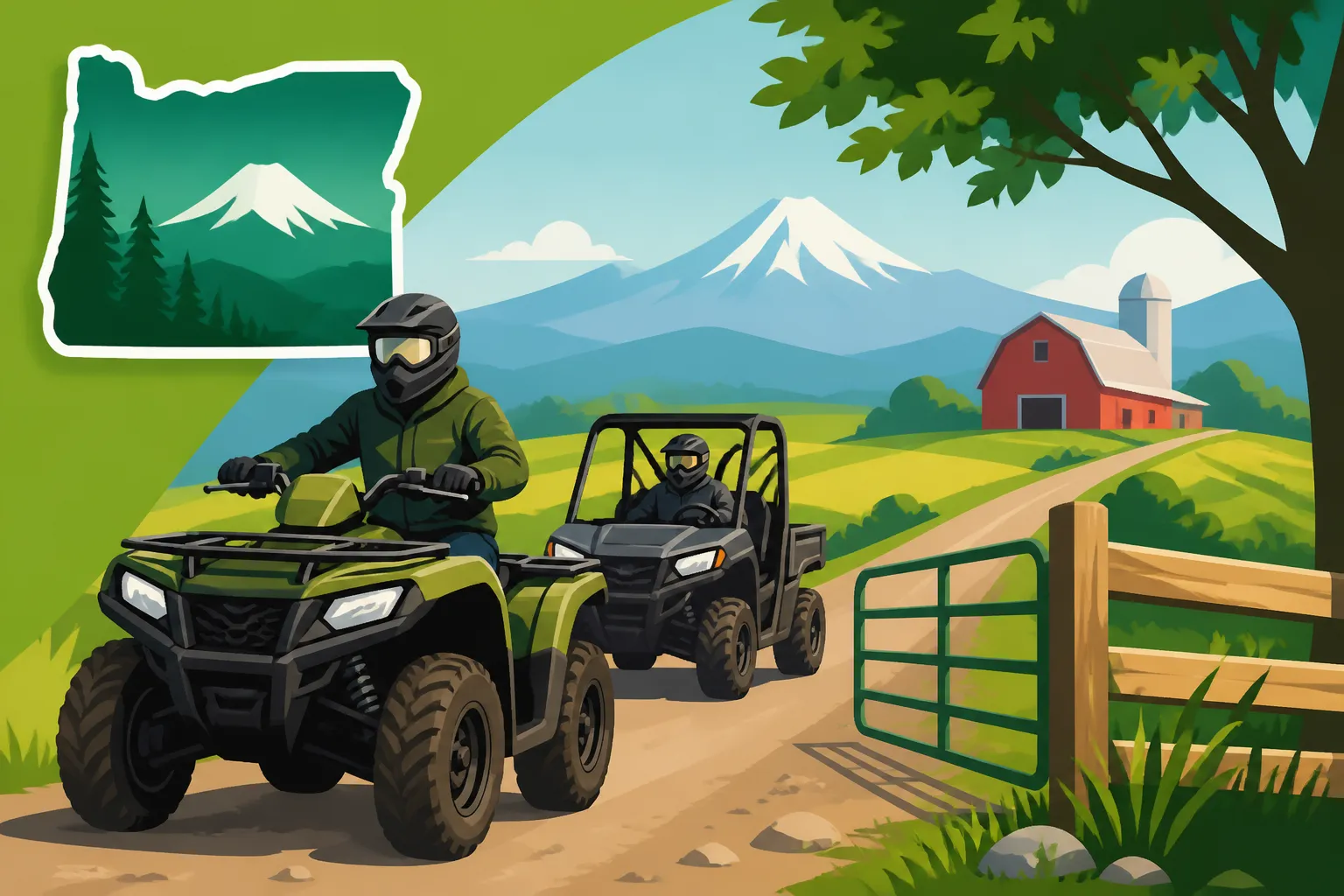
If your farm has internal roads that you genuinely want to keep private and free from public OHV regulations, the clearest way to do so is to mark them unequivocally as private. Posting "No Trespassing" signs frequently and clearly visible at all entry points to these private roads is essential. Using gates, even if they're often left open for your convenience, can also help establish the private nature of the road.
The goal here is to remove any ambiguity. If a road looks like a public access road, people (including law enforcement) might treat it as such. By clearly delineating your private property and private roads, you reinforce that the rules about permits, safety cards, and other OHV regulations do not apply to machines used solely within those boundaries. This doesn't mean you can ignore safety, but it clarifies the legal framework.
Understanding Easements and Shared Access
Many farm access roads are not exclusively private, even if they're on your deed. They might be subject to easements, which grant others (like utility companies, neighbors, or even the public for specific purposes) the legal right to use a portion of your land. If your farm road sits on an easement that grants public access, or shared access with multiple property owners, it might fall under public road regulations, even if you primarily maintain it.
It's highly advisable to review your property deeds and discuss any easements with your local county planning department or a legal professional. Understanding the precise legal status of your farm roads can prevent future headaches. What you perceive as "your" private road might, from a legal standpoint, be considered a shared or public access point, which then triggers the need for permits and safety cards as outlined in [Oregon Rules for Agricultural Road Use].
The Importance of Documentation and Local Knowledge
When operating an ATV or UTV on any road that might be considered public, even a farm access road, always carry your [Oregon's ATV Operating Permit] card and your [Oregon ATV Safety Card] (or driver's license if it serves as an exemption). Keep them in a waterproof pouch on your machine or on your person. When a ranger or county sheriff pulls you over, having your documentation readily available can make the stop much smoother.
Beyond personal documentation, it's incredibly helpful to have local knowledge. What are the specific ordinances in your county regarding OHV use on county roads? Are there any peculiar rules about forest roads in your area? A quick, friendly call to the local Oregon Parks and Recreation Department (OPRD) office or the county sheriff's department can provide invaluable, up-to-date information specific to your location. This proactive step can save you from inadvertently receiving a citation, which, as detailed in [Oregon Fines for Riding Without a Permit], can be costly. Knowing the rules and having the papers to prove you're following them is the best defense.
Here’s a quick overview of key rules for different types of farm access roads in Oregon:
| Feature/Requirement | Strictly Private Farm Road (No Public Access) | Public County/Forest Farm Access Road | Crossing a Paved Public Highway |
|---|---|---|---|
| Oregon OHV Permit | Not required | Required | Required |
| Oregon Safety Card | Not required | Required (with exemptions) | Required (with exemptions) |
| Helmet (Adult) | Recommended | Often Required (Class I/III) | Often Required (Class I/III) |
| Helmet (Under 18) | Required | Required | Required |
| Spark Arrester | Recommended (fire safety) | Required | Required |
| Lights (Dusk/Dawn) | Recommended | Required | Required |
| Right-Angle Crossing | N/A | N/A | Required |
| Yield to Traffic | N/A | N/A | Required |
| Passenger Rules | Recommended (safety) | Required | Required |
Disclaimer
This article is for general informational purposes only and does not constitute professional advice. Laws, prices and regulations vary by location and change over time. Consult a qualified professional for guidance on your specific situation.