Spinreel and Hauser on the Oregon Coast
Spinreel and Hauser are two familiar access points for riding the Oregon Coast dunes, but choosing where to unload is only part of the plan. You also need to understand how the staging areas relate to the riding terrain, what rules and fees may apply, and how sand, crowds, and changing closures can affect your day. This guide helps you plan a safer, less stressful visit.
Understanding Spinreel and Hauser
Where the staging areas fit
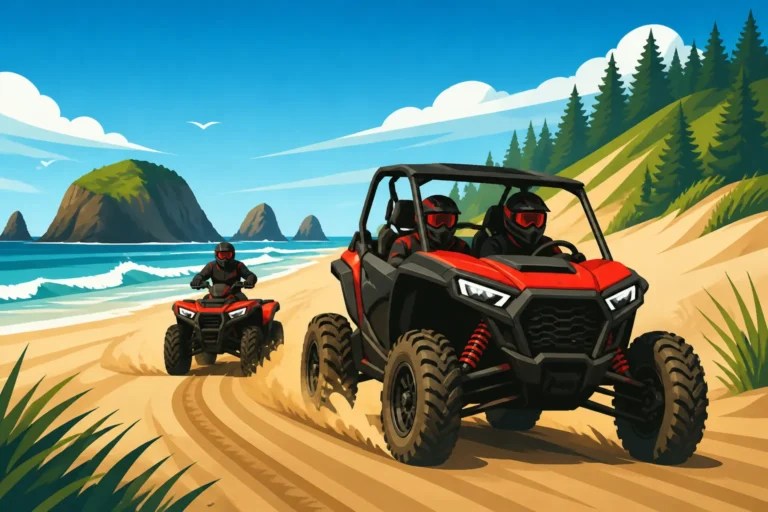
Spinreel and Hauser provide access to the larger Oregon Dunes riding area, a coastal landscape of shifting sand, forest edges, and designated recreation zones. They are not two separate little tracks with fixed boundaries. Once you leave a staging area, the ride may take you across open-looking terrain where navigation, land-use rules, and posted closures still matter.
In broad terms, Spinreel is associated with riding around the southern portion of the North Bend area, while Hauser provides access farther north. The two are close enough that a map can make them look interchangeable, especially when you are planning from home. On the ground, though, your chosen staging point affects where you begin, how you organize your group, and how much you may need to travel before reaching the kind of terrain you want.
Think of the staging area as your ride’s starting point, not a guarantee that every nearby stretch of sand is open to motorized use. Boundaries and closures can shape which routes are available, and conditions may change. Before unloading, check the signs at the site and consult current land-manager information. For a wider overview of the area, [The Oregon Dunes National Recreation Area](The Oregon Dunes National Recreation Area) and [Oregon Dunes Staging Areas From North to South](Oregon Dunes Staging Areas From North to South) offer useful related reading.
Choosing a starting point for your group
The best starting point depends less on which name sounds familiar and more on your group’s needs. A family hauling several machines may care most about straightforward trailer access and a calm place to get everyone’s helmets and gear sorted. A group of experienced riders may prioritize the direction they want to explore, how they’ll keep in contact, and whether their route plan matches the day’s access conditions.
It also helps to think about the day beyond the ride itself. Where will your group meet if someone arrives late? What happens if a machine needs attention before you reach the sand? Is everyone comfortable unloading in a busy lot? Those practical details can prevent the familiar scramble of trying to find each other while engines are running and other vehicles are maneuvering around trailers.
If you are choosing between the two and have not visited either, compare the route from your lodging or campsite, the size and needs of your group, and the information posted for each area. Don’t assume that a spot you used on a previous trip is available in the same way today. The [Oregon Dune Riding Areas Compared](Oregon Dune Riding Areas Compared) guide can help put these access points in the context of other coastal riding options.
What the staging area does not tell you
A staging area is a place to prepare and access a recreation area; it is not a blanket permission to ride everywhere you can see. A dune ridge, open-looking flat, forest road, or beach entrance may be subject to a different rule from the trail or sand you just crossed. Stay alert for signs, barriers, marked habitat, and changes in the route.
That distinction is especially important when a group is following someone who knows the area. Familiarity is helpful, but it does not replace checking for closures or confirming that a route remains open. A trail that was passable on a previous visit may be affected by seasonal protections, maintenance, weather, or land-management decisions.
Before you start, agree that riders will stop when the group encounters a confusing sign or an uncertain boundary. It is much easier to check a map together than to untangle a wrong turn after the group has spread out. For information about site fees, see [Paying the Day Use Fee at a Staging Area](Paying the Day Use Fee at a Staging Area); a day-use payment and an ATV operating permit are separate considerations.
Planning your route and navigating the dunes
Start with a realistic ride plan
A good dune plan gives the group direction without pretending you can predict every turn. Decide whether you want a shorter exploratory ride, a longer loop, or a route that stays near a familiar return point. For a mixed-ability group, plan around the least experienced rider rather than the person most eager to cover ground.
Choose a regrouping habit before anyone starts the engine. For example, riders can stop at agreed intersections or prominent landmarks and wait for the full group before moving on. Set a simple rule for separation: if someone loses sight of the group, they stop somewhere safe rather than guessing which direction everyone went. That small agreement can keep a minor navigation hiccup from becoming a stressful search.
Tell someone who is not riding where you plan to go and when you expect to return. Carry a charged phone, but do not depend on continuous cell service in a large outdoor recreation area. Paper or offline navigation can be useful backups. The article [Oregon Trail Maps Worth Carrying](Oregon Trail Maps Worth Carrying) covers the value of having a map available when a screen, signal, or battery becomes unreliable.
Use maps as one part of navigation
A map can help you understand the shape of the riding area, identify access points, and keep your intended route in view. It cannot always show you the latest on-the-ground condition. Pair your map with official notices and signs at the staging area, and treat a posted closure as controlling even if a digital map appears to show a route continuing through it.
Some riders use an app such as onX Offroad to review routes and terrain before arriving. It can be a helpful planning aid, especially when you download relevant information in advance rather than assuming you will have a signal at the dunes. Still, no app should be treated as permission to ride across land that is closed, restricted, or not designated for motorized use.
A useful routine is to look at the map at home, check the latest area information before the drive, then confirm your starting point and any visible restrictions once you arrive. If the route on your screen conflicts with a sign, stop and resolve the discrepancy before continuing. You can also read [Riding Out of Spinreel Staging](Riding Out of Spinreel Staging) for more focused route-planning context.
Navigate for changing sand and visibility
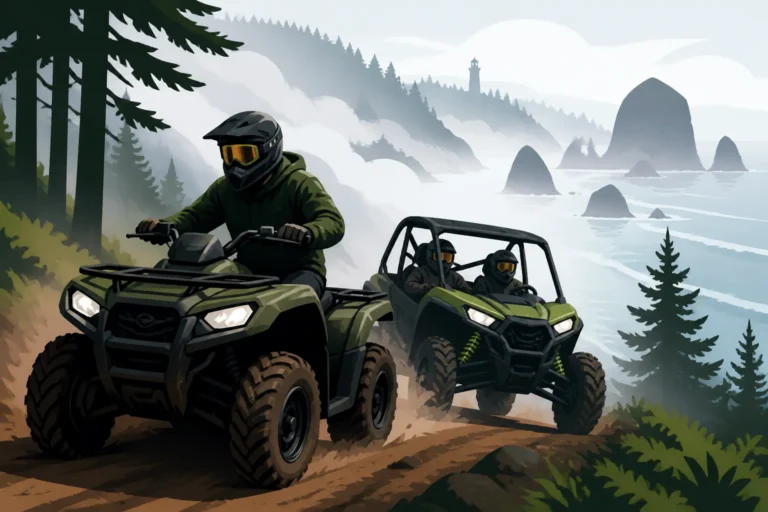
Dunes are not a paved trail system. Wind can reshape the surface, and familiar-looking terrain may be harder to recognize when you are riding from a different direction. Even a route that seems simple on a clear afternoon can feel less obvious in coastal fog, blowing sand, or low light.
Give yourself room to slow down when visibility changes. Avoid cresting a dune at speed if you cannot see what is on the other side, and do not assume another rider will be able to stop in time if you suddenly change direction. Keep a safe gap between machines, particularly when the sand is loose or a rider is climbing.
A flag helps other riders see your machine over rises and around terrain, but it does not replace cautious speed or keeping to the right side of shared routes where appropriate. Check local requirements for flag equipment and placement before riding. The related guide [Oregon Dune Flags and Whips](Oregon Dune Flags and Whips) explains why visibility gear deserves attention on a dune ride.
Comparing Spinreel and Hauser for a day out
A practical comparison
There is no universal winner between Spinreel and Hauser. The right choice comes down to the access point that fits your route, group, and current conditions. The table below is a planning aid, not a claim that one staging area is always quieter, easier, or more suitable.
| Planning question | Spinreel | Hauser |
|---|---|---|
| What should guide your choice? | Whether its access point fits the part of the dunes you plan to explore | Whether its access point fits your intended route and day’s conditions |
| What should you check before arrival? | Current access information, posted restrictions, and any applicable site requirements | Current access information, posted restrictions, and any applicable site requirements |
| What should a group plan in advance? | Meeting point, unloading routine, regrouping spots, and return plan | Meeting point, unloading routine, regrouping spots, and return plan |
| What should not be assumed? | That nearby sand is all open or that yesterday’s route remains available | That nearby sand is all open or that yesterday’s route remains available |
If your group has a specific destination in mind, choose the staging point that makes sense for the route you have confirmed—not simply the one that appears closest on a broad map. If you do not have a fixed destination, compare the access information and choose the site that allows your group to start calmly and stay together.
It is also worth considering what happens if your first plan changes. A closure, crowded lot, or equipment issue may call for a different approach. Have a backup plan that does not involve pushing past a barrier or assuming you can ride between areas without checking whether the connecting route is open and permitted.
Busy-day preparation
On a busy weekend, arriving with a plan matters. Know who is driving each tow vehicle, where your group will meet, and who is responsible for checking that machines are properly secured before the trailer moves. Once you reach the staging area, give yourself enough time to unload without rushing or blocking another group’s setup.
A simple pre-ride check can catch problems while you are still near your vehicle. Confirm that everyone has the right protective gear, the machines are fueled and ready, and essential items are secured. Make sure younger or less-experienced riders understand the group’s signals and what to do if they become separated. A quick conversation in the lot is easier than trying to explain the plan over engine noise.
Crowded conditions also call for patience. Give other drivers room to turn and back trailers, and avoid leaving gear spread across shared space. If your preferred staging point is too congested for your group to prepare safely, pause and reassess rather than trying to force a hurried departure. The specific guide [Hauser Staging on a Busy Weekend](Hauser Staging on a Busy Weekend) offers more context for planning around a high-traffic visit.
Think beyond the riding route
The day’s logistics include more than the time spent on the dunes. Consider where you will park, whether your vehicle and trailer will remain at the staging area, and how you will handle a late return. Keep keys, permits, documents, and phones somewhere secure and accessible without leaving them exposed to sand or moisture.
If your plans include moving between locations, verify the route and parking arrangements ahead of time. Do not assume you can use a nearby road or access point just because it connects on a consumer map. Road access can have separate rules from off-highway riding areas, and a route may cross land with its own restrictions.
Finally, plan a little buffer into the day. Sand riding can take longer than expected, especially when a rider needs help or the group stops to regroup. Returning with enough daylight to load carefully is better than rushing through the final checks when everyone is tired.
Rules, permits, and site requirements
Separate operating permits from site fees
A common source of confusion is the difference between an operating permit for a machine and a day-use fee or pass for a location. One does not automatically cover the other. Before leaving home, confirm what your machine needs to operate on the public riding area and what the staging site requires for parking or day use.
Requirements can depend on the machine, where it is registered, and the kind of land you are entering. Visitors should not assume that a permit or sticker from another state is automatically accepted for every ride or every length of stay. Check the applicable Oregon requirements and the rules for the specific recreation area.
Keep any required permit information with the machine and make sure required decals are mounted where they can be seen and remain readable. A decal that has peeled, is covered in grime, or is stuck in a place that is hard to inspect can create avoidable questions. Related resources include [Oregon ATV Permits Explained](Oregon ATV Permits Explained) and [Oregon Day Use Fees Explained](Oregon Day Use Fees Explained).
Confirm rider education and equipment rules
Rider education requirements can depend on factors such as the machine class and the rider’s age or circumstances. Do not rely on a friend’s recollection of what applied to them; check the rules for each person in your group. If you are bringing a youth rider, make sure the adult supervision plan and equipment match the rider’s experience and the machine they will use.
Protective equipment matters even when the trip is short. A properly fitted helmet, eye protection, gloves, sturdy clothing, and footwear can make a difficult moment less likely to turn into an injury. For a side-by-side, make sure each passenger understands how to use the seat belt and remains seated while the machine is moving.
Noise and equipment standards may also apply to off-highway vehicles. Check the current requirements for your machine and the riding area rather than assuming that a part is acceptable because it came with the vehicle or was installed by a shop. For a closer look at rider education, see [Oregon's ATV Safety Education Card](Oregon's ATV Safety Education Card).
Respect closures and sensitive areas
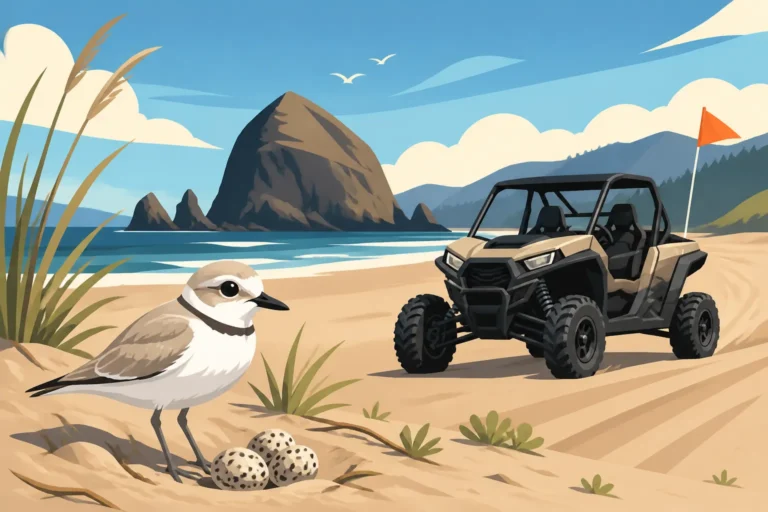
Coastal riding areas can include seasonal protections and habitat closures. These restrictions may be marked with signs, fencing, or other indicators, and they can affect where you can ride or cross. Avoid riding around a barrier or through an area that appears closed, even if the sand beyond it looks like a convenient route.
Take special care when a group is moving across open terrain. One rider’s shortcut can lead several others into the same restricted area before anyone realizes what has happened. When in doubt, stop and check the boundary rather than following tracks in the sand. Tire marks are not proof that a route is open.
Closures are part of responsible riding, not an inconvenience to negotiate around. They protect places and resources that share the coast with recreation, and ignoring them can result in a citation or make access harder for everyone. Review posted notices shortly before the trip and again when you arrive, since conditions and restrictions may change.
Making the ride safer and more enjoyable
Prepare for coastal conditions
Coastal weather can shift quickly. Fog may reduce visibility, wind can blow sand across open areas, and damp conditions can change how the surface feels under your tires. Check the forecast and bring layers rather than assuming a sunny start will last all day. Protect phones, maps, and other small gear from moisture and grit.
Sand also places a different kind of demand on a machine than a familiar road or packed trail. Follow your manufacturer’s guidance for operating and maintaining the vehicle, and avoid making adjustments based solely on a tip from someone you just met in the parking lot. If you are unsure how your machine will respond in soft terrain, begin cautiously and stay within your ability.
Coastal riding can be tiring even when the ride is going well. Bring drinking water and a small first-aid kit, and take breaks before riders become exhausted. A tired driver is more likely to miss a sign, misjudge a dune, or forget the group’s agreed route.
Ride with clear group habits
Before heading out, choose a lead rider and a sweep rider if your group is large enough. The lead can set a manageable pace and watch for route changes; the sweep can help ensure that no one is left behind. Keep the group small enough that riders can communicate and make decisions without confusion.
Agree on a few simple hand signals or stop points. If someone needs to pause, the group should know whether to wait together or move to a pre-agreed safe location. Avoid pressuring a beginner to keep up with a faster rider. Splitting by experience can work only if each subgroup has a capable leader and a clear way to meet again.
Give other riders plenty of space, especially near staging routes, blind rises, and busy sand corridors. Don’t follow so closely that you cannot react to a sudden stop or a machine losing traction. Courtesy is practical safety: predictable riding makes the dunes easier to share.
Leave the area ready for the next visit
At the end of the ride, take time to check your machine and gear before loading. Sand can hide small problems, and a loose item may be easy to miss when everyone is eager to head back. Secure equipment, check that your group is accounted for, and leave the staging area tidy.
If you notice a damaged sign, a blocked access point, or a hazard that may affect other riders, use the appropriate land-manager reporting channel. Do not try to move a barrier or mark a route yourself. Your report may help the responsible agency respond while keeping official signs and boundaries intact.
A well-planned trip to Spinreel or Hauser is not about squeezing in the maximum number of miles. It is about choosing an appropriate access point, checking what is open, riding within your group’s ability, and returning with everyone and every machine in good shape.
Disclaimer
This article is for general informational purposes only and does not constitute professional advice. Laws, prices and regulations vary by location and change over time. Consult a qualified professional for guidance on your specific situation.