The Night Curfew on Oregon’s Middle Riding Area
The 10:30 p.m. curfew in Oregon’s Middle Riding Area can catch people off guard, especially when a sunset ride, slow return across soft sand, or a late start pushes the schedule back. This guide explains what the curfew means, how to plan a ride around it, and what to check before heading out so you are not still riding when the cutoff arrives.
What the Middle Riding Area curfew means
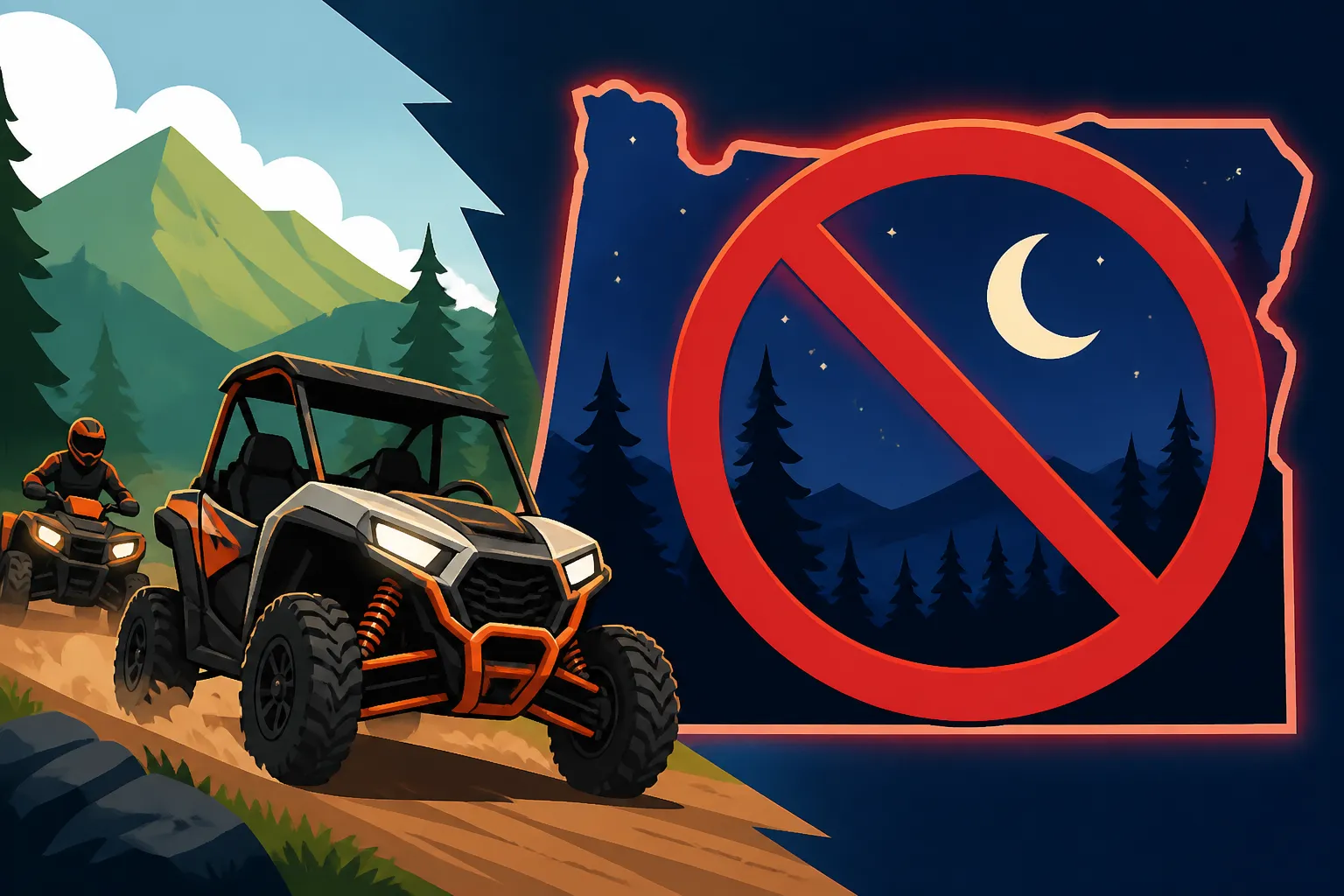
Treat 10:30 p.m. as a ride-ending deadline
The curfew means you should be off the riding area before 10:30 p.m. It is not a good idea to interpret the time as a reminder to begin heading toward the staging area. Dune travel can be slower than expected, and the route back may take longer when visibility is poor, the sand is soft, or you need to help another rider.
For a practical plan, work backward from the deadline. If it could take you 30 minutes to return from the farthest point you expect to visit, plan to turn around with enough time to cover that distance and handle a delay. A stuck machine, a wrong turn, or a group member who needs a break can quickly use up the margin you thought you had.
This is especially worth remembering on a relaxed evening outing. Riders may check the time when they are near the staging area and assume they have plenty of room for one more run. But the distance between “one more run” and a safe exit can be hard to judge on dunes. Set a group-wide turnaround time before unloading, and treat it as firm rather than optional.
A curfew is not permission to ride elsewhere after the cutoff
The Middle Riding Area curfew applies to riding in that area. It should not be read as permission to continue riding somewhere nearby once the cutoff passes. Another zone, access road, or trail may have separate operating hours, seasonal restrictions, or closures. A route that appears open on one map may also have a different status on a posted sign.
Keep these distinctions in mind:
| Question | Practical approach |
|---|---|
| What time should we be off the Middle Riding Area? | Plan to be out before 10:30 p.m. |
| Can we begin returning at 10:30 p.m.? | Do not plan on that. Build in time to exit before the deadline. |
| Does the curfew apply to every dune area? | Do not assume so. Check the rules and signs for the specific area. |
| Does a map replace a posted closure notice? | No. Follow current signs and directions from the land manager. |
| Can we keep riding on a nearby route? | Only if that route is separately open to your machine and riding is allowed there. |
The [The 10:30 p.m. Dune Curfew Means] guide is a useful companion if you want to focus on the meaning of the cutoff itself. For a broader orientation to the coastline’s riding zones, also review [The Oregon Dunes National Recreation Area] and [Oregon Dunes Staging Areas From North to South]. Those topics can help you understand why checking the specific riding area matters rather than assuming that rules are uniform across the entire coast.
Why the cutoff matters on a dune ride
Darkness changes the ride, even when you know the area
Dunes can look familiar in daylight and feel entirely different after dark. The shape of a ridge may be difficult to read, shadows can hide abrupt changes in the sand, and a familiar landmark may no longer be easy to identify. Headlights help you see what is immediately ahead, but they do not necessarily give you a clear view of every slope, dip, or machine approaching from another direction.
Visibility is not the only challenge. Night riding can make it harder for a group to stay together and easier for one rider to miss a turn or follow the wrong track. A small delay can become a search problem when people are spread out and cannot see one another clearly. Anyone who has watched a group become separated in daylight knows how stressful that can be; darkness adds another layer of uncertainty.
The cutoff also helps riders plan around conditions and impacts in the area. Rules can be tied to site management, wildlife, public safety, or other local considerations. You do not need to know the reason behind every restriction to follow it. If a posted notice sets an operating limit, plan your ride around that limit and check for other area-specific restrictions before entering.
Sound, dust, and other riders deserve extra consideration
A busy riding area can be noisy and dusty even before dark. At night, a machine approaching over a ridge may be difficult to see until it is close, and its sound may be the first warning another rider gets. Dust kicked up by a group can also linger, reducing visibility for people following behind. Keeping speeds controlled and giving others room matters at any hour, but it becomes even more important when light is fading.
Riders who are camping or staying near an access point may be trying to rest while others are finishing their day. A curfew helps provide a clear boundary between active riding and the quieter part of the evening. It also reduces the temptation to keep making repeated passes when people nearby may be expecting the area to settle down.
The best approach is to avoid treating a quiet or apparently empty stretch as evidence that riding is allowed. A lack of other machines does not cancel a time restriction. If you are unsure whether a particular section is included, pause and check official signs, area information, or directions from the relevant land manager before continuing.
Plan a ride that ends before 10:30 p.m.
Choose a turnaround time before you unload
A useful plan starts with the return journey, not with the first run out onto the sand. Estimate how far the group intends to travel, where the slowest rider may need to stop, and how long it could take to get back. The person with the least experience, the machine with the least range, or the rider who needs the most frequent breaks should shape the pace for everyone.
For example, imagine your group wants to explore a distant section before heading back to a staging area. One rider has not been to the area before, and another is using a machine that handles soft sand differently from the rest of the group. Rather than relying on the fastest rider’s estimate, agree on a conservative turnaround time that leaves room for the whole group to return together.
Build in a buffer for ordinary problems. A loose strap, a dropped item, a navigation check, or a short recovery can add time without anything being seriously wrong. Do not plan a route that only works if every rider moves quickly and nothing unexpected happens. If the route takes longer than planned, turn back earlier instead of trying to recover the schedule by riding faster.
Make the plan easy for the whole group to follow
Before riding, identify who is leading and who is sweeping at the back. The leader should know the agreed route and turnaround time; the sweep rider should help confirm that nobody is left behind. If anyone stops, the group should have a simple rule for regrouping rather than continuing out of sight.
It also helps to agree on a clear signal for turning back. A radio call, a hand signal, or a planned meeting point can prevent a confusing discussion on a windy ridge. If your group uses a navigation app such as onX Offroad, discuss how you will use it before leaving the staging area. An app can help with orientation, but it should not replace posted closures, official directions, or good judgment about whether conditions are safe.
Make sure everyone knows the cutoff and understands that the group will turn around early enough to be out before it. This is particularly important with mixed-experience groups, where a confident rider may be ready to continue while someone else is already tired or uncertain. A shared plan makes it easier for any rider to speak up without feeling that they are spoiling the outing.
For broader trip preparation, see [Oregon Trail Maps Worth Carrying] and [Riding Etiquette on a Busy Staging Day]. They can help you think through navigation and group behavior before the ride, while [Riding the Middle Area Before the Curfew] offers a related look at arranging time in this specific part of the dunes.
Check conditions and restrictions before you go
Confirm the area, access point, and posted rules
Do not rely on the phrase “the dunes” as if it refers to one simple, uninterrupted riding area. The Oregon coast has multiple access points and riding zones, and local restrictions may differ. Confirm that your intended staging area and destination are open to the type of machine you are bringing, and check whether any part of the planned route has a closure or time restriction.
At the staging area, read posted notices rather than assuming the information you saw earlier is still enough. Signs may identify boundaries, closures, or specific rules that are easy to miss when you arrive focused on unloading. If a notice is unclear, ask an appropriate site contact or land manager before setting out, instead of interpreting the sign in the way that best fits your plans.
The [Oregon Trail Closures to Check First] and [Oregon Dune Flags and Whips] topics can help with other parts of a coastal ride, but neither should be treated as a substitute for checking the rules where you are actually riding. Navigation tools, including onX Offroad, may help you orient yourself and review a planned route. Still, use the official information available for the site and follow signs on the ground if they differ from what you expected.
Leave room for seasonal changes and unexpected delays
A ride planned for one month may not work the same way in another. Seasonal closures, wildlife protections, weather, and site-management decisions can affect where riding is permitted. Coastal fog can reduce visibility, while changing sand conditions can make a return trip slower than expected. Check conditions close to your departure, not only when you first start planning a weekend away.
A storm or heavy rain can also change the character of a route. A section that felt manageable on an earlier visit may be more difficult after the sand shifts or water collects in low spots. If visibility is poor or someone in the group is uncomfortable, shorten the ride. A plan is useful only if you are willing to adjust it when conditions do not match what you expected.
If you arrive late, do not try to make up for lost time by rushing. Choose a shorter route, stay closer to the staging area, or save the longer outing for another visit. That decision may feel disappointing after a long drive, but it is far better than turning a recreation trip into a stressful race against the clock.
What to do if the group is running late
Turn back early and keep the group together
If the time is getting close, stop adding distance. Turn toward the exit using the route you know is appropriate, and keep the group together at a controlled pace. The fastest rider should not race ahead to “save time” while less experienced riders are left to make decisions alone. A staggered group can take longer to regroup and may create additional confusion.
If someone becomes stuck or has a mechanical issue, focus first on the people and the situation. Keep other riders at a safe distance, make the group visible, and avoid sending someone off alone to search for help without a clear plan. If the problem cannot be resolved promptly, follow the site’s safety procedures and contact appropriate assistance where needed. A late departure is not a reason to take unsafe recovery risks.
It can help to have a simple contingency plan before the ride: who carries a phone or radio, where the group will regroup if separated, and what the leader will do if a machine cannot continue. Cell coverage can vary, so do not assume that a call or map update will always be available. Tell someone outside the riding group where you expect to ride and when you plan to return.
Avoid trying to solve a late return by riding faster
Riding faster in darkness or low visibility can make the situation worse. It reduces the time available to react to changing terrain, other machines, or a rider who slows down unexpectedly. Speed can also widen the gap between the lead rider and the rest of the group, making a late return less organized rather than more efficient.
Instead, prioritize a controlled exit and follow applicable signs and directions. If you are uncertain which way leads out, stop somewhere safe and regroup before choosing a route. A brief pause to confirm your location is usually preferable to pressing ahead on a route that may be closed, unfamiliar, or unsuitable for your machine.
Once the ride is over, note what caused the delay and adjust the next plan. Perhaps the group chose a route that was too ambitious, underestimated the return time, or spent longer than expected at a stop. That is useful information, not a reason to blame the slowest rider. A better schedule next time can make the outing more enjoyable for everyone.
A simple pre-ride checklist
Before leaving the staging area
Use a short checklist so the curfew does not become something the group remembers only when it is already late:
- Confirm that your intended riding area is open and identify any posted closures or restrictions.
- Check the applicable operating hours and plan to be out of the Middle Riding Area before 10:30 p.m.
- Pick a turnaround time that leaves a generous margin for the return ride.
- Agree on the route, group leader, sweep rider, and regrouping plan.
- Make sure each rider has suitable lighting, protective equipment, and a way to communicate.
- Consider the least experienced rider and the slowest machine when setting the group’s pace.
- Tell someone where you plan to ride and when you expect to return.
The checklist is not complicated, but it addresses common sources of frustration: unclear expectations, a route that takes longer than predicted, and riders who assume somebody else has checked the rules. A few minutes of planning at the staging area can prevent arguments later about whether the group should turn around or press on.
If plans change during the ride
Keep checking the time and conditions instead of relying on your original estimate. If fog thickens, a rider becomes tired, or the route is slower than expected, move the turnaround time earlier. If the group is already behind schedule, shorten the route rather than trying to recover lost time with speed.
When a sign, closure, or instruction conflicts with your plan, follow the instruction and choose a different route if one is open and appropriate. A navigation app can support orientation, but it cannot make a closed area legal to ride. Tools such as onX Offroad are most useful as one part of a broader approach that includes current site information, visible signage, and communication within the group.
A curfew is easier to respect when it is part of the plan from the beginning. Make the deadline clear, leave a buffer, and be willing to call the ride early. That way, the evening ends with everyone back safely and no last-minute scramble to beat the clock.
Disclaimer
This article is for general informational purposes only and does not constitute professional advice. Laws, prices and regulations vary by location and change over time. Consult a qualified professional for guidance on your specific situation.