Oregon Dune Flags and Whips
A dune crest can hide an oncoming quad, side-by-side, or sand rail until both machines are nearly on top of each other. A properly mounted dune flag helps other riders spot you sooner, but choosing the right whip and using it well matter just as much. This guide explains flag basics, installation, care, and safer riding at Oregon’s coastal dunes.
Why Oregon dune flags matter
Visibility over a dune crest
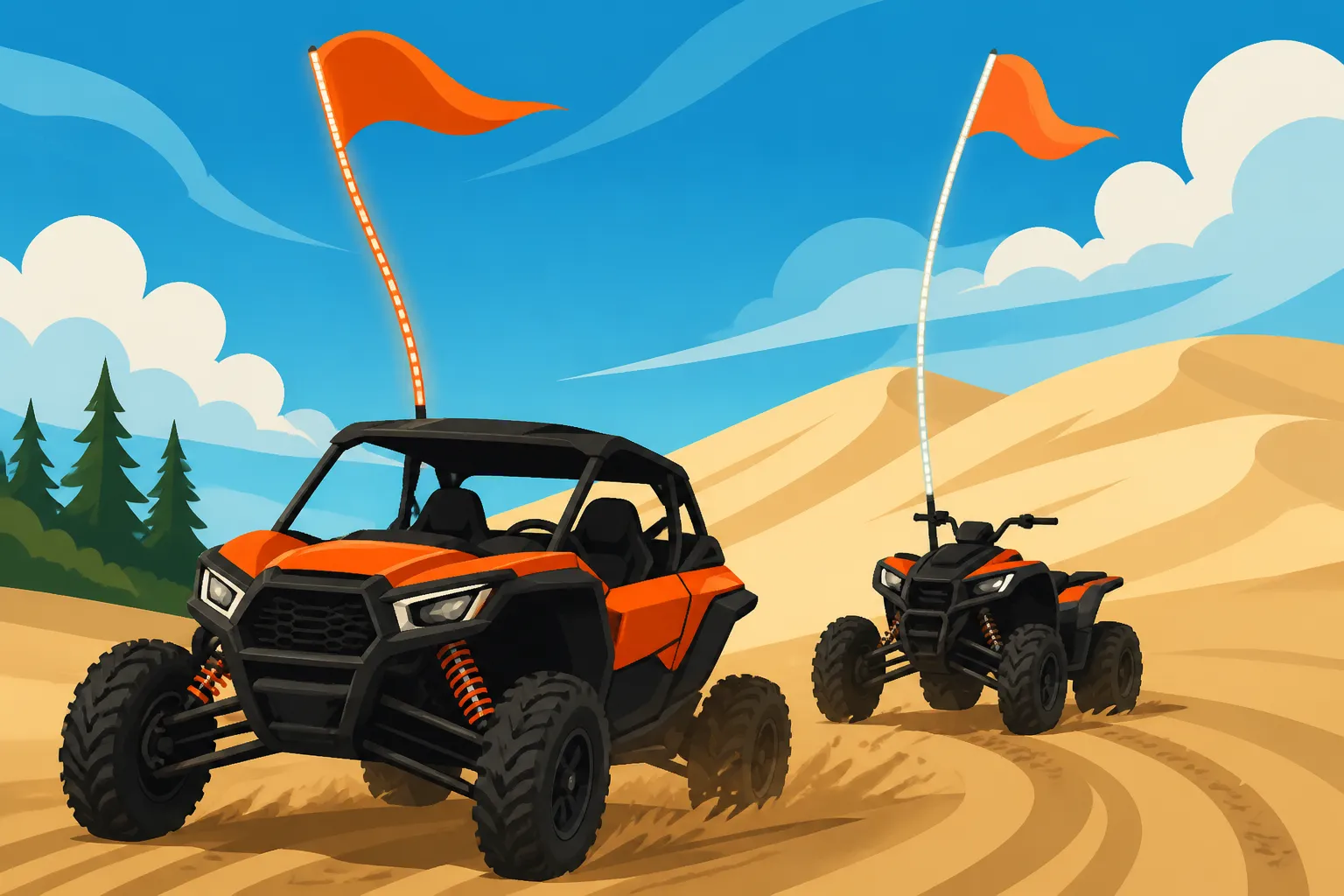
A dune flag is a bright marker attached to a flexible whip pole, mounted high enough to show above the machine. On open sand, it can be one of the first parts of your vehicle another rider sees. That extra warning matters when dunes block the view of approaching traffic, especially around busy riding areas near Florence and Winchester Bay.
A flag does not mean a dune is clear. A rider approaching from the other side may still be hidden, and a flag can disappear behind a high ridge or be hard to pick out against a bright sky. Treat it as one visibility aid among several: slow down near crests, avoid charging over blind ridges, and be ready for someone to appear on the other side.
The same caution applies if you are riding in a group. A lead rider’s flag does not make it safe for everyone to follow closely over a crest. Give each other room, wait until the person ahead has cleared a feature, and keep enough distance to react if they stop or change direction.
A flag is not a substitute for safe riding
It is tempting to think that a tall whip solves the visibility problem. It doesn’t. A flag can help other people notice you, but it cannot tell you whether the trail ahead is clear, control your speed, or prevent a collision if you crest a dune without looking.
Make a habit of easing off the throttle as you approach a blind rise. If you cannot see what is beyond it, choose a line and speed that let you stop or turn safely. Keep an eye out for other riders, pedestrians, parked machines, and changing sand conditions. Visibility is shared: other people need to see you, and you need to give yourself time to spot them.
Flags also work best when they are clean, upright, and easy to distinguish from the background. Sand, salt air, fog, and sun can all make a once-bright flag less visible. Before heading out, check that it is still attached, not tangled, and not drooping so low that it disappears behind the vehicle.
A dune flag does not grant access
A whip flag is safety equipment, not a permit or an authorization to ride anywhere. You still need to follow the rules for the specific riding area, use permitted routes and open areas, and respect closures. If you are planning a longer trip, [The Oregon Dunes National Recreation Area] and [Oregon Dune Riding Areas Compared] can help you think through where you want to ride and what kind of terrain to expect.
At the coast, riders may also encounter area-specific requirements and closures that change where riding is allowed. Check official notices and signs before unloading, then pay attention to posted information at your staging area. An app or paper map can help you understand the terrain, but neither should be treated as a substitute for closure signs or current land-manager instructions.
Choosing a whip and flag for your machine
Height, color, and flag size
At Oregon’s dunes, plan to ride with a tall, high-visibility flag mounted on a whip. A commonly cited Oregon Dunes requirement is a flag reaching at least eight feet above the ground, with a clearly visible flag at the top. Requirements can depend on the site and may be updated, so check the current posted rules before your ride, especially if you are visiting an area for the first time.
Choose a flag color that stands out against pale sand and the sky. Bright orange or red is generally easier to notice than a dark or muted color. Keep the fabric in good condition: a torn, faded, or twisted flag may still be attached but can be much harder for another rider to recognize at a distance.
A bigger flag is not automatically better if it catches excessively in the wind, folds around the pole, or makes the whip difficult to control. Look for a flag designed for off-road use and compatible with your pole. If you have questions about the exact dimensions required where you plan to ride, confirm them with the site’s official information rather than relying on a product description or an old forum post.
Picking a whip that suits your vehicle
Quads, dirt bikes, side-by-sides, and sand rails may need different mounting solutions. The right setup depends on where the vehicle has a secure attachment point, how much room is available, and whether the pole can remain visible without interfering with the rider or passenger. A mount that works neatly on a quad’s rear rack may not be suitable for a roll cage or a sand rail.
Flexibility is useful because a whip may bend when it brushes a branch, shifts in the wind, or meets a minor snag. But the pole still needs to be strong enough to stay upright and carry the flag. A whip that constantly leans, vibrates loose, or bends until the flag is hidden defeats much of its purpose.
Before buying, check that the pole and mount are intended to work together and can be secured to your specific machine. If you have a side-by-side, consider how the mount will sit in relation to the roof, cage, and passenger area. For a quad, check that the whip will not catch on a rider’s gear or interfere with normal handling.
Compare setups before you install
| Setup detail | What to look for | Why it matters |
|---|---|---|
| Pole height | Meets the posted requirement for your riding area | Helps the flag show above the machine and terrain |
| Flag color | Bright, easy-to-see fabric | Makes the vehicle more noticeable against sand and sky |
| Mounting point | Secure attachment suited to the machine | Reduces the chance of a loose or falling whip |
| Pole flexibility | Flexible but able to hold its position | Helps it handle vibration and light contact without staying bent |
| Flag condition | Clean, untorn, and not faded | Keeps the marker recognizable at a distance |
| Clearance | Away from passengers, controls, and moving parts | Prevents interference while riding |
If you are sorting out which machine and riding area fit your plans, [Oregon Dunes Staging Areas From North to South] can help you organize the trip around your launch point. For navigating, a map app such as onX Offroad can help you review terrain and routes before leaving home; still, confirm access and closures with official signs and land-manager information.
Mounting a dune flag securely
Choose a stable attachment point
Start with the machine parked on level ground and the engine off. Find a solid attachment point designed to support an accessory. Avoid fastening the whip to a loose body panel, a flexible plastic fender, or a part that could shift under vibration. A mount that seems firm in the garage may loosen after a day of bouncing across rutted sand.
The location should let the flag rise above the machine and remain visible from multiple directions. On a side-by-side, that often means checking how the whip sits relative to the roof and roll cage. On a quad, check the rear rack or another suitable mounting point while keeping the pole clear of the seat, rider, and carried gear.
Think through the whole setup before tightening everything down. Will the pole interfere with a passenger getting in or out? Could it snag a strap or a helmet? Is it likely to hit a trailer tie-down or another machine when parked close together? A few minutes spent checking these details can prevent an annoying mid-ride adjustment.
Check the flag from more than one angle
Once the mount is installed, stand back and look at the vehicle from the front, rear, and sides. Check that the flag is not hidden behind the roof, folded around the whip, or angled so far back that it disappears when the vehicle moves. If your setup includes a flexible pole, it should return toward an upright position after you gently move it.
Then check the attachment by hand. The mount should not rotate, slide, or wobble excessively. Inspect any fasteners and make sure the pole is seated as intended. If the equipment uses a quick-release mechanism, confirm that it locks securely rather than merely appearing to be in place.
For a first ride with a new setup, take a short, controlled trip and inspect it again before heading farther into the dunes. Vibration can reveal a loose mount that did not show up while the machine was stationary. Carrying an appropriate spare flag or replacement part can also save a ride if the original gets damaged.
Make a quick pre-ride check part of loading
It is easy to focus on the machine and forget the whip until you reach the staging area. Add it to the same routine as checking your tires, fuel, and riding gear. Confirm that the pole is in the vehicle, the mount is present, and the flag is attached before you leave home.
At the staging area, make sure the whip is mounted and visible before entering the riding area. This is especially useful when you are unloading several machines or getting children and passengers organized; those busy moments are when a small piece of safety equipment is easiest to overlook.
If you use onX Offroad to plan a route or identify nearby riding areas, include a quick check of local access information in the same planning routine. A route on a map does not guarantee that the area is open or that every route is permitted. Combine digital planning with posted signs, official notices, and a look around when you arrive.
Riding with a flag in changing dune conditions
Blind crests and crowded riding areas
The most important time to ride cautiously is often just before the dune crest. Ease off the throttle as your view narrows, approach at a speed that gives you room to react, and avoid jumping or accelerating over a rise when you cannot see the landing area. A flag may reveal that another machine is nearby, but you may not see it until it is already close.
Busy weekends and popular staging areas can bring a mix of quads, side-by-sides, sand rails, beginners, and experienced riders. People may take different lines across the sand, stop unexpectedly, or turn around when they realize a route is not suitable for them. Leave space, make your movements predictable, and do not assume a machine you can see has noticed you.
Groups should agree on simple riding practices before setting off. Keep a safe gap, choose a meeting point if someone gets separated, and avoid bunching up at the top of a dune. For more on sharing space and staying courteous, see [Riding Etiquette on a Busy Staging Day].
Fog, glare, and low contrast
Coastal weather can make flags harder to see. Fog can blur the horizon and flatten the contrast between a vehicle and its surroundings. Bright sun can create glare, while shadows and shifting light can make the sand look more uniform than it really is. In those conditions, slow down and increase your following distance rather than expecting a flag to solve the visibility problem.
Before riding into reduced visibility, consider whether conditions are suitable for your group and experience level. If you cannot confidently see the terrain, other riders, or the route back to your staging area, it may be safer to pause or stay in a more familiar, open area. Keep your lights and other required equipment in working order, but remember that lights and flags serve different purposes.
For more context on coastal conditions and sight lines, [Fog and Visibility on the Dunes] is worth reviewing before your trip. If a map app helps you understand where you are, treat it as a navigation aid rather than a way to ride faster in poor visibility. onX Offroad may help with pre-trip route planning, but it cannot make a hidden rider or obstacle visible around a dune.
Wind, salt, and sand
Wind can make a flag flap, twist, or wrap around its pole. After a windy ride, check whether the fabric has become tangled or whether the pole has stayed bent. A flag that looks fine while the machine is parked may stream differently once you are moving, so keep an eye on it during breaks.
Coastal sand and salt air can wear on mounts and fasteners. After riding, inspect the attachment for grit, corrosion, cracks, or loosened hardware. Clean the flag and pole as appropriate for the materials, and let fabric dry before storing it if it has become wet or damp. Storing a dirty, damp flag in a gear bag can leave it faded or damaged for the next trip.
Sand can also collect around the mount and make a connection seem tighter or looser than it really is. Clear away grit before tightening or removing hardware. If a pole is damaged or a mount no longer holds securely, replace or repair it before riding again rather than relying on a temporary fix that could fail on the dunes.
Pre-ride checks and common mistakes
A practical flag check before unloading
A simple inspection can catch most problems before they interrupt your ride:
- Confirm that you have the correct whip, mount, and flag for your machine.
- Check the posted requirements for your riding area, including any height or flag specifications.
- Attach the mount to a secure point and tighten it according to the equipment instructions.
- Make sure the pole sits high enough and the flag is visible from multiple directions.
- Check that the fabric is not torn, faded, folded around the pole, or tangled.
- After a short ride, stop and inspect the mount for movement or loosened hardware.
If you are riding with family or friends, check each other’s setups before leaving the staging area. It is easier to spot a flag hidden behind a roof when you are standing outside the machine than when you are seated inside it. This is also a good time to make sure everyone understands where the group will stop and how far apart to ride.
Flag checks belong alongside other preparation, not instead of it. Review the route, know where you are allowed to ride, and check applicable rules for permits, safety equipment, and area access. [Oregon Trail Closures to Check First] and [Oregon Trail Maps Worth Carrying] can support that planning, but posted signs and official information should guide decisions on the ground.
Mistakes that reduce visibility
One common mistake is choosing a flag that is too small, too dark, or difficult to distinguish from the landscape. Another is installing it low behind a roof, body panel, or rack load. The whip may be present, but if other riders cannot see the flag, it is not doing its job well.
A second problem is assuming that a whip has been secured just because it did not fall off during the first few minutes. Vibration and repeated movement can loosen mounts over time. Check it at breaks, after rough sections, and whenever you notice the pole leaning or moving differently than it did at the start.
Finally, avoid riding as if a flag makes you visible under every condition. A flag can be hidden by terrain, glare, fog, or another vehicle. Keep your speed appropriate, use extra care at blind crests, and make room for the fact that other people may not see you immediately.
When to replace or adjust your setup
Replace a flag that is badly torn, faded, or no longer holds its shape. Adjust a whip that bends and stays bent, repeatedly wraps the flag around itself, or sits where the vehicle blocks it from view. If a mount shifts despite being tightened correctly, inspect the mounting point and hardware rather than simply tightening it harder.
After a collision, tip-over, or hard snag, check the pole and mount carefully before riding again. A crack or bent connection may not be obvious at a glance. If you are unsure whether a damaged setup is secure, use a replacement part or get help from someone familiar with the equipment.
If your machine changes, revisit the installation. Adding a roof, cargo rack, spare tire, or other accessory can block a previously visible flag. A setup that worked on your old quad may not work the same way on a new side-by-side. Measure and inspect the complete vehicle, not just the whip on its own.
Planning a safer Oregon dunes trip
Match your preparation to the riding area
Oregon’s dunes are not one uniform riding zone. Terrain, access, staging, closures, and local requirements can vary. Decide where you intend to ride, check the area’s rules, and understand where you can unload and enter the open riding area. Avoid assuming that a familiar setup or route from one location automatically applies somewhere else.
A map can help you plan distances and orient yourself, especially if you are visiting the coast for the first time. onX Offroad can be one tool for reviewing riding-area information before you leave, while official land-manager notices and signs help you confirm access. Keep a backup plan in case a route is closed or the conditions are not right for your group.
For more background on equipment rules, [Oregon Spark Arrester Requirements on Trails] and [Oregon Sound Limits and Where They Apply] address other checks that may matter before riding. Keep these separate from the flag check: a compliant whip does not resolve other equipment or access requirements.
Plan for the whole group
If you are bringing newer riders, children, or people unfamiliar with sand, plan a conservative first outing. Choose an area and pace that match their experience, explain how to approach blind crests, and set a clear meeting point. Make sure everyone understands what to do if a machine stops or someone becomes separated.
Before starting, take a moment to look over each machine and confirm that the flags are mounted and visible. Review basic hand signals or your group’s preferred way to communicate, and agree that anyone can call for a stop if conditions feel uncomfortable. A relaxed plan often makes the day more enjoyable than trying to cover as much ground as possible.
Finally, remember that a flag is most useful when it is part of a broader habit of awareness. Ride at a speed that lets you respond, give other machines room, and check your equipment during the day. Those small steps can make a big difference when the view changes quickly on the sand.
Disclaimer
This article is for general informational purposes only and does not constitute professional advice. Laws, prices and regulations vary by location and change over time. Consult a qualified professional for guidance on your specific situation.