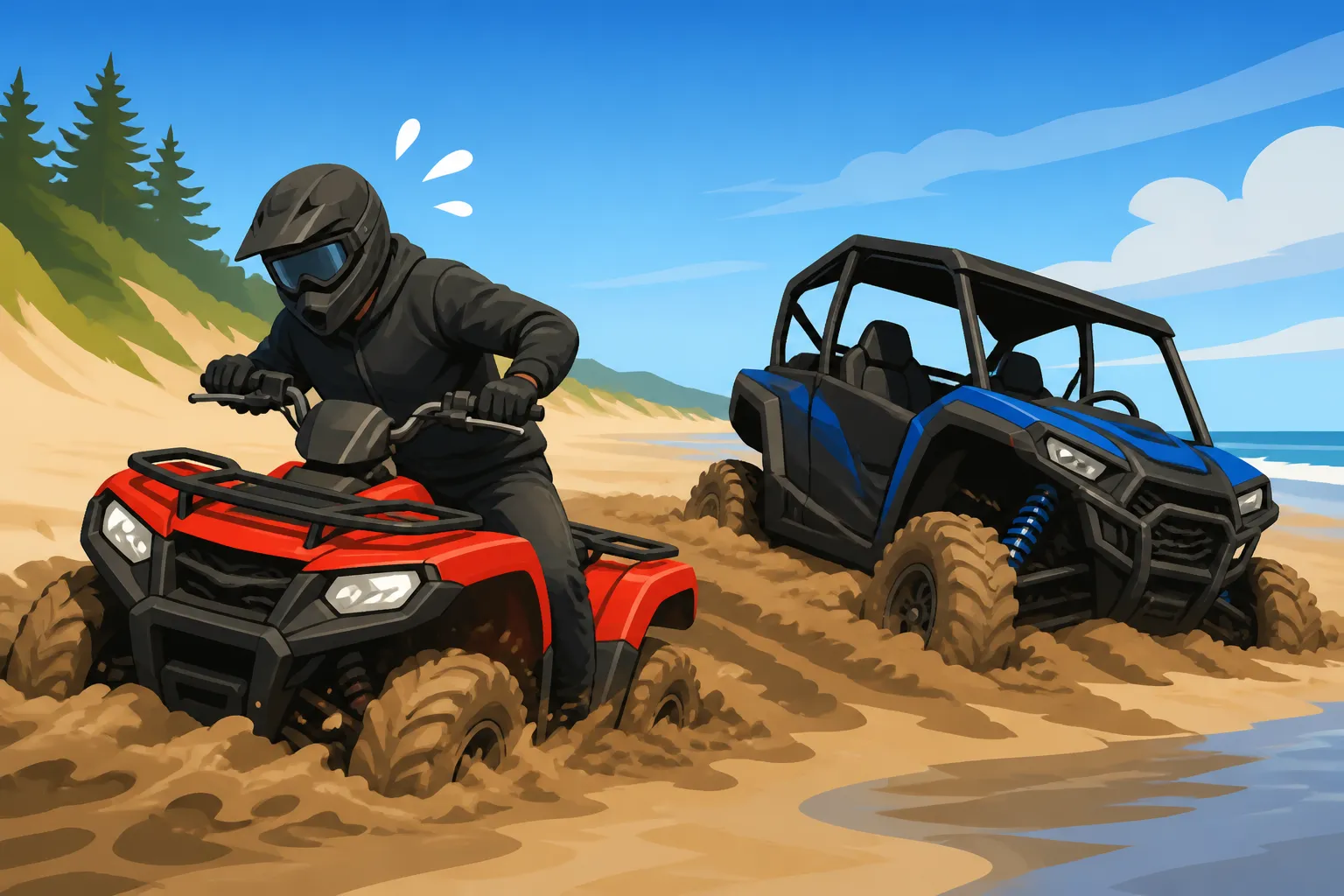
Getting Stuck in Wet Sand
Wet sand can look like a firm shortcut, then swallow an ATV or UTV up to its axles before you have time to react. On Oregon’s coast, changing tides, damp pockets, and soft dune transitions make getting unstuck more complicated than just pressing the throttle harder. This guide explains how to avoid bogging down, what to do when a machine stops moving, and how to recover it without creating a bigger problem.
Why Oregon’s wet sand catches riders off guard
Damp does not always mean firm
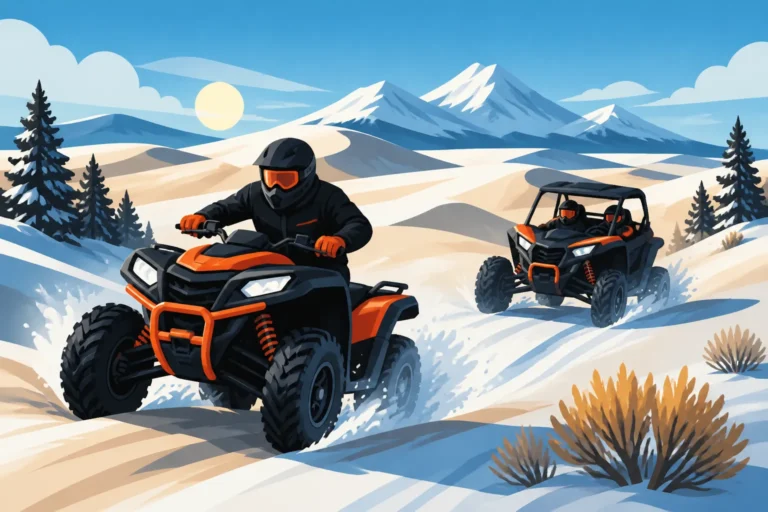
Along the Oregon coast, sand conditions can change over a short distance. A packed track may hold a machine’s weight, while a dark, damp patch beside it gives way under the tires. Water content, recent weather, traffic, and the shape of the terrain all affect how well sand supports a vehicle. A surface that looks smooth and even can conceal a soft pocket or a sudden change in depth.
The beach and dunes present different kinds of risk. Near the water, sand may feel compacted in places, but the firm-looking strip can narrow or disappear. The shoreline is also affected by tides and waves, so riding closer to the water to find firmer ground can leave you with less room to turn around. Inland, wet depressions, low spots, and the transition between a dune face and a flatter area can bog a machine down just as quickly.
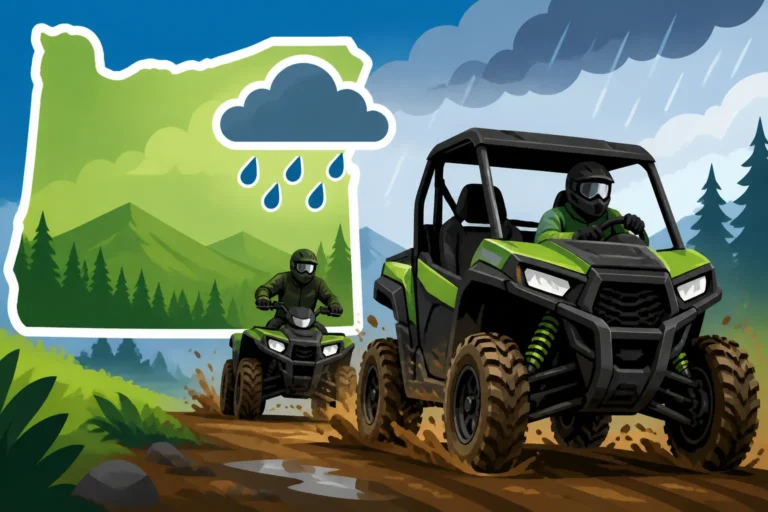
Be especially cautious after rain, in shaded or low-lying areas, and wherever you see deep tire ruts. Ruts can hold water and soften the sand beneath them. A leading rider may cross successfully while the next machine sinks into the churned-up track, particularly if traffic has loosened the surface.
How momentum and machine setup affect traction
A machine needs enough steady momentum to cross loose or damp sand, but speed is not a substitute for a safe line. Charging into a wet patch can make the tires dig down, send sand flying, and leave the vehicle harder to recover. The aim is controlled, even movement: choose a route you can see, keep the throttle smooth, and avoid abrupt steering or braking when the sand is loose.
Tire condition and setup matter too. Worn tread, unsuitable tires, or pressure outside the manufacturer’s guidance can reduce traction. Some experienced riders adjust pressure for sand, but there is no one setting that suits every machine, tire, load, and terrain. Lower pressure can increase the tire’s contact area, but going too low may risk tire damage or a bead coming loose. If you are considering an adjustment, follow the vehicle and tire maker’s instructions and bring a way to reinflate before returning to firmer ground.
For more on how tire pressure and soft coastal sand work together, see Soft Sand and Tire Pressure on the Coast. A vehicle with passengers, cargo, or a trailer may respond differently from an unloaded machine, so account for the total load rather than assuming a setup that worked on a previous ride will work today.
Read the route before committing
Before entering a questionable area, pause somewhere safe and look across the route. Check for standing water, deep ruts, a steep exit, a narrow turnaround, and other riders approaching from behind. If you cannot see a firm way through—or a safe place to stop if the machine loses traction—choose another route.
Maps can help you plan, but they do not tell you whether a specific patch of sand is firm right now. Apps such as onX Offroad may help riders review mapped routes and orient themselves, but a mapped line is not a guarantee that the ground is passable or that access is open. Compare your route with current land-manager information and posted signs; the guidance in Oregon Trail Maps Worth Carrying can help you think through map use without treating a map as a substitute for conditions on the ground.
On the coast, a safe route is one that leaves room to turn around and does not push you toward the surf, a closure, or a crowded staging area. If the only way through appears to be a fast run across a soft patch, that is a useful warning—not a reason to accelerate.
How to avoid getting bogged down
Choose a visible, manageable line
Approach soft or wet sand at a steady pace, not with a sudden burst of throttle. Avoid sharp turns, hard braking, and repeated stop-start movements where the surface is loose. Those actions can make tires dig in and break up the sand underneath the machine.
Use an existing route only when it is open and safe to ride. A track that looks established may be deeply rutted, waterlogged, or headed somewhere you should not go. Check signs and closures before a ride, and do not assume a tire track means the route is permitted. Oregon Trail Closures to Check First is useful preparation if your trip includes coastal riding areas or forest routes.
A dune flag or whip improves visibility over rises and around other riders; it does not make a blind crossing safe. Keep enough distance from the machine ahead that you can react if its rider stops or turns. For a closer look at visibility equipment, see Oregon Dune Flags and Whips.
Slow down before the soft patch
If the surface changes, ease off before reaching it rather than braking sharply once you are in it. Keep your steering smooth and try to follow the line you chose. On a UTV, avoid abrupt steering inputs that could shift the vehicle’s weight. On a quad, stay balanced and do not lean suddenly as the tires cross a soft area.
If the machine begins to lose forward movement, do not respond by holding the throttle wide open. Spinning tires often excavate the sand beneath the vehicle, turning a shallow loss of traction into a deeper hole. Ease off, keep the vehicle under control, and stop as soon as you can do so safely.
Riding with a partner helps, but communication matters. Agree on a simple way to signal “stop,” “wait,” or “come forward,” and do not have someone stand directly in the machine’s path. If you ride alone, be more conservative about uncertain terrain because you may have no one nearby to help if the vehicle becomes stuck.
Keep distance from the shoreline and crowded areas
Do not treat wet sand near the water as a dependable recovery route. The beach can change with tide and waves, and a machine stuck near the water may become exposed to rising water before a recovery is complete. Give yourself a wide margin from the surf and obey posted boundaries and closures. Review [Oregon Rules for Riding a Beach] before planning a coastal ride.
Crowded staging areas create a different hazard. A vehicle spinning its tires can throw sand toward other people, and a recovery strap can put bystanders at risk. Move away from traffic if you can do so safely, ask other riders to wait at a clear distance, and avoid blocking the route while you assess the situation. Riding Etiquette on a Busy Staging Day covers the kind of shared-space awareness that matters when a recovery draws attention.
What to do when your ATV or UTV stops moving
Stop wheelspin and assess the machine
As soon as forward movement stops, ease off the throttle. Continuing to spin the tires usually digs them in further and can bury the frame or undercarriage. Shift to a safe position according to your owner’s manual, apply the parking brake if appropriate, and check that the machine is stable before anyone approaches it.
Look at the tires and the space beneath the vehicle. Are the wheels buried, or is the chassis resting on the sand? Is the machine tilted, near water, or in the path of other riders? Is there room for a recovery vehicle to approach without entering a dangerous slope or soft patch? These details determine whether a small, careful effort is reasonable or whether you should stop and seek help.
Keep people clear of the tires and any recovery equipment. Never ask someone to push directly in front of a powered vehicle, and do not stand between a machine and a fixed object. If the vehicle is close to the surf, on a steep face, or in a position where it could slide, prioritize people’s safety and get assistance instead of attempting a rushed recovery.
Clear sand carefully and try a controlled exit
If the machine is only lightly stuck and the ground around it is stable, remove loose sand from in front of the tires and from beneath the chassis where it is preventing movement. Use a shovel or another suitable tool, and avoid reaching near moving parts. If passengers are present, have them exit only if they can do so safely and without stepping into traffic or unstable terrain.
Once the tires have a clear path, try to move out smoothly in the direction that offers the least resistance. Avoid repeated rocking or rapid forward-and-reverse changes unless your owner’s manual allows the procedure and you know the machine can handle it. If the tires spin again, stop. Each failed attempt can dig the vehicle in deeper and heat or stress components.
Do not use a tow ball as a recovery point. If a strap, winch, or another vehicle may be needed, use only equipment and recovery points suitable for that machine and follow the manufacturers’ instructions. A strap under tension can cause severe injury if it fails or comes loose. Keep everyone well outside the line of tension, and never wrap a strap around a person or attach it to an unapproved component such as a suspension arm or bumper.
Know when to stop and call for help
A machine resting on its undercarriage, stuck on a steep slope, or close to incoming water is not a good candidate for improvised recovery. The same applies when you do not have rated equipment, a suitable recovery point, or an experienced person who can manage the process safely. A local operator or land manager may be able to advise you about appropriate help for that area.
Before attempting a recovery with another ATV or UTV, consider whether the second machine has firm footing and a safe route out. Pulling from another vehicle can simply bog down both machines. A recovery vehicle needs enough traction, a clear line, and an approved attachment point. If any of those are missing, do not turn one stuck machine into two.
A winch also requires care. Follow its instructions, use the correct attachment point, and keep people away from the cable or rope while it is under tension. Do not stand over a line or put hands near a loaded connection. If the recovery feels unstable or the vehicle shifts unexpectedly, stop and reassess.
Prepare for a coastal ride and compare your options
Pack for a recovery before you need one
A compact shovel, gloves, basic first-aid supplies, water, and a charged phone can make a difficult stop more manageable. For vehicle recovery, carry only equipment suited to your machine and learn how to use it before a trip. A strap that looks strong is not automatically appropriate for a particular recovery, and using unfamiliar gear under pressure is a poor substitute for preparation.
Keep essential items secured so they do not become projectiles if the machine tips or stops abruptly. If you carry recovery gear in a UTV, make sure it is accessible without unloading everything on the trail. In a quad, avoid overloading racks in a way that changes handling or interferes with safe operation.
| Situation | Safer first response | Avoid |
|---|---|---|
| Tires begin to spin | Ease off the throttle and stop safely | Holding the throttle open |
| Machine is lightly stuck | Assess the route and clear loose sand carefully | Repeated high-speed attempts |
| Undercarriage is resting on sand | Stop and plan a suitable recovery | Pulling from an unapproved point |
| Vehicle is near surf or on a slope | Move people to safety and seek help | Rushing a recovery under pressure |
| Recovery line is under tension | Keep everyone clear of the line | Standing beside or in front of it |
| Route conditions are uncertain | Turn around or choose a visible alternative | Following tracks into an unknown area |
Plan around land access and changing conditions
Before setting out, confirm that the area and route are open. Oregon riding areas can have different access rules and seasonal restrictions, and a route that appears on an app may cross land with separate rules. onX Offroad can be one planning reference for orientation, but use official land-manager information and signs to verify access and closures. For a broader starting point, see Where to Ride an ATV in Oregon and Oregon Dunes Staging Areas From North to South.
Tell someone where you plan to ride and when you expect to return, especially if you are exploring a less familiar area. Carry a charged phone, but do not assume you will have reliable service everywhere. A paper map or offline map can help if your phone loses signal, battery, or access to a location display. Mark a sensible turnaround point before you enter a section where the sand becomes uncertain.
Give yourself enough time to leave before conditions or visibility become difficult. If the route is getting crowded, the weather changes, or you encounter a closure, change the plan rather than pressing on. A ride that ends early is far better than attempting an exhausting recovery in poor visibility or near rising water.
Clean and inspect the machine after the ride
Sand and salt can work into places that are easy to overlook. After a coastal ride, rinse and inspect your machine according to the owner’s manual, paying attention to the wheels, brakes, undercarriage, and other exposed components. Look for trapped sand, damaged tires, loose fittings, or signs that a recovery placed unusual stress on the machine. Washing a Machine After a Beach Ride offers more detail on post-ride cleanup.
If you adjusted tire pressure for the ride, restore it to the recommended setting before returning to pavement or transporting the machine. Check that the tires are seated properly and that recovery gear is in good condition before storing it. A strap with cuts, fraying, or damaged hardware should not be treated as ready for the next trip.
Getting stuck is frustrating, but it does not have to become a dangerous scramble. Stop wheelspin early, choose a route you can see, keep well clear of the surf, and use only a recovery method you understand. When the ground, equipment, or vehicle position makes a safe recovery uncertain, call for appropriate help rather than forcing the machine out.
Disclaimer
This article is for general informational purposes only and does not constitute professional advice. Laws, prices and regulations vary by location and change over time. Consult a qualified professional for guidance on your specific situation.