Whip Height for a Coastal Dune
At Oregon’s coastal dunes, a whip flag is more than a visibility accessory: it helps riders see machines approaching over a ridge before the vehicles themselves come into view. A practical baseline is to keep the flag at least eight feet above the ground, but the exact setup and riding-area rules matter. Here’s how to choose, mount, and check a dune whip safely.
Whip height and flag visibility at Oregon dunes
How tall should a dune whip be?
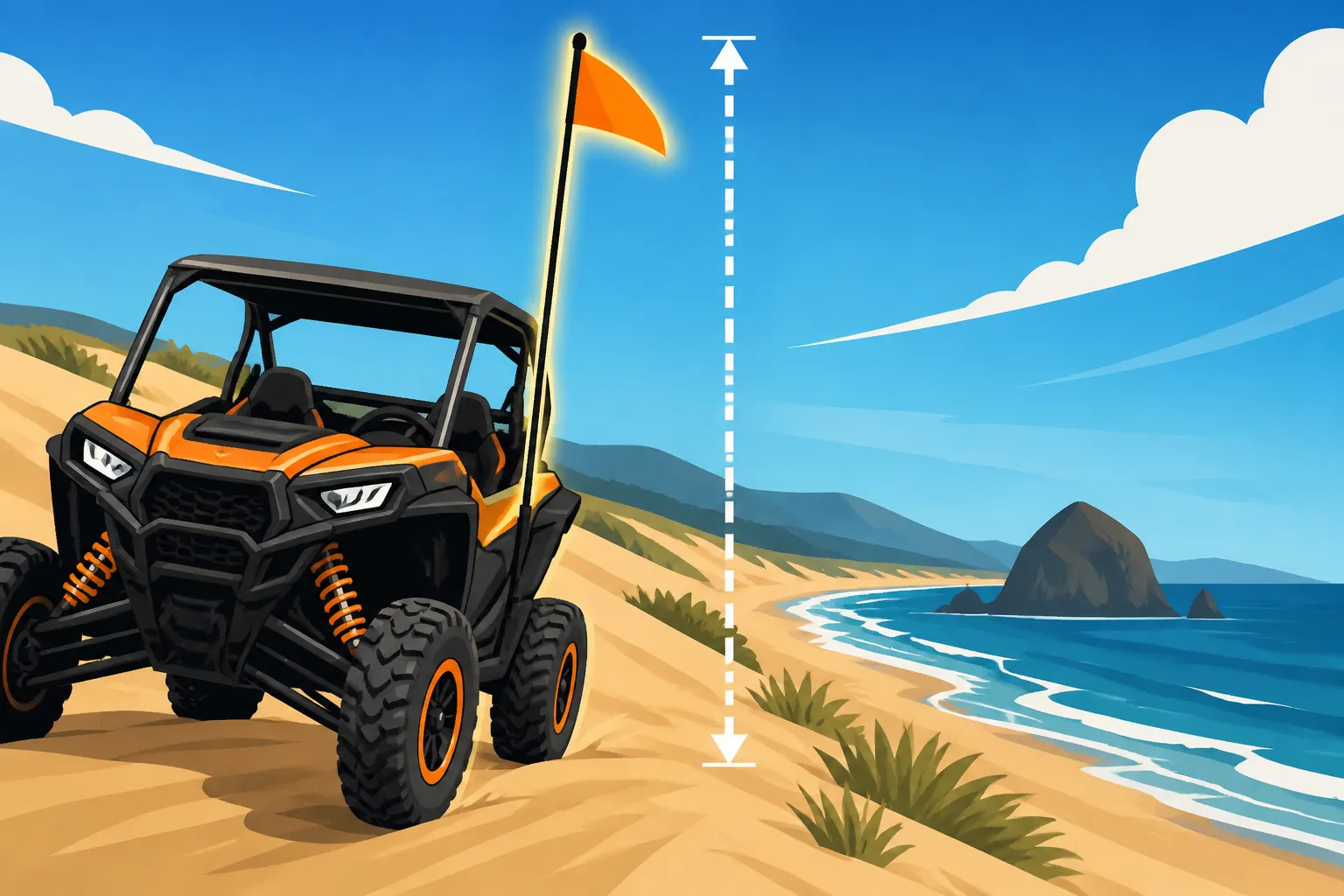
For riding Oregon’s coastal dunes, use a whip and flag that put the flag at least eight feet above the ground. The important measurement is the flag’s height when the machine is sitting on its tires, not simply the whip’s advertised length. Mounting position, suspension height, tires, and the flag’s position on the whip can all affect the final result.
That distinction can catch people out. A whip described as eight feet long may not place the flag eight feet above the ground if part of the whip sits below the mounting point or the flag is attached lower than the tip. Measure from the ground to the flag itself after installation. If the machine is parked on uneven sand, move it to a level area before checking.
A flag that barely clears the minimum can also be harder to see when a machine is bouncing, leaning, or climbing a dune. A little extra height can improve visibility, provided the whip remains secure and does not interfere with the rider, passengers, or nearby equipment. The goal is not to make the tallest flag in the staging area. It is to make your machine easier to spot from the other side of a dune.
Why the whip matters over a dune crest
A dune crest blocks a rider’s view of what is on the other side. Without a visible flag, two machines can approach the same blind crest from opposite directions and meet before either driver has time to react. A high, bright flag gives each rider an earlier warning, especially when the vehicle itself is hidden by the slope.
Think about a family riding near Spinreel or another busy staging area. One machine climbs toward a crest while another comes over from the far side. If both flags are visible above the ridge, each driver has a chance to slow down or change course before the vehicles meet. If the flags are too low, folded, or difficult to distinguish from the background, that warning arrives later.
A whip is not a substitute for careful dune riding. Slow down near blind crests, avoid charging over a ridge you cannot see beyond, and give other riders room to respond. Good habits matter just as much as equipment; the guidance in Riding Etiquette on a Busy Staging Day applies well beyond crowded holiday weekends.
What height means in practice
| Check | What to look for | Why it matters |
|---|---|---|
| Height above ground | The flag is at least eight feet above the ground when the machine is parked normally | The whip’s listed length may not equal the flag’s actual height |
| Flag position | The flag sits high on the whip and is not sliding down | A low flag may be hidden behind a dune crest |
| Visibility | The flag is bright, easy to distinguish, and not twisted around the whip | A flag that is hard to see offers less warning |
| Mounting | The whip base is firmly secured to a suitable mounting point | A loose mount can lean, detach, or shift during a ride |
| Condition | The whip, mount, and flag are not cracked, frayed, or bent out of shape | Damaged gear may fail when the machine is moving |
Treat the eight-foot figure as a setup baseline, then check the signs and applicable requirements for the specific riding area before unloading. The details of Oregon Dune Flags and Whips are useful background, but local instructions posted at an entrance or staging area should guide your ride.
Choosing and mounting a whip for coastal riding
Pick a flag you can actually see
Visibility depends on more than height. A flag needs to stand out against pale sand, dark trees, coastal fog, and the changing light around the dunes. Choose a bright, high-contrast flag and keep it clean enough to remain noticeable. A flag coated with dust or twisted tightly around the whip may technically still be attached but will not serve its purpose as well.
Size and shape also affect how a flag behaves in the wind. A very small flag may be difficult to pick out at a distance, while an oversized flag can pull hard on the whip and mount. Follow the product’s installation guidance and the land manager’s requirements rather than modifying the flag to make it larger or adding attachments that could cause it to snag.
Before a ride, step back far enough to see the flag against the dunes. Check it from the front, rear, and side of the machine. If the flag disappears against the background or blends into nearby equipment, adjust its position or replace it with a more visible option. Oregon’s coastal fog makes this check especially useful; see Fog and Visibility on the Dunes for more about changing coastal conditions.
Mount the whip where it stays secure
A whip needs a solid mounting point that can handle vibration and movement. Follow the manufacturer’s instructions for your vehicle and mount. Before riding, check that the base is tight, the whip is seated correctly, and the flag is attached where it should be. Avoid placing it where it blocks the driver’s view, catches on a passenger, or interferes with loading and unloading.
A quick hand check can reveal a loose base, but do not rely on a single check at the start of the day. Sand, bumps, and repeated flexing can work hardware loose. Recheck the mount after the first short ride and whenever the whip has taken a hard bend or been caught by something. If the mount shifts, stop and fix it rather than continuing with a flag that is leaning or at risk of coming off.
Keep the whip away from other moving parts and from places where a passenger may grab it while climbing in or out. On a side-by-side, make sure the location works with the roof, cage, doors, and any gear mounted to the vehicle. A tall flag is only useful if it stays upright and does not create a new hazard.
Check the setup on the vehicle you are riding
The same whip may sit at different heights on different machines. A quad, a dirt bike, and a side-by-side have different mounting points and overall dimensions, so do not assume that a whip that worked on one vehicle automatically meets the needs of another.
This is particularly easy to overlook when borrowing a machine or switching vehicles midway through a trip. Check the flag’s height on the actual machine, not just the whip packaging. If you are renting, ask the rental staff where the flag should be mounted and whether the machine is set up for the riding area you plan to visit. The pointers in What an Oregon ATV Rental Includes can help you think through equipment questions before you leave the counter.
If you use a map app such as onX Offroad to plan a route, treat it as a planning aid rather than a replacement for posted rules or on-the-ground signs. A map may help you understand where you intend to ride, but it cannot confirm that your flag is mounted securely or that a particular area’s current instructions match your setup.
Before you ride the Oregon coast
Make a pre-ride whip and flag check
A simple routine can prevent a lot of frustration at the staging area. Check the flag before unloading, then check it again once the vehicle is on level ground. If several people are riding in your group, make sure each machine has a visible, properly mounted flag rather than assuming one person’s equipment covers everyone.
Use this sequence before heading onto the sand:
- Park the machine on a reasonably level surface.
- Check the whip base and mounting hardware for looseness, cracks, or movement.
- Confirm the flag is attached high on the whip and is not wrapped around it.
- Measure from the ground to the flag to confirm the setup reaches at least eight feet.
- Stand back and check that the flag is easy to see from more than one direction.
- Recheck after the first ride, after a hard impact, or if the whip has bent or shifted.
Keep a spare flag or repair supplies in your trailer if you ride often. A bent whip or torn flag can become an annoying problem when the nearest shop is a drive away. If a repair cannot restore a stable, visible setup, pause the ride rather than treating a loose whip as good enough.
Plan for terrain, weather, and changing conditions
The coast can shift from clear visibility to fog, wind, or blowing sand during a single outing. A flag that looks obvious in the parking area may be harder to distinguish once it is dusty or backlit. Make visibility part of your overall ride plan: keep enough space between machines, slow down when sight lines are poor, and avoid cresting a dune at speed.
Route planning can help your group avoid getting separated, but do not rely on a phone screen to make a blind crest safe. Apps such as onX Offroad can support route preparation when you are deciding where to go, while Oregon Trail Maps Worth Carrying is a reminder to have usable navigation available beyond a single device. Check official maps and local signs for closures and permitted riding areas before setting out; Oregon Trail Closures to Check First is a useful companion when planning a trip.
Dune access points and staging areas have their own practical details. If you are exploring a specific part of the coast, read Riding the Dunes From South Jetty or Spinreel and Hauser on the Oregon Coast before you go, and confirm the instructions posted where you park. A route that looks straightforward on a map may involve crowded traffic, changing sand, or an area with its own restrictions.
Common whip problems and how to respond
A flag that has slipped down the whip is one of the easiest issues to miss. Check the attachment point before riding and after stopping. If the flag keeps sliding, use the correct attachment method or replace worn hardware instead of relying on tape or a temporary fix that may fail in the wind.
A whip that leans sharply, wobbles at its base, or has a visible crack needs attention. Stop in a safe place and inspect it. Tighten or replace parts according to the manufacturer’s instructions. Do not bend a damaged whip back into shape and assume it will stay reliable; repeated flexing can make it more likely to fail.
Also watch for interference. A flag may be tall enough but still be obscured by a roof, cargo, another whip, or a passenger’s position. If your group’s machines travel close together, stagger your spacing so one flag does not hide another. When riding on soft sand, tire pressure and traction affect how the machine handles, but they do not reduce the need for a visible flag; Soft Sand and Tire Pressure on the Coast covers that separate part of coastal preparation.
A safer setup for a dune day
A useful coastal-dune whip setup starts with a flag at least eight feet above the ground, a secure mount, and a bright flag that stays visible in wind and changing light. Measure the installed setup rather than relying on the product’s stated whip length, and check the machine again if you switch vehicles or notice the flag has shifted.
Most importantly, treat the whip as one piece of a larger safety routine. Slow down near blind crests, keep a safe gap between riders, watch for closures, and follow signs at the riding area. A well-positioned flag gives other riders an earlier warning; cautious riding gives everyone more time to respond.
Disclaimer
This article is for general informational purposes only and does not constitute professional advice. Laws, prices and regulations vary by location and change over time. Consult a qualified professional for guidance on your specific situation.