Riding Millican in May
May can be a rewarding time to ride Millican Valley east of Bend, but spring conditions can change quickly across the high desert. A trail that looks dry near the staging area may turn muddy, snowy, or rutted farther out. This guide explains how to plan a May ride, choose a suitable area, prepare your machine, and avoid common springtime surprises.
What to expect when riding Millican in May
Spring weather and trail conditions
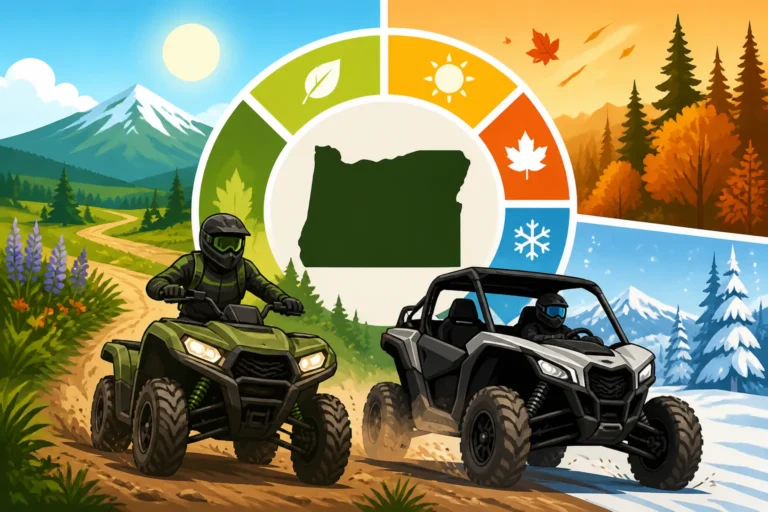
Millican Valley’s high-desert setting means May can bring a mix of pleasant riding weather and lingering winter conditions. You might start the day in cool air, warm up as the sun climbs, and still encounter damp ground or patches of snow in shaded or higher areas. Wind can also make an exposed ride feel colder than the temperature suggests.
Conditions can vary across the riding area, so don’t assume that a dry staging lot means every route is ready. A low spot may hold water, while a shaded section can stay slick after nearby ground has dried. In loose soil, a little moisture may improve traction; in saturated ground, repeated tire traffic can deepen ruts and damage the route.
Check local land-manager notices and any posted signs before unloading. Seasonal access can differ between parts of Millican, and conditions can change after rain, snow, or a stretch of warm weather. For broader planning, see [Oregon Riding Seasons by Area] and [Oregon Trail Closures to Check First].
Choosing a ride that fits the day
Treat your planned route as a flexible idea, not a promise. If you arrive to find wet ground, snow, a closure, or more traffic than expected, shorten the ride or choose a different open area rather than pushing farther in. This matters especially when you’re riding with children, newer riders, or a group with different machines and experience levels.
Millican has several staging areas and distinct riding zones, so it helps to know where you’re headed before you leave home. The area’s individual sections may have different access conditions; check the latest information for the specific staging area and route you intend to use. [Millican Valley's Nine Staging Areas] can help you understand the layout, while [Millican Valley's Play Areas] offers a useful starting point for thinking about where to ride.
| May condition | What it may mean for your ride | A practical response |
|---|---|---|
| Dry, firm ground | Routes may be easier to follow, though dust can develop as traffic increases | Carry eye protection and leave room between machines |
| Damp or soft soil | Traction may vary, and repeated passes can make ruts | Ride gently, avoid spinning tires, and turn back if the route is deteriorating |
| Snow or standing water | Route edges and hazards may be difficult to see | Don’t ride around closures or create a new route to bypass an obstacle |
| Wind or cool temperatures | Exposed sections may feel colder and visibility can be affected by dust | Bring layers and reassess conditions during the ride |
| Busy staging area | More trailers and riders can mean congestion near the start | Park considerately, review the plan, and keep children close |
Planning a safe and comfortable May ride
Check access and route information before leaving
A little preparation can prevent the frustrating arrival where everyone is geared up, the trailer is parked, and the route you expected to ride is unavailable. Before leaving, check current access notices, weather, and any area-specific restrictions. Confirm that your planned staging point is open and that the route suits your machine and group.
Use maps as planning tools, not as proof that a route is open. A line shown on a digital map may not reflect a temporary closure, a newly posted sign, or a condition on the ground. Apps such as onX Offroad can help you review terrain and organize an intended route; download the information you may need before you lose service. Still, follow signs and current land-manager directions over an app or an older saved track.
It’s also useful to tell someone who isn’t riding where you plan to go and when you expect to return. Cell coverage may be inconsistent, so don’t make a phone your only navigation or emergency plan. If your group uses onX Offroad, have each rider understand the planned route rather than relying on one person to lead without explanation.
Pack for changing conditions
May rides are easier when you prepare for both the warm part of the day and the cold, wet, or windy part. Wear layers you can adjust, bring gloves suited to the weather, and pack dry clothing in a sealed bag. Goggles or other eye protection are especially helpful if wind or passing machines stir up dust.
Bring enough water and basic food for a longer outing than you expect. A delay can happen because a machine needs attention, a route is blocked, or your group takes a slower pace. Carry a first-aid kit, a tool kit suited to your machine, and a way to communicate in an emergency. Keep essentials secured so they don’t shift or fall out on rough ground.
Before loading, check tires, brakes, lights, fuel, and any other items your machine’s manual identifies for routine inspection. If a route is wet, avoid aggressive throttle and sudden turns; wheelspin can dig into soft ground and make a small problem worse. If you want a broader preparation list, [Oregon Trail Maps Worth Carrying] and [Oregon Spark Arrester Requirements on Trails] cover useful planning details.
Riding thoughtfully across Millican Valley
Respect closures, signs, and fragile ground
Spring can make it tempting to ride around a wet patch or a closed gate to keep the day moving. Resist that urge. Going around a barrier can widen the disturbed area, damage recovering ground, and put you on a route that isn’t open to motorized use. If a trail is too muddy, snowy, or blocked to ride responsibly, turn around and choose another open option.
Stay on established, authorized routes. Avoid cutting across vegetation or creating shortcuts between tracks, even if the ground looks bare. In the high desert, plants and soils can be slow to recover from repeated disturbance. A route that seems harmless to one rider can become a scar used by many others.
Keep an eye out for posted restrictions and changes in conditions as you ride. A route that was passable on the way out may be harder after weather moves in or traffic churns up the surface. On a group ride, agree in advance that anyone can call for a turnaround if conditions become unsafe. [Oregon Rules for Riding a Closed Trail] explains why a closure sign is not something to work around.
Share the area with other riders
Millican is more enjoyable when riders give one another space, especially around staging areas and busy trail intersections. Keep your speed under control where visibility is limited, and slow down around parked vehicles, pedestrians, and other groups. Dust can hide people and machines ahead, so leave enough distance that you can stop safely.
Before setting out, make sure everyone knows the route plan, where the group will regroup, and what to do if someone falls behind. Beginners may need more time to handle loose surfaces, turns, or changing terrain. Keep the pace comfortable rather than letting the fastest rider set the rhythm for everyone.
If the route changes, make sure the whole group knows before anyone moves on. A quick stop to regroup is safer than assuming everyone saw the same turn. For more guidance on courteous riding, [Riding Etiquette on a Busy Staging Day] is useful, and [Oregon Rules for a Group Ride] can help you plan around shared responsibilities.
A practical May ride plan
Use a simple pre-ride sequence
A straightforward routine can make a spring outing feel much less uncertain:
- Check the forecast and access notices. Look for recent rain, cold weather, wind, and any area-specific closures or restrictions.
- Choose a staging area and backup plan. Confirm that your preferred access point is suitable for the day, and decide what you’ll do if it isn’t.
- Match the route to the group. Consider machine type, experience, fuel range, daylight, and how comfortable everyone is with variable ground.
- Prepare maps and communication. Save useful information before leaving service, but treat signs and official notices as the authority on access.
- Inspect machines and pack essentials. Check basic operating items, bring water and layers, and secure tools and personal gear.
- Reassess at the staging area. Look at the ground, read posted information, and be willing to adjust the plan before unloading or heading out.
This is also a good point to confirm that each machine is properly permitted for the riding area and that riders understand any applicable safety-card requirements. If you’re bringing a machine from outside Oregon, review [Oregon ATV Permit Reciprocity List] rather than assuming a permit or decal from another state automatically covers every situation.
Know when to postpone or turn back
Sometimes the best May ride is the one you delay. If the access road or trail is too soft, your machine is leaving deep ruts, visibility is poor, or a route is closed, choose another open area or come back when conditions improve. That can be disappointing after organizing a group, but it’s better than getting stuck, damaging a trail, or turning a relaxed outing into a recovery job.
Once you’re riding, keep the same flexibility. A clear morning does not guarantee that every part of the area will stay easy to navigate. If weather changes, someone gets tired, or the ground becomes rougher than expected, shorten the loop and head back while the group is still comfortable.
After the ride, check your machine for packed mud, debris, loose parts, and damage. Clean it as needed, especially if you’ve ridden through wet or abrasive material, and note any maintenance that should be handled before the next outing. A quick post-ride check is easier than discovering a problem when you’re ready to leave for another ride.
Disclaimer
This article is for general informational purposes only and does not constitute professional advice. Laws, prices and regulations vary by location and change over time. Consult a qualified professional for guidance on your specific situation.