Why Oregon’s Two Reciprocity Lists Differ
If you are bringing an ATV or UTV into Oregon, it is easy to assume one out-of-state credential covers everything. It may not. Oregon uses separate reciprocity lists for operating permits and rider safety cards, and each answers a different question. This guide explains why the lists differ, what to check before you ride, and how to avoid discovering a paperwork problem at the trailhead.
Why Oregon Has Two Reciprocity Lists
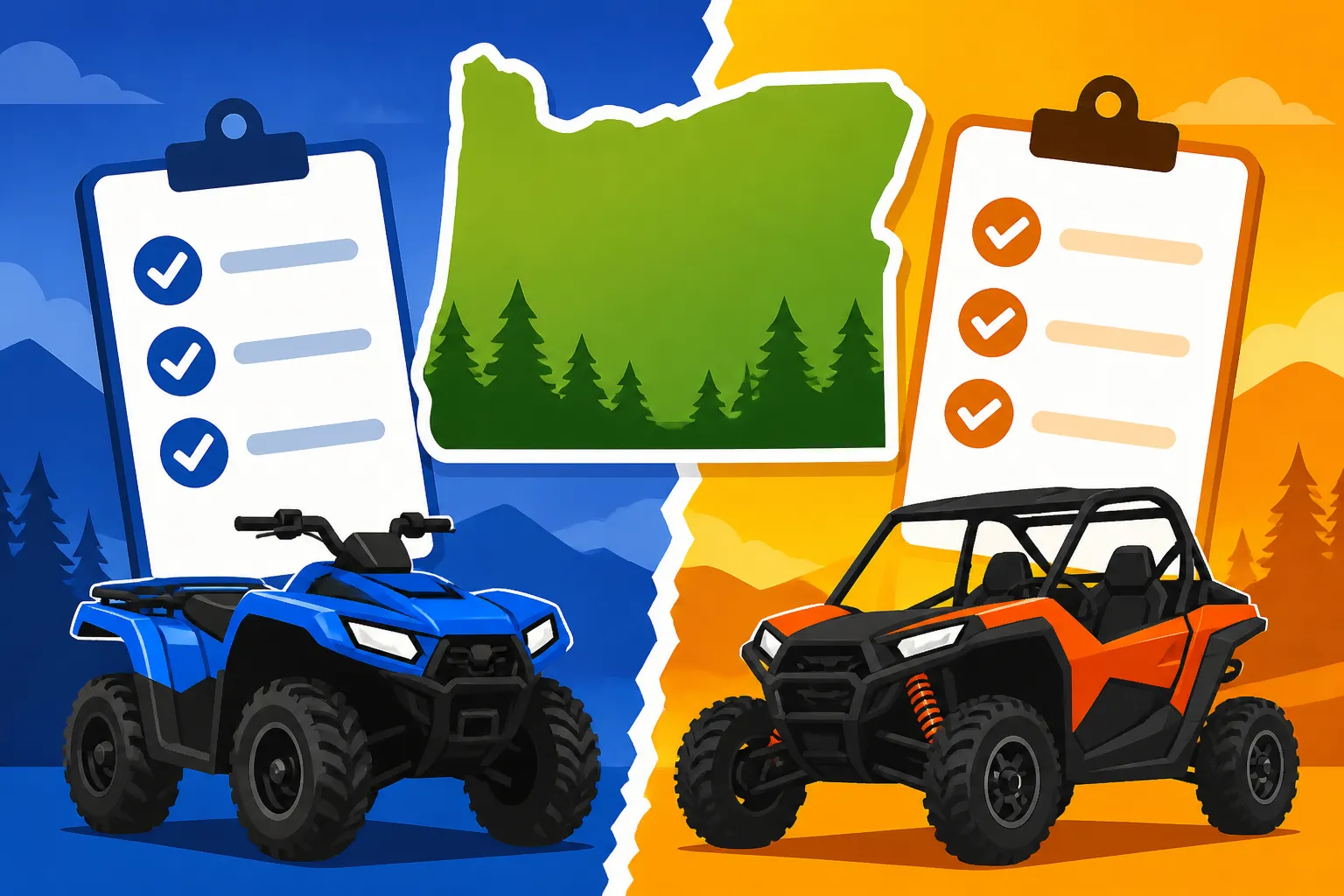
An operating permit and a safety card do different jobs
An ATV operating permit is tied to the machine and its authorization to operate in places where an Oregon permit is required. A safety education card is tied to the rider and demonstrates completion of an accepted safety education requirement. They are not interchangeable, even if both are stickers or cards from another state.
That distinction is easy to miss when you are packing for a trip. A family might have a valid out-of-state permit on the quad but no accepted safety card for the person riding it. Another rider might have completed a recognized safety course but be using a machine whose permit is not accepted in Oregon. In either case, having one credential does not automatically solve the other problem.
Think of the checks as two separate questions: “Is this machine covered for the place we are riding?” and “Does this rider meet the education requirement for this type of machine?” The permit reciprocity list addresses the first question. The safety card reciprocity list addresses the second.
For the basics of Oregon’s permit system, start with [Oregon ATV Permits Explained]. For the separate rider education rules, see Oregon ATV Safety Card Requirements. Keeping those topics separate makes the rest of the reciprocity rules much easier to follow.
The lists come from different rules and standards
Oregon does not simply compare neighboring states and decide that everything from a state is accepted. Permit reciprocity depends on how the other state authorizes off-highway vehicles and whether its credential meets Oregon’s requirements for machine operation. Rider-card reciprocity depends on whether the other state’s safety education credential is accepted as equivalent under Oregon’s rules.
That is why two lists can be different without being inconsistent. One state may have a permit program Oregon recognizes but a rider education credential Oregon does not accept. Another state may issue a safety card Oregon recognizes while its machine permit does not qualify for Oregon’s permit reciprocity. The state is not being judged as a whole; each credential is being evaluated for a particular purpose.
The practical result is that a rider cannot use a state’s presence on one list as proof that it appears on the other. Checking only the permit list leaves a safety-card question unanswered. Checking only the safety-card list leaves the machine’s permit status unresolved. Oregon’s reciprocal treatment is specific to the credential, the rider or machine it applies to, and the circumstances of the trip.
Reciprocity is not a general exemption from every riding rule
Even when Oregon accepts an out-of-state credential, that acceptance does not cancel Oregon’s other requirements. It does not give a rider permission to use a closed trail, ride on a road that is not open to ATVs, ignore local site fees, or skip rules about helmets, equipment, passengers, or age.
It also does not mean an out-of-state credential works indefinitely. Oregon’s permit reciprocity has a time limit for visitors, and separate rules apply to safety cards and particular rider or machine classes. A visitor planning a long stay should not assume that a credential accepted on the first weekend remains enough for the entire season.
A useful way to avoid confusion is to treat reciprocity as a narrow recognition rule, not as a universal pass. Before unloading, confirm the machine’s permit status, the operator’s safety-card status, and the rules for the exact riding area. For a visitor-focused overview, Oregon Rules for a Visiting Rider explains why residency and trip length can matter.
How Oregon’s Permit Reciprocity List Works
The permit list is about the machine
The operating-permit question generally follows the ATV or UTV, not just the person towing it into Oregon. The vehicle’s class, the out-of-state credential it carries, and where and how long it will be operated all matter. A valid permit from home is not necessarily accepted just because it is current in the state that issued it.
This becomes especially important when a trip includes more than one machine. Imagine a group arriving near Florence with a side-by-side carrying one state’s permit and two quads carrying another state’s stickers. It is not safe to assume that all three machines receive the same treatment because they were registered or permitted in the same household. Check each machine against Oregon’s permit reciprocity rules.
Classification matters too. Oregon sorts off-highway vehicles into classes based on features such as width, seating configuration, and other machine characteristics. A rider who calls every recreational machine an “ATV” may overlook that the rules can differ for a quad, dirt bike, side-by-side, or sand rail. If you are uncertain about the category, Which Oregon ATV Class Your Machine Falls Into is a useful starting point.
State permit systems are not identical
States use different names and systems for off-highway vehicle credentials. One may issue a permit decal, another may use a registration or sticker, and another may distinguish between use on public land and use on private property. A credential that looks similar to an Oregon permit is not automatically equivalent.
The reverse assumption can also cause trouble. A visitor might think Oregon’s permit will be accepted everywhere in the same way, but reciprocity is determined by the destination state’s rules. Oregon’s acceptance of a particular out-of-state permit does not create a national standard or guarantee that the home state accepts Oregon’s credential in return.
This is why the list itself matters more than a casual description of a state’s OHV program. Check the exact permit reciprocity list and make sure the credential you have is the kind Oregon recognizes. For a deeper explanation of the states involved, see The Eighteen States Oregon Honors. A list of states is only useful when you also confirm that your particular credential qualifies.
Visitor reciprocity has a time boundary
Oregon’s permit reciprocity for visitors is not unlimited. The rules include a 60-consecutive-day cap on the applicable exemption. That means a visitor planning an extended stay should track the time carefully rather than assume an out-of-state permit remains sufficient for the whole visit.
A short trip can make the rule feel invisible. Someone arriving for a long weekend may check the state list, confirm the permit, and leave without encountering the time limit. A person spending much of the summer in Oregon has a different planning problem: the calendar becomes part of the permit question. Do not rely on memory or count loosely across separate trips; check how the rule applies to your particular travel pattern.
If your stay may run beyond the reciprocal period, plan ahead instead of waiting until the deadline is close. Confirm whether you need to obtain an Oregon permit and what documents you will need. Oregon’s Sixty-Day Cap on Reciprocity and When Sixty Consecutive Days Ends Your Exemption focus on this timing issue.
How Safety Card Reciprocity Works
The safety-card list is about the rider
A safety card belongs to the rider, not the ATV or UTV. A parent’s card does not cover a child, and a card held by one person in a group does not satisfy another person’s requirement. Each rider’s age, machine class, and applicable education status should be considered separately.
For example, a family may tow one side-by-side and two youth quads to an Oregon riding area. The adult driving the side-by-side, a teenager who wants to operate it, and a younger child riding a quad may not all be subject to the same safety-card rule. A card that is accepted for one family member does not necessarily settle what another family member needs.
Oregon’s requirements also vary by class and age. Some classes have requirements that apply broadly, while Class IV rules are different for riders under 16. A driver’s license may affect whether a safety card is needed in particular circumstances, but riders should confirm the precise rule rather than assume a license replaces every education requirement. See Oregon’s ATV Safety Education Card for the broader framework.
Recognition depends on the education credential
A safety-card reciprocity decision is about whether the issuing state’s rider education credential is accepted, not whether the rider has experience. Years of riding, a parent’s instruction, or a completion certificate from an unrelated course may not be equivalent to an accepted card under Oregon’s rules.
That can feel frustrating to an experienced rider who has been operating machines safely for years. But the reciprocity question is not a judgment of skill. It is about whether the rider holds a credential Oregon recognizes for the relevant requirement. When the credential is not accepted, the rider may need to meet Oregon’s education requirement rather than rely on a long riding history.
Oregon’s safety-card reciprocity list is narrower than its permit list. The state recognizes safety cards from a separate group of states, and the list should be checked independently. The Thirteen States on Oregon’s Card List addresses that group. If you are coming from Idaho, in particular, do not assume that an accepted Idaho safety card means an Idaho machine permit is also accepted; the two decisions are separate.
The rider’s age and machine class can change the answer
A common source of confusion is applying one person’s rule to everyone in the group. A child operating a quad, an adult driving a UTV, and a teenager taking the wheel of a side-by-side may have different safety education obligations. The vehicle’s class and the operator’s age are key details, not minor exceptions to ignore until arrival.
Before a family ride, write down each operator’s age and the class of machine they will operate. Then check the Oregon requirement and whether each person’s out-of-state safety credential appears on the correct list. This simple step can prevent a last-minute scramble to find a course or change who is allowed to operate a machine.
If a rider needs to meet Oregon’s requirement, do not treat the course as a formality to sort out while everyone else is ready to ride. Complete the required steps in advance, save the card where it is accessible, and make sure the rider can show it if asked. How to Get an Oregon ATV Safety Card explains the process for riders who need an Oregon credential.
Why the Lists Do Not Match
The state may have different systems for permits and education
The central reason the lists differ is that permits and safety education are separate programs. A state can have an OHV permit structure that Oregon accepts while offering rider education credentials that do not meet Oregon’s recognition criteria. Another state can have an accepted education card without having a permit that qualifies for Oregon’s machine-permit reciprocity.
This is not unusual when states build their systems independently. One state may emphasize land-use permits and decals; another may focus on registrations; another may have its own training curriculum and age rules. Oregon must evaluate each item against the requirement it is meant to satisfy, rather than treating an entire state’s OHV program as one package.
The comparison is a little like travel documents: a document that proves one thing does not prove every other thing. A machine permit shows something about the machine’s authorization. A safety credential shows something about the rider’s education. Neither should be used as a substitute for the other.
The qualifications Oregon compares are different
For a permit, the relevant questions may include what the credential authorizes, what vehicle or land use it covers, and whether it is valid for the type of riding at issue. For a safety card, the comparison may involve the education course, who must take it, the age rules, and what the credential certifies. Different criteria naturally produce different lists.
The lists may also be affected by how another state defines its credential. A sticker or registration could be designed for a different legal purpose than an Oregon operating permit. A safety course might be optional in one jurisdiction but required in another, or the age groups covered may differ. Even when two credentials have similar names, their scope can be different.
For riders, that means the label alone is not enough. “Permit,” “registration,” “safety card,” and “OHV sticker” can be used differently from state to state. Verify the exact credential and the exact list rather than relying on a friend’s description or a decal that looks familiar.
A nearby state is not automatically a reciprocal state
People often assume that neighboring states must have automatic reciprocity because residents regularly cross state lines to ride. Oregon’s rules do not work on geography alone. Washington is nearby, for example, but its proximity does not by itself establish that a Washington credential is accepted for every Oregon requirement.
That catches visitors off guard because the practical trip can feel local. A rider from southwest Washington may be closer to a popular Oregon staging area than to a riding site at home. Still, crossing the state line means Oregon’s recognition rules apply. Check the relevant list before loading the trailer, even if you have made the same drive many times.
The same caution applies in the other direction. An Oregon credential does not automatically work in Washington, Idaho, California, Nevada, or any other state. Reciprocity is not a general promise between neighboring jurisdictions. If you plan to ride across state lines, check both the destination’s requirements and any time limits that apply. Oregon Permit Reciprocity List and Does Oregon Accept an Out-of-State Safety Card? help distinguish the two checks.
A Practical Checklist Before Riding in Oregon
Identify every machine and its Oregon class
Start with the machine, not the paperwork. Note whether it is a quad, off-road motorcycle, side-by-side, sand rail, or another type of vehicle. Then determine which Oregon class applies. A machine’s everyday name or its marketing description may not tell you how Oregon categorizes it.
Write down the machine’s key features, including its width, seating arrangement, and steering setup. These details can affect classification. For instance, a machine with a steering wheel and side-by-side seating should not automatically be treated like a straddle-seat quad simply because the owner calls it an ATV.
If you are traveling with several vehicles, make a separate entry for each one. Record the state credential displayed or carried with each machine and check it against the permit reciprocity list. This small bit of organization is more reliable than trying to remember which sticker belongs to which vehicle at a busy staging area.
Check every operator separately
Make a list of the people who may operate a machine, not just the people who own one. Record each rider’s age, the class of machine they may drive, and the safety credential they hold. Then compare each person’s situation with Oregon’s safety-card rules and reciprocity list.
This is particularly useful when children or teenagers are involved. Families often plan around who is tall enough to reach the controls or who has driven at home, but Oregon’s age and education requirements are separate questions. A rider’s comfort with the machine does not establish that the rider meets the legal requirement.
For a group ride, share the checklist with the person organizing the trip. If one person is responsible for the route and another brings the machines, both should know which credentials have been checked. Clear communication prevents the awkward moment when the group is ready to leave and someone discovers that a rider or machine needs separate documentation.
Confirm the riding area and trip dates
A permit or card does not guarantee that a particular trail is open to your machine. Check where you intend to ride, what rules apply there, and whether any seasonal closure or local requirement affects access. A valid credential cannot override a closure sign or authorize riding outside designated areas.
Also record your Oregon arrival and departure dates if you plan to rely on visitor permit reciprocity. The 60-consecutive-day cap makes duration relevant. If the visit is long, or if your travel dates are irregular, get a clear answer about how the rule applies before you depend on the exemption.
Finally, keep the documents easy to reach. Some riders store a card on a phone and carry a physical backup; others keep printed documents in a protected pouch. If you use Amazon to shop for a waterproof document pouch, check that it closes securely and can be opened easily with riding gloves off. The goal is reliable access, not a bulky pile of paperwork.
Common Reciprocity Mistakes and How to Avoid Them
Assuming one credential covers both requirements
This is the most common mistake: seeing a valid out-of-state permit and assuming the rider education requirement is handled too. The opposite happens as well. A rider has an accepted safety card and assumes that the machine is covered for Oregon use.
Avoid this by checking two columns, not one: machine permit and rider safety card. If one is not applicable for a particular rider or machine, note why. Do not leave the box blank because you think the other credential probably takes care of it.
For trips with multiple people and machines, make the list specific. Write “permit checked” beside each machine and “safety card checked” beside each operator. That is more useful than a general note saying “Oregon paperwork done,” especially when plans change and someone swaps machines.
Assuming a neighbor’s experience guarantees your result
A friend may tell you that they rode in Oregon last summer using a particular state credential. Their trip may have involved a different machine class, a shorter visit, a different rider age, or a credential that has since changed. Personal experience is useful as a prompt to investigate, but it is not a substitute for checking your own situation.
The same goes for advice from an online forum or a group chat. A confident answer may be based on an older rule, a different reciprocity list, or a misunderstanding between permits and safety cards. Ask what credential the person actually had and whether it was for the machine or the rider. Then confirm the current rule through the appropriate Oregon information.
If you need physical copies of course records or permit documents, keep them dry and organized. Some riders use a small document pouch purchased through Amazon for towing and riding paperwork, while others prefer a waterproof case they already own. Whatever you choose, do not store a paper card loose in a wet toolbox or leave the only copy in a vehicle you are not using that day.
Waiting until the staging area to sort it out
A crowded staging area is a poor place to reconstruct a state’s reciprocity rules. There may be limited cell service, the group may be waiting, and the operator who needs an answer may already be geared up. The stress is avoidable: check both lists before departure and save the relevant information offline or in a printed note.
If you discover a problem before the trip, you have options. You may be able to obtain an Oregon permit, complete an Oregon safety-card requirement, adjust who operates a machine, or change your itinerary. At the staging area, choices are narrower and more frustrating.
A good pre-trip routine takes only a few minutes: verify the machine class, check the permit list, check the safety-card list, count the visit days, and confirm site access. Revisit those checks if the group adds a machine, a new rider joins, or the trip extends beyond its original dates.
Keeping Documents Useful During the Trip
Carry proof in a form you can access
A document is only helpful if you can locate it when needed. Keep permits and cards somewhere protected from rain, sand, and mud, but do not bury them under tools or luggage. For a coastal ride near Florence or Winchester Bay, windblown sand and damp gear can make loose paper difficult to read.
Some riders carry a physical copy and keep a clear digital image as a backup. A phone image should be easy to find without scrolling through hundreds of photos, and the screen should be usable if the phone is wet or low on battery. A digital copy is a convenience, not a guarantee that it replaces any required original credential.
For paperwork that travels in the tow vehicle, a sealed pouch can help keep it separate from maps, snacks, and muddy gloves. If you are buying one through Amazon, compare the closure style, size, and whether it is practical to open without spilling the contents. A simple system you will actually use is better than an elaborate case left at home.
Keep permit and rider records separate
Store the machine’s documents with the vehicle information and the safety cards with the rider information. That way, if someone changes machines, you can still see which permit applies to which vehicle and which card belongs to which person.
For a family, a folder with one section for each machine and another for each operator can work well. For a club or group, the organizer might maintain a checklist while each rider keeps their own credential accessible. Avoid assuming the owner of the machine is also the only person who may operate it.
Before leaving the staging area, do a quick check that the permit decal is present and readable where required, and that each rider can access the appropriate card or proof. Oregon’s decal placement rules are separate from reciprocity, but a qualifying permit still needs to be displayed as required. See Oregon ATV Permit Decal Placement for decal details.
Recheck when plans change
Reciprocity decisions can depend on details that shift during a trip. If a visitor stays longer than planned, a teenager takes over driving, the group rents a different machine, or a ride moves to another area, the original checklist may no longer answer the question.
Treat each change as a reason to review the relevant part of the checklist. A new machine means checking its class and permit. A new operator means checking age and safety-card requirements. A longer stay means reviewing the time limit. A new riding site means checking local access and fees.
This is not about making recreation feel bureaucratic. It is about reducing the chance that a small assumption spoils a long-planned day. A little preparation means more time riding and less time searching for answers beside a trailer.
Questions Riders Commonly Ask
If my state is on Oregon’s permit list, is my safety card accepted too?
Not automatically. The permit list and safety-card list serve separate purposes and contain different state groupings. Check both lists if both requirements may apply to your trip. A state’s presence on one list does not establish that its credential qualifies under the other.
Also check the specific credential, not just the state name. A state can issue different documents for different vehicle or education purposes. Make sure the document you hold is the one Oregon recognizes for the requirement you are trying to meet.
If Oregon accepts my safety card, do I still need a permit for my machine?
Possibly. A safety card addresses the rider’s education requirement; it does not authorize the machine. Whether your out-of-state permit is accepted depends on Oregon’s permit reciprocity rules, the machine, and the trip circumstances. Confirm the machine’s permit status independently.
If your state’s permit is not accepted, or if your visit extends beyond the applicable reciprocity period, find out whether you need an Oregon permit before riding. Do not assume that proof of training substitutes for machine authorization.
Does reciprocity mean I can ride anywhere in Oregon?
No. Reciprocity concerns recognition of a particular permit or safety credential. It does not open closed trails, roads, private land, or areas with separate access rules. You still need to follow the rules of the land manager and riding site, including any applicable day-use requirements.
The safest habit is to treat credentials and access as two different checks. First confirm that the rider and machine meet the relevant credential rules. Then confirm that the exact route or site is open to that machine and that any other site requirements are met.
What should I do if I cannot tell which list applies?
Ask what you are trying to establish. If the question concerns a sticker, permit, registration, or authorization on the vehicle, check permit reciprocity. If it concerns a rider’s course completion or safety card, check safety-card reciprocity. If both questions apply, check both lists.
When the credential’s purpose is unclear, do not guess based on its appearance or name. Find the issuing state’s description of the document and compare it with the Oregon requirement. A few minutes of careful checking before travel can prevent a much more stressful conversation after you arrive.
Disclaimer
This article is for general informational purposes only and does not constitute professional advice. Laws, prices and regulations vary by location and change over time. Consult a qualified professional for guidance on your specific situation.