Oregon OHV Reciprocity With 18 States
A weekend ride can turn into a frustrating paperwork check when your ATV or UTV is registered in another state. Oregon’s reciprocity rules may let you ride without buying an Oregon operating permit, but the answer depends on your machine’s permit, the state that issued it, and separate requirements such as safety education and site fees. This guide explains how to check each piece before you travel.
What Oregon OHV reciprocity means
Reciprocity applies to permits, not every riding rule
OHV reciprocity is an agreement that may allow an out-of-state machine to use its home-state permit or registration in Oregon instead of displaying an Oregon operating permit. It is not a general exemption from Oregon rules. You still need to follow the requirements that apply to your vehicle class, the place you are riding, and the person operating the machine.
That distinction matters because people often use “registration,” “permit,” “sticker,” and “decal” as if they mean the same thing. They can refer to different documents or markings depending on the state. A plate or sticker that is valid at home does not automatically prove that Oregon accepts it for OHV reciprocity. Check the Oregon reciprocity list for the specific credential Oregon recognizes.
Even when reciprocity applies, it does not make every road, trail, beach, or riding area open to you. A machine can have valid permit coverage and still be prohibited from a closed trail or a road that does not allow OHVs. For a wider look at Oregon’s permit system, start with [Oregon ATV Permits Explained].
The 18-state count is only part of the answer
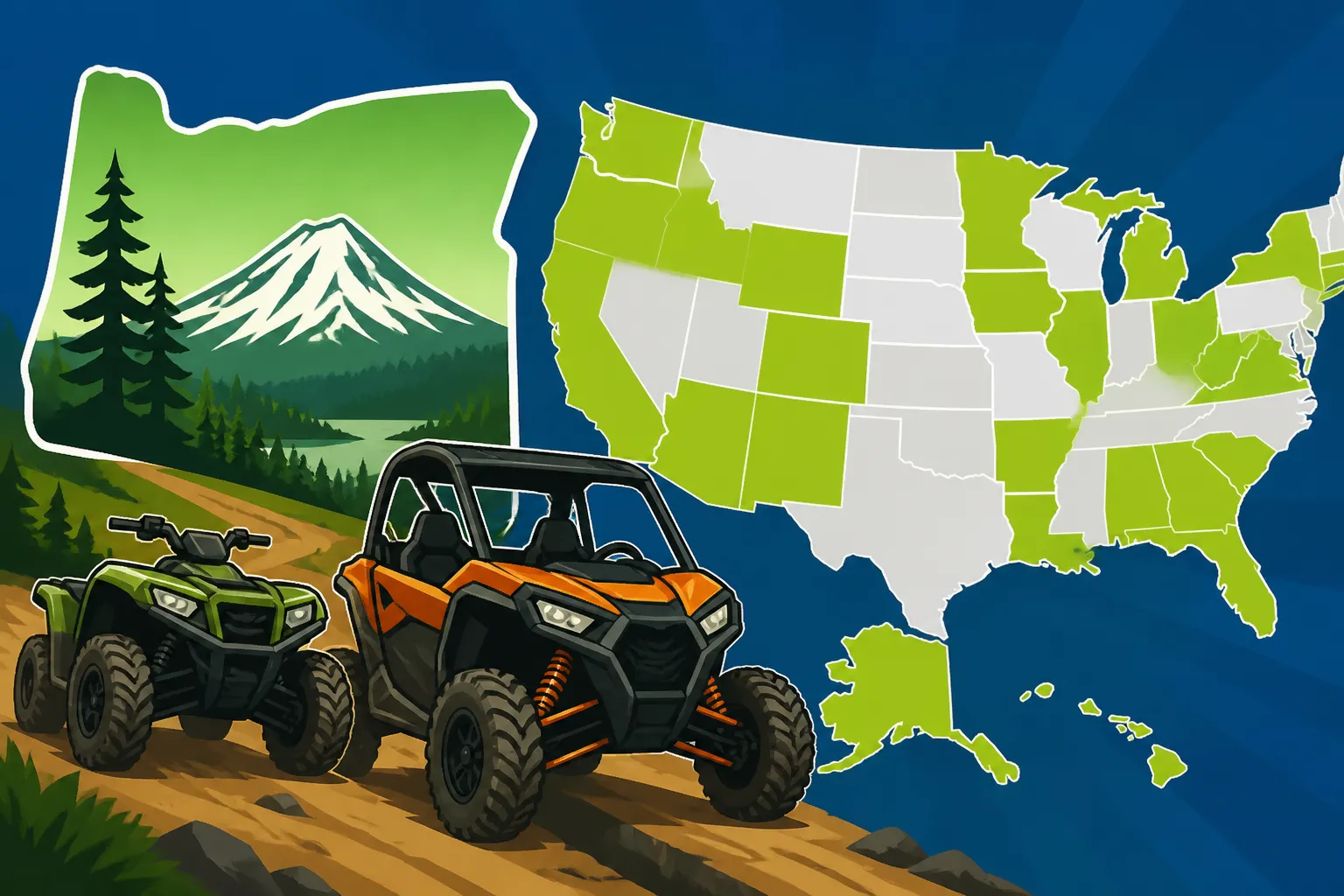
Oregon is commonly described as recognizing OHV permits from 18 states. That number is a useful starting point, but it is not enough to determine whether your machine qualifies. You need to confirm that the state that issued your permit is included on Oregon’s current reciprocal permit list and that your document is the type covered by the agreement.
For example, a state might issue a registration for a particular vehicle category while requiring a separate off-highway permit for another category. Oregon’s decision may depend on the actual permit or registration attached to the machine, not simply the state where you live or where you bought it. A road-use plate, a title, or proof of ownership should not be assumed to substitute for an OHV permit.
The safest routine is to check the reciprocal list close to your trip, then compare your credential with its description. Keep the confirmation accessible with your ride paperwork. If the wording is unclear, ask the relevant Oregon program or the agency that issued your home-state permit before you tow to the trailhead. The state list can be explored further in Oregon Permit Reciprocity List and Oregon OHV Reciprocity With 18 States.
The two reciprocity lists riders often confuse
Permit reciprocity and safety-card reciprocity do different jobs
Oregon’s permit reciprocity list and its ATV safety-card reciprocity list are separate. One concerns whether an out-of-state vehicle permit can satisfy Oregon’s operating-permit requirement. The other concerns whether a rider’s safety education credential is accepted. A state can appear on one list without appearing on the other, so checking only one can leave you with an incomplete answer.
This is an easy mistake to make when planning a trip. A rider may see that Oregon recognizes a permit from their state and assume that their safety card is automatically accepted too. Another rider may have an accepted safety card but still need to address the machine’s permit. These are independent checks, even if both involve the same home state.
Before leaving, make two separate notes: “Does Oregon accept my machine’s permit?” and “Does Oregon accept my rider’s safety credential?” The article Why Oregon’s Two Reciprocity Lists Differ explains why the lists do not match, while Oregon ATV Safety Card Reciprocity List focuses on the rider-education side.
A recognized permit does not automatically cover every vehicle
A reciprocal permit is tied to the rules and vehicle categories of the issuing state. Oregon classifies OHVs according to characteristics such as width, seating, steering, and vehicle design. If your machine is unusual, modified, or classified differently at home, do not assume that its home-state label settles its Oregon classification.
This can matter with a side-by-side, dune buggy, sand rail, or a machine that has been modified since it was registered. A UTV owner might have a valid state credential but still need to know which Oregon class the vehicle falls into and whether the credential meets the relevant reciprocity conditions. The class also affects which safety rules and operating restrictions apply.
If you are uncertain how Oregon would categorize your machine, compare its actual configuration with Which Oregon ATV Class Your Machine Falls Into. Then confirm the reciprocal permit question separately. A class guide can help you understand the vehicle; it does not, by itself, prove that your out-of-state permit is accepted.
| Question | What it concerns | What to check |
|---|---|---|
| Is my state on Oregon’s permit reciprocity list? | The machine’s operating permit or registration | Oregon’s current reciprocal permit list |
| Is my safety card accepted? | The rider’s education credential | Oregon’s separate safety-card reciprocity list |
| What Oregon class is my machine? | Vehicle type and applicable rules | Width, seating, steering, and vehicle configuration |
| Can I ride at this location? | Site access and local restrictions | Land-manager maps, signs, closures, and fees |
| Can I use a road? | Road access and traffic requirements | The road’s legal designation and vehicle rules |
How to check whether your out-of-state permit qualifies
Start with the state that issued the credential
Look at the permit or registration itself and identify the issuing state and the credential type. Do not rely on the state where you live if the machine is registered elsewhere, and do not rely on a seller’s description such as “good in all states.” The document’s issuing authority and category are the important details to verify.
Next, compare that credential with Oregon’s permit reciprocity information. Check the exact state name and any limits or conditions stated for the credential. If the list says that a particular permit or registration is recognized, make sure yours is the same type rather than a related document that only establishes ownership or street use.
If you recently bought the machine, make sure the paperwork is current and belongs to that vehicle. A bill of sale or title can help establish ownership, but it should not be treated as proof of operating-permit coverage unless Oregon specifically says it qualifies. For broader help with visitors’ obligations, see Oregon Rules for a Visiting Rider.
Check the credential’s validity and its connection to the machine
Even when Oregon recognizes a state’s permit category, an expired credential is not a sound basis for relying on reciprocity. Check the expiration date, renewal status, and any vehicle identification details shown on the document. If the marking is attached to the machine, make sure it is still present and readable.
A common real-world snag happens after a machine changes hands. The new owner may inherit a decal or paperwork but not know whether it remains valid, whether it is tied to a particular vehicle, or whether the state requires an update after a sale. Contact the issuing state’s vehicle or OHV program when the document’s status is uncertain. Do not assume that a previous owner’s permit remains effective simply because the sticker is still attached.
It is also worth checking whether the vehicle’s configuration has changed since the credential was issued. A major modification, a change in use, or a different classification may affect what documentation is appropriate. The more unusual the machine, the more useful it is to resolve those questions before the trip rather than at a staging area.
Keep evidence available during the ride
Carry a practical way to show the machine’s permit or registration, along with any required rider safety credential. A phone photo can be a backup, but it is unwise to rely on a single device that could lose power, become damaged, or have no signal. Keep the original document or an acceptable copy protected and easy to reach.
For a coastal weekend, paperwork can be exposed to wet gear, sand, and salt spray. A small document sleeve or dry bag can keep papers from becoming unreadable in a pack or glove compartment. Riders sometimes shop for basic storage supplies through retailers such as Amazon, but the important point is not where you buy the pouch; it is that the documents remain legible and available.
Make sure another adult in your group knows where the paperwork is kept. If the operator changes during the day, the next rider should not have to search through the trailer, camp, and machine storage to find proof of permit status. A simple folder with the vehicle credential, safety documentation, emergency contact details, and trail information can save time when plans are already stressful.
Reciprocity does not replace Oregon safety-card rules
Riders may have separate education requirements
Oregon’s safety-card requirement is about the rider, not the machine. A valid reciprocal permit does not automatically demonstrate that the operator meets Oregon’s safety education rules. Before your trip, check whether your age, vehicle class, and home-state credential qualify for recognition or whether you need an Oregon card.
This is especially important for families. A parent may have a recognized credential while a teenager riding a different class of machine has separate requirements. Do not assume that an adult’s experience, a driver’s license, or a family member’s card covers everyone in the group. Check each operator individually.
When a group includes riders of different ages and vehicle types, write down each person’s status before departure. One rider may need to carry a safety card while another may fall under a different rule. Oregon ATV Safety Card Requirements gives a broader overview, and Does Oregon Accept an Out-of-State Safety Card? focuses on recognition of credentials issued elsewhere.
Treat a permit and a card as two separate checklist items
A helpful way to prevent confusion is to keep vehicle documents and rider documents in separate sections of your trip folder. Under “machine,” note the permit or registration and its expiration. Under “operator,” note the safety card or other accepted credential for each person who will ride. This simple separation makes it less likely that a correct answer to one question will be mistaken for an answer to the other.
Imagine a family arriving at a staging area near the Oregon Dunes after several hours on the road. The machine has a home-state decal that qualifies for reciprocity, but one of the riders has not checked whether their card is accepted. The permit question is settled, yet the rider question is not. Sorting this out before departure is much easier than trying to resolve it when the rest of the group is ready to ride.
The same approach works for a rental or borrowed machine. The vehicle may already have a permit, while the operator remains responsible for meeting rider-specific safety requirements. If you are renting, check the paperwork supplied by the rental provider and ask what applies to each person in your party. More detail is available in [Oregon Rules for a Rented Machine].
A visitor’s home-state credential may have limits
Reciprocity should not be read as unlimited permission for a visitor to ride in Oregon indefinitely. A state may place conditions on how long its permit remains valid for out-of-state use, and Oregon may have separate rules for visitors or residents. If you are staying for an extended period, moving to Oregon, or riding there repeatedly, check whether the short-visit assumptions still apply.
A one-week vacation and a season-long stay can raise different practical questions. Someone who has relocated may need to transition from visitor documentation to Oregon requirements. Someone who returns often may find it simpler to obtain an Oregon permit rather than repeatedly work out whether a home-state credential continues to qualify.
If your situation falls between a quick trip and a permanent move, do not guess based on what another rider did. Check How Long a Visitor Can Ride Oregon and Oregon ATV Permit After Moving to the State for the relevant distinctions. The useful question is not just “Can I ride today?” but “Does this credential still cover this machine for the full period and purpose of my visit?”
What reciprocity does not pay for or authorize
Site fees and passes are separate from the operating permit
An operating permit is not the same as a day-use fee, campground reservation, parking pass, or land-manager access fee. A rider can satisfy the vehicle-permit requirement and still need to pay for access or parking at a particular location. Costs and requirements vary by site, so check the destination’s rules before loading the trailer.
This is a common source of surprise at coastal riding areas. Someone checks the machine’s permit, assumes that the permit covers everything, and then encounters a separate fee or pass requirement at the staging area. The same issue can come up at other public riding sites, where the agency managing the land sets additional conditions.
For trip planning, keep a separate line in your notes for “vehicle permit,” “rider safety,” and “site access.” Oregon Day Use Fees Explained and Why the Permit Does Not Cover Parking help clarify the distinction. Confirm the rules for your specific destination rather than assuming that a pass valid at one recreation site covers another.
Reciprocity does not open closed roads or trails
A valid permit does not authorize riding on a route that is closed, restricted to another vehicle type, or located on land where you do not have permission to ride. Signs, gates, seasonal closures, active timber operations, fire restrictions, and habitat protections can all affect access. Conditions may differ between nearby areas, so a familiar route is not automatically open on every visit.
This is particularly important in Oregon, where OHV riding happens on land managed by different agencies and landowners. A map may show a broad riding area, while a particular spur road or trail has its own restriction. Follow posted signs and check the land manager’s current information before setting out.
If your route crosses private timberland or an unmaintained road, investigate who controls access and whether OHVs are allowed. Reciprocity addresses the machine-permit question; it does not establish permission to use someone else’s land. For more on the separate issue of road access, see Which Oregon Roads You May Legally Ride.
Street use has different requirements
An OHV permit is not a road registration, and reciprocal off-highway status does not turn an ATV or UTV into a street-legal vehicle. A road may be open to certain vehicles only under specific conditions, and public-road access can involve equipment, insurance, licensing, or local authorization rules.
This distinction can catch riders who see an OHV route marked on a map and assume that any machine with a valid state permit may use it. The route’s designation and the vehicle’s legal status still matter. Do not rely on the presence of a trail connection or a nearby town as proof that the road is open to your machine.
If your plan includes public-road use, check the requirements for your machine type and the particular route. A machine that can be permitted for off-road riding may still not qualify for ordinary road use. The guide Street Legal ATVs in Oregon: The Short Answer explains why off-road permit reciprocity and street legality must be treated as separate questions.
A practical pre-trip checklist for visitors
Verify the machine before you leave home
Begin by locating the actual permit or registration attached to the machine. Confirm which state issued it, what type of credential it is, and whether it remains valid. Then check whether Oregon’s reciprocal permit list recognizes that state and credential. If the description is ambiguous, get clarification before you travel.
Take a clear photo of the document and the vehicle identification number for your records, while also keeping the required paperwork accessible. Photos are useful as a backup but should not replace the credential if the rules require the original or a physical marking. If the machine has changed owners recently, confirm that the documentation still applies.
Finally, work out the Oregon vehicle class using the machine’s current configuration. Width, seat style, steering, and design can all matter. A side-by-side and a quad may be treated differently even if both are described casually as “ATVs.” Resolve classification questions in advance using Oregon’s Four ATV Classes Explained.
Check every operator in the group
List each person who expects to ride, including adults who may take turns operating the vehicle. For each person, check the safety-card requirement and whether an out-of-state card is accepted. If a rider is young, review the rules that apply to their age and machine rather than assuming that supervision alone answers every requirement.
This step is easy to skip when a trip is organized around one primary driver. But on a family outing, a teen may take a turn on a youth machine, an adult may switch to a side-by-side, or a friend may borrow a quad for a short loop. Each change can bring a different rider and vehicle combination into play.
Keep the group’s documents together, but label them clearly. A waterproof pouch or organizer can help; some riders look for these supplies through Amazon or other general retailers. Before leaving the parking area, make sure the operator knows how to access the relevant documents without leaving the vehicle unattended or rummaging through wet camping gear.
Confirm the destination and the route
Check the specific riding area, not just the general region. Confirm that the area is open, that your vehicle type is allowed, and that no seasonal closure or special restriction affects your intended trail. If the ride involves public roads or a connecting route, verify those segments separately.
For a coast trip, that might mean checking the staging area, the dunes where you plan to ride, any seasonal habitat protections, and whether a day-use fee or parking pass applies. For a forest ride, it could mean checking trail closures, road restrictions, and whether active work is taking place. The right preparation depends on the location, not merely the state where your permit was issued.
Build a backup plan. If a favored trail is closed, identify another legal area rather than deciding at the gate to try an unmarked route. Carry an up-to-date map and pay attention to signs in the field. A permit can be perfectly valid while the ride plan itself needs to change.
When buying an Oregon permit may be the simpler choice
Reciprocity is not always the easiest option
If your state is not covered, your credential does not qualify, or the paperwork is difficult to interpret, purchasing an Oregon operating permit may be the straightforward path. It can also make sense for someone who rides in Oregon frequently and wants to avoid rechecking the same out-of-state eligibility question on every trip.
That does not mean every visitor should automatically buy an Oregon permit. If your home-state credential clearly qualifies for reciprocity, you may not need a second permit. The sensible approach is to compare the official requirement with your actual paperwork instead of making a purchase based on a guess or on what a friend did last year.
When you do need an Oregon permit, learn how and where it is sold, what the decal requirement is, and how long the permit remains valid. Where to Buy an Oregon ATV Permit and Oregon ATV Permit Decal Placement cover those practical details. Check the administering agency’s information for current purchase instructions and rules.
Resolve uncertainty before you reach the trailhead
The worst time to interpret an unfamiliar permit is when you are at a staging area, the group is waiting, and your phone has poor reception. If the state list or document description is unclear, contact the relevant program ahead of time. Keep a record of the response and the exact document details you asked about.
If you cannot establish that your home-state credential qualifies, do not assume that enforcement staff will accept a verbal explanation or a photo of an old registration. Decide whether to obtain the Oregon permit or postpone the ride until the question is settled. A small amount of preparation can prevent a costly interruption and an avoidable citation.
When you are comparing options, Amazon may be useful for ordinary trip supplies such as a waterproof document pouch, but it cannot answer the legal eligibility question. The permit decision should come from the applicable Oregon requirements and the issuing state’s credential details. Keep shopping decisions separate from compliance decisions.
Common questions about Oregon OHV reciprocity
Does a Washington or Idaho permit automatically work in Oregon?
Do not infer permit eligibility from a neighboring state or from the fact that riders frequently travel across the border. Oregon maintains separate information for permit reciprocity and safety-card reciprocity, and the state’s treatment of one credential does not establish acceptance of another. Check the current permit list for the issuing state and the exact document you have.
The same caution applies to safety education. A state may be treated differently on the card list than on the permit list. If you hold an Idaho safety card, for example, that does not by itself prove that an Idaho machine permit qualifies for Oregon reciprocity. The reverse is also true: permit acceptance does not guarantee safety-card acceptance.
For state-specific questions, consult Why Washington Is Not on Oregon’s List, Why Idaho Is Not on Oregon’s List, and Why Oregon Accepts an Idaho Safety Card. Read each in the context of the credential it addresses, rather than treating “on Oregon’s list” as a single all-purpose status.
Can I use my out-of-state registration instead of an Oregon permit?
Possibly, but the word “registration” alone is not enough to answer. Oregon’s reciprocal arrangement may recognize particular permits or registrations from listed states, subject to its conditions. Check that your state and your credential type qualify, and confirm that the document is valid and connected to the machine you intend to ride.
A license plate or title may serve a different purpose from an OHV operating permit. It can establish ownership or street use without necessarily satisfying Oregon’s off-highway operating-permit requirement. If your machine is road registered, still verify whether that registration is the one Oregon recognizes for OHV riding.
When in doubt, identify the credential by the issuing agency’s name and its stated purpose. A generic description from a dealer, seller, or online discussion is not a reliable substitute for checking the actual reciprocal rule. The key is to match your document to Oregon’s stated requirement.
Do I need an Oregon permit if I am only visiting for a weekend?
A short visit does not automatically exempt you. If your state’s credential qualifies under Oregon’s reciprocity rules, you may be able to rely on it for the visit. If it does not qualify, you may need an Oregon operating permit even for a brief ride. Length of stay is only one part of the question.
Visitors should also separate the permit issue from day-use fees, safety-card requirements, trail closures, and road access. A weekend trip may still involve all of those considerations. Check the destination and your rider credentials as carefully as you check the machine’s decal.
If the visit becomes extended or you begin riding in Oregon regularly, revisit the question rather than assuming your original answer applies indefinitely. Oregon Permit Reciprocity With 18 States is a useful starting point, but your own machine, document, rider, and destination determine what you need for a particular trip.
Disclaimer
This article is for general informational purposes only and does not constitute professional advice. Laws, prices and regulations vary by location and change over time. Consult a qualified professional for guidance on your specific situation.