Choosing a Forest Service Rated Spark Arrester
A spark arrester is easy to overlook until a trail rule, inspection, or damaged exhaust makes it an urgent question. For Oregon ATV and UTV riders, choosing the right one means more than buying a screen that appears to fit. Check the machine, the product’s Forest Service qualification, and the riding area’s rules before heading out.
What “Forest Service rated” means
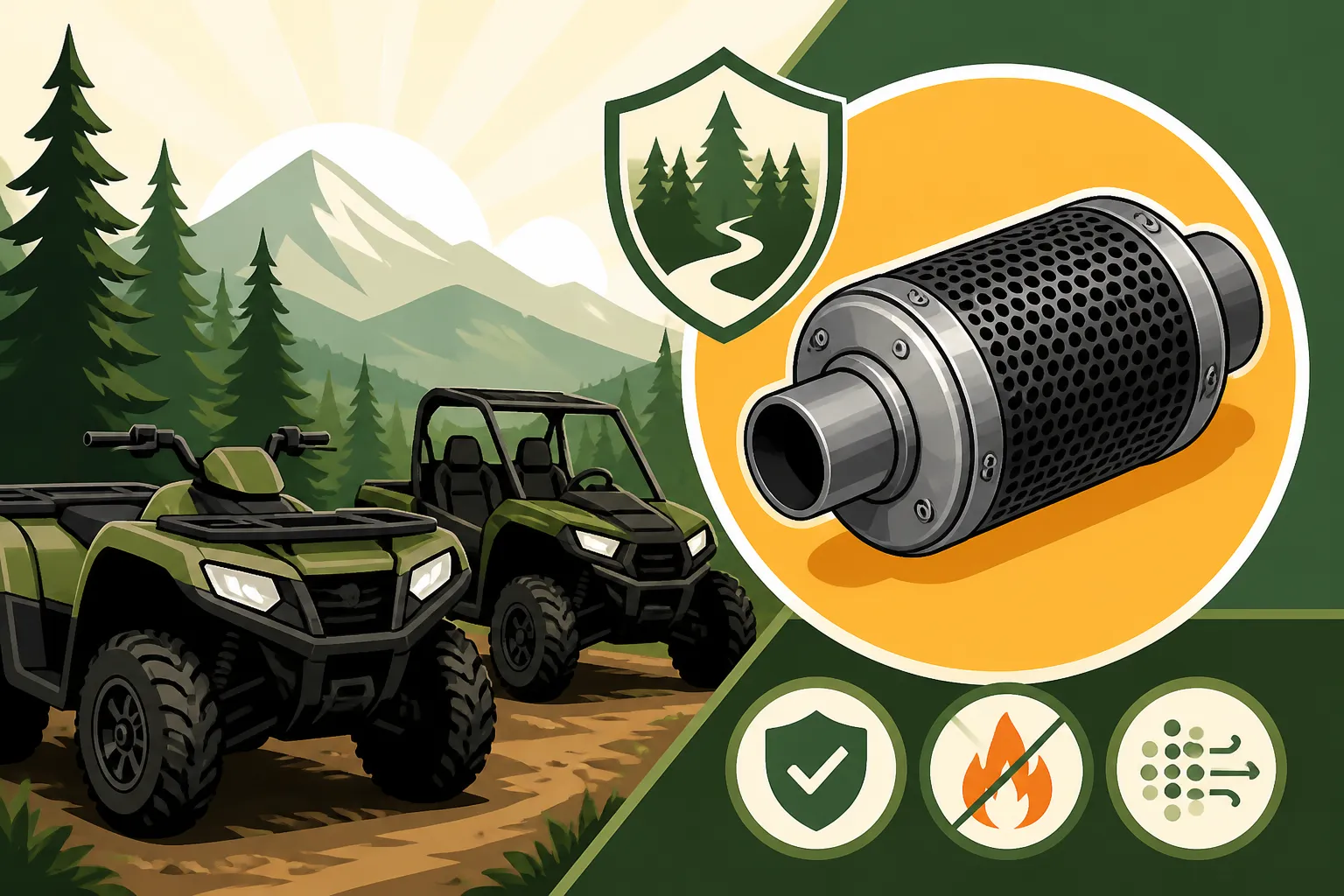
A spark arrester is a device in an exhaust system that helps prevent hot particles from escaping and igniting nearby vegetation. On public lands, fire prevention is a serious concern, and land managers may require a spark arrester that meets the USDA Forest Service standard. Riders often call this “Forest Service rated,” “USFS approved,” or “Forest Service qualified,” but the wording on a product listing is not, by itself, proof that the device meets the relevant standard.
The practical question is whether the exact arrester, installed on your exact machine and exhaust, has credible documentation showing that it qualifies. A screen or insert that looks similar to an approved part should not be treated as equivalent. Mesh size alone does not establish compliance, and a generic exhaust screen may not be designed or tested for the same purpose.
Requirements depend on where you ride. A National Forest, state forest, BLM area, or riding site can have its own rules and enforcement practices. Before choosing a part, check the requirements for your destination, including any posted restrictions. For broader context, see Oregon Spark Arrester Requirements on Trails, Oregon Rules for Riding a National Forest, Oregon Rules for Riding State Forest Land, and [Oregon Rules for Riding BLM Land].
A spark arrester also does not automatically make a machine compliant with noise limits. Those are separate requirements, and an exhaust that passes one check may fail the other. Review Oregon Sound Limits and Where They Apply and the site’s current rules rather than assuming one compliant part covers every exhaust requirement.
How to choose an arrester that fits and qualifies
Start with the machine’s make, model, year, engine, and exhaust configuration. Factory exhausts and aftermarket systems can use different outlets, mounting hardware, and internal designs. A part listed for one model year may not fit another, even when the machines look alike. If the exhaust has been replaced or modified, a fitment guide for the original equipment may no longer apply.
Verify the exact product
Look for the manufacturer’s documentation for the specific arrester model. It should identify the product and explain its qualification or intended compatibility. If a seller’s page only says “spark arrestor” or “off-road screen,” ask the manufacturer whether that precise part meets the Forest Service standard for your application. Keep the answer and product documentation with your maintenance records.
Marketplace listings can be useful for comparing parts, but titles and seller descriptions are not a substitute for manufacturer confirmation. If you search Amazon or another marketplace, check the manufacturer’s part number, the application list, and the documentation rather than relying on a broad claim in the listing.
Be cautious when the part is described only as a universal insert. Universal products may work for some setups, but you still need to confirm the fit, retention method, and qualification for your machine. A loose insert, improvised screen, or unverified replacement can create both compliance and operating problems.
Compare the main options
| Option | When it may make sense | What to verify |
|---|---|---|
| Factory-installed arrester | The original exhaust is intact and the machine’s documentation identifies it as spark-arresting | That it is still installed, undamaged, and maintained as specified |
| Replacement insert for the original exhaust | The stock arrester is missing, worn, or damaged | Exact fitment, qualification, and secure installation |
| Arrester designed for an aftermarket exhaust | The machine has a compatible aftermarket system | Compatibility with the exhaust model and qualification evidence for the exact part |
| Generic screen or universal insert | Only if the manufacturer confirms the specific application and compliance | Do not rely on appearance or mesh dimensions alone |
If you are unsure whether the factory exhaust includes an arrester, consult the owner’s manual or contact the machine or exhaust manufacturer. A muffler is not automatically a spark arrester simply because it is part of the exhaust system. Likewise, a product marketed as a “quiet core” or noise insert should not be assumed to meet spark-arrester requirements unless its documentation says so.
Ask for clarification before purchasing when the product information is vague. Useful questions include: Is this exact part qualified as a spark arrester? Which exhaust and machine models does it fit? Does the qualification depend on a particular insert or configuration? What inspection or cleaning does the manufacturer require? Clear answers are more useful than a general assurance that the product is “trail legal.”
Installation, inspection, and upkeep
A correctly selected part can still be ineffective if it is installed incorrectly, damaged, or removed. Follow the manufacturer’s installation instructions and use the specified hardware. The arrester should be seated and retained as designed, with no missing fasteners or gaps that could let hot particles bypass it. Do not drill, cut, enlarge, or otherwise alter the part unless the manufacturer’s instructions explicitly allow it.
After installation, confirm that the exhaust is assembled in the same configuration covered by the documentation. A qualified insert installed in the wrong muffler or behind an incompatible component may not provide the intended protection. If several components have been changed, check the full exhaust setup with the manufacturer instead of assuming the arrester’s approval transfers to any combination of parts.
Inspect the system before rides, especially after transport, repairs, or a hard outing. Look for a missing insert, loose fasteners, cracks, unusual rattling, rust-through, or a screen clogged with carbon. Clean it only as the manufacturer directs. Some designs need regular cleaning to prevent blockage; others have different service instructions. Do not burn out buildup with an open flame or use a method that can damage the screen or housing.
A clogged or damaged arrester can affect engine performance and may cause overheating or exhaust problems. If the machine suddenly runs differently, loses power, or the exhaust becomes unusually hot, stop and inspect it rather than continuing to ride. Replace a failed part with one documented for the same application. See Replacing a Burned-Out Arrester for practical replacement considerations.
Keep a copy of the product information, receipt, and installation details where you can retrieve them. This can help answer questions during a site inspection and make it easier to identify the correct replacement later. A document does not replace the physical inspection, but it supports your claim that the part is the specified model.
A pre-ride check for Oregon riders
Before a trip, check three separate things: the arrester, the exhaust’s sound compliance, and the rules for the land you plan to use. Requirements can differ by area and may change with fire conditions, seasonal restrictions, or closures. A machine that was acceptable at one trailhead may not meet the rules at another.
Use this quick process:
- Identify the riding area and check its current spark-arrester and fire restrictions.
- Confirm that the installed part is the exact model documented for your exhaust setup.
- Inspect the arrester, fasteners, and exhaust for damage, blockage, or missing parts.
- Check sound requirements separately; an arrester does not establish that the machine meets a sound limit.
- Carry the manufacturer’s documentation and know how to show the installed part if asked.
A properly selected arrester is one part of responsible riding, not a pass for every trail or condition. Follow closure notices and fire restrictions even when your machine has a qualified device. Oregon Rules for Riding During Fire Season can help explain why access may be restricted independently of your equipment, and Passing a Sound Check at a Staging Area covers the separate noise-compliance issue.
Disclaimer
This article is for general informational purposes only and does not constitute professional advice. Laws, prices and regulations vary by location and change over time. Consult a qualified professional for guidance on your specific situation.