Golf Carts Versus ATVs in Oregon Towns
One of the most common head-scratchers for folks looking to enjoy their recreational vehicles is understanding where they can and can't legally ride them, especially when it comes to getting to a trailhead or just cruising around a small town. It's a frustrating maze of state laws and local ordinances, and often, the biggest confusion crops up when people try to apply golf cart rules to their ATVs or UTVs, or vice-versa. This guide aims to clear up that confusion, explaining why these machines are viewed so differently in Oregon and where you can realistically expect to ride each type within town limits.
Understanding the Legal Landscape: Why Golf Carts and ATVs Are Treated Differently
It’s easy to look at a small UTV or a side-by-side and think, "Hey, that looks a lot like a golf cart, maybe I can drive it on the same roads!" But this is where the differences really start to matter, and Oregon law is pretty clear on how it classifies these various machines. The distinction isn't just about size or how many people they seat; it's deeply rooted in their original design purpose and the specific regulations built around that.
Defining a Golf Cart in Oregon's Eyes
When Oregon talks about a golf cart, it's generally referring to a low-speed, electrically powered (though gas models exist) four-wheeled vehicle primarily designed for use on a golf course. These aren't built for high speeds or rugged off-road terrain. They typically have a maximum speed of around 20-25 miles per hour and are equipped with basic safety features suitable for low-speed environments. The legal framework surrounding golf carts often acknowledges their limited capabilities and intended use, which is why some towns can create specific rules for them. They're seen as less of a traffic safety risk than faster, more powerful vehicles.
What makes them distinct in the eyes of the law is that they fall into their own unique category, separate from conventional automobiles or even ATVs. Their lightweight construction and lower power output mean they don't meet the stringent safety and emissions standards required for typical on-road vehicles. This specific classification is what allows local jurisdictions to have the flexibility to permit their use on certain designated public roads, often with speed limits and other restrictions.
Defining an ATV in Oregon's Eyes
Now, let's talk about ATVs and UTVs, which Oregon lumps into a broader category of Off-Highway Vehicles (OHVs). Oregon's laws define ATVs and UTVs by their design: they are motor vehicles specifically manufactured for off-highway use. This is the critical difference. Whether it's a quad with a straddle seat or a side-by-side (Class IV) with a steering wheel and bench seats, their fundamental engineering is geared towards tackling trails, dunes, and rugged terrain, not asphalt.
Oregon has specific classes for these machines, like [Oregon's Class I Under ORS 801.190] for most quads and [Oregon's Class IV Side-by-Sides Under 75 Inches]. These classifications dictate everything from operating permits to helmet requirements. They are designed with powerful engines, knobby tires, high ground clearance, and robust suspensions to handle challenging environments. While some UTVs might resemble a small car, their chassis, braking, and safety systems are not designed to the same standards as on-road vehicles. This inherent off-road design is why they face much stricter rules when it comes to riding on public roads, especially in populated areas.
The Fundamental Legal Distinction: Designed for Road Use (or not)
The core difference between how Oregon views golf carts and most ATVs comes down to their initial design and certification. Golf carts, even if not fully "street legal" in the traditional sense, can be considered "low-speed vehicles" in some contexts, allowing for local ordinances to designate specific roads for their use. They are generally seen as less aggressive and less capable of causing serious damage in a traffic accident due to their speed and construction.
Most ATVs and UTVs, however, are explicitly designed and manufactured for off-highway operation. They lack many of the features mandatory for on-road vehicles, such as DOT-approved tires, laminated safety glass windshields, specific lighting requirements, and advanced emissions controls. Trying to operate an off-road vehicle on a public road designed for cars poses significant safety risks, both for the operator and for other drivers, and is largely prohibited. This is why you need an [Oregon ATV Permit for a Side-by-Side] even for off-road use, and why the rules change drastically when pavement enters the picture. The assumption is that if it's an ATV, it belongs off the paved road unless explicitly stated otherwise by state law or specific local allowances.
Where Golf Carts Can Roam in Oregon Towns
While the idea of zipping around town in your golf cart might sound appealing, it's not a free-for-all. Oregon gives local jurisdictions the power to decide if and where golf carts can be operated on public roads. This means that rules can vary wildly from one town to the next, often depending on local needs and safety considerations.
Designated Golf Cart Streets and Ordinances
For a golf cart to be legally driven on a public street in Oregon, that street must be specifically designated for golf cart use by a local ordinance. This isn't something that just happens; it requires a formal decision by a city council or county commission. These ordinances usually spell out precisely which streets are permissible, what hours of operation are allowed, and any specific safety equipment requirements (like turn signals, reflectors, or even seatbelts) that might be above and beyond what a standard golf cart comes with. The intent behind these designations is typically to allow residents access to local amenities like grocery stores, the beach, or community centers, especially in smaller, often tourism-dependent towns where traffic speeds are lower and volumes are less.
It’s not just a matter of "can I drive it on the road?" but "can I drive it on this specific road under these specific conditions?" A designated golf cart street will usually have signage indicating its status, and it will often be a street with a low speed limit, rarely exceeding 25 mph. These are often quieter residential streets or secondary roads, not main thoroughfares or state highways.
Limited Scope of Travel: From Golf Course to Home
Even on designated streets, the permissible travel of golf carts is often very limited. It’s usually about connecting specific points within a community, rather than providing general transportation. Think about getting from a residence to a local golf course, a marina, or a designated beach access point. The idea is to reduce the number of short car trips in certain areas, promoting a more leisurely, environmentally friendly form of local transit.
You generally won't find golf carts allowed on state highways, major arterial roads, or any street where the speed limit is above 25 mph. These restrictions are put in place for obvious safety reasons, as golf carts simply aren't designed to interact safely with faster-moving traffic. Their low profile, limited acceleration, and lack of robust crash protection make them unsuitable for higher-speed environments. So, while you might see them puttering along a beach town's side streets, don't expect to take one on a cross-town journey or a trip to the next municipality over.
Specific Town Examples: Manzanita's Approach
A great example of a town that has embraced golf cart usage is Manzanita, a charming coastal community on the Oregon coast. Manzanita has a specific ordinance that allows golf carts on certain public streets. The town's regulations, often referred to as [Golf Cart Rules on Manzanita's Streets], permit residents and visitors to use golf carts for local travel, such as heading to the beach, visiting local shops, or getting to their vacation rentals. However, these rules come with strict limitations. Golf carts are generally permitted on streets with speed limits of 25 mph or less, and they are typically restricted from main thoroughfares like U.S. Highway 101, which is a state highway.
The intent in Manzanita is to enhance the small-town, relaxed atmosphere and reduce vehicle traffic for short trips. The ordinance details specific requirements, such as the need for valid driver's licenses for operators, appropriate lighting for nighttime use, and adherence to all traffic laws. It’s a carefully considered balance to allow convenience while prioritizing safety within the community. Other towns might follow a similar pattern, but it's crucial to always check the specific local ordinances for any town you plan to visit, as what's allowed in Manzanita might be strictly prohibited just a few miles down the coast.
The Reality for ATVs and UTVs on Oregon Town Streets
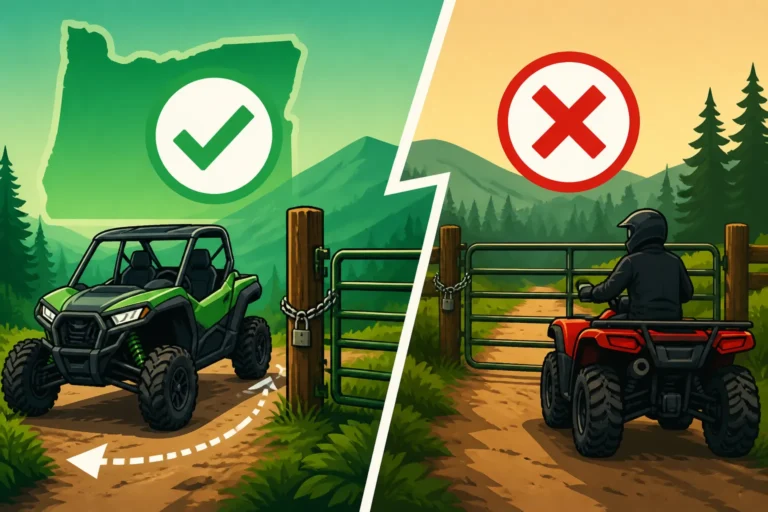
Now, shifting gears to ATVs and UTVs, the picture changes significantly. For the vast majority of these machines, operating on public roads, especially in town, is simply not allowed. The legal framework is designed to keep these powerful, off-road machines in their intended environment – the trails, dunes, and forest lands – unless they meet very specific, stringent criteria.
Why Most ATVs Aren't Street Legal in Oregon
The fundamental reason most ATVs and UTVs are not street legal in Oregon boils down to their design and the state's vehicle code. As mentioned earlier, these machines are built for off-highway use. They lack standard safety features required for on-road vehicles, such as DOT-approved tires that can handle pavement wear, turn signals, brake lights, headlights with high/low beams, rearview mirrors, and sometimes even a proper horn. Many also lack laminated safety glass windshields or full enclosures that provide occupant protection in a collision with another road vehicle.
Oregon's vehicle registration laws, managed by the DMV, focus on vehicles designed for highway use. Since ATVs and UTVs don't meet these design and safety standards, they generally cannot be registered for street use. This means you can't simply put a license plate on your quad and drive it down Main Street. Attempts to do so can result in significant fines and legal trouble, as operating an unregistered, unpermitted, and unsafe vehicle on public roads is a serious offense. This is why the question [Are ATVs Street Legal in Oregon?] usually gets a resounding "no" for most machines.
The Exception: Oregon's Class II Street-Legal Machines
There is, however, a notable exception to the general "no street legal" rule in Oregon: [Oregon's Class II Under ORS 801.193]. This class is specifically for vehicles that were originally manufactured for off-highway use but can, under very specific circumstances, be modified and registered for limited street use. We're primarily talking about sand rails, dune buggies, and some larger utility vehicles that are specifically designed to meet certain on-road safety standards after modification.
To qualify as a street-legal Class II machine, the vehicle must meet all the requirements for highway use, which can include things like DOT-approved tires, windshields, wipers, turn signals, brake lights, headlights, rearview mirrors, a horn, and often an exhaust system that meets sound and emissions standards. This isn't a simple bolt-on job; it often requires significant investment in parts and careful attention to detail. Once these modifications are made, the vehicle can then be inspected by the DMV and, if it passes, registered and plated for road use. However, even with these modifications, their road use is often limited to certain types of roads, and they are typically subject to specific insurance requirements, like [Oregon Insurance Requirements for Class II].
Designated ATV Highway Access Routes: A Rare Opportunity
Beyond the Class II exception, there's another very limited scenario where ATVs and UTVs (including Class I, III, and IV) can legally operate on public roads: designated [Oregon ATV Highway Access Routes]. These are very rare, specific sections of road that have been explicitly opened to OHV traffic by local and state authorities. Currently, Oregon only has two such routes: one in [Riding an ATV Through Lakeside] and another in [Riding an ATV Through Sumpter]. These routes are the result of specific, detailed processes involving local governments, the Oregon Parks and Recreation Department, and the Oregon Transportation Commission.
These routes are not free passes to ride anywhere. They are carefully selected roads, often connecting trailheads to towns, or allowing riders to access different sections of a riding area. They will be clearly marked with signs indicating that OHV use is permitted. Riders must still adhere to all traffic laws, carry their [Oregon ATV Permits Explained] and [Oregon's ATV Safety Education Card], and ensure their machines meet basic safety requirements (like headlights and taillights). You can't just assume any county or forest road is an "access route." It must be formally designated. For more information, you can look up [Oregon's Only Two Designated ATV Routes: Lakeside and Sumpter].
The Risks and Consequences of Misusing Your Machine
The temptation to take a shortcut through town or just quickly run to the store on your ATV can be strong, especially in rural areas. However, the legal and safety consequences of operating an off-highway vehicle on prohibited public roads are significant and can easily outweigh any perceived convenience. It's not just about getting a ticket; it's about personal safety, the safety of others, and protecting your investment.
Potential Citations for Unpermitted or Improper Road Use
The most immediate consequence of riding your ATV or UTV on a non-designated public road is a citation. Oregon law classifies operating an OHV on a highway without proper registration or in a prohibited area as a Class C traffic violation. This isn't just a slap on the wrist. [Oregon Fines for Riding an Unopened Road] can be substantial, often hundreds of dollars, and can sometimes be accompanied by impoundment of your machine. An Oregon State Trooper, a county sheriff's deputy, or even a local police officer can pull you over. They're often looking for things like proper [Oregon ATV Permit Decal Placement], visible headlights, and whether the vehicle looks street-legal, as described in [What an Oregon Trooper Checks Roadside].
Beyond state fines, local jurisdictions might have their own ordinances and penalties. It's a complex web, and ignorance of the law is rarely an excuse. Repeated offenses can lead to even harsher penalties, and these violations can affect your driving record, potentially leading to increased insurance rates or even license suspension, depending on the severity and frequency.
Safety Concerns: Designed for Off-Road, Not Main Streets
Putting an ATV or UTV on a paved road presents significant safety hazards. These machines are engineered for loose surfaces like dirt, sand, and mud, not hard, abrasive asphalt. Their knobby tires provide excellent traction off-road but can be unstable and wear quickly on pavement, reducing braking effectiveness and handling precision. The suspension systems are designed to absorb rough terrain, not provide smooth, stable handling at higher road speeds or during quick maneuvers required in traffic.
Furthermore, most ATVs and UTVs lack the basic safety features found on cars. They often don't have roll-over protection structures designed for highway-speed collisions, airbags, or crumple zones. Visibility can also be an issue; a low-profile ATV can be difficult for drivers of larger vehicles to see, especially in traffic. [Oregon Helmet Law for ATV Riders] is mandatory, but even a helmet doesn't fully protect against impacts with a passenger vehicle. The risks of serious injury or fatality are dramatically higher when an off-road machine is involved in a collision on a paved road compared to its intended environment.
Insurance Implications for On-Road Incidents
If you're involved in an accident while riding your ATV or UTV on a public road where it's not legally permitted, you could face severe insurance implications. Your standard off-road ATV insurance policy, which covers you for trail riding and private land, almost certainly will not cover incidents that occur on public roads where the vehicle is not legally authorized to be. This means you could be personally liable for all damages, including property damage, medical bills, and potential lawsuits from other parties involved in the accident.
This financial exposure can be catastrophic. Without specific street-legal registration and a corresponding auto insurance policy (which is usually mandatory for Class II street-legal machines), you're essentially uninsured for road accidents. Even if you have liability coverage for your off-road activities, the moment you transition to an unauthorized public road, that coverage may be void. This is a crucial consideration, and one many riders overlook until it's too late.
Navigating the Grey Areas and Local Ordinances
The landscape of where you can and cannot ride your golf cart or ATV/UTV in Oregon towns is complex and often feels like a patchwork of rules. It requires diligence, a good understanding of both state law and local ordinances, and a proactive approach to ensure you're riding legally and safely.
How Towns Adopt Their Own Rules
The power for towns and counties to create specific rules for vehicles like golf carts, and in rare cases, even ATVs, comes from the Oregon Revised Statutes (ORS). While the state sets the overarching framework, it often grants local governments the authority to pass ordinances that address unique local conditions. This is why you'll find places like Manzanita with golf cart streets, but not every coastal town has them. A town typically adopts such rules after a public process, including community input, safety assessments, and formal votes by city councils or county commissioners. These ordinances are designed to meet local needs, manage traffic, and ensure public safety within their specific jurisdiction.
However, this local authority is usually limited. A town cannot pass an ordinance that directly contradicts state law. For example, a town cannot simply declare that all ATVs are street-legal if state law says they are not, unless the state law itself provides for such a local option (as it does for designated access routes). So, while towns have some flexibility, it's always within the broader confines of Oregon's vehicle code.
The Process for Designating New ATV Routes
For ATVs and UTVs, the process for designating new public road access routes is far more involved than for golf carts. It falls under the purview of the [Oregon ATV Highway Access Routes Advisory Committee] and the Oregon Transportation Commission. This isn't a simple local decision. A local government or community group must formally apply to the state to designate a specific road as an OHV access route. This application typically requires extensive documentation, including safety studies, traffic analyses, environmental impact assessments, and clear justification for why the route is necessary.
The advisory committee reviews these applications, gathers public input, and makes recommendations to the Oregon Transportation Commission. The Commission then makes the final decision. This rigorous process is why there are currently only two such designated routes in Oregon. It ensures that any road opened to OHV traffic has been thoroughly vetted for safety and community impact. If you're passionate about seeing more access, understanding [Applying to Designate a New Oregon Route] is the first step, but be prepared for a long and detailed process.
What to Do Before You Ride on Any Town Road
Given the complexities, the golden rule before riding any motorized vehicle on a public road within an Oregon town is to do your homework. Never assume that because you see someone else doing it, it's legal. Here's a practical checklist:
- Identify Your Machine: Know your machine's Oregon ATV Class ([Which Oregon ATV Class Your Machine Falls Into]). This dictates what rules apply to you.
- Check Local Ordinances: If you're considering riding a golf cart or an ATV on a town street, contact the city hall or county clerk's office for that specific jurisdiction. Ask for their current ordinances regarding golf cart or OHV use on public roads. This is the only way to get accurate, up-to-date information for that specific location.
- Look for Signage: Designated golf cart streets and [Oregon ATV Highway Access Routes] will have clear signs indicating where you can and cannot operate. Always obey these signs.
- Understand Your Insurance: Confirm with your insurance provider what your policy covers. If you're considering a street-legal Class II machine, ensure you have appropriate on-road liability insurance.
- Be Prepared for Enforcement: If you choose to ride on a road, always have your [Oregon ATV Safety Card Requirements], and current [Oregon ATV Permits Explained] with you, displayed correctly. Law enforcement can stop you to verify compliance. You don't want to get caught unprepared, facing [Oregon Fines for Riding Without a Permit].
- Consider Safety Gear: Regardless of the specific rules, always wear appropriate safety gear, including an approved helmet. Even on slow-speed golf cart streets, accidents can happen.
By following these steps, you can significantly reduce your risk of citations, accidents, and financial liability, ensuring a safer and more enjoyable experience with your recreational vehicle in Oregon.
| Feature / Vehicle Type | Golf Cart (Designated Street Use) | ATV / UTV (General) | ATV / UTV (Class II Street-Legal) | ATV / UTV (Designated Access Route) |
|---|---|---|---|---|
| Primary Design | Low-speed, golf course/local travel | Off-highway, rugged terrain | Off-highway (modified for street) | Off-highway, rugged terrain |
| Speed Limit | Usually max 25 mph | N/A (not for road use) | Varies by road, up to posted limit | Varies by road, up to posted limit |
| Street Legal Status | Only on designated local streets | Not street legal | Can be street-legal after modification & registration | Only on specifically designated routes |
| State Registration/Plate | No (local permit may apply) | No (OHV permit for off-road) | Yes, mandatory DMV registration & plate | No (OHV permit for off-road) |
| Insurance Req. | Often local liability | Off-road insurance recommended | Mandatory auto insurance for road | Off-road insurance recommended |
| Typical On-Road Use | Short trips within specific towns (e.g., Manzanita) | None, prohibited | General road use on approved roads | Specific connectors between trails/towns (e.g., Lakeside) |
| Required Safety Gear | Varies by local ordinance (helmets often not required) | [Oregon Helmet Law for ATV Riders] always required | [Oregon Helmet Law for Adults] depends on enclosure/roof | [Oregon Helmet Law for Every Rider Under 18] always required for quads |
| Required Equipment | Varies (lights, reflectors, turn signals often added) | Off-road specific (spark arrester, sound limits) | Full suite of DOT-compliant road equipment | Basic lights, functional brakes, spark arrester |
Disclaimer
This article is for general informational purposes only and does not constitute professional advice. Laws, prices and regulations vary by location and change over time. Consult a qualified professional for guidance on your specific situation.