Marked Habitat on the Sand
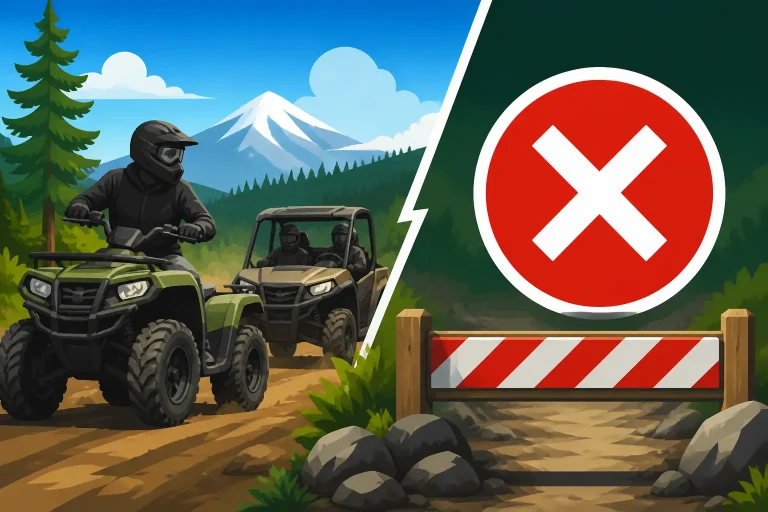
Marked habitat on Oregon’s sand can be easy to mistake for an ordinary stretch of dune, especially when wind softens tire tracks or signs are partly obscured. For ATV and UTV riders, the safe rule is simple: treat fencing, stakes, signs, and marked boundaries as closed areas. A riding permit does not give permission to cross them.
What marked habitat means on the dunes
Habitat markers identify areas set aside to protect wildlife or sensitive natural features. On Oregon’s coast, seasonal protections can include places used by nesting shorebirds, including snowy plovers. Other closures may protect habitat or help managers limit damage to fragile dune environments. The exact purpose and boundary depend on the site and the signs in place.
Markers can take several forms: signs, posts, rope, temporary fencing, cones, or other visible boundaries. Some areas may also be shown as closed on a map. A line of markers is not an invitation to ride up to it, pass through a gap, or follow another rider’s tracks beyond it. The boundary itself is the point to respect.
Habitat protection is not always obvious from the ground. A dune may look empty, and a rider may not see an animal or nest. That does not mean the area is open. Wildlife can be difficult to spot, and nesting sites can be small or camouflaged. Staying out of marked areas helps avoid disturbing animals and prevents damage to the habitat being protected.
Closures can be temporary or seasonal, and boundaries may change. A map or memory from a previous trip may not reflect current conditions. Before riding, check current site information and posted notices, then follow signs and barriers at the staging area and on the sand. If a map and an on-site marker seem to conflict, do not ride into the marked area while trying to resolve the discrepancy. Choose an open route and confirm the boundary with the responsible land manager.
For practical background on coastal closures and nesting areas, see Oregon Rules for Riding Near Nesting Birds and Snowy Plover Fencing on the Beach. The broader rules for riding on the coast are covered in Oregon Rules for Riding a Beach.
Common markers and what to do
| What you see | What it may indicate | Safer response |
|---|---|---|
| A sign that says an area is closed or identifies habitat | A restricted area or seasonal protection | Stop outside the boundary and use an open route |
| Rope, temporary fencing, or a line of stakes | A boundary that riders should not cross | Do not go around, over, or through the barrier |
| A closure shown on a current map | A route or area that is not open for riding | Plan another route and check for updates |
| An unclear or partly buried marker | A boundary that may be hard to read | Keep back, avoid the uncertain area, and ask site staff |
| Tire tracks beyond a marker | Evidence that someone rode there, not proof that it is allowed | Do not follow the tracks |
A marker may be hard to see because of windblown sand, fog, darkness, or traffic. Riders should slow down where visibility is limited and avoid charging toward a boundary they cannot clearly read. If visibility is too poor to identify the open route, stopping or turning back is safer than guessing.
Permits and access are separate questions
Oregon’s ATV operating permit addresses machine use under the state’s permit system. It does not automatically open every road, trail, beach, or dune area to riding. A valid permit and an open route are separate requirements: riders need to satisfy applicable permit rules and stay within the areas currently authorized for riding.
The same principle matters to visitors. An out-of-state permit or registration may affect whether a machine meets Oregon’s permit requirements, but it does not override habitat closures or local access restrictions. Reciprocity is about whether certain out-of-state credentials are recognized for the relevant purpose; it is not permission to enter a closed zone. Check Oregon Permit Reciprocity List and Riding Oregon With an Out-of-State Permit if you are bringing a machine from elsewhere.
Do not assume a route is open just because it appears on a map, has tire tracks, or connects two areas where riding is allowed. A route can pass near a protected section, and an open staging area does not mean every nearby patch of sand is open. Follow the posted boundaries and use designated, currently open routes.
It also helps to separate the different costs and permissions involved in a trip. An ATV operating permit, any site-specific day-use requirement, and permission to ride a particular route are not interchangeable. A pass or receipt for one purpose does not cancel a closure for another. For more on access notices and current closures, consult Oregon Trail Closures to Check First and The Oregon Dunes National Recreation Area.
If a boundary is confusing
When a marker is hard to interpret, do not test it by driving closer or crossing to see what is on the other side. Stop in a safe, open location. Read nearby signs, check the map or site information you have, and ask an official or site contact if one is available. If you cannot confirm that the route is open, turn back and choose a clearly open route.
This cautious approach is useful when markers have shifted, a sign is damaged, sand has covered part of a boundary, or two maps show different information. A gap in a fence does not necessarily mean the area is open; it may be an access point for people managing the site, or the barrier may have been damaged. Do not move a marker or drive around it to make your own route.
How to ride responsibly near marked areas
A good ride plan begins before the machine reaches the sand. Check current access information for the riding area, note any seasonal or temporary closures, and identify the open routes you intend to use. At the staging area, read posted notices again. Conditions can change, and signs at the site may address restrictions that are not obvious from older maps.
On the sand, leave a clear buffer around habitat markers rather than riding right along a fence or line of stakes. Give yourself room to turn without cutting across a protected edge. If other riders approach from the opposite direction, slow down and avoid making sudden maneuvers that could push either machine toward the boundary.
Keep the machine on open riding areas and avoid widening tracks into undisturbed sand. Do not ride over signs, fencing, or stakes, and do not use a protected area as a shortcut around a crowded route. If a route appears blocked, backtrack to an open area instead of detouring through nearby habitat.
A dune flag or whip can help other riders see a machine over a rise, but it does not make a closed area safe or legal to cross. Use the required visibility equipment for the site and your machine, and keep a speed that allows time to react to people, wildlife, markers, and changing terrain. Oregon Dune Flags and Whips explains the role of flags on the dunes.
Responsible riding also means avoiding unnecessary stops, revving, or circling near sensitive areas. If you see wildlife, give it room and do not chase it for a closer look or a photograph. Keep dogs under control and follow site rules about pets. When riding with a group, make sure everyone knows the boundary before setting off; a lead rider should not assume the rest of the group can see every marker.
A few habits make it easier to stay on the right side of a closure:
- Check the area’s current notices before leaving for the ride.
- Read signs at the staging area and near route junctions.
- Keep a map or other reliable route information available.
- Slow down when approaching markers or when visibility is poor.
- Turn around if the open route is uncertain.
- Tell other riders in your group not to cross a closure, even if tracks lead beyond it.
- Report damaged or unclear markers to site staff when possible, without moving them yourself.
These steps are especially useful in changing coastal conditions. Wind can cover tracks and shift sand, while fog can make signs and other riders harder to see. A line that was easy to spot on a clear day may be difficult to distinguish in poor visibility. In those conditions, stay within the route you can confidently identify and avoid exploring unfamiliar edges.
What to do if you find a closure or have crossed one
If you reach a marked boundary, stop before it and turn around. Do not ride along the barrier looking for a gap, and do not treat a gap as an authorized entrance unless a sign or official map clearly identifies it as an open route. Use the route you came in on, or return to a junction and choose a route that is clearly open.
If you realize you have crossed into a marked area, do not continue farther in or ride around to find a different exit. Stop safely, avoid disturbing the area further, and retrace your entry path carefully if doing so does not require crossing a more restrictive barrier. If you cannot tell how to leave without causing more damage, contact site staff or the responsible land manager for direction.
If a marker is down, obscured, or missing, do not assume the area has reopened. Treat the boundary as uncertain and stay out until you can confirm the route status. You can report the problem to the appropriate site contact. A photo of the marker and a general location can help staff understand what needs attention, but do not approach wildlife or enter a closed area to get a better picture.
Avoid arguing with another rider at the boundary or following them into a closure. Their choice does not establish that the route is open. If the situation seems unsafe, give them space, remain on an open route, and notify site staff if appropriate.
The most dependable way to prevent a problem is to treat marked habitat as a firm boundary, not a suggestion. Oregon’s dunes offer plenty of room for riding where access is open, but the right to ride a permitted machine does not include the right to cross a protected area. Stay outside marked habitat, verify current routes, and turn back whenever the boundary is unclear.
Disclaimer
This article is for general informational purposes only and does not constitute professional advice. Laws, prices and regulations vary by location and change over time. Consult a qualified professional for guidance on your specific situation.