The Oregon Dunes National Recreation Area
The Oregon Dunes National Recreation Area can look like one enormous playground on a map, but not every stretch of sand is open to riding. Visitors also have to sort out staging areas, permits, day-use requirements, habitat closures, and changing dune conditions. This guide explains how to plan a safer, more enjoyable visit, choose a riding area, and avoid common first-trip mistakes.
Understand the Oregon Dunes before you ride
Where the recreation area is and what it includes
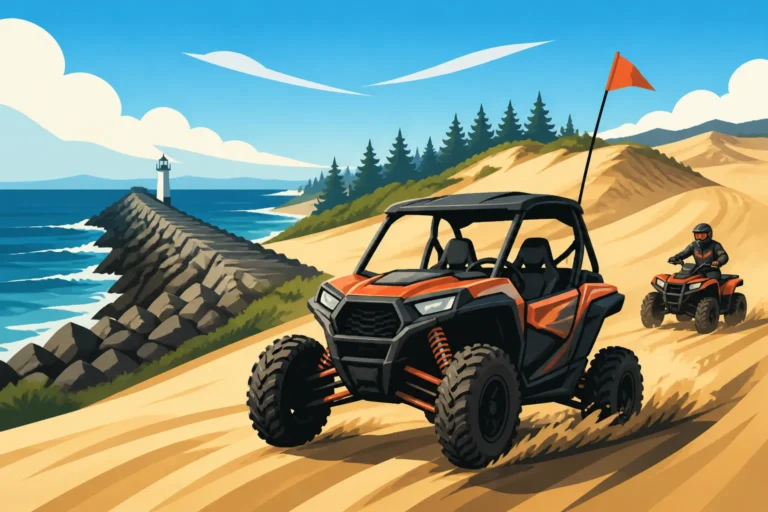
The Oregon Dunes National Recreation Area follows a long section of the central Oregon coast, with dunes and recreation sites near Florence, Reedsport, and North Bend. It is part of a varied coastal landscape that includes forest, wetlands, lakes, shorelines, and open sand. The name can make it sound like one continuous riding area, but access and permitted activities differ from place to place.
For riders, that distinction matters. A road or trail leading toward the sand is not automatically an authorized OHV route, and an open-looking dune is not necessarily open to motorized use. Boundaries, posted signs, seasonal restrictions, and designated riding areas determine where you can go. Before unloading, identify the specific site you plan to use and check its current map and notices.
The region includes several staging areas and riding zones rather than one central entrance. A family staying near Florence might choose South Jetty, while someone near Winchester Bay may be better placed for Spinreel or Hauser. For an overview of how the access points fit together, see [Oregon Dunes Staging Areas From North to South].
Riding areas are not interchangeable
The dunes change dramatically along the coast. Some places offer broad, exposed sand and large dune faces; others have narrower corridors, more vegetation, or closer connections to forest and coastal habitat. Wind, rain, tides, and seasonal closures can change what a route feels like even when the site itself is open.
Your machine and experience should influence your choice. A novice on a small quad may prefer an area where it is easy to stay oriented and return to the staging lot. A group with side-by-sides may want to confirm that the planned routes accommodate the machines’ width and turning needs. Riders hoping to reach the beach should check whether the route is legal and open, not assume the sand connects freely to the shoreline.
It helps to compare sites by practical details rather than reputation alone: the kind of riding, the distance from your lodging, available staging, and the restrictions that apply. [Oregon Dune Riding Areas Compared] is a useful next read when you are narrowing down options. Treat any map as a planning aid, then confirm conditions with the responsible land manager before heading out.
Choose a riding area that fits your trip
South Jetty and the Florence area
South Jetty is a convenient choice for many visitors staying in or around Florence. The town has lodging, restaurants, fuel, and other trip essentials, while the staging area gives riders access to a portion of the dunes. The ease of reaching the coast is appealing, but it can also mean busy weekends, mixed traffic, and more pressure to keep track of companions.
Before choosing South Jetty, check which access points and riding sections are open for your planned date. The broader Florence area includes multiple recreation destinations, and visitors sometimes confuse one parking or beach access point with another. Confirm the route from the staging area to the riding zone, and make sure your group understands where motorized travel is allowed.
The northern part of the dunes has its own character and access patterns. For a closer look at the area, see [South Jetty and Oregon's Northern Dunes]. If you are staying in Florence, plan for extra time to load, secure gear, and handle permits before riding. A short drive from town does not mean you can skip preparation once you reach the sand.
Spinreel, Hauser, and Winchester Bay
Spinreel and Hauser serve riders near Winchester Bay and North Bend. These areas can be a practical base for a coastal riding weekend, especially if your group is staying nearby or wants to explore the southern portion of the dunes. The setting, staging arrangements, and riding connections are different from those around Florence, so do not assume advice from one area applies exactly at the next.
A common planning error is treating a named staging area as a guarantee that every nearby route is open. Check posted information at the site and verify the boundaries on a current map. If you are meeting friends, agree on a staging lot and a return time before anyone rides away. Dunes can make it difficult to see a vehicle or rider only a short distance beyond a ridge.
For a site-by-site comparison, [Spinreel and Hauser on the Oregon Coast] can help you decide which location better suits your group. Nearby access points such as Umpqua Beach Two and Three also have their own conditions and rules; [Umpqua Beach Two and Three] offers additional context. Choose based on the actual ride you want, not just the shortest distance from your lodging.
Bull Run, Goosepasture, and other access points
Bull Run and Goosepasture are names riders may encounter when planning a trip around the dunes near Winchester Bay. Even experienced coastal riders benefit from checking the details before arrival: a small difference in staging location can affect the first part of the ride, where you park, and how your group gets oriented.
If you are unfamiliar with an access point, give yourself time to look over posted maps before unloading. Identify the legal riding boundaries, any route connections, and the way back to your trailer. When several people arrive in separate vehicles, share the same meeting location in advance; “near the dunes” is not a useful rendezvous plan when there are multiple entrances and broad expanses of sand.
Conditions can also vary with the season and with land-management decisions. A familiar route may be affected by habitat protection, access changes, or a closure. Check the latest available information for your chosen staging area rather than relying only on an old trip report. [Bull Run Staging and Where It Goes] and [Goosepasture for a Quiet Morning] provide more specific planning context for these locations.
Plan your permits, access, and paperwork
Separate the ATV operating permit from site access
An Oregon ATV operating permit and a recreation-site day-use or parking requirement are not the same thing. The operating permit relates to the machine and its authorized use; site fees or passes, where required, relate to access or parking at a particular place. Having one does not automatically cover the other.
Before leaving home, check what applies to your machine, the riding area, and your route. Oregon’s ATV class system uses machine characteristics to classify vehicles, so a quad, dirt bike, and side-by-side may not fit into the same category. A visitor should also confirm whether an out-of-state permit or registration is accepted for the planned stay. The rules are not something to guess at in the parking lot.
Keep the required permit display in place and readable. If the machine will be transported through wet, sandy, or salty conditions, inspect the decal before and after the trip. For more detail on the operating permit itself, see [Oregon ATV Permits Explained]. For the separate question of access charges at recreation sites, [Oregon Day Use Fees Explained] helps clarify why riders should check both requirements.
Check safety-card and visitor requirements
Permit compliance is only one part of being ready to ride. Oregon has ATV safety education requirements, and what applies can depend on the rider’s age, machine class, and whether the person is visiting from another state. Do not assume that a driver’s license, a rental agreement, or a permit decal satisfies every requirement.
This matters especially for families. If adults and children are riding different machine types, check the requirements for each rider rather than relying on one person’s paperwork. Young riders may also be subject to supervision, equipment, and operating rules that affect which routes and situations are appropriate. Get any required card or documentation sorted out before the group reaches the staging area.
Visitors should check reciprocity rules carefully. A sticker or safety card accepted in one context may not meet Oregon’s requirements for another. Review [Oregon ATV Safety Card Requirements] and [Oregon Rules for a Visiting Rider] before traveling. If you rent a machine, ask the rental provider what documentation and instructions are included, then confirm that the arrangement covers your intended ride.
Prepare the machine and riding gear
Set up for sand, salt, and coastal weather
Coastal riding can be hard on equipment. Fine sand works into moving parts, salt air and spray encourage corrosion, and wet weather can leave gear damp long after the ride ends. Before the trip, inspect tires, brakes, steering, throttle response, lights, and any safety equipment required for your machine. A machine that ran well in the garage may behave differently on soft, shifting sand.
Bring basic items for the conditions, including water, eye protection, weather-appropriate layers, and tools suitable for minor issues. Secure loose belongings so they do not fall off when the machine pitches over uneven terrain. If you are transporting a phone or map, protect it from sand and moisture and make sure it is accessible without distracting the driver.
After the ride, rinse and clean the machine appropriately, paying attention to areas where sand and salt can collect. Follow the manufacturer’s guidance for washing and maintenance rather than blasting sensitive components with high-pressure water. For specific coastal care ideas, see [Salt Air and Your Machine] and [Washing a Machine After a Beach Ride]. A little maintenance after each day can prevent a small nuisance from becoming a repair problem.
Use a dune flag and keep your group visible
A dune flag helps other riders spot your machine when you are approaching or crossing a ridge. The sand itself can block the view of a vehicle until it is close, and a flag that is too low or poorly mounted may not give other drivers enough warning. Check applicable rules for flag requirements and placement, and make sure the flag and mount are secure before riding.
Visibility is about more than equipment. Keep a safe distance from other machines, slow down near crests, and avoid charging over the top of a dune when you cannot see what is on the other side. That hidden area could contain another rider, a steep drop, soft sand, or a marked closure. The few seconds saved by a blind approach are never worth the collision risk.
In a group, establish simple habits: ride within sight of one another where practical, stop in a safe place when someone falls behind, and choose obvious landmarks for regrouping. If a rider becomes separated, the plan should be to stop and reconnect rather than keep searching at speed. [Oregon Dune Flags and Whips] covers the visibility equipment that riders commonly need to think through before arriving.
Navigate safely across changing sand
Read the terrain before committing to a line
Dunes can look smooth from a distance while hiding sharp transitions, soft patches, ruts, or steep faces. A route that felt manageable on the way out may feel very different when the light changes or the wind reshapes the surface. New riders should start slowly, observe the terrain, and avoid following a faster rider onto a line they have not assessed for themselves.
Approach crests cautiously. Reduce speed before reaching the top, keep a lookout for traffic, and do not launch over a ridge if you cannot see the landing area. The safest line is not always the straightest or most dramatic one. If the slope looks beyond your experience or machine’s capability, turn around where it is safe and choose another route.
Sand conditions also affect control. Soft sand can make a machine feel sluggish, while firm or rutted sections can change steering and braking. Do not assume that a particular tire pressure or riding technique works for every machine and every condition. Follow your manufacturer’s guidance, learn gradually, and leave room between vehicles so a sudden stop or turn does not become a pileup.
Ride with navigation and closure awareness
A phone map can be helpful, but reception may be weak or absent in parts of the coast, and a digital route does not override a closure sign. Carry an appropriate map or have offline navigation ready, then compare what you see on the ground with posted boundaries. Make note of your starting point and the route back before heading deeper into the dunes.
Apps such as onX Offroad can help riders review routes and plan around mapped roads and trails, but no app should be treated as the final authority on whether an area is open. Maps may not show a new closure or temporary restriction. Use mapping tools to orient yourself, then follow official signs and current land-manager information. [Oregon Trail Maps Worth Carrying] is a useful companion when deciding how to navigate beyond phone coverage.
When you encounter a closed route, habitat boundary, or sign that conflicts with an older map, stop and follow the restriction. Do not cross a closure because another rider has left tracks there. Sensitive areas may be protected for wildlife, plants, or public safety, and tire marks are not evidence of legal access. If the boundary is unclear, choose a different route and ask the managing agency for clarification.
Respect habitat and other visitors
Know why some sand is off limits
The Oregon coast is not only a riding destination. Dunes and adjacent habitats support wildlife and sensitive plant communities, and some areas are closed or seasonally restricted to reduce disturbance. Those boundaries may not be obvious from the crest of a dune, particularly when vegetation or beach features change with wind and weather.
Stay within designated riding areas and do not cut across vegetated sections to create a shortcut. Even a brief detour can damage plants that help stabilize the dunes or disturb wildlife using the habitat. Pay particular attention to signs, fencing, and marked boundaries near shorelines and nesting areas. If a route looks closed or unclear, do not treat the absence of a visible barrier as permission.
Closures can be seasonal or change in response to environmental conditions. Plan to check current notices shortly before the trip, even if you visited the same site previously. A map saved months earlier may not reflect updated restrictions. Respecting closures keeps the area safer and helps preserve access for riders who follow the rules.
Share the dunes thoughtfully
Riders may encounter hikers, campers, wildlife watchers, beach users, and other OHV drivers. They may not expect a machine to appear over a dune crest, so slow down around staging areas, parking, and places where people are likely to cross. Keep noise and dust in mind, and do not crowd other riders who are stopped or trying to navigate a difficult section.
Make space for differences in experience. A family with a new rider may travel more slowly than a group on familiar machines. Give them room rather than pressuring them from behind, and pass only when you have clear visibility and enough space to do so safely. If your own group is spread out, stop somewhere that does not block a route or create a hazard.
Pack out everything you bring in, including food wrappers, damaged straps, and small repair items. At the end of the day, check the staging area and your trailer for loose gear. Responsible riding is not only about staying on the right side of a sign; it is also about leaving the site clean, being considerate, and helping ensure the next visit is as enjoyable as yours.
Make a practical trip plan
Choose the season and check conditions
Coastal weather can change quickly. Fog can reduce visibility, rain can alter sand and access conditions, and wind can make exposed areas uncomfortable. Check the forecast for the specific coast location rather than relying on conditions inland. Also check for road work, closures, fire restrictions, and recreation-site notices that may affect your route or parking plan.
The season influences more than the weather. Habitat protections, access restrictions, crowding, and site operations may vary over the year. A quiet weekday in one season can feel very different from a busy holiday weekend. If your schedule is flexible, consider visiting outside peak periods and arriving early enough to park, prepare, and review site information without rushing.
Have a backup plan. If your first-choice staging area is crowded, closed, or unsuitable for the group, know which other legal area might work and what its requirements are. Do not assume you can simply ride along the coast to another location. Each access point has its own rules and boundaries, so plan the alternative before leaving the trailer.
Build a simple day-of checklist
A short checklist reduces the familiar last-minute scramble: a missing permit, an uncharged phone, or a helmet left at home. Confirm that each machine is ready, each rider has the required documents and safety gear, and the group knows where to meet if separated. Give someone outside the ride your general plan if you expect to be away from the staging area for a while.
Use this table as a starting point, then adjust it to the site, machine, and riders in your group.
| Before you leave | At the staging area | Before you ride back |
|---|---|---|
| Check site notices, closures, and weather | Confirm signs, boundaries, and allowed routes | Account for every rider and machine |
| Verify permits and rider documentation | Secure loose cargo and check safety gear | Inspect for damage or problems |
| Inspect tires, brakes, steering, and lights | Agree on a regrouping point and return time | Clean off sand and salt as appropriate |
| Pack water, eye protection, and weather layers | Confirm navigation and a route back | Recheck the trailer and parking area |
Do not let the checklist turn into a substitute for judgment. If a machine has a mechanical problem, a rider feels unwell, or visibility becomes poor, pause and reassess. Turning back early is a sensible decision, not a failed trip. The best dune day is the one where everyone gets back to the staging area safely and leaves ready to ride another time.
Disclaimer
This article is for general informational purposes only and does not constitute professional advice. Laws, prices and regulations vary by location and change over time. Consult a qualified professional for guidance on your specific situation.