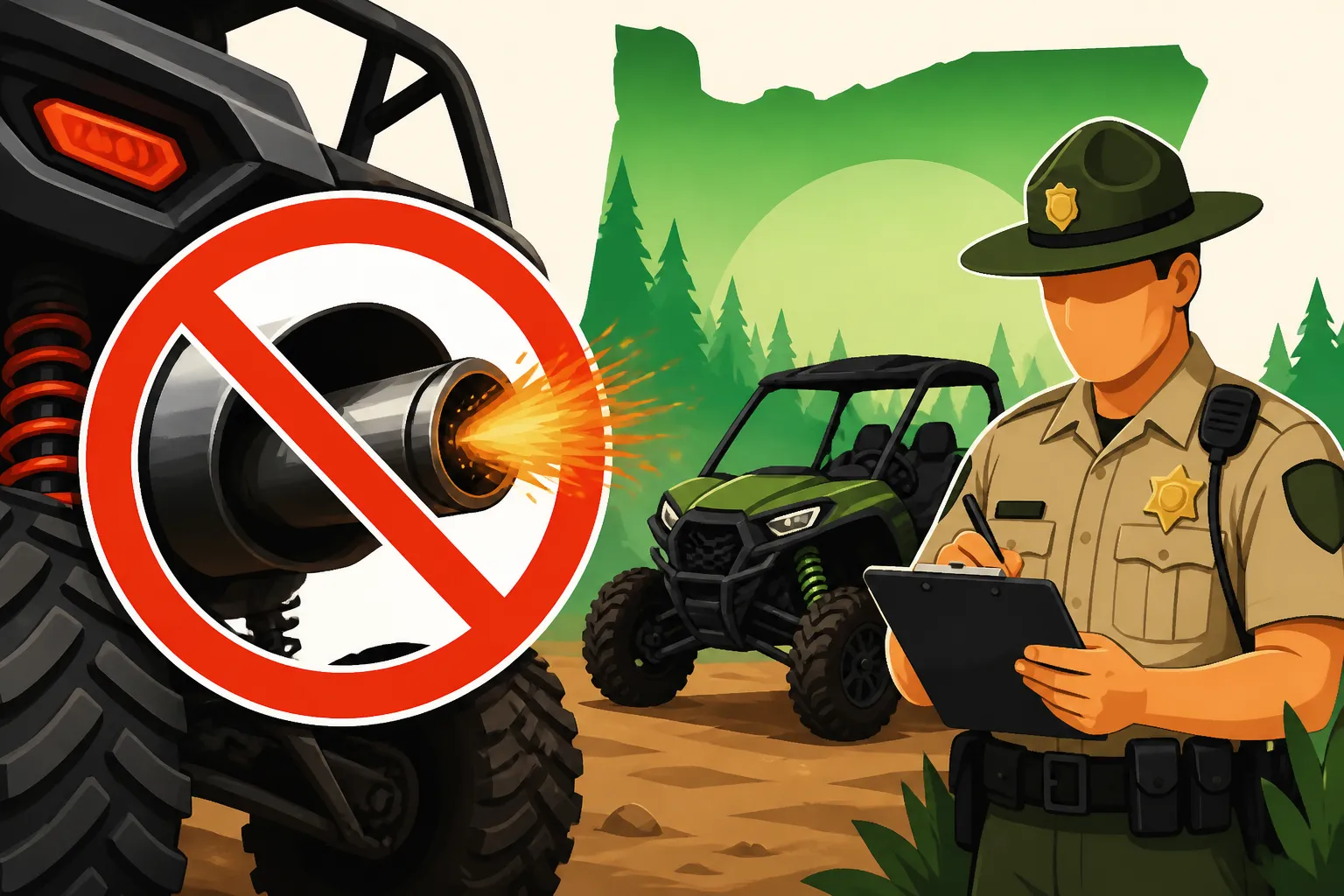
Oregon Fines for No Spark Arrester
A missing or noncompliant spark arrester can turn an Oregon ride into a citation, but the exact penalty depends on the violation and current fine schedule. The practical fix is to confirm what the riding area requires, check that the machine’s equipment qualifies, and inspect it before unloading.
What Oregon’s spark-arrester rule means
A spark arrester helps keep hot particles from escaping an engine’s exhaust. It is not the same thing as a muffler: a muffler reduces noise, while a spark arrester is designed to prevent sparks from leaving the exhaust system. A machine can have one without having the other, and one does not automatically replace the other.
For riders, the key question is not simply whether the ATV or UTV has an exhaust component that looks like a spark arrester. The equipment must meet the requirements that apply where you plan to ride. Public riding areas can have state or federal requirements, as well as site-specific rules. Check the land manager’s current information before heading out, particularly if you are crossing between different kinds of public land.
The relevant requirements may depend on the type of machine, the installed exhaust system, and whether the arrester is still intact. A screen or insert that has been removed, damaged, altered, or replaced with a noncompliant part may not meet the rule. Don’t assume that a vehicle is exempt because it is small, used only on trails, or carries a current Oregon permit.
The details of the equipment rule are covered in Oregon Spark Arrester Requirements on Trails. It is also worth checking Oregon Spark Arrester and Sound Rules if your exhaust has been modified. Spark-arrester compliance and noise compliance are separate questions: passing one does not establish that the machine meets the other.
| Riding situation | What to check | Practical next step |
|---|---|---|
| Riding on public land | The land manager’s current equipment requirements | Confirm the rule for the specific riding area |
| Using an aftermarket exhaust | Whether the arrester is approved for the machine and remains installed as intended | Check the exhaust and arrester documentation |
| Unsure whether a screen qualifies | Its rating, identification, and fitment | Ask the manufacturer or land manager before riding |
| A permit or decal is current | Whether the machine also meets equipment rules | Treat the permit and arrester as separate requirements |
| Riding on private land | The owner’s rules and any applicable law | Get permission and confirm what equipment is required |
A permit authorizes riding only under the rules that apply to the machine and location. It does not certify that every part of the machine is compliant. For permit questions, see Oregon ATV Permit Decal Placement; for the broader permit rules, [Oregon ATV Permits Explained] is a useful starting point.
What fine may apply for no spark arrester
A rider may receive a citation for operating a machine without required equipment. There is no safe way to give one universal fine amount without knowing the exact violation cited and checking the current schedule. Fine amounts and court assessments can change, and the final amount can depend on the citation and the court handling it.
Read the citation carefully. It should identify the alleged violation and provide instructions for responding. If the description is unclear, contact the court listed on the citation or the issuing agency and ask which violation was recorded and where to confirm the current amount. A general web search or another rider’s old ticket may not reflect the current schedule or your specific citation.
It also helps to separate a spark-arrester citation from other possible violations. A permit, safety card, road-access rule, and equipment requirement are distinct obligations. For example, being cited for an equipment issue does not necessarily mean a missing permit is involved; likewise, having a permit does not resolve an equipment citation. Oregon’s rules for safety cards are explained in Oregon ATV Safety Card Requirements.
A roadside or staging-area check may lead to questions about more than one part of the ride. If an officer or land manager identifies additional concerns, each may be handled separately. Avoid assuming that fixing one issue automatically clears another. Ask what specific requirement applies and what action is needed before continuing.
If you receive a citation, don’t ignore the response deadline printed on it. Follow the instructions from the court or issuing agency, and keep copies of any relevant records. If you believe the machine complied, gather information that relates directly to the cited issue, such as the exhaust model, arrester identification, purchase or installation records, and photographs taken before the ride. Whether that information affects the outcome depends on the facts and the process available for the citation.
A spark-arrester citation is also not the same as a citation for riding on a closed trail or road. If access was part of the encounter, review the site’s current rules separately. [Oregon Rules for Riding a Closed Trail] explains why a route’s status matters even when the machine itself is properly equipped.
How to check your machine before riding
A quick inspection can catch an obvious problem, but it cannot establish compliance if you do not know what equipment your riding area requires. Use this process before a trip, especially after exhaust work or a machine change.
- Identify the riding area and land manager. Check the current rules for the exact trail system, forest, dunes, or other site. If your route crosses between areas, confirm the requirements for each one.
- Identify the installed exhaust and arrester. Look for the manufacturer, model, and any identifying information. Compare it with the documentation for your machine and exhaust setup.
- Confirm the part is suitable for the machine. A part that fits physically is not necessarily the right arrester for the engine or exhaust system. If the documentation is missing or unclear, contact the manufacturer or the land manager rather than guessing.
- Inspect for damage or changes. Check that the arrester is present, secure, and not visibly damaged or removed. Exhaust work, a replacement muffler, or a modified insert can change whether the original setup still qualifies.
- Keep useful documentation accessible. Save the product information and installation records, and carry them in a dry place if you may need to show what is installed. Documentation does not replace compliant equipment, but it can make it easier to identify the part.
- Recheck after repairs. If a shop changes the exhaust or replaces a component, ask what arrester is installed and whether the setup meets the rules for your destination.
Do not rely on a mesh screen simply because it appears to block debris. Appearance alone does not confirm that a part is approved or appropriate. Nor should you remove or modify an arrester to change exhaust sound or engine performance without first confirming that the resulting setup remains legal for the riding area.
If you need a replacement, start with the machine or exhaust manufacturer’s fitment information. Amazon may have listings for replacement parts, but a marketplace listing is not proof that a part meets the requirements for your machine or a particular Oregon riding area. Verify the exact model and documentation before ordering, and do not ride until the required equipment is installed correctly.
Sound rules are another separate check. An exhaust that includes an arrester may still be too loud under the rules that apply at a particular location. See Oregon Sound Limits for ATVs for more on that distinction.
What to do if you discover a problem at the riding area
If you find that the arrester is missing, loose, damaged, or uncertain, the safest choice is to stop before riding. Don’t assume a short trip from the staging area, a low-speed ride, or a trail with little dry vegetation makes the equipment rule irrelevant. Ask the site’s staff or land manager what applies and whether there is a compliant repair option nearby.
If you are already on the trail when you notice a problem, avoid continuing the ride until you can determine what the rules require. Choose a safe way to return or get help without creating another problem, and follow any direction from site staff. A temporary workaround should not be treated as a compliant replacement unless the responsible authority confirms that it is acceptable.
Before future trips, add the arrester to the same pre-ride check as tires, brakes, lights, fuel, and required safety gear. This is especially useful after storing a machine, transporting it for service, or changing its exhaust. For a broader checklist of land-use requirements, see [Oregon Rules for Riding a National Forest] or [Oregon Rules for Riding State Forest Land], depending on where you plan to go.
The central point is straightforward: a current permit does not replace required equipment, and a part that looks like a spark arrester may not be enough. Confirm the applicable rule, keep the correct equipment installed and intact, and verify the current citation amount through the court or agency if you receive a ticket.
Disclaimer
This article is for general informational purposes only and does not constitute professional advice. Laws, prices and regulations vary by location and change over time. Consult a qualified professional for guidance on your specific situation.