Reserving Browns Camp for 2026
Planning a Browns Camp trip is exciting until you realize the campsite you want, the dates you can travel, and the reservation rules may not line up. This guide walks through how to check the official booking information, choose a site and dates, and prepare for riding in Tillamook State Forest without relying on assumptions about availability.
Start with the official Browns Camp reservation information
Confirm who manages the campground and how bookings work
Browns Camp is in Tillamook State Forest, so begin with the current campground information from the Oregon Department of Forestry. Follow the reservation instructions linked from the official Browns Camp or Tillamook State Forest pages rather than relying on an old booking link, a search-result snippet, or a forum post. Reservation platforms and procedures can change, and information copied from a previous season may not apply to the dates you are planning.
Before you start a booking, check whether the site you want is reservable for your travel dates, whether any sites are held for first-come use, and whether the campground has seasonal operating conditions. Don’t assume that every site is available for every date—or that an empty calendar means the campground is open. A closure, maintenance work, or a change in operating dates can affect what appears in the booking system.
If you are planning for 2026, treat the official calendar as the source of truth for when dates become available and what the campground’s rules are for that season. If dates are not open to book yet, note when to check back rather than assuming the campground is full. For a broader overview of the booking process, see [Browns Camp and Oregon's 2026 Reservations].
Check what the reservation actually covers
A campsite reservation is not automatically permission to ride anywhere you like, and it may not cover every fee or access requirement connected with your trip. Read the booking details carefully for what is included, what you need to pay separately, and any rules about vehicles, trailers, occupancy, or length of stay. If a detail matters to your group—such as whether there is room for a tow rig and trailer—confirm it before you book.
Also distinguish between the campground reservation and the requirements for operating an ATV or UTV in Oregon. Riders may need to consider permits, safety education requirements, riding-area rules, and day-use or site fees separately. Start with [Oregon OHV Camping Fees] and [Oregon ATV Permits Explained] so you can build a realistic checklist rather than discovering a missing requirement at the staging area.
If the booking page leaves an important question unanswered, contact the campground or the managing agency before you pay. This is especially worthwhile if you are bringing a large group, multiple machines, or equipment that might not fit neatly into a standard campsite description. A few minutes spent confirming the rules can prevent a frustrating arrival after a long drive.
Choose dates and a campsite that fit your riding plan
Compare the site, your equipment, and your group
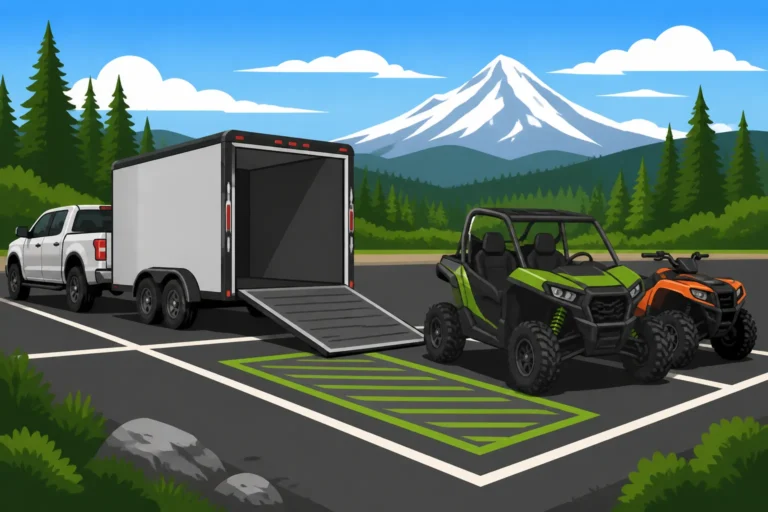
Don’t choose a site based only on whether it is available. Think through the full footprint of your setup: tow vehicle, trailer, tent or RV, machines, and the space your group needs to move around safely. A site that looks suitable for a small tenting trip may feel cramped when you add a trailer and several ATVs. Use the site description and campground map, if available, and ask the managing agency about anything the listing doesn’t make clear.
Your group’s schedule matters just as much as the campsite. If you are traveling with children, newer riders, or friends arriving at different times, a site that makes it easy to meet up and unload may be more useful than one that simply looks appealing on a map. If you want to ride from camp, verify whether that is allowed and how the campground connects to legal routes. Don’t assume every road or trail nearby is open to motorized use.
A quick comparison can help keep the choice practical:
| Planning question | What to check before booking |
|---|---|
| Does the site fit your setup? | Site dimensions or description, vehicle limits, and room for your trailer |
| Are your dates actually available? | Official calendar, operating dates, and any closure notices |
| What does the booking include? | Included occupants or vehicles, fees, and any separate passes or permits |
| Can your group ride from camp? | Current campground rules and the map of open, designated routes |
| Will the trip suit your riders? | Trail difficulty, riding experience, and access to breaks or support |
If your first-choice site is unavailable, compare other dates and sites before abandoning the trip. A weekday stay, a shorter visit, or a different site may work better than trying to squeeze too many vehicles into a space that does not fit.
Pick dates with riding conditions in mind
The best date is not always the first date you can reserve. Browns Camp is part of the Coast Range, where wet weather can make the riding experience very different from a dry summer outing. Mud, slick roots, standing water, and changing trail conditions can affect how long a ride takes and what kind of machine or experience level is appropriate. Before committing to a trip, review [Oregon Riding Seasons by Area] and the campground or forest’s current alerts.
If you are new to the area, avoid building a tightly timed itinerary around a long trail loop. Weather, trail conditions, closures, and the pace of the least experienced rider can all change the day’s plan. Leave space for unloading, checking equipment, and choosing a shorter route if conditions are worse than expected. [Oregon Trails for a Beginner] can help you think about matching a route to your group’s experience.
For map planning, onX Offroad can be useful for reviewing routes and keeping your group oriented, but treat any digital map as a planning aid—not proof that a road or trail is open to motorized travel. Check official land-manager information and posted signs as well. If a map, sign, and online post disagree, don’t ride through a closure on the strength of a third-party map.
Book carefully and keep your trip details organized
Use a simple booking checklist
Once you’ve found a suitable date and site, slow down at checkout. Confirm the arrival and departure dates, the exact campsite, the number of people and vehicles allowed, and the cancellation or change terms. Check that the reservation confirmation goes to an email address you can access on the trip. Save the confirmation somewhere available offline, because cell service may be limited or unreliable around forest roads and staging areas.
Use this checklist before completing the reservation:
- Confirm the official booking page is linked from current Browns Camp or Tillamook State Forest information.
- Check that the dates are open and match your intended arrival and departure.
- Read the campsite description and compare it with your vehicle and trailer setup.
- Review the rules for occupants, vehicles, fires, quiet hours, and other campground use.
- Identify any separate riding permits, safety card requirements, or day-use fees.
- Read the change and cancellation policy before paying.
- Save the confirmation and note any arrival instructions.
If you’re coordinating several families, share the campsite details and rules before everyone travels. “We got a spot” is not enough information when one household is bringing a large trailer and another plans to arrive late. Agree on who has the confirmation, where the group will meet, and what the backup plan is if someone gets delayed.
Prepare for a low-signal arrival
Download or save the information you’ll need before leaving town. That includes the reservation confirmation, campground directions, a current riding-area map, and any relevant closure or access notices. onX Offroad may help you keep a route available on your phone, but make sure you understand how to use downloaded maps before you lose signal. Bring a paper map or another backup if your group depends on navigation.
Keep important documents somewhere they will stay dry and easy to find. That might mean a sealed pouch in the tow vehicle rather than loose papers in a riding pack. For more ideas, see [Keeping Paperwork in a Wet Climate] and [Oregon Trail Maps Worth Carrying]. A little preparation is particularly helpful in the Coast Range, where rain can soak paperwork and make a phone harder to use.
Finally, plan your arrival around unloading and campground rules. Don’t assume you can occupy a site before its stated check-in time or leave equipment there after checkout. If your group wants to ride on arrival day, decide in advance whether there is enough time to set up camp, gear up, and reach a permitted route without rushing.
Ride responsibly around Browns Camp
Confirm access and closures before every ride
A campground reservation does not guarantee that every nearby road or trail will be open during your stay. Conditions and access rules can change, and a route that appears on an older map may have a seasonal restriction or closure. Check current forest information before you unload, then pay attention to signs at the trailhead and along the route.
That distinction is important around Tillamook State Forest, where forestry operations, weather, and land-management decisions can affect access. Be prepared to change your plan rather than ride past a gate or closure sign. [Oregon Trail Closures to Check First] and [Oregon Rules for Riding State Forest Land] are useful starting points for understanding why checking the specific route matters.
Keep your group together in a way that matches its experience. Agree on a meeting point, set expectations about stopping at junctions, and make sure each rider knows what to do if they become separated. A beginner may need a shorter loop and more frequent breaks; a confident rider may be comfortable covering more ground. Planning for the slowest or least experienced rider makes the outing safer and less stressful for everyone.
Make the campground part of a realistic trip plan
Think beyond the riding hours. Pack for damp weather, keep food and gear organized, and have a plan for cleaning muddy equipment without creating a mess at the site. Follow posted rules about fires, waste, noise, and vehicle movement. If you’re bringing several machines, check that unloading and parking will not block access or create a hazard for other campers.
It is also worth deciding what your group will do if weather or a closure changes the day’s ride. Have a shorter route or a non-riding activity in mind instead of treating a reservation as a promise of perfect trail conditions. For a closer look at campground logistics and the riding experience, see [Browns Camp on a Saturday] and [Trail Loops Out of Browns Camp].
A practical Browns Camp trip is built from several small checks: a confirmed campsite, a suitable setup, current access information, and a backup plan. Verify each piece before you leave, and recheck route conditions as your trip approaches. That approach can’t guarantee ideal weather or open trails, but it can help you avoid the preventable surprises that turn a weekend away into a scramble.
Disclaimer
This article is for general informational purposes only and does not constitute professional advice. Laws, prices and regulations vary by location and change over time. Consult a qualified professional for guidance on your specific situation.