The 50-Inch Limit That Defines a Class I
Navigating Oregon's labyrinth of ATV and UTV rules can feel like trying to find your way through a dense forest without a map, especially when it comes to understanding how your machine fits into the state's classification system. One of the most common points of confusion revolves around what defines a "Class I" all-terrain vehicle, particularly the crucial 50-inch width limit. This guide aims to clear up that mystery, helping you confidently identify your machine's class and understand what that means for your Oregon adventures.
Understanding Oregon's ATV Classification System
Before we dive deep into the nuances of Class I, it’s helpful to understand that Oregon, like many states, doesn't treat all off-highway vehicles (OHVs) the same. The state has a robust system for classifying these machines, which directly impacts everything from where you can ride to the type of safety education required. If you've ever felt overwhelmed trying to figure out if your quad, dirt bike, or side-by-side fits neatly into one box, you're not alone. The classifications are designed to ensure safety and manage environmental impact across diverse terrains, but for us riders, they can sometimes feel like an extra hurdle.
A Quick Look at All Four Classes
Oregon breaks down its OHVs into four distinct classes: Class I, Class II, Class III, and Class IV. Each class has specific characteristics that set it apart, primarily focusing on things like width, dry weight, seating configuration, and steering type. For instance, a traditional quad is typically a Class I, while a street-legal dune buggy might fall into Class II, and your dirt bike is definitely a Class III. Then you have the popular side-by-sides, which usually land in Class IV. These distinctions aren't just bureaucratic; they're foundational to how you interact with the state's riding regulations. Understanding these fundamental categories is the first step in avoiding potential fines or misunderstandings out on the trails. You can learn more about each category in [Oregon's Four ATV Classes Explained].
Why Oregon Categorizes OHVs
The primary reason Oregon categorizes OHVs is for safety and resource management. Different types of machines have different operational characteristics. A nimble dirt bike (Class III) handles trails differently than a wide side-by-side (Class IV). By categorizing them, the state can set appropriate rules for trail access, rider age limits, safety equipment, and even the type of permit decal required. This system helps protect riders by ensuring they are operating machines in suitable environments and helps protect the environment by managing where certain types of vehicles can go. For example, some single-track trails are simply too narrow for anything wider than a Class I ATV or Class III motorcycle, and these classifications help guide enforcement.
The Definition of an "ATV" in Oregon Law
When Oregon law talks about an "all-terrain vehicle," it's not always referring to what we colloquially call an "ATV" (a quad). The term "ATV" in the broader sense often refers to any of the OHV classes. However, when we talk about Class I ATVs, the definition becomes very specific. An Oregon Class I all-terrain vehicle is defined as a motorized, off-highway recreational vehicle that is 50 inches or less in width, has a dry weight of 1,200 pounds or less, travels on three or more pneumatic tires, and has handlebars for steering, and is designed for a single operator. This precise definition is crucial because it’s the legal benchmark against which your machine will be measured, especially when a ranger checks your vehicle at a staging area like Spinreel or Browns Camp.
The Critical 50-Inch Rule for Class I ATVs
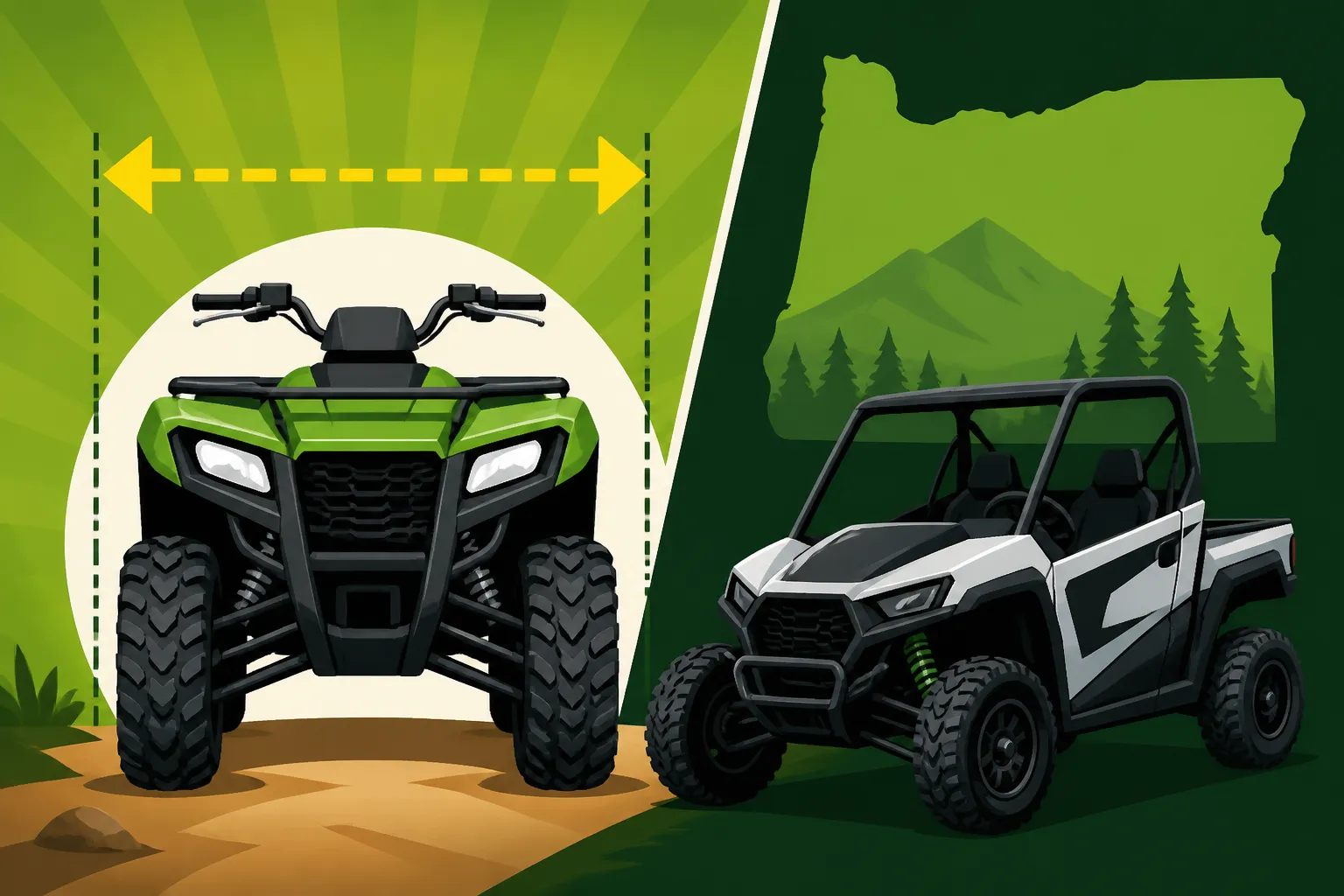
The 50-inch limit is arguably the most defining characteristic of an Oregon Class I ATV. It's the measurement that often separates a traditional quad from larger utility quads or, more critically, from side-by-sides. This seemingly small detail has massive implications for where and how you can ride in Oregon. Many trails, especially those designated for ATVs, are specifically designed with this width in mind. If your machine is even an inch over, it simply isn't a Class I in the eyes of Oregon law, regardless of how many wheels it has or whether you steer with handlebars. It's a hard line, and knowing your machine's exact width is paramount.
Measuring Your Machine Accurately
Getting an accurate measurement of your ATV's width is more important than simply eyeballing it. You need to measure the widest point of the machine, which usually includes the outside edges of the tires. Don't just measure the frame; tires often extend beyond that. It’s best to use a measuring tape and have a friend help you get a precise reading from the outer edge of one tire across to the outer edge of the other, at the widest point. Remember, if your tires are angled or you have custom offset wheels, these will factor into your overall width. Many riders assume their stock quad is automatically under 50 inches, but variations exist, and aftermarket modifications can easily push a machine over the limit. Taking the time to do this correctly can save you a lot of hassle.
What Exactly Is a "Straddle Seat"?
Beyond the 50-inch width, another key identifier for a Class I ATV is the "straddle seat." This means the operator sits astride the engine, with one leg on either side, much like a motorcycle. It’s distinct from a bench seat, which is found on Class IV side-by-sides, or the bucket seats often seen in Class II vehicles like dune buggies. The straddle seat design is fundamental to the maneuverability and rider input characteristics of a traditional ATV, contributing to why these machines are often permitted on narrower, more technical trails. The combination of a straddle seat, handlebars, and the 50-inch width is what really locks a machine into that Class I category. You can explore this further in [Straddle Seat Versus Bench Seat in Oregon's ATV Classes].
Handlebars: The Other Defining Feature
The steering mechanism is another critical component in Oregon's classification system. For a Class I ATV, the requirement is "handlebars for steering." This is a clear distinction from the steering wheel found in Class IV side-by-sides and most Class II vehicles. Handlebars provide a different kind of control and body input, which is again, characteristic of the more agile, single-operator machines designed for tighter spaces. If your machine has a steering wheel, it cannot be a Class I, even if it somehow meets the width and weight requirements. It's these three elements—width, straddle seat, and handlebars—that collectively define a Class I machine in Oregon. More on the steering differences can be found in [Handlebars Versus a Steering Wheel].
Why the 50-Inch Limit Matters Beyond Just Width
The 50-inch limit isn't just an arbitrary number for a dusty rulebook; it has tangible, real-world consequences for ATV owners in Oregon. It dictates everything from where you can legally ride to how your machine needs to be permitted and even what safety gear might be recommended. Ignoring this crucial detail can lead to frustrating experiences, from being turned away at a trailhead to facing fines. It's a core component of responsible OHV use in the state, designed to maintain order and safety on public lands.
Trail Access and Designated Routes
Perhaps the most significant impact of the 50-inch rule is on trail access. Many of Oregon's single-track and narrower multi-use trails are specifically designated for Class I ATVs (and Class III motorcycles) because their compact size allows them to navigate tight turns, dense brush, and narrow bridges without damaging the trail or surrounding environment. If your machine exceeds 50 inches in width, you'll find yourself restricted from a substantial portion of the state's OHV trail network. Imagine planning a trip to the Tillamook State Forest or Millican Valley, only to discover upon arrival that your wider UTV can only access a fraction of the trails because it doesn't fit the Class I definition. This is a common frustration for riders who haven't verified their machine's class. Always check trail maps and designated use signs, as many will specify "Class I only" or "vehicles under 50 inches."
Permit Decal Requirements and Placement
While all OHVs used on public land in Oregon require an operating permit, the classification can sometimes subtly influence decal placement guidelines, especially for machines with unique designs. For a Class I ATV, the permit decal must be affixed to the right side of the machine in a visible location. This ensures that rangers and officials can easily verify that your quad is properly permitted without extensive inspection. For example, if you're out at the Oregon Dunes, a ranger will be looking for that decal. Knowing your machine is a Class I and understanding its specific decal placement ensures a smooth experience when encountering enforcement. More details on how and where to put your decal can be found in [Oregon Permit Decal Placement].
Insurance Considerations and Road Use
While not directly mandated by the 50-inch rule, the classification of your ATV can indirectly influence insurance discussions and potential road use. Class I ATVs, by their very nature, are designed for off-road use, and generally, Oregon does not permit them on public roads, with very few exceptions like crossing highways or designated "highway access routes" in places like Lakeside or Sumpter. Unlike Class II machines, which can sometimes be made street-legal and require mandatory liability insurance for road use, Class I machines operate purely in the off-highway realm. This means that while insurance for your Class I is highly recommended for protecting your investment and liability off-road, it's not compulsory in the same way it is for street-legal Class II vehicles. Understanding this distinction is key to making informed decisions about your coverage and avoiding illegal road use.
Verifying Your Machine's Width
The last thing anyone wants is to get to a staging area, unload their pride and joy, and then be told they can't ride a specific trail because their machine is too wide. Verifying your ATV's width is a proactive step that can save you significant disappointment and potential legal issues. It's not always as straightforward as it seems, especially with the prevalence of aftermarket parts that can alter a machine's original specifications. A thorough check ensures you comply with Oregon's Class I definition and opens up access to countless miles of trails.
Checking Manufacturer Specifications
The first place to start when determining your ATV's width is the manufacturer's specifications. Most reputable manufacturers provide detailed specs for their machines, often available in the owner's manual or on their website. This will give you the "stock" width of your ATV. This is a good baseline, but it's crucial to remember that these specs refer to the machine as it left the factory. If you bought your ATV used, or if you've made any modifications yourself, the manufacturer's spec might no longer reflect its current dimensions. Always use this as a starting point, but be prepared to verify with a physical measurement.
The Real-World Measurement Challenge
As mentioned, a physical measurement is often the most reliable way to confirm your ATV's width. Don't rely solely on online forums or anecdotal evidence. Grab that tape measure and accurately assess the widest point, usually tire-to-tire. This might seem like a hassle, but it's far better to do it in your garage than to face questions from a ranger or discover your machine won't fit through a trail gate. Consider how your tires bulge, if you have wider aftermarket wheels, or even if your fender flares extend beyond the factory specification. These real-world factors are what determine your actual width when out on the trail.
When Aftermarket Parts Change Everything
This is where many riders get tripped up. Aftermarket parts, while fantastic for customization and performance enhancement, can easily alter your ATV's classification. Wider A-arms, wheel spacers, negative offset wheels, or even particularly aggressive tire treads can push a Class I machine beyond the 50-inch limit. For example, a stock Yamaha Raptor is typically under 50 inches, fitting neatly into Class I. However, add a wider axle or spacers, and it could easily exceed that, effectively reclassifying it out of Class I. It’s vital to re-measure your ATV after installing any width-altering modifications. If you've just bought a used machine, especially from a private seller, you might use a tool like LawDepot to draft a bill of sale, but regardless of your purchase method, you'll still need to personally verify its dimensions. Never assume that because it looks like a quad, it is a Class I, especially if it’s been modified. [Making Sure a Quad Counts as Class I] provides more insights here.
| Oregon ATV Class | Max Width (inches) | Max Dry Weight (pounds) | Seating Type | Steering Type | Example Machines |
|---|---|---|---|---|---|
| Class I | 50 or less | 1,200 or less | Straddle | Handlebars | Traditional sport/utility quads (e.g., Honda TRX, Yamaha Raptor) |
| Class II | Over 50 (no limit) | Over 1,200 (no limit) | Bucket or Bench | Steering Wheel | Dune buggies, sand rails, Jeeps modified for off-road |
| Class III | N/A | N/A | Straddle | Handlebars | Dirt bikes, off-road motorcycles, trials bikes |
| Class IV | 75 or less | 3,500 or less | Bench/Bucket | Steering Wheel | Recreational side-by-sides (e.g., Polaris RZR, Can-Am Maverick) |
Common Misconceptions and How to Avoid Them
The world of OHV regulations can be a minefield of assumptions and old wives' tales. Many riders unintentionally fall afoul of the rules simply because they're operating on outdated information or common misunderstandings. When it comes to the 50-inch limit and Class I ATVs, there are a few persistent myths that can lead to real problems on the trail. Let's debunk some of these to ensure you're always riding within the lines, so to speak.
"It's Just a Quad, So It's Class I, Right?"
This is perhaps the most common misconception. While most traditional "quads" or four-wheeled ATVs do fall into Class I, it's not a universal truth. The market has evolved, and many utility ATVs are now manufactured with widths exceeding 50 inches, especially those designed for heavier work or increased stability. These wider quads, despite still having a straddle seat and handlebars, would technically not qualify as Class I in Oregon due to their width. If your "quad" is over 50 inches, it won't fit the Class I definition. This is a crucial distinction, especially for riders bringing machines in from out of state, or those who simply bought a larger utility ATV for recreational riding. Always measure, don't just assume based on appearance. For a deeper dive, check out [Oregon Rules for a Machine Over 50 Inches].
The Side-by-Side Confusion
Another frequent area of confusion arises between Class I ATVs and side-by-sides (UTVs), which are typically Class IV machines in Oregon. People sometimes mistake a very compact side-by-side for a large ATV, or vice-versa. However, the differences are clear: side-by-sides have a steering wheel, bench or bucket seats, and are designed to carry multiple passengers (side-by-side, hence the name). Even the narrowest side-by-side will almost always exceed 50 inches in width and far surpass the 1,200-pound dry weight limit, firmly placing them in Class IV. You'll often see them labeled as UTVs or SxSs. The distinction matters immensely for trail access, as Class I trails are generally off-limits to Class IV vehicles. Understanding [Oregon Class I Versus Class IV] can help clarify this difference.
Impact on Youth and Electric Machines
The 50-inch limit also has implications for youth machines and electric ATVs, though perhaps less directly than for larger conventional quads. Many youth ATVs are specifically designed to be under 50 inches, making them perfectly suited for Class I designation and the trails that accompany it. This is important for ensuring young riders are on appropriately sized machines for their skill level and for trail compatibility. For electric ATVs, as long as they meet the width, weight, seating, and steering criteria, they fall into the same classification system. An electric quad under 50 inches wide would be a Class I, just like its gasoline-powered counterpart. The method of propulsion doesn't change the physical dimensions that define its class. This consistency helps ensure that all machines, regardless of power source, adhere to the safety and environmental guidelines for their designated class.
Final Thoughts on Your Oregon Class I ATV
Oregon's OHV classification system, particularly the defining 50-inch limit for Class I ATVs, is more than just a regulatory formality. It's a critical framework that dictates where you can ride, what type of permit you need, and ultimately, how safely and responsibly you can enjoy the vast and varied landscapes our state has to offer. Taking the time to accurately measure your machine, understand the nuances of the "straddle seat" and "handlebars" requirements, and debunk common myths will significantly enhance your riding experience. Don't get caught off guard at a staging area or on a trail. Know your machine, know the rules, and make every ride a great one. Whether you're hitting the dunes, exploring the forests, or cruising the high desert, being informed is your best tool for an adventure that's both thrilling and compliant.
Disclaimer
This article is for general informational purposes only and does not constitute professional advice. Laws, prices and regulations vary by location and change over time. Consult a qualified professional for guidance on your specific situation.