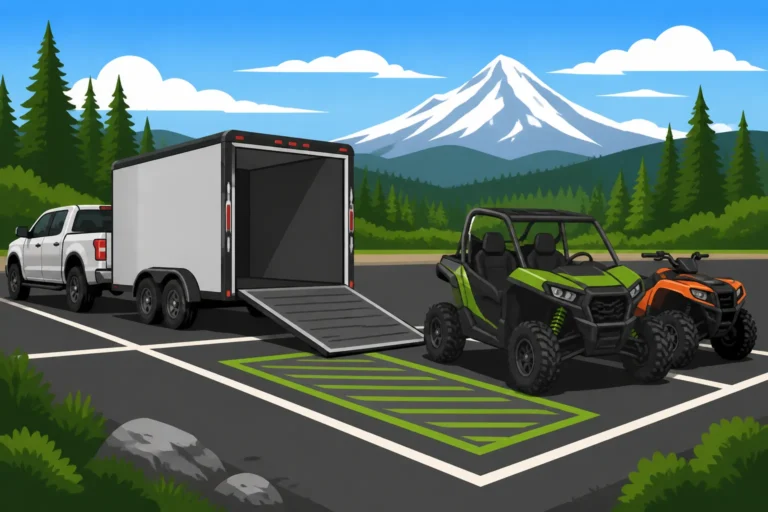
The Northwest Forest Pass on Oregon Dunes
The Northwest Forest Pass can help cover day-use parking at some Oregon Dunes sites, but it does not replace an Oregon ATV permit or guarantee that every access point accepts the pass. The confusing part is that parking, riding authorization, and seasonal access are separate things. This guide explains what the pass may cover, where to check, and what to sort out before unloading your machine.
What the Northwest Forest Pass Covers at the Oregon Dunes
Parking access is not the same as permission to ride
The Northwest Forest Pass is a recreation pass for certain U.S. Forest Service sites. At an Oregon Dunes location that accepts it for day-use parking, displaying the pass may take care of the site’s parking fee. It does not, by itself, authorize you to operate an ATV or UTV on the dunes.
That distinction matters when you arrive with a trailer full of gear. You may have the right parking pass and still need the appropriate Oregon ATV operating permit for the machine, along with any required safety card or other documents. Likewise, a valid ATV permit does not necessarily pay for parking at the staging area. Think of them as separate checks: one for the vehicle parked at the recreation site, another for the off-highway vehicle you plan to ride.
If you are sorting out the difference for the first time, [Oregon Day Use Fees Separate From the Permit] explains why the parking fee and riding permit should not be treated as interchangeable. The basic Oregon permit rules are covered in [Oregon ATV Permits Explained]. Before you head out, confirm that both the machine and the tow vehicle are covered by whatever requirements apply to your trip.
Acceptance depends on the specific site
The Oregon Dunes National Recreation Area stretches along the coast, and riders use different staging areas to reach different portions of the dunes. A pass accepted at one Forest Service day-use location should not be assumed to work at every nearby parking lot, campground, or access point. The managing agency, fee arrangement, and posted rules can differ from one site to another.
That is why it is useful to identify your intended staging area before you leave home. Check the site’s official information and read the fee signs when you arrive. If a fee station or sign lists accepted passes, follow that information rather than relying on a memory from a previous trip. Fees and access details can also change, so old notes from a friend or a photo from last summer may not reflect what is posted now.
For a broader explanation of where this pass can fit into Forest Service recreation, see [The Northwest Forest Pass and Oregon Sites]. For a coast-focused comparison, [Using an Interagency Pass on the Oregon Coast] can help you think through whether another pass you already own may be accepted at the location you plan to visit.
Choosing a Pass or Paying the Day-Use Fee
Compare the options before you leave
For a single ride, it may be simplest to pay the posted day-use fee at the site. If you already own a qualifying pass, displaying it may be the more convenient option where that pass is accepted. The right choice depends on where you are going, what kind of pass you have, and how often you expect to use eligible recreation sites.
| Option | What it may cover | What to check before relying on it |
|---|---|---|
| Northwest Forest Pass | Day-use parking at participating Forest Service sites | Whether your exact staging area accepts it and how it must be displayed |
| Other accepted recreation pass | Day-use access at sites included under that pass | Whether the pass applies to the specific site and vehicle |
| Posted day-use payment | Parking access under the site’s fee rules | Payment method, fee-station instructions, and the location covered |
| Oregon ATV operating permit | Operating the covered off-highway machine where required | Machine class, decal placement, expiration, and any other riding rules |
The comparison is about parking and access fees, not about whether your ATV or UTV is legally prepared for the ride. A pass may be perfectly valid for the tow vehicle’s parking fee while the machine still needs its own permit decal. And a day-use payment does not necessarily cover camping, a separate facility fee, or access to an area that is closed.
If you are deciding between paying at the staging area and using a pass you already have, [A Northwest Forest Pass Instead of the Day Fee] is a useful related topic. For practical arrival details, [Paying the Day Use Fee at a Staging Area] addresses the moments that can otherwise slow down your group just as everyone is ready to unload.
Make sure the pass belongs with the vehicle you bring
A common source of confusion is treating a recreation pass like a general permission slip for everyone in the group. Pass rules can depend on the pass type and the site’s instructions, including how it must be displayed and whether the pass holder needs to be present. Read the conditions associated with your pass rather than assuming it transfers freely between vehicles or covers every person and machine in your convoy.
This is especially important when friends arrive separately. One truck may have an eligible pass, but that does not automatically mean a second truck and trailer are covered. If the group splits between staging areas, each driver should know what the payment or pass requirement is for the location where they park. Keep the pass visible as directed, and do not leave the question until you are blocking the entrance while the rest of the group waits behind you.
If the instructions are unclear, pause before unloading and ask at the fee station or contact the site manager through official channels. It is easier to resolve a pass question before riding than to return from the dunes and discover that the display was not accepted. Carrying a digital record of the pass purchase can be useful, but it is not a substitute for displaying it in the manner required at the site.
Planning Around Oregon Dunes Staging Areas
Start with the staging area, not just the destination name
“Oregon Dunes” describes a long, varied recreation area, not one parking lot with identical rules everywhere. A trip to Spinreel is different from a trip to a northern staging area, and the appropriate access point depends on where you intend to ride, what facilities you need, and which routes are open. The pass question is therefore easiest to answer after you have chosen a specific staging area.
Use [Oregon Dunes Staging Areas From North to South] to get oriented, then confirm the exact site you plan to use. For the wider landscape and riding context, [Oregon Dunes National Recreation Area] is a helpful companion topic. If your group is meeting from different directions, send everyone the same named staging area rather than a vague pin somewhere along the coast.
Mapping tools can help with trip planning, particularly when you are comparing access points or trying to understand how a road connects to a riding area. Some riders use onX Offroad to review route context and organize a planned trip. Treat it as a planning aid, not the final authority on closures, fee acceptance, or current access. Before you go, compare your plan with official land-manager information and signs at the site.
Read the signs at the entrance and in the parking area
When you pull into a staging area, take a moment to read the posted instructions before unloading. Look for the fee details, accepted pass types, display directions, and any separate restrictions that apply to the site. If there are multiple lots or payment stations, make sure you are following the instructions for the lot where your tow vehicle is actually parked.
This small pause can prevent a frustrating end to the day. Imagine arriving with two trucks, a trailer, and several riders who are eager to get moving. One person assumes the pass covers the whole group, another remembers paying a fee at a different access point, and nobody checks the sign. A few minutes of confirming the rules can save a return trip to the entrance or an avoidable parking citation.
Keep an eye out for rules beyond the pass itself. Signs may address parking, camping, road access, riding boundaries, or seasonal restrictions. A road that leads toward the dunes is not automatically open to off-highway vehicles, and a parking pass does not grant permission to ride beyond designated areas. Use onX Offroad or another mapping tool to help organize your route, but verify important access decisions against official maps, local notices, and signs.
Permits, Decals, and Other Requirements Still Apply
The ATV permit is separate from the parking pass
An Oregon ATV operating permit and a Northwest Forest Pass solve different problems. The recreation pass relates to parking or day-use access at participating sites. The ATV permit applies to the off-highway machine under Oregon’s rules. Buying one does not automatically satisfy the other, even if both are part of the same weekend plan.
Before loading, check the machine’s class and permit status. Confirm that the decal is current, attached where required, and readable. If you ride more than one machine, do not assume that a permit associated with one vehicle automatically covers the rest. The details can vary by machine type, so consult [Oregon ATV Permit Decal Placement] and the relevant class information rather than guessing where a decal belongs.
Visitors should also avoid assuming that an out-of-state sticker or registration settles every Oregon requirement. Oregon has rules for visiting riders and for reciprocity, and those rules are separate from federal recreation-site parking fees. If you are bringing a machine from elsewhere, [Riding Oregon With an Out-of-State Permit] is a useful place to start. Check the relevant requirements before the trip rather than trying to interpret them at a busy staging area.
Keep the necessary information easy to reach
A little organization can make a ride day much calmer. Keep the recreation pass or payment confirmation accessible, and know where the ATV permit information is for each machine. If your group includes several drivers, make sure the person operating each vehicle understands what must be displayed and what must be carried. A document buried beneath camping equipment is technically present but not especially useful during a check.
Some riders use a small waterproof pouch or a dedicated spot in the tow vehicle for receipts, permit information, and other trip documents. Keep personal information secure, and follow the specific instructions for displaying any pass. If you rely on a phone, consider whether you will have service at the coast and keep relevant information available offline when possible.
A digital map can also help prevent the group from drifting onto a closed route or confusing a staging access road with a permitted riding area. onX Offroad may be useful for organizing a route and viewing map context, but maps can lag behind changing conditions. Use official closure notices as the deciding source, and stop to check a posted sign if it conflicts with what your screen shows.
Closures, Seasons, and Trip-Day Checks
A valid pass cannot open a closed area
A Northwest Forest Pass does not override a seasonal closure, habitat protection, road restriction, or emergency order. Oregon Dunes access can be affected by management decisions and conditions that change during the year. You may have paid the correct fee and brought a properly permitted machine, yet still need to change plans if the intended area or route is closed.
This is one reason to check more than the pass information before leaving. Confirm the status of the staging area and the riding zone, then review any notices about seasonal or wildlife-related restrictions. [Oregon Trail Closures to Check First] is a useful planning topic, and [Snowy Plover Season on the Oregon Coast] explains why coastal access can change to protect sensitive habitat.
onX Offroad can help you visualize a planned route and notice where your intended ride intersects mapped areas, but it should not be treated as a live closure bulletin. When a map, a sign, and a posted official notice do not agree, stop and follow the current direction from the responsible land manager. Do not assume a route is open just because other tire tracks continue past a closure marker.
Build a quick check into your arrival routine
A reliable arrival routine keeps small uncertainties from turning into a day-long hassle. Before unloading, confirm that you are in the intended lot, check the fee sign, display the pass or make the required payment, and review any posted riding restrictions. Then check that the machine’s permit and decal are in order. If conditions have changed since your last visit, adjust the plan before the group spreads out.
A practical sequence looks like this:
- Confirm the staging area and its managing agency.
- Check whether the Northwest Forest Pass is accepted there or whether a separate day-use payment is required.
- Follow the posted instructions for displaying the pass or proof of payment.
- Confirm that every ATV or UTV has the required permit and decal.
- Review current closure notices and signs for the routes you intend to ride.
- Tell the whole group where the open riding area begins and what boundaries to avoid.
This routine is particularly helpful for families and mixed groups, where one person may be handling parking while another is getting children ready or unloading machines. Assigning one person to check the fee and another to verify permits can make the process smoother, as long as everyone agrees on the same plan. Keep the group together until the staging and access questions are settled.
Common Mistakes to Avoid
Assuming one pass covers every cost
The most frequent mistake is assuming that a Northwest Forest Pass covers every expense associated with the trip. It may apply to eligible day-use parking, but it does not necessarily include camping, separate facility fees, an Oregon ATV permit, or a rental company’s requirements. Those are distinct items, each with its own rules.
The reverse assumption can cause trouble too: some people pay the day-use fee and then think that payment authorizes riding. It does not. Before the trip, list the tow-vehicle parking requirement, machine permit requirement, any safety-card requirement, and any camping or rental costs separately. That simple checklist makes it much less likely that one valid item will be mistaken for another.
Relying on old information or a nearby site’s rules
A friend’s experience is useful, but it may relate to a different staging area, a different pass, or a different season. Likewise, a fee sign at one location does not establish what applies at another. Use the exact site name in your planning, check official information close to your trip, and read the signs when you arrive.
The goal is not to make the day complicated. It is to avoid arriving at the dunes with a loaded trailer and discovering that the pass you brought does not apply to the lot you chose. Confirm the parking rules, riding permit, decal, and open-area status as separate pieces. Once those basics are settled, you can spend your attention where it belongs: on the ride, the conditions, and the people in your group.
Disclaimer
This article is for general informational purposes only and does not constitute professional advice. Laws, prices and regulations vary by location and change over time. Consult a qualified professional for guidance on your specific situation.