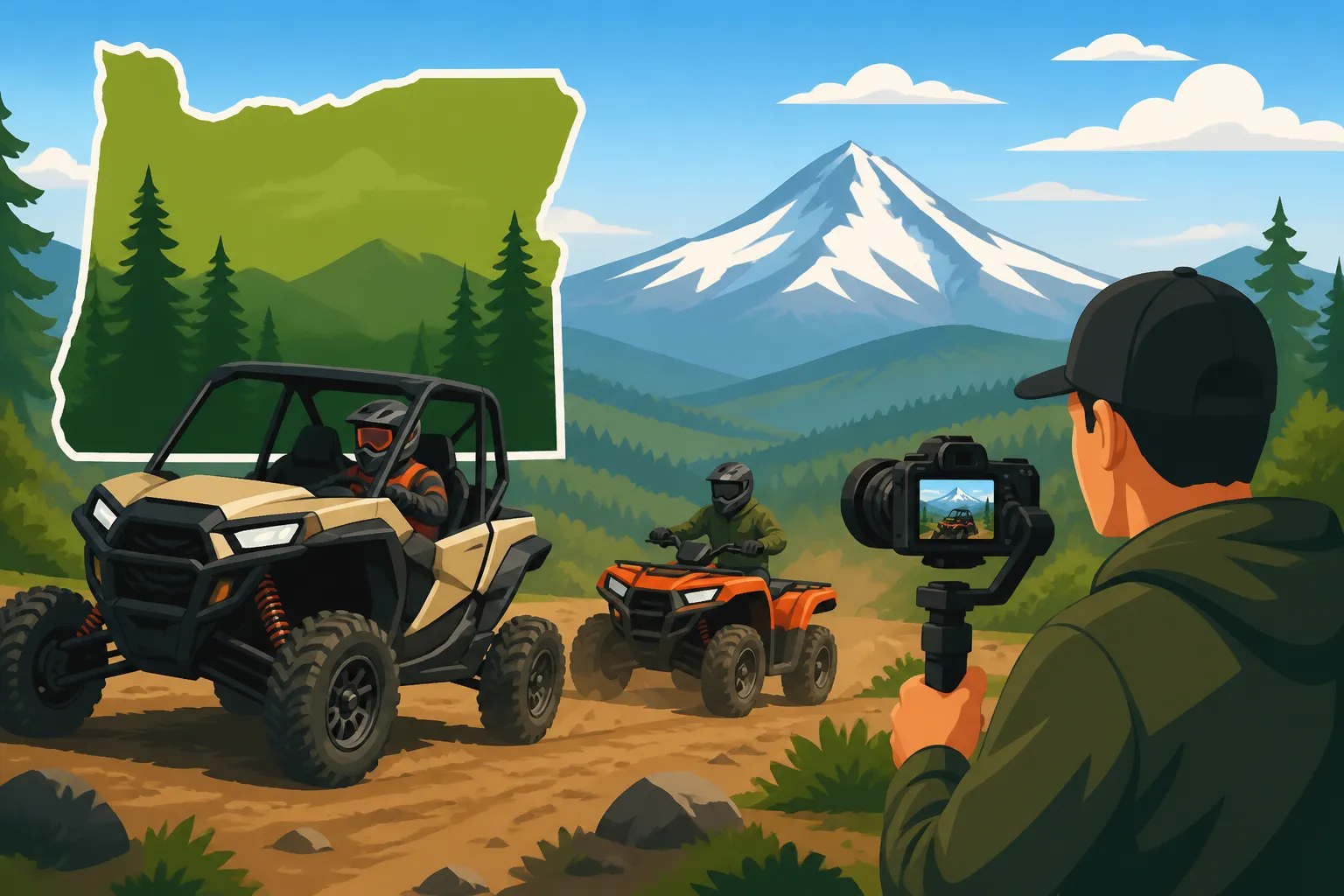
Filming on Public Land
Filming an ATV or UTV ride on public land in Oregon can be as simple as recording a personal trip—or involve approvals if the shoot is organized, commercial, or disruptive. The key is to separate permission to film from permission to ride. Here’s how to check what applies before you bring a camera crew, drone, or mounted camera onto public land.
First, identify the land and the kind of filming
“Public land” is not one set of rules. An area may be managed by the Bureau of Land Management, the U.S. Forest Service, Oregon Department of Forestry, or another agency. A trail or road can also cross between public and private ownership. The agency responsible for the exact location is the place to ask about filming permission.
Start by identifying the specific staging area, trail, road, or parcel where you plan to record. Check the signs at the site and look for an official land-manager map or contact page. If a route crosses several management areas, ask each responsible office rather than assuming one approval covers the whole trip. For questions about riding rules, see Oregon Rules for Riding a National Forest, [Oregon Rules for Riding BLM Land], and Oregon Rules for Riding State Forest Land.
Next, describe what you mean by filming. A rider recording a normal outing with a phone or action camera is different from a production with several operators, vehicles, lighting, a support truck, or a planned sequence that blocks or changes access. The details matter more than whether the camera is professional.
| Filming situation | What to check before you go |
|---|---|
| Personal video from a helmet or machine mount | Whether the location is open to riding and whether the camera or mount creates a safety issue |
| A small group making a planned video | Whether the agency treats the activity as an organized event or requires advance coordination |
| A monetized channel or sponsored shoot | Whether the agency considers the purpose commercial and requires filming authorization |
| A production with crew, equipment, or repeated takes | Whether a permit, insurance, location approval, or site-specific conditions apply |
| Drone footage | Aviation rules, land-manager restrictions, and any site-specific closures or limits |
| Filming a ride that closes, blocks, or affects an area | Whether separate event or special-use approval is needed |
This table is a screening tool, not a guarantee. Agencies can define commercial filming and organized activity differently, and requirements can depend on the land, the scale of the shoot, and its effects on other visitors or resources.
A useful way to frame the question is: “Will this activity use the land differently from an ordinary ride?” A camera secured to your helmet during a regular trip may have little impact. Bringing a crew, staging equipment, repeating passes for a shot, asking riders to hold traffic, or reserving a location can create impacts that need agency review. Do not assume that posting footage online makes a personal ride commercial, or that calling a project recreational removes the need for permission.
Separate filming approval from riding requirements
Permission to film does not make an otherwise illegal ride legal. The machine and riders still need to meet the rules that apply at the location. Depending on the machine and the route, that may include an Oregon ATV operating permit, a safety card, a day-use fee, or compliance with local access restrictions. A filming approval—if required—does not replace any of them.
Before the shoot, confirm:
- The route is open to your machine’s class and width.
- The machine has the required permit or qualifying out-of-state authorization.
- Each rider meets applicable safety-card and age requirements.
- Any parking, day-use, or recreation-site fee is handled separately.
- The route is not affected by a seasonal closure, fire restriction, habitat protection, or temporary order.
- The machine meets applicable equipment rules, including spark-arrester or sound requirements where they apply.
For a closer look at permit rules, start with [Oregon ATV Permits Explained]. If anyone in the group is visiting from another state, check Riding Oregon With an Out-of-State Permit rather than assuming a registration or sticker from home is accepted. Riders who need a safety card can review Oregon ATV Safety Card Requirements. Also check Oregon Day Use Fees Explained; an ATV permit and a site’s parking or day-use charge are separate things.
Plan the filming around the riding rules, not the other way around. A request to make repeated passes, use a closed road for a shot, ride outside a designated area, or stop in a travel lane does not create an exception. If a location is closed or a route is not open to your machine, choose another shot or another site.
If the shoot involves a group ride, staging, or a planned gathering, ask whether the activity needs event approval as well as filming permission. These are related but separate questions. Oregon Rules for an Organized Ride explains why a coordinated group activity may need additional planning. If the production is also an event, see Applying for a Special Use Permit for an Event and ask the agency how much lead time it needs. An event permit may address gathering or use of the site without necessarily resolving every filming or commercial-use requirement.
Ask the land manager before committing to a shoot
Contact the office that manages the exact area and be specific. “Can we film on public land?” is too broad to get a dependable answer. Describe the activity in enough detail for staff to decide whether it needs review.
Include:
- The exact location, including the staging area and intended route.
- The date or date range, and whether you have backup dates.
- The number of riders, machines, crew members, and support vehicles.
- The equipment you plan to bring, such as tripods, lighting, generators, or a drone.
- Whether the video is personal, editorial, sponsored, monetized, or made for a client.
- Whether you will repeat passes, stage scenes, block a route, or ask other visitors to wait.
- Whether you plan to use the footage commercially or distribute it publicly.
Ask whether the activity requires a filming permit, event approval, insurance, a location agreement, or any other authorization. Also ask if there are restrictions on the route, time of day, equipment, group size, parking, or areas where filming is not allowed. If the office says no permit is needed, keep a record of the response and any conditions. A phone answer can be helpful, but written confirmation is easier to refer to when plans change or another office needs to review the shoot.
If more than one agency manages the route, explain that in your request and ask who else needs to be contacted. An approval from one land manager may not cover another agency’s land or a road crossing. The same caution applies to private parcels between public lands: public access to a route does not automatically authorize filming or staging on adjoining private property. For background on boundaries and access, see Private Land Between Two Public Parcels.
Build time for a response into your schedule. A small personal recording may not need a formal review, while a production with crew, equipment, or a commercial purpose may take more coordination. Do not book a crew or promise a client a location until you know what the land manager requires. If an application is needed, follow the office’s instructions and confirm whether its approval covers all planned activities or only a defined part of them.
Film without creating a riding or resource problem
A camera can change how people ride. The safest approach is to keep recording subordinate to operating the machine and respecting other visitors. Set up mounts before entering the riding area, secure straps and accessories, and make sure equipment cannot interfere with steering, controls, visibility, or protective gear. Never try to adjust a camera while moving.
A mount bought through a retailer such as Amazon should still be checked for secure fit and compatibility with the machine or helmet. Avoid loose attachments that can snag, fall onto a trail, or distract the operator. A passenger or crew member should not be placed in a position that makes the machine harder to control or violates passenger rules.
Use these habits on the route:
- Stop only where stopping is allowed and safe. Move fully out of the travel path before adjusting equipment.
- Do not block a trail, road, staging area, or access point for a take.
- Give other riders room to pass; do not assume they have agreed to appear in footage.
- Avoid repeated high-speed passes or close approaches for dramatic footage.
- Stay on designated routes and out of closed or sensitive areas.
- Follow signs and instructions from land managers, law enforcement, and site staff.
- Pack out batteries, tape, zip ties, packaging, and other production waste.
- Keep a copy of any relevant approval and the contact details for the responsible office.
Drones need separate attention. A recreational or production drone may be subject to aviation requirements as well as land-manager rules, and a drone may be restricted at a particular site even when riding is allowed. Check the applicable aviation rules and contact the land manager about takeoff, landing, and operation from the area. Do not assume that permission to film from a vehicle also authorizes drone use.
Respect privacy as well as access. Public land does not mean every visitor wants to be featured in a video. Avoid lingering on identifiable people, license plates, or children without permission, especially in close-up or promotional footage. If another rider asks not to be filmed, a practical response is to stop recording them or choose a different shot.
Finally, check conditions again on the day of the shoot. Closures, fire restrictions, weather, and site operations can change access. A route that was open when you made plans may be closed when you arrive. For general closure planning, see Oregon Trail Closures to Check First. If filming cannot be done without ignoring a closure or disrupting other users, postpone or move the shoot. The camera does not change the rules of the place.
Disclaimer
This article is for general informational purposes only and does not constitute professional advice. Laws, prices and regulations vary by location and change over time. Consult a qualified professional for guidance on your specific situation.