Oregon Golf Cart Street Rules
It can be incredibly confusing trying to figure out where your golf cart, ATV, or UTV can legally be driven in Oregon, especially when you see people driving various machines on streets in different towns. Many folks assume that if one small town allows golf carts on its streets, then all similar machines, like their UTV, should be fine everywhere else. But the reality is far more nuanced, leading to frustration and potential fines. This guide will walk you through Oregon's specific rules for golf carts on public streets, clearly distinguishing them from ATVs and UTVs, so you can ride confidently and legally.
The Core Confusion: Golf Carts Versus ATVs in Oregon
The lines blur so easily when you look at different types of off-highway vehicles (OHVs) and golf carts. They all have four wheels, steering wheels (or handlebars in some ATV cases), and engines (or electric motors). It’s natural to think they might fall under similar regulations, especially when you see them cruising around. But in Oregon, the law draws very distinct lines, and understanding these differences is crucial for anyone hoping to take their machine off the beaten path or, more specifically, onto a paved one.
Why They're Often Mistaken for Each Other
Think about it: a side-by-side UTV and a decked-out golf cart can look quite similar at first glance. Both might have a roof, a windshield, multiple seats, and even some aftermarket accessories like bigger tires or light bars. You might see a golf cart at the local hardware store parking lot, or a UTV being driven by a farmer on a rural road, and assume their "street legal" status is comparable. This visual similarity often leads riders to believe that if a golf cart is allowed on certain streets, their ATV or UTV should be too, or vice versa. The convenience factor also plays a huge role; wouldn't it be great to drive your UTV or golf cart directly from your campsite to the store without trailering? This desire for seamless travel fuels a lot of the confusion and wishful thinking about street legality.
Oregon's Legal Definitions That Set Them Apart
Oregon law is quite specific about what defines each type of vehicle, and these definitions are the foundation of all the rules. A "golf cart" in Oregon is generally defined as a motor vehicle that has not less than three wheels, has an unloaded weight of 1,300 pounds or less, is designed to be operated at not more than 20 miles per hour, and is designed to carry golf equipment and persons. The key here is its design and maximum speed. These vehicles are inherently low-speed and designed for specific recreational purposes.
On the other hand, ATVs (Class I and Class III) and UTVs (Class IV side-by-sides) are defined as off-highway vehicles. These machines are built for rugged terrain, higher speeds, and more robust performance than a typical golf cart. The state's primary concern with ATVs and UTVs is their off-road operation, and they have separate permitting requirements through the Oregon Parks and Recreation Department. For instance, a side-by-side, even if it looks somewhat like an oversized golf cart, is legally a Class IV machine in Oregon and is subject to completely different rules, including needing an [Oregon ATV Permit for a Side-by-Side] for off-road use. The important takeaway is that Oregon views these as fundamentally different vehicles with different purposes and capabilities, leading to distinct regulatory frameworks.
When Can a Golf Cart Legally Hit Oregon Streets?
This is where the rubber meets the road, or rather, where the small, hard golf cart tires meet the pavement. Unlike ATVs and UTVs, which have some very limited statewide exceptions for road use, golf carts in Oregon are almost entirely dependent on local city or county ordinances for street legality. You can't just assume your golf cart is good to go on any public road.
Designated Local Ordinances
The biggest hurdle for golf cart owners in Oregon is that there isn't a blanket statewide law allowing them on public roads. Instead, it’s up to individual cities and counties to decide if, and under what conditions, golf carts can operate on their streets. This means what's perfectly legal in one town could get you a hefty fine just a few miles down the road in the next jurisdiction. These local ordinances often specify which streets are open, what hours of operation are permitted, and what safety equipment the golf cart must possess to be considered safe for road use. It’s not uncommon for them to be restricted to roads with speed limits below a certain threshold, often 25 mph or less, and sometimes only during daylight hours. Always, always check with the specific city or county government where you plan to ride. Their local police department or city clerk's office is the best resource for current regulations.
Specific Town Examples and Their Rules
Let's look at a real-world example: the charming coastal town of Manzanita. Manzanita is one of those places that does have a specific local ordinance allowing golf carts on certain streets. If you've visited, you might have seen people zipping around in their golf carts, heading to the beach or the local shops. But even in Manzanita, there are rules. You can't just drive anywhere. Typically, golf carts are restricted to streets with lower speed limits, and there are often requirements for basic safety equipment like lights, turn signals, and mirrors. You'll find these specifics outlined in the city's municipal code. This is why you see "Golf Carts Versus ATVs in Oregon Towns" often sparking debate—what applies to a golf cart in Manzanita absolutely does not automatically apply to an ATV or UTV, which is generally not allowed on those same streets. The key message here is hyper-local: a golf cart is only street-legal if the specific municipality has passed an ordinance allowing it. [Manzanita's Golf Cart Streets] are a prime example of this local control.
The 'Low-Speed Vehicle' Loophole (and Why It's Not a Golf Cart)
Now, here's where another layer of complexity comes in: the Low-Speed Vehicle (LSV). An LSV is a street-legal vehicle, but it's not simply a golf cart. Oregon law, aligning with federal standards, defines an LSV as a four-wheeled vehicle with a top speed greater than 20 miles per hour but not greater than 25 miles per hour. Critically, to be classified as an LSV and operate on public roads, these vehicles must comply with federal safety standards. This means they need specific equipment: headlamps, tail lamps, stop lamps, turn signal lamps, reflex reflectors, an exterior mirror mounted on the driver's side and either an exterior mirror mounted on the passenger's side or an interior rearview mirror, a parking brake, a VIN, and safety glazing windshields.
While some golf carts can be modified to meet these LSV standards, they are no longer just "golf carts" in the eyes of the law; they become true Low-Speed Vehicles, often registered and titled like other motor vehicles. This is a common route for people who want a small, electric vehicle for short trips around town. Manufacturers might sell vehicles specifically designed as LSVs, or an aftermarket company might offer kits to upgrade a golf cart. For instance, if you're outfitting a vehicle to meet LSV standards, you might look to aftermarket providers like SuperATV for DOT-approved windshields, mirrors, or lighting kits. Understanding [Oregon Low-Speed Vehicle Rules] is key if you're considering this path, as it's a very different set of requirements than simply having a golf cart for the links.
Why Most ATVs and UTVs Aren't Golf Carts on Oregon Roads
So, we've established that golf carts have a very narrow path to street legality, primarily through local ordinances or by becoming a federally compliant Low-Speed Vehicle. But what about your shiny ATV or powerful UTV? For these machines, the rules are even stricter, and the answer to "Can I drive my ATV/UTV on the street?" is almost always "No," with very few, specific exceptions.
Oregon's Strict ATV Street Legality Rules
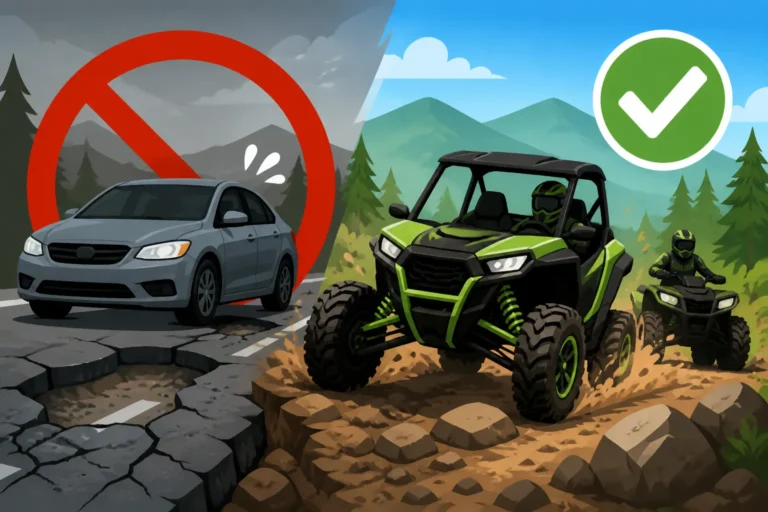
Oregon views ATVs and UTVs as off-road machines, first and foremost. This means they are generally prohibited from operating on highways, public roads, or shoulders. The entire system for permitting ATVs in Oregon, handled by the Oregon Parks and Recreation Department, is focused on ensuring safe and responsible off-road recreation. The notion of [Are ATVs Street Legal in Oregon?] is a frequent query, and the short answer is overwhelmingly "no" for the vast majority of public roads. These vehicles lack many of the safety features required for on-road use, such as proper lighting, turn signals, DOT-approved tires, and crash protection, making them inherently unsafe for typical traffic conditions. Trying to bypass these rules will not only result in fines but also puts you and other motorists at significant risk.
Designated Highway Access Routes for ATVs
There are, however, very specific and limited exceptions that often lead to confusion. Oregon has created a few "highway access routes" where ATVs and UTVs are allowed to operate on public roads for short distances to connect trails or access services. Currently, the most prominent examples are located in the small towns of Lakeside and Sumpter. These are specifically designated routes, often marked with signs, and they are not a free pass to ride your ATV on any road in those towns. They exist solely to facilitate access to off-road riding areas. [Lakeside and Sumpter: Oregon's Only Two Routes] are critical to understand because they represent the extreme rarity of legal ATV street access. Even on these routes, riders must adhere to all traffic laws, carry an [Oregon ATV Operating Permit], and wear helmets, among other requirements. This is very different from a golf cart cruising residential streets.
Mandatory Equipment for Any Road-Legal Vehicle
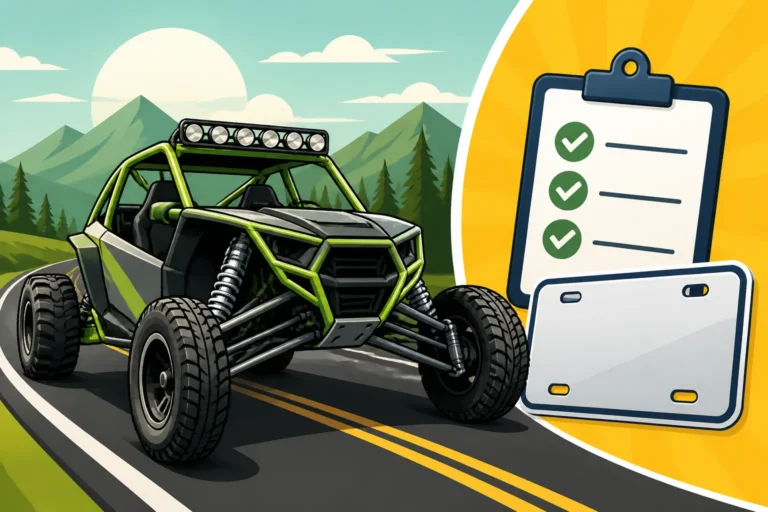
Converting an off-road ATV or UTV to meet street-legal requirements in Oregon is a complex and often expensive endeavor, primarily because it means transforming it into a specific class of street-legal vehicle like a Class II all-terrain vehicle (which is a street-legal side-by-side or buggy, not your typical quad) or an LSV if it meets those speed and weight restrictions. This isn't just about slapping on some mirrors; it involves ensuring your machine meets Department of Transportation (DOT) standards for tires, lighting, horns, windshields, and more. Companies like SuperATV offer a huge range of aftermarket parts that can help convert a UTV for various uses, including some that might be part of a street-legal conversion kit, but simply buying parts doesn't make your machine street legal. You'd need a comprehensive set of upgrades and inspections. For example, [Oregon Street Legal UTV Requirements] detail the full gamut of equipment needed, which is far beyond what a golf cart requires (even an LSV-compliant one) and typically more than a standard UTV comes with from the factory. Without these upgrades and proper registration as a street-legal machine, your average quad or side-by-side is strictly for off-road use. [Oregon Class II Machines That Can Be Plated in Oregon] illustrates the specific type of machine and modifications needed to achieve this very rare status.
What Happens If You Break the Rules?
The consequences of mixing up golf cart rules with ATV rules, or simply ignoring local ordinances, can range from a stern warning to significant financial penalties and even impoundment of your vehicle. It's not just about getting caught; it's about the safety risks you create for yourself and others by operating an inappropriate vehicle on a public road.
Consequences for Improper Golf Cart Use
If you're caught driving a golf cart on public streets where it's not expressly permitted by a local ordinance, you're likely looking at a traffic citation. This can be treated as a Class D traffic violation, which means a fine. The exact amount will depend on the local jurisdiction and the specific circumstances, but it can quickly add up. Beyond the fine, there's the inconvenience and potential embarrassment of being pulled over. Local law enforcement takes these rules seriously, not just to enforce the law, but to protect public safety. A golf cart, by design, isn't meant to interact with regular traffic moving at higher speeds, and operating it improperly can lead to accidents. Imagine a situation where you're slowly crossing a main road and a car doesn't see you or can't react in time – the outcome could be devastating.
Penalties for Riding an Unpermitted ATV on a Road
For ATVs and UTVs, the penalties for unauthorized street use can be even more severe. Operating an ATV or UTV on a public road where it's not specifically allowed (i.e., outside of a designated highway access route) is generally considered a traffic violation. Depending on the specifics, this could lead to a Class C or Class B traffic violation, with fines that are considerably higher than for golf cart infractions. [Oregon Fines for Riding an Unopened Road] or an unauthorized road can be substantial, often hundreds of dollars, plus court fees. In some cases, especially if you're found to be riding recklessly or if there are repeated offenses, your vehicle could be impounded. This isn't just a slap on the wrist; it's a major hassle and expense to recover your machine. Furthermore, if you're involved in an accident while illegally operating an ATV or UTV on a public road, your personal insurance may not cover the damages, leaving you personally liable for repairs, medical bills, and any damages to other property or persons.
Here's a quick comparison to help clarify the main differences:
| Feature | Standard Golf Cart (Not LSV) | Low-Speed Vehicle (LSV) | Off-Highway ATV/UTV (Classes I, III, IV) | Street-Legal Class II (Buggies/Rails) |
|---|---|---|---|---|
| Primary Use | Golf courses, private communities | Short-distance street travel | Off-road recreation | Street-legal fun, limited off-road |
| Street Legal? | Only by specific local city/county ordinance | Yes, if manufactured/modified to federal LSV standards | No, except for specific designated routes | Yes, with registration, title, and insurance |
| Top Speed | Typically ≤ 20 mph | 20-25 mph | Varies widely (often much higher than 25 mph) | Varies widely (can be highway speeds) |
| Equipment Req. | Basic (lights often optional) | Head/tail/stop lamps, turn signals, reflectors, mirrors, DOT tires, VIN, safety glass windshield | Off-road specific (spark arrester, sound limits, flag often required) | Full DOT compliance (lights, signals, mirrors, horn, DOT tires, windshield, VIN, etc.) |
| Registration/Permit | N/A (unless local ordinance requires) | Yes, typically registered with DMV | [Oregon ATV Operating Permit] for off-road use | Yes, registered and titled with DMV |
| Insurance | Not typically required for private use | Yes, liability insurance required | Not typically required (except Class II for street use) | Mandatory liability insurance |
| Example Locations | Manzanita (specific streets), private property | Residential streets (typically speed limit ≤ 35 mph) | Oregon Dunes, Tillamook State Forest, Millican Valley | Designated highway access routes (Lakeside, Sumpter), other roads where street-legal |
In Oregon, the easiest way to sum it up is this: your golf cart is usually only street legal if a sign or city code explicitly says so for that exact street. Your ATV or UTV is almost never street legal unless it's a purpose-built Class II machine that has been properly registered and titled, or you are on one of Oregon's rare designated highway access routes. Don't take chances; always verify the rules for your specific machine in the specific location you plan to ride. It saves you from headaches, fines, and potentially dangerous situations.
Disclaimer
This article is for general informational purposes only and does not constitute professional advice. Laws, prices and regulations vary by location and change over time. Consult a qualified professional for guidance on your specific situation.