Oregon Riding Areas That Allow Night Riding
Arriving at an Oregon riding area near sunset can leave you wondering whether you have time for one more loop—or whether riding after dark is prohibited altogether. The answer depends on the land manager, the specific trail or riding zone, and any posted hours or closures. This guide explains how to check before you unload, with special care for coastal dunes and forest trails.
How to tell whether night riding is allowed in Oregon
There is no single statewide night-riding schedule
Oregon does not have one set of nighttime operating hours that applies to every ATV and UTV area. A trail system may close at dusk, allow evening riding in certain zones, or impose a curfew that affects only part of a larger riding area. The rules can also differ between nearby parcels managed by different agencies.
That makes a general search for “Oregon night riding” a starting point, not a green light. Check the rules for the exact destination, access point, and riding zone you plan to use. A campground being open overnight does not automatically mean the nearby trails are open to vehicles after dark.
Start with the land manager’s posted information and signs at the staging area. If the hours are unclear, contact the managing office before your trip. When you arrive, check again for temporary closures or local notices. A rule that applies to one trailhead may not apply to another entrance in the same region.
Understand what “night riding” means at a particular site
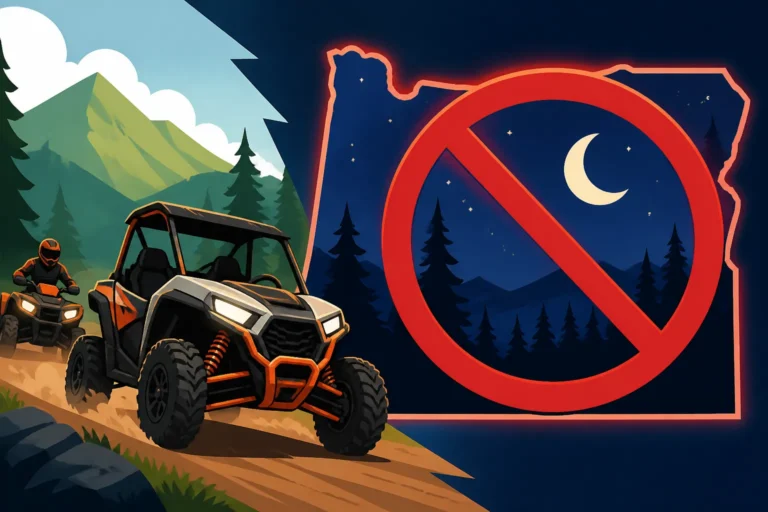
A site may allow riding during the evening but require riders to stop by a stated curfew. That is different from allowing riding all night. For example, the Oregon Dunes area has a curfew associated with its middle riding area; check the current official rules and signs before planning a ride there. The relevant details may include which zone is affected and when the restriction begins.
Other places may use terms such as “day use,” “after dark,” or “closed hours.” Don’t assume those phrases mean the same thing everywhere. If a notice says a trail is closed at dusk, returning to camp after sunset on that trail may still violate the closure—even if your campsite remains accessible.
This distinction matters when planning a late ride. If your group expects to ride until dark, confirm that riding is allowed through the time you expect to be on the trail, and identify a legal route back to the staging area. For site-specific background, see [Oregon Riding Areas That Allow Night Riding] and [Oregon Trail Closures to Check First].
Check restrictions beyond the clock
Hours are only one part of the picture. A route can be closed temporarily for fire conditions, maintenance, wildlife protection, weather damage, or other land-management reasons. Restrictions may apply to a particular road, trail, dune zone, or season rather than to the entire riding area.
Also check whether the access route itself is legal for your machine. A route that looks like a convenient connection on a map could be a closed road, a private road, or a route with separate rules. The guide to [Oregon Rules for Riding After a Storm Closure] is useful when conditions have changed, while [Oregon Fire Closures That Shut Trails] can help you think through fire-season restrictions.
Oregon riding areas to investigate before planning an evening ride
Oregon Dunes National Recreation Area
The Oregon Dunes offer a large coastal riding landscape, but “the dunes” are not one simple zone with one set of hours. Riding access and restrictions can vary by location, and the middle riding area has a curfew that riders should verify before setting a late schedule. Do not interpret a late-afternoon or evening ride as permission to continue past a posted cutoff.
If you are considering the dunes, decide which staging area you will use and check the rules for that area and the route you intend to ride. A plan that starts at Spinreel may not have the same practical return route or restrictions as one that starts farther north. Fog, changing light, soft sand, and the distance back to your vehicle can make a seemingly short evening ride take longer than expected.
The local guides [The Oregon Dunes National Recreation Area], [Oregon Dunes Staging Areas From North to South], and [Riding the Middle Area Before the Curfew] can help you narrow down the area to investigate. Treat them as planning context, then confirm current access information directly with the responsible land manager before you go.
Sand Lake and coastal riding areas
Sand Lake is another coastal destination where it is important to distinguish the riding area from its campgrounds and day-use facilities. A campsite or parking area may remain available while vehicle access to a particular riding zone follows different hours or restrictions. Check the posted rules for the specific area you plan to use rather than relying on a general assumption about the whole site.
Nighttime conditions on the coast can change quickly. Fog can reduce visibility, sand can conceal ruts, and familiar landmarks may be harder to identify after sunset. If your group is unfamiliar with the terrain, plan a shorter route and set a turnaround time that leaves a comfortable margin to return before any curfew or closure.
For area-specific planning, see [Sand Lake for a Weekend] and [Oregon Dune Riding Areas Compared]. These can help you choose a destination, but neither camping availability nor a comparison of riding areas replaces checking the exact operating hours and restrictions for your planned visit.
Forest and high-desert riding areas
Riders often consider places such as Tillamook State Forest or Millican Valley for a change from coastal sand. These areas have their own management rules, trail systems, and seasonal conditions. A forest road or staging area being accessible does not necessarily mean every OHV trail nearby is open for night riding.
At a forest site, pay particular attention to signs at trail junctions and gates. Timber activity, road maintenance, weather, and seasonal closures can affect where you may ride. In a high-desert area, darkness can make it harder to judge terrain, locate trail markers, or spot other riders. A route that feels easy in daylight may be much less forgiving after dark.
Use destination-specific information such as [Oregon's Tillamook State Forest Trails], [Millican Valley Outside Bend, Oregon], and [Oregon Riding Areas Open Year Round] to build a shortlist. Then confirm which routes are open at the time you plan to ride. “Open year round” describes seasonal availability, not necessarily permission to ride throughout the night.
| Riding destination | What to verify before an evening ride | Common planning mistake |
|---|---|---|
| Oregon Dunes | Exact riding zone, staging area, curfew, and route back | Assuming every dune area has the same hours |
| Sand Lake | Separate rules for riding areas, access points, and facilities | Treating an open campground as proof that trails are open |
| Tillamook State Forest | Trail-specific hours, gates, closures, and road activity | Assuming a forest road is an open OHV route |
| Millican Valley | Staging-area access, seasonal closures, and marked routes | Confusing year-round access with after-dark access |
How to plan a safe and legal ride after sunset
Confirm the rules before leaving home
Before loading your machine, check the official information for the land manager responsible for your destination. Look for operating hours, curfews, maps, seasonal closures, and restrictions that apply to the exact riding zone. If the information does not clearly address after-dark use, contact the managing office rather than interpreting silence as permission.
A mapping app can help you understand the area and keep track of routes, but it is not a substitute for official closure notices. For instance, onX Offroad can be useful for reviewing mapped routes and keeping your group oriented, especially when you are comparing possible access points. Still, confirm the legal status and hours of your planned route with the land manager and with signs on site. Maps may not reflect a recent closure or a restriction posted only at a trail entrance.
Before you set out, agree on a return time and a route back to the staging area. If you are riding with people who know the area better than you do, ask them to point out the planned turnaround location and any confusing junctions while there is still enough light to see them clearly.
Prepare your machine and group for low visibility
Working lights are essential for seeing the route and making your machine visible to others. Check the headlights and any required rear lighting before unloading, and carry a backup light source for basic tasks such as checking equipment or finding an item in a pack. Do not assume that a phone flashlight is an adequate substitute for a machine’s lighting.
Keep your group together and agree on what to do if someone falls behind. A simple plan might be to stop at a safe, visible location, avoid splitting up at junctions, and use a reliable way to communicate. On a busy trail, other riders may approach from an unexpected direction, so reduce speed and leave more room than you would in daylight.
OnX Offroad may help you follow a planned route, but phones and GPS devices can lose power, be difficult to read in wet conditions, or fail to show a newly posted closure. Carry a backup navigation option appropriate for the area, and make sure at least one person in the group understands the route without relying solely on a screen.
Choose a route that suits the conditions
Night riding is not the best time to explore an unfamiliar trail network or test how far your fuel will carry you. Pick a familiar, straightforward route with a clear return path. Avoid planning a loop that depends on a narrow time window, especially if your group includes new riders, young riders, or machines with different speeds.
Conditions matter as much as the clock. On the coast, fog and soft sand can change visibility and handling. In the forest, roots, rocks, ruts, and damp surfaces may be difficult to distinguish in artificial light. In open high-desert terrain, it can be easy to misread a junction or drift away from the intended route.
A practical approach is to ride the route in daylight first, then consider an evening ride only if the area permits it and the group is comfortable with the terrain. If the site’s rules are uncertain, if weather is reducing visibility, or if your lights are unreliable, call the ride early. Avoiding one more loop is frustrating; getting lost or riding into a closed zone is a much worse end to the day.
A pre-ride checklist for Oregon night riding
Use this checklist before you leave and again when you reach the staging area:
- Identify the land manager. Confirm who manages the riding area, since nearby lands may have different rules.
- Check hours and curfews. Look for limits that apply to the exact zone, trail, or access route.
- Review closures. Check for seasonal, weather-related, fire-related, or temporary restrictions.
- Confirm your route is legal. Make sure every segment is open to your machine and type of riding.
- Inspect lights and equipment. Test your lights, bring a backup light, and carry navigation and communication options.
- Set a turnaround time. Leave enough time to return before a closure or curfew, with extra room for delays.
- Recheck signs at the site. Follow posted notices even if they differ from an older map or your initial plan.
If you are choosing among destinations, use [Oregon Trail Maps Worth Carrying] to think through navigation needs and [Oregon Rules for Riding a Closed Trail] as a reminder that a route’s appearance on a map does not override a closure. The safest answer to “Can I ride here after dark?” is always specific: this zone, on this date, during these hours, under the rules posted by its manager.
Disclaimer
This article is for general informational purposes only and does not constitute professional advice. Laws, prices and regulations vary by location and change over time. Consult a qualified professional for guidance on your specific situation.