Taking an Oregon Permit Into Nevada
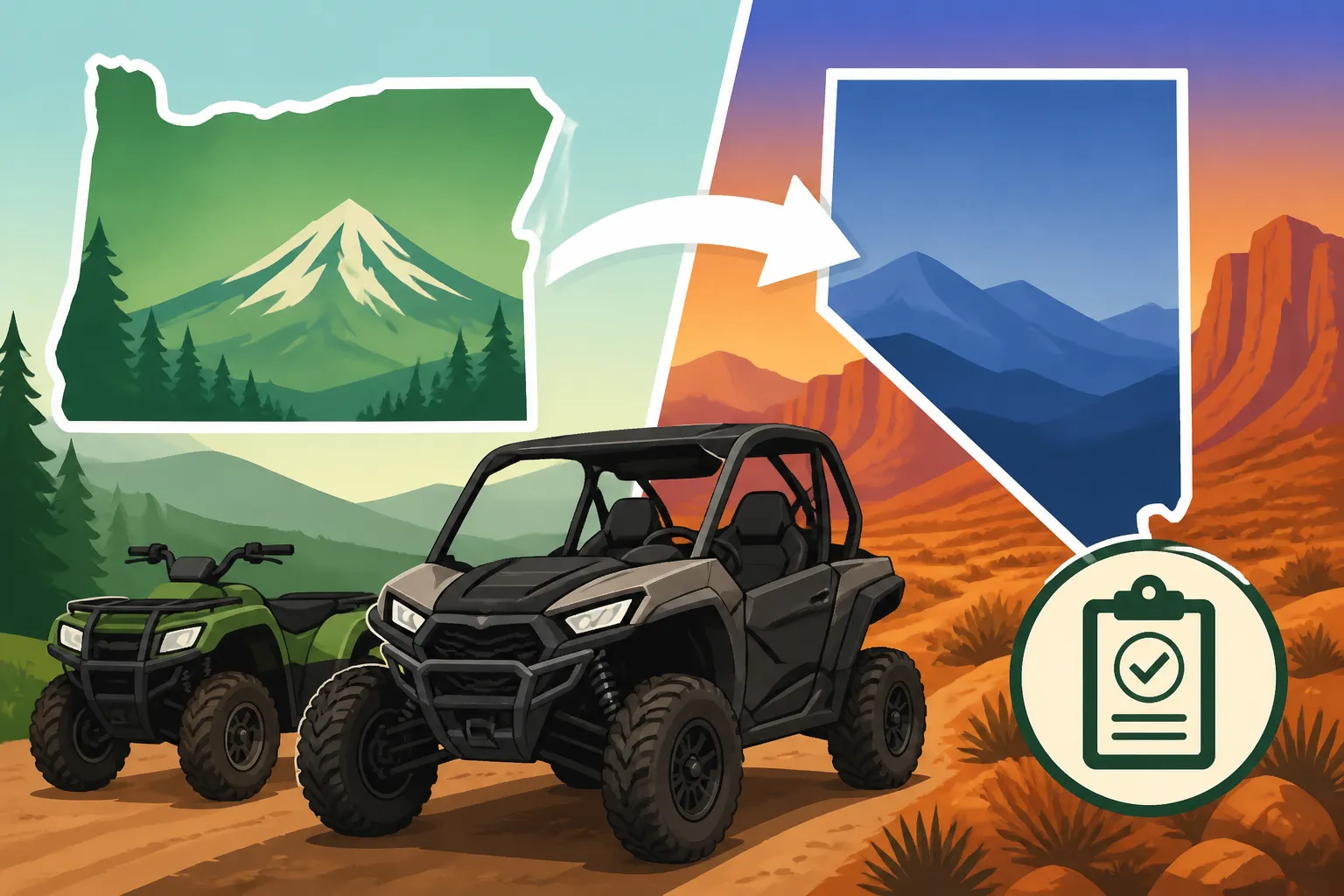
A current Oregon ATV permit may be accepted for off-highway riding in Nevada, but it is not a universal pass. The key is to confirm that Nevada recognizes the permit for your machine and intended riding area, then check the separate rules for registration, safety, equipment, and land access.
Does an Oregon Permit Work in Nevada?
In general, Oregon’s ATV operating permit can serve as out-of-state OHV authorization in Nevada where Nevada recognizes a visitor’s valid home-state permit. That recognition is about off-highway operation; it does not turn an ATV into a street-legal vehicle or grant access to every road, trail, or parcel of land.
The details matter. A permit that has expired, is attached to the wrong machine, or does not meet Nevada’s current reciprocity requirements may not qualify. Nevada rules can also distinguish between types of off-highway vehicles, so confirm that the particular machine and permit are covered before leaving home.
Oregon and Nevada do not use identical systems. Oregon issues an operating permit for eligible off-highway vehicles, while Nevada has its own OHV registration and use rules. Reciprocity is a way for visitors to ride without duplicating a home-state process when the states recognize each other’s credentials. It is not a promise that every state’s decal is accepted for every vehicle or purpose.
For a useful starting point, see Oregon Permit Reciprocity List and Oregon OHV Reciprocity With 18 States. The lists and descriptions of reciprocity can be easy to misread: one may explain where Oregon accepts permits from other states, while another concerns where other states accept Oregon permits. Why Oregon’s Two Reciprocity Lists Differ explains why those two directions should not be assumed to be identical.
Before you travel, check the current Nevada OHV requirements through the state’s official source. Ask whether a valid Oregon ATV permit is accepted for your machine, whether a visitor time limit applies, and whether you must carry proof of the permit while riding. If the answer is unclear, get confirmation before relying on reciprocity.
What the permit does not do
Even if Nevada accepts your Oregon permit, it generally addresses only the permit or registration requirement for off-highway use. It does not automatically:
- Give the vehicle permission to travel on public roads.
- Replace a driver’s license or other operator qualification required for a specific route.
- Waive Nevada safety, equipment, age, or passenger rules.
- Pay a day-use fee or parking charge at a riding area.
- Grant access to private land or a closed trail.
- Replace any separate document required for a street-legal vehicle.
Think of reciprocity as one item in your travel checklist, not an all-access pass.
Check the Machine, Permit, and Decal Before Leaving
Start by identifying exactly what you are taking. Oregon classifies off-highway vehicles by characteristics such as width, weight, seating position, and controls. A quad, dirt bike, side-by-side, dune buggy, or Jeep-style vehicle may fall into a different class, and that classification can affect which rules apply. If you are unsure where your machine fits, use Which Oregon ATV Class Your Machine Falls Into as a starting point, then confirm Nevada’s treatment of that vehicle type.
Next, check the permit itself. Make sure it is current for the dates of your trip and assigned or displayed as required for that machine. Oregon permits have a set term, so don’t judge validity only by when you remember buying it. Check the printed expiration details and review How Long an Oregon ATV Permit Lasts if you need help understanding the term.
Inspect the decal before departure. It should be present, readable, and attached to the machine in the location Oregon requires. A decal that has peeled, cracked, or become obscured may create a problem even if the permit record is valid. See Oregon ATV Permit Decal Placement for Oregon placement guidance. Nevada may have its own display expectations, so confirm whether Oregon’s display satisfies the rules for a visiting machine.
Use this checklist:
| Check | What to confirm | Why it matters |
|---|---|---|
| Vehicle type | Oregon class and Nevada vehicle category | Rules may vary by machine type |
| Permit validity | Expiration and trip dates | An expired permit may not qualify for reciprocity |
| Machine match | Permit and decal belong with the vehicle | A permit for another machine may not cover this one |
| Decal condition | Readable and properly attached | A missing or damaged decal can complicate a roadside check |
| Visitor conditions | Any time limit or proof requirement | Reciprocity may have conditions |
| Route and land | Whether OHVs are allowed there | A permit does not open closed or restricted areas |
If you have just bought a machine or recently transferred ownership, make sure the paperwork and permit information match the vehicle you plan to take. A bill of sale or proof of ownership can be useful for your records, but it is not a substitute for a current operating permit where one is required.
Keep proof easy to reach
Carry the permit documentation in a secure place, such as a waterproof pouch or a protected compartment. Keep it accessible enough to show during a check, but not where it can fall out or be damaged by dust, rain, or a rough ride. A photo or digital copy can be a helpful backup, but do not assume it replaces a required physical document or decal.
Before the trip, take clear photos of the permit and the decal as they appear on the machine. Keep those images with your travel documents. This will not make an invalid permit valid, but it can help you explain what you have if the decal is damaged or you need to contact the issuing office.
Nevada Rules Still Apply on the Trail
An Oregon permit does not exempt you from Nevada’s operating rules. Once you cross the state line, you need to follow the rules that apply where you ride, including requirements for operators, passengers, helmets, equipment, and vehicle use. Requirements can differ by vehicle type and riding location, so check them for the actual trip rather than assuming Oregon rules carry over.
In particular, determine whether the trail or route allows your machine. A trail suitable for a narrow dirt bike may not be open to a wide side-by-side. A road shown on a map may be closed to motorized use, privately controlled, or subject to seasonal restrictions. Posted signs and current land-manager information are important, even when a route appears on a general-purpose map.
Also check whether any local riding area requires a separate entrance, parking, or day-use payment. An Oregon ATV permit is not a substitute for those charges. Oregon Day Use Fees Explained describes the distinction between an operating permit and site-use fees in Oregon; the same practical distinction is worth keeping in mind when planning a Nevada ride. Confirm Nevada site fees and access conditions directly with the relevant land manager.
Roads are a separate question
A permit for off-highway use does not make an ATV or UTV road legal. If a route includes a public road, first establish whether that specific road is open to OHVs and whether your vehicle is equipped and authorized for road use. A machine that can be driven on a trail may not be permitted on the road connecting the trailhead to town.
Do not rely on a navigation app alone. Maps can show a road without indicating whether OHVs are allowed, and access can change because of closures, maintenance, fire conditions, or land-management decisions. Follow signs and barriers, and do not ride around a gate because the route looks passable.
If your machine is street legal in Oregon, that still does not automatically settle whether it can be driven on a particular Nevada road. Registration, insurance, equipment, and local access rules may all be relevant. Treat highway or town-road travel as a separate legal question from taking an Oregon permit into Nevada.
Check vehicle equipment and rider requirements
Confirm Nevada’s requirements for helmets and other protective equipment, including whether rules change by age or vehicle style. A roof, roll cage, windshield, or seat belt does not necessarily replace a helmet requirement. Likewise, a machine designed to carry a passenger does not automatically make every passenger arrangement legal. Check the rules for your vehicle and riders before loading up.
Equipment requirements may also include items such as lighting, brakes, or a spark arrester, depending on the machine and riding area. Noise restrictions can apply as well. Oregon’s rules are a useful reminder to check these details, but they are not a substitute for Nevada requirements. For Oregon-specific background, see Oregon Spark Arrester and Sound Rules.
Do Not Confuse Reciprocity With a Safety Card
A permit decal and a rider safety credential are different things. The permit relates to the vehicle’s operating authorization; a safety card or course requirement relates to the person operating it. One does not automatically replace the other.
Oregon has its own safety-card rules, and Nevada may have separate requirements for residents, visitors, or particular riders. Before the trip, check whether Nevada requires a safety credential for your age, machine, or riding situation, and whether it accepts Oregon documentation. Do not assume that holding an Oregon permit proves you meet Nevada’s rider-training rules.
For an overview of the Oregon side, see Oregon ATV Safety Card Requirements. For Nevada, consult the state’s current OHV information and verify the rule that applies to each person who will operate a machine. This is especially important when children or teenagers will ride, because minimum-age, supervision, and training requirements can vary.
If you are riding with a group, agree in advance on who will carry the permit information and safety documents. Each rider should know the basic rules for the machines they may operate. A family member who is permitted to ride one type of vehicle should not assume that the same age or training rule applies to another.
If you rent or borrow a machine
Ask the rental company or owner what documentation comes with the vehicle and what you must provide yourself. A rental may have its own permit decal, but that does not necessarily settle the operator’s safety-card obligations or the rules for the route. Confirm that the vehicle is permitted for the planned Nevada riding area and that the rental agreement allows the intended use.
For a borrowed machine, get clear permission from the owner and confirm that the permit applies to that vehicle. Do not assume that a permit attached to one ATV can be moved to another. If you are crossing state lines in a rental or borrowed vehicle, keep the owner’s contact details and any documents that demonstrate your authorization to use it.
A Practical Pre-Trip Check
A short check before departure can prevent a long delay at a trailhead or roadside stop. Use this sequence:
- Identify the vehicle. Record its make, model, class, and any relevant measurements or seating details.
- Confirm the Oregon permit is current. Check its expiration information and make sure it is associated with the machine you are taking.
- Verify Nevada reciprocity. Confirm directly with Nevada’s official OHV source that the Oregon permit is accepted for your vehicle and that any visitor conditions are met.
- Check rider requirements. Look up age, supervision, helmet, and safety-course rules for everyone who may operate a machine.
- Confirm the destination rules. Check that the specific riding area is open to your vehicle and review closures, seasonal limits, fees, and staging-area requirements.
- Review the route. Separate off-highway trails from public roads and verify road access with the relevant land manager.
- Inspect the decal and equipment. Make sure the permit display is legible and the vehicle meets applicable requirements.
- Pack proof. Carry the permit documentation and any other required records in a secure, accessible place.
If the official information is ambiguous, contact the relevant agency before you travel. Be specific: give the vehicle type, explain that the permit was issued in Oregon, and ask whether it qualifies for use in Nevada. A general answer about “out-of-state vehicles” may not resolve whether an Oregon operating permit counts as the credential Nevada requires.
It is also sensible to recheck conditions close to departure. A trail can close after you make your plans, and an agency can update its access information. Keep a backup riding option in mind rather than assuming that the nearest route will be open when you arrive.
Frequently Asked Questions
Can I ride in Nevada with only my Oregon ATV permit?
A valid Oregon permit may meet Nevada’s out-of-state OHV requirement where reciprocity applies. Confirm current Nevada recognition for your machine and check whether additional documents, time limits, or rider requirements apply.
Does my Oregon permit let me ride Nevada roads?
No. An OHV permit does not make a machine street legal or authorize it to use any particular road. Road access depends on the vehicle’s legal status and the rules for that specific route.
Do I need to display the Oregon decal in Nevada?
Keep the Oregon decal attached and readable as required in Oregon, and confirm Nevada’s display rules for visiting vehicles. Do not assume that a loose permit document alone is enough if the machine is required to display a decal.
Does the permit cover trailhead or parking fees?
Not necessarily. An operating permit and a site-use or parking fee serve different purposes. Check the rules and fees for the Nevada riding area you plan to visit.
Should I carry the permit paperwork?
Yes. Carry the permit information and any documents Nevada requires for a visiting machine. A digital copy can be a useful backup, but verify whether the physical decal or paperwork is required.
Disclaimer
This article is for general informational purposes only and does not constitute professional advice. Laws, prices and regulations vary by location and change over time. Consult a qualified professional for guidance on your specific situation.