Where Oregon Permit Fees Are Spent
Oregon ATV permit fees can feel like a direct payment for the trail or dunes where you ride, but that is not how the system works. The money supports a statewide off-highway vehicle program. Here’s how permit revenue is handled, what it can help fund, and why a permit does not necessarily cover parking or a site’s other charges.
What an Oregon ATV permit fee pays for
An Oregon ATV operating permit is part of a statewide program, not a ticket that pays only for the place where you plan to ride. Permit revenue helps support off-highway vehicle (OHV) recreation across Oregon. That can mean work at riding areas far from the point of sale, as well as services that benefit riders statewide.
The permit is required for many machines used on Oregon’s designated OHV trails and areas. It provides evidence that the machine is permitted under the state program; it is not a reservation, a parking pass, or a guarantee that a particular route is open. For details on the permit itself, see Oregon’s ATV Operating Permit.
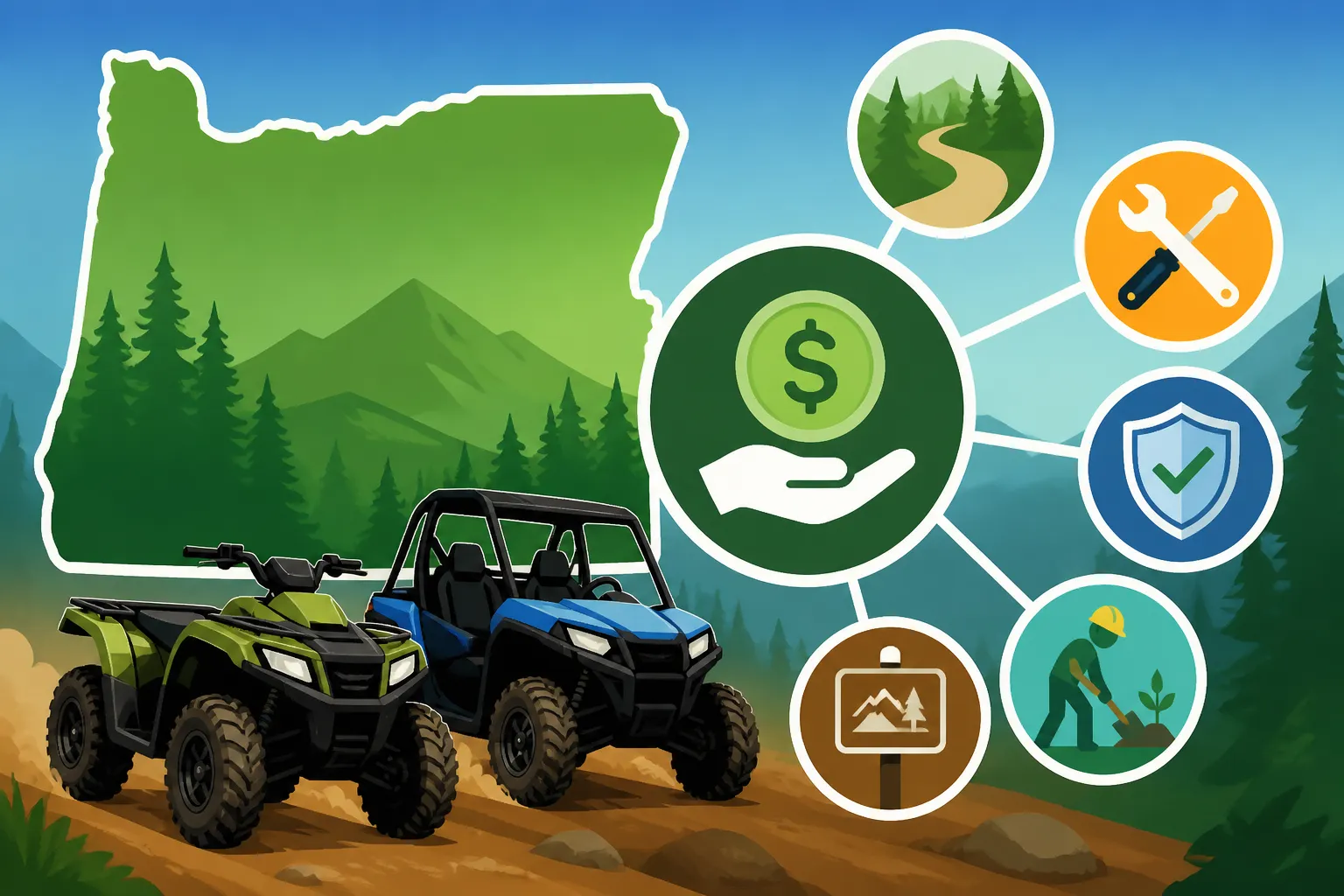
Revenue from permits is one part of how Oregon supports the program. Funded work may include trail and riding-area operations, maintenance, planning, safety education, and enforcement, depending on program priorities and the grants or budgets approved. The exact project mix can change. A popular riding area might receive support for its facilities or trails, while another award could help an agency plan future work or improve safety.
A useful way to think about the permit is as a contribution to a shared system. Riders use different types of machines and visit different parts of the state, but the statewide program helps coordinate funding, standards, and services across those locations. It is not a promise that the full permit fee will be spent where the decal is displayed.
This distinction matters when you are budgeting for a ride. You may still need to pay a separate day-use, parking, campground, or reservation charge. A permit may be required even when a particular place has no additional entrance fee, and paying a site fee does not replace the required permit. Oregon Day Use Fees Separate From the Permit explains how those charges differ.
How permit revenue moves through the program
Oregon Parks and Recreation Department (OPRD) administers the state’s ATV program. The department’s role includes managing the permit system and administering program funding. For more on its responsibilities, see The Oregon Parks and Recreation Department’s Role.
In broad terms, permit revenue is collected into the state’s ATV funding system and used for eligible program purposes. The money is not generally assigned to the exact trail, campground, or riding area where a particular permit was bought. Instead, funding is managed through statewide program rules and budget decisions. Some of the program’s work is carried out through grants to eligible organizations and public land managers.
The ATV Fund may also receive revenue from sources other than permit purchases. For example, a share of fuel-tax revenue associated with OHV use can support the program. That means the total pool available for OHV work is not simply the sum of the decals sold. The details of what revenue is available, how it is accounted for, and what can be spent may depend on state funding rules and approved budgets. Gas Tax Money in Oregon’s ATV Fund covers that funding source in more detail.
A grant is one way money can reach a project on the ground. An eligible agency or organization applies for support for work that fits the program’s requirements. Applications are reviewed through the grant process, and approved projects receive funding under the applicable conditions. A grant award is not automatic just because an area is popular or has many permitted machines.
This helps explain why there can be a gap between buying a permit and seeing a visible improvement at a riding area. Project planning, review, approvals, contracting, seasonal access, and the availability of staff or matching resources can all affect when work happens. Some funded activity is also less visible than a new trail feature: inspections, enforcement, safety instruction, planning, or routine maintenance may not be obvious to a rider passing through.
The stages are easier to distinguish when set out separately:
| Stage | What happens | What it means for a rider |
|---|---|---|
| Permit purchase | A rider buys a permit for a machine that needs one | The purchase supports the statewide program, but does not assign the fee to one site |
| Fund management | Revenue is handled under state program and budget rules | More than permit sales may contribute to the available funding |
| Project or service proposal | An eligible applicant identifies work that fits program requirements | A local need must still be planned and submitted through the relevant process |
| Review and award | Applications are assessed and selected projects receive support | Not every proposed project is funded |
| Delivery and reporting | The recipient carries out the approved work and reports as required | Timing and visible results depend on the project and its conditions |
The state’s grant program is an important part of the connection between funding and local work. Oregon ATV Grant Program Explained describes the grant process, while What Oregon ATV Grant Program Funds looks at the kinds of work that program support can cover.
The kinds of work permit revenue can support
Funding does not have a single use. Eligible projects and services can address different needs, from keeping an existing trail usable to helping riders understand rules or supporting enforcement. The precise categories and requirements should be checked against current program guidance, because not every project or applicant will qualify.
Common kinds of support can include:
- Operations and maintenance. Work may help keep OHV areas, trails, and related facilities usable and in reasonable condition. Depending on the approved project, this might involve routine upkeep, repairs, signs, or managing a riding area.
- Planning and design. An agency may need to assess an area, prepare plans, or develop a proposal before construction or larger improvements can proceed. Planning work can be a necessary step even when it does not immediately change what a rider sees.
- Safety education. The program can support education intended to help riders operate responsibly, understand requirements, and reduce avoidable risks.
- Enforcement. Support may help responsible agencies address riding rules and compliance. Enforcement is part of managing shared riding areas, where unauthorized use can create safety issues or damage resources.
- Land or facility work. Depending on program eligibility and approvals, funding may support certain improvements or projects related to OHV recreation and access.
These are broad examples, not a guarantee that every type of work is funded in every grant round. The grant application rules determine what an applicant can request, and the approved award determines what the recipient may do with the money. A rider who wants to know whether a specific improvement is eligible should check the current grant information or ask the responsible agency.
Some improvements also depend on more than grant funding. An agency may need landowner permission, environmental review, a qualified contractor, or other approvals before work can begin. Seasonal closures, weather, fire restrictions, and staffing can affect the schedule. A project may be funded but still take time to complete.
Funding can also serve the less dramatic work that makes riding areas function: maintaining signs, managing access, monitoring use, preparing for future needs, or helping staff respond to problems. These activities may not add a new trail, but they can contribute to a safer and better-managed riding experience.
For riders, the practical takeaway is to consider the whole system. A permit supports a statewide program with a range of needs; it does not operate like a direct purchase of a specific trail service. If your main concern is whether a particular site has new work planned, a local land manager or project announcement is a better source than the location where you bought the permit.
Why the fee does not stay at the place where you ride
It is natural to assume that buying a permit near a riding area sends the money back to that area. In a statewide program, however, the permit sale is generally not a local earmark. The permit supports the broader system, and local projects may receive funding through a grant or other approved process.
That arrangement has a practical reason: riding areas do not all have the same needs or the same ability to generate revenue. One location may need trail repairs, while another may need safety work, planning, or enforcement support. A statewide approach can consider needs across multiple areas rather than tying every dollar to the nearest sales counter.
It also means there is no simple one-to-one connection between the number of permits sold at a location and the funding that location receives. Local funding may depend on eligible applications, program priorities, the review process, and project readiness. A high-use area can still have to plan and apply for a project, while an approved project elsewhere may address a different need.
Nor does the decal itself tell you where program money has gone. A permit decal is evidence that a machine has a permit; it is not a receipt showing how revenue was divided. If you want to follow the public spending, look for grant awards, project information, budgets, or reports from the responsible agency rather than trying to infer spending from a sticker or a sales location.
There is another distinction worth keeping in mind: a permit and a site fee serve different purposes. A permit supports the state OHV program. A day-use fee or parking charge may be collected under the rules of a particular site or land manager. A campground reservation charge is another separate cost. Which charges apply depends on where you go and the rules in effect there.
| Charge or payment | Main purpose | Does it automatically pay for a specific trail? |
|---|---|---|
| Oregon ATV permit | Supports the statewide OHV program and authorizes operation where required | No |
| Site day-use or parking fee | Applies to access or services at a particular location, where charged | It is tied to the site’s fee system, but check the land manager’s terms |
| Campground or reservation charge | Covers a campsite or reservation under the provider’s rules | No; it is for the booked service |
| Grant funding | Supports an approved project or service under program conditions | It is linked to the approved project, not to an individual permit sale |
A permit does not guarantee that every route will be open when you arrive. Closures may be needed for maintenance, seasonal conditions, fire risk, wildlife protection, or other management reasons. Check current area information before traveling, especially if the ride depends on a particular trail or access road.
Likewise, buying a permit does not remove the need to follow local signs or land-manager rules. A valid permit is one part of lawful riding; it does not authorize riding on a closed route, private land without permission, or a road that is not open to your machine. [Oregon ATV Permits Explained] is a useful starting point for understanding how the permit fits into the wider set of riding requirements.
How to find out where the money is going
If you want a clearer picture than “the fees support the program,” follow the public grant and budget information. Start with OPRD’s ATV program materials and look for current grant guidance, award announcements, project descriptions, and reporting. Those documents are more useful than trying to trace an individual permit purchase.
When reviewing a grant or project notice, check a few details:
- Who received the funding? The recipient may be a land manager, public agency, or another eligible applicant. The recipient is responsible for carrying out the approved work.
- What was approved? A project description should explain whether the award supports maintenance, planning, education, enforcement, or another eligible activity.
- Where will the work happen? A statewide program can support work at particular locations, but the project documents are what identify the area.
- What is the project schedule? An award does not always mean work begins immediately. Check for planning, permitting, contracting, and seasonal constraints.
- What does the report say was completed? Where reporting is available, it can show whether work took place and what the recipient delivered.
You can also ask the land manager responsible for the place you ride. They may know whether a grant application was submitted, whether an award was made, or whether an improvement is being planned through another source. Be specific: ask about the named riding area, the project, or the trail segment rather than asking generally whether permit fees have been spent there.
For a broader view, look at more than one grant cycle or project. A single award only shows one piece of the program. The statewide program may fund different kinds of work in different places, so one area’s project list is not a complete picture of all permit-supported activity.
It can also help to separate three questions that are often bundled together:
- Where does permit revenue go? Into the statewide OHV funding system, under program rules.
- What can the program support? Eligible services and projects, as defined by current guidance and approvals.
- What did a particular place receive? That requires checking the relevant project or asking its land manager.
Keeping those questions separate makes the system easier to understand. It also avoids a common frustration: expecting a permit purchased for one weekend trip to function as a direct payment for every service at the destination.
If you are planning a ride rather than researching program spending, check the destination’s current access rules and any separate fees before leaving. A permit purchase settles the permit requirement where applicable, but it does not replace local day-use charges, reservations, or closure information.
Frequently Asked Questions
Do Oregon ATV permit fees go to the place where I buy the permit?
Not necessarily. Permit revenue supports a statewide OHV program and is not generally assigned to the specific sales location or riding area where the permit was purchased.
Do permit fees pay for trail maintenance?
They can support eligible operations and maintenance work through the program, including projects that may benefit OHV areas. The funding available for a particular location depends on program rules, project approvals, and other conditions.
Does an Oregon ATV permit include parking or campground fees?
No. A permit and a site’s parking, day-use, or campground charges are separate. Check the land manager’s current rules for the location you plan to visit.
Where can I check which projects received funding?
Start with OPRD’s ATV program information and current grant announcements or reports. You can also contact the land manager responsible for the specific riding area.
Disclaimer
This article is for general informational purposes only and does not constitute professional advice. Laws, prices and regulations vary by location and change over time. Consult a qualified professional for guidance on your specific situation.