Oregon Safety Card Replacement
Replacing a missing Oregon ATV safety card can be stressful when a ride is coming up, especially if you are unsure whether you must take the course again. The first step is to identify which card or document you lost and confirm what your machine and age require. Then use the official course or program contact to retrieve or replace the card.
Confirm which document is missing and whether you need it
An Oregon ATV safety card is proof of safety education. It is not the same as an ATV operating permit, permit decal, title, or vehicle registration. If the card is missing, replacing a decal will not solve the problem, and a safety card does not authorize a machine to ride without its required permit.
That distinction matters because riders often keep several documents together and refer to all of them as a “permit.” Before you start looking for a replacement, check what was lost:
| Missing item | What it generally proves or does | What to do |
|---|---|---|
| ATV safety card | Completion of, or eligibility under, Oregon’s safety education rules | Contact the original course provider or the Oregon ATV safety program about retrieving or replacing the record |
| ATV permit decal | The machine has the required operating permit | Follow the process for a lost or damaged permit decal |
| Title or bill of sale | Ownership or transfer records | Use the relevant title or sale paperwork process |
| Out-of-state card or credential | Safety education or authorization from another state | Confirm Oregon’s current reciprocity rules before riding |
For information about who needs a card, see Oregon ATV Safety Card Requirements. Requirements depend on the machine class and rider’s age. Oregon’s card rules do not apply identically to every kind of ATV or every rider, so do not assume that another person’s card requirement is yours. The related explanations Class I and Class III Card Rules in Oregon and Class IV Cards Only for Riders Under 16 can help you narrow down the question.
If you are unsure of the machine’s Oregon class, resolve that first. A quad, dirt bike, side-by-side, and larger off-road vehicle may fall into different classes. The relevant class can affect both permit requirements and safety-card requirements. Use Oregon’s Four ATV Classes Explained or Which Oregon ATV Class Your Machine Falls Into to check the classification before deciding that a replacement is unnecessary.
A card may still be required even if you have ridden for years. Familiarity with a machine is not, by itself, proof that you have met Oregon’s education requirement. Likewise, a card belonging to a family member or riding partner cannot stand in for yours when a card is required.
How to request a replacement Oregon safety card
Start with the organization that issued your original card or recorded your course completion. If you completed an online course, check the account or confirmation email associated with that course. Look for a card download, a completion record, or instructions for getting a replacement. If you took a course through an instructor or another provider, contact that provider and ask how it handles lost cards and record retrieval.
If you cannot identify the provider, or the provider cannot help, contact the Oregon ATV safety program through the Oregon Parks and Recreation Department. Give the program enough information to locate the record, but do not send sensitive personal information through an unverified website or email address. Use contact details from an official Oregon government source.
A useful request is brief and specific. Include your name as it appeared when you took the course, approximate course date, course format, and any confirmation or certificate number you still have. If your name has changed, explain that and ask what documentation is needed to connect the current name to the old record. Keep copies of the response and any replacement confirmation.
- Search your existing records. Check email, downloads, printed paperwork, and any course account you may have used. Search for the provider’s name, the course completion message, or “ATV safety.”
- Identify the issuing provider. Use a course certificate, confirmation email, or saved browser information to determine where you completed the training.
- Ask for a record lookup or replacement. Explain that you completed the course and need access to your card or proof of completion. Ask whether the provider can reissue it or whether you must contact the state program.
- Confirm the correct official contact. If the provider has closed, changed its system, or cannot locate you, check with the Oregon ATV safety program for the appropriate next step.
- Save the new copy securely. Keep the card where you can retrieve it before a ride, and save a backup in a place that does not depend on one device or email account.
Do not assume that you need to repeat the whole course just because the physical card is gone. A missing document and a missing course record are different problems. The provider or program can tell you whether it can verify your completion and issue access to the card, or whether additional steps are required. If no record can be found, ask what acceptable proof or course options are available rather than signing up for a new course immediately.
For the normal course and card process, How to Get an Oregon ATV Safety Card explains the basic route to completion, and Free Oregon Safety Card Online covers the online option. Those pages are useful if you discover that you never completed the course, cannot establish that you did, or need to understand the available path before asking for a replacement. Confirm current procedures directly with the provider or state program, since account systems and reissue instructions can change.
Before riding, make sure the replacement solves the right problem
A replacement card only addresses the education-document issue. It does not replace the machine’s operating permit or make a closed trail or road legal to ride. Before leaving, check that the machine has the required permit, that its decal is present and readable, and that the riding area is open to that class of machine.
The permit decal is associated with the machine; the safety card is associated with the rider. If both are missing, treat them as separate tasks and follow the right process for each. Oregon ATV Permit Decal Falling Off is useful if the machine’s decal is damaged or missing. For a broader explanation of operating permits, see [Oregon ATV Permits Explained].
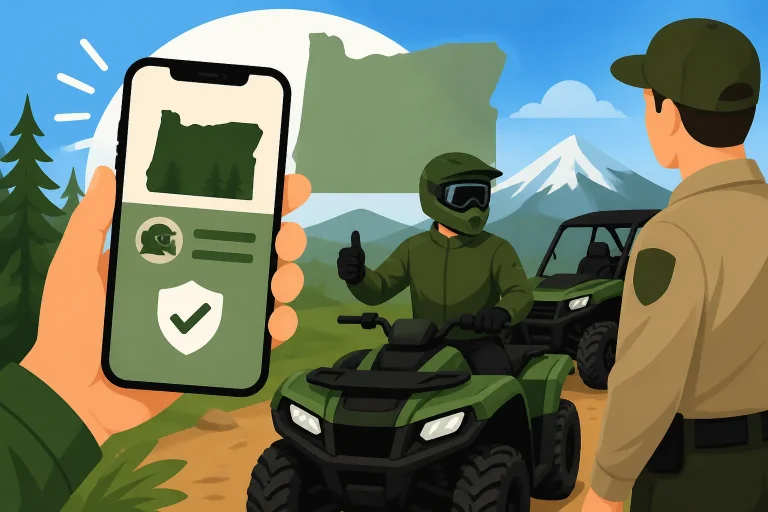
Also check whether you need to carry the card itself or whether an accepted electronic display is sufficient for your situation. Do not rely on a photograph, screenshot, or someone else’s copy unless the official program confirms that format is acceptable. If you plan to show a card on a phone, review Showing an Oregon Safety Card on Your Phone and make sure the document is accessible without a weak signal or a depleted battery. A printed backup can be practical on rides where devices may get wet, dirty, or damaged.
If the card was earned in another state, do not assume that replacing it in Oregon is the right solution. You may need to establish whether Oregon recognizes that state’s safety credential. The rules for safety-card reciprocity are distinct from rules for an out-of-state machine’s permit or registration. Check Oregon Safety Card Reciprocity List and Does Oregon Accept an Out-of-State Safety Card? before a trip. Keep the original card or course information available while you confirm what Oregon accepts.
Visitors should make the same distinction. An out-of-state operating decal does not automatically establish that a safety card is valid in Oregon, and a recognized safety card does not necessarily settle permit requirements. If you ride in Oregon often, verify both requirements separately. Riding Oregon With an Out-of-State Permit and How Long a Visitor Can Ride Oregon address the permit side of the question.
A practical pre-ride check is:
- Confirm your machine’s class and the card requirement for your age and situation.
- Make sure the replacement card or other accepted proof is readable and accessible.
- Check the machine’s permit and decal separately.
- Confirm that any out-of-state credential is accepted for the intended ride.
- Check the riding area’s current access rules before you travel.
If you are riding with children or teenagers, check each rider’s requirement individually. A parent’s card does not cover a young rider, and being a passenger is not necessarily the same as operating the machine. The rules for age, supervision, and machine class are covered in Oregon Rules for Riders Under 16 and Oregon Minimum Age to Ride an ATV. When a rental is involved, ask the rental business what it provides and what the rider must bring; do not assume the rental’s permit or safety paperwork belongs to you.
Preventing another lost-card problem
Once you have a replacement, make it easy to find without relying on a single copy. Store the physical card with other ride documents in a dry, secure place. If the program permits an electronic version, save it somewhere you can access offline, and consider keeping a printed backup with your vehicle paperwork. A backup is useful only if you know where it is and can read it when asked.
Avoid attaching the only copy to gear that is often swapped between machines or riders. If you carry documents in a toolbox, tank bag, or dry bag, check that the storage is protected from water and abrasion. A card left loose in a glove compartment can be torn, faded, or lost during routine gear changes.
Keep basic course information with your records: the provider’s name, the email used to register, the approximate completion date, and any certificate or student number. That information can make a future record lookup much easier, especially if you change email addresses or complete training through a provider that later updates its website.
If you move or change your legal name, ask the provider or program how to update the record. Do not assume the old card becomes invalid, but make sure you can explain a mismatch between the card and your current identification if one arises. Follow the official instructions rather than altering the card yourself.
Finally, make replacement part of trip planning rather than a last-minute stop. If the card is missing, contact the provider early enough to resolve the record question and check current requirements before traveling. If you cannot obtain proof in time, ask the official program what options are available. Do not ride on the assumption that a lost card will be excused or that a permit decal can substitute for it.
Disclaimer
This article is for general informational purposes only and does not constitute professional advice. Laws, prices and regulations vary by location and change over time. Consult a qualified professional for guidance on your specific situation.