Taking an Oregon Permit Into California
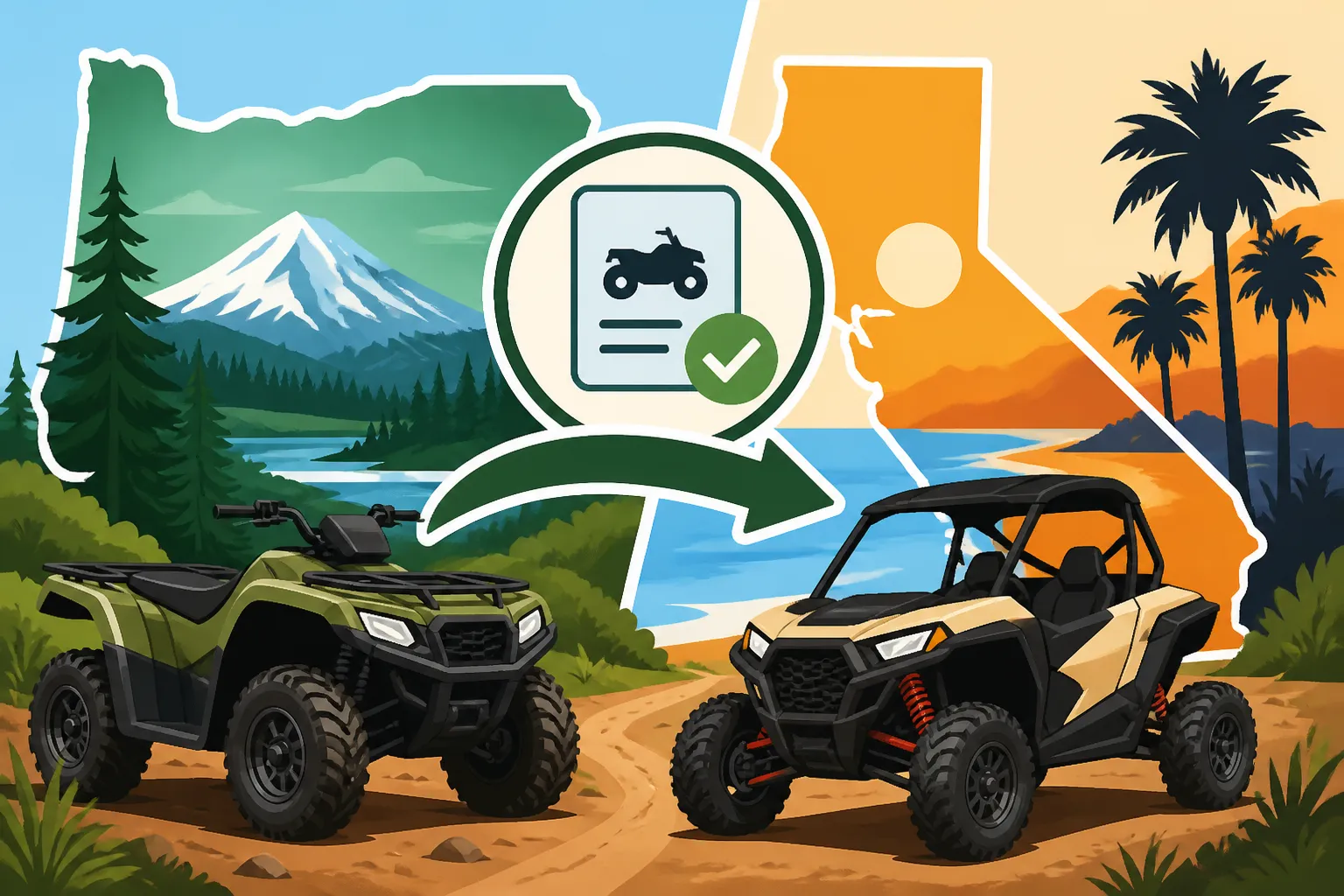
Taking an Oregon permit into California raises a practical question: will the Oregon decal let you ride there, or do you need another permit? The answer depends on California’s current reciprocity rules and the machine’s status. The safest approach is to check the California requirement for your vehicle before you travel, then check the rules for the specific riding area.
What an Oregon ATV permit does—and does not—cover
An Oregon ATV operating permit is for operating a covered off-highway vehicle under Oregon’s rules. It is not a general license to ride in every state, and it does not make a quad, dirt bike, or side-by-side street legal. California sets its own requirements for visiting off-highway vehicles.
That distinction matters because a permit decal, a state registration, a title, and a safety card are different documents. They may serve different purposes, and one does not automatically replace the others. For a refresher on what the Oregon decal is for, see [Oregon ATV Permits Explained].
California may recognize some out-of-state credentials under reciprocity rules, but recognition is not something to infer from the fact that both states regulate off-highway riding. Oregon’s rules for accepting another state’s credential do not, by themselves, tell you what California accepts. The two states can have different recognition lists and conditions. See Oregon Permit Reciprocity List for the Oregon side of that distinction.
The practical question is whether California currently accepts the specific Oregon credential displayed on your machine, for that vehicle type and use. If California’s current rules do not clearly confirm that the Oregon permit qualifies for an exemption, do not assume the decal is enough. Check with California’s off-highway vehicle program before setting out; if your machine needs a California nonresident permit, arrange that before riding.
| Document or credential | What it generally relates to | What to check before a California ride |
|---|---|---|
| Oregon ATV operating permit | Authorization under Oregon’s off-highway rules | Whether California recognizes it for your machine |
| Vehicle registration | A state record and credential for a vehicle | Whether the registration is valid for this vehicle and accepted in California |
| Vehicle title | Evidence of ownership | Whether you need it for ownership or a transaction; it is not an operating permit |
| Safety card | Rider education or qualification | Whether California requires a separate card or training credential |
| California nonresident OHV permit | California’s own permit process for certain visiting vehicles | Whether your Oregon vehicle qualifies for an exemption instead |
An Oregon permit also does not grant access to a particular California trail, forest road, beach, or riding area. Land managers can set their own rules, closures, fees, and equipment requirements. A vehicle can meet a state permit requirement and still be barred from a specific route.
This is why the useful answer is not simply “Oregon permits work” or “Oregon permits do not work.” First confirm whether California recognizes your Oregon credential. Then confirm that the place you plan to ride is open to your vehicle and that you meet its local requirements.
How to check California’s reciprocity requirement
Before the trip, look for California’s current instructions for nonresident off-highway vehicles. California State Parks’ Off-Highway Motor Vehicle Recreation program is the relevant starting point for California OHV permit information. Check its current guidance directly, rather than relying on an old forum post, a friend’s past trip, or a retailer’s general statement.
When you check, be precise about what you own. Explain that the vehicle has an Oregon ATV operating permit and identify its type and use. A permit for an off-road vehicle may not be treated the same as a plate or registration issued for a street-legal vehicle. The answer may also depend on whether the machine is a quad, motorcycle, side-by-side, or another type of off-highway vehicle.
A useful way to check is to:
- Identify the vehicle’s Oregon class and confirm that its permit is current. If you are not sure how Oregon classifies it, start with Which Oregon ATV Class Your Machine Falls Into.
- Find California’s current rule for a nonresident vehicle that is used off-highway.
- Ask whether an Oregon ATV operating permit is accepted for that vehicle or whether California requires a nonresident OHV permit.
- Confirm whether the rule changes for a machine that has valid street registration, rather than only an Oregon off-highway permit.
- Save the official answer or the relevant current instructions with your trip documents.
- Check again if the trip is much later or if the machine’s registration, permit, or home-state status changes.
If you speak with an agency representative, ask about the exact credential—not just whether California accepts “Oregon vehicles.” State clearly whether you have an Oregon OHV permit, an Oregon road registration, or both. Those are not interchangeable terms.
The Oregon decal is not a California riding pass
A decal shows that a machine has a particular credential. It does not mean every California land manager must accept it, and it does not replace a local day-use payment or site pass. For Oregon-specific decal information, see Oregon Permit Decals and Where They Go. In California, follow the directions for the California credential that applies to your vehicle, including any display instructions.
Avoid buying a permit based only on a general assumption that a neighboring state’s decal will work. Equally, do not buy a second credential without first checking whether your Oregon permit qualifies for an exemption. A quick confirmation can prevent both a compliance problem and an unnecessary purchase. If the official rule is unclear, ask the state program directly and keep a record of the answer.
A safety card is a separate question
A rider education card is not the same thing as a vehicle permit. Even if your Oregon decal is accepted for the vehicle, that does not automatically establish that your rider has met every California age, training, or supervision requirement. The reverse is also true: holding an Oregon safety card does not replace a vehicle credential.
If riders in your group have questions about Oregon training credentials, Oregon ATV Safety Card Requirements explains Oregon’s separate rules. For California, verify the requirements that apply to the person riding, especially for a young rider. Do not treat a vehicle’s decal as proof that every rider is qualified to use it.
What to prepare before crossing the state line
Start with the machine’s documents and make sure they tell a consistent story. Carry proof of the current Oregon credential and any registration or ownership papers that apply to your vehicle. If the machine is permitted for off-road use but has no road registration, be prepared to describe that accurately. Do not call the Oregon operating permit a plate or road registration.
If you recently bought the machine, make sure the permit or registration information is not left in the seller’s name or confused with paperwork for another vehicle. A title can help establish ownership, but a title by itself does not establish that the machine has the operating credential California requires. Oregon’s title rules are separate from its permit system; Titling an ATV in Oregon Is Optional covers that distinction.
Before departure, check the physical decal too. It should be present, legible, and displayed as Oregon requires. Keep any supporting paperwork somewhere dry and accessible rather than buried under camping gear. If you are asked about the machine during a stop or at a staging area, being able to show what it is and which credential it carries makes the conversation simpler.
A short pre-trip document check can include:
- The Oregon permit is current and belongs to the machine you are transporting.
- The decal is displayed in the required location and can be read.
- Any registration document is current and matches the machine.
- The vehicle identification number on the paperwork matches the machine.
- You have the official California reciprocity instructions or confirmation you relied on.
- Each rider has checked any separate age, safety, or supervision requirements.
- You know which permit or pass, if any, the destination requires in addition to the state credential.
If you use a rental, borrowed machine, or club vehicle, ask who is responsible for the vehicle credential and what documentation will be available to you. Do not assume that another person’s Oregon permit or safety card automatically covers every machine or every rider. For a rental-specific overview of Oregon obligations, see Oregon Rules for a Rented Machine; California’s rules still need their own check.
A road-registered vehicle is a different case
Some off-highway-type machines may also be registered for street use, depending on the vehicle and applicable state rules. If yours is road-registered, that may affect how California treats it, but it does not erase every off-highway requirement. The vehicle still needs to be allowed on the route, and its road equipment, insurance, license, and registration must be appropriate for the type of road and use.
An Oregon off-highway operating permit does not make a machine road legal in California. Nor does the fact that a vehicle is road legal in one place give it unrestricted access to trails or OHV areas elsewhere. Check the rules for the actual route rather than relying on the vehicle’s general appearance or its ability to travel on pavement.
Check the destination as carefully as the permit
Once you have settled the state credential question, check where you intend to ride. California’s riding opportunities may involve different land managers, and a statewide permit does not guarantee entry to every area. A riding area may require a separate day-use payment, parking pass, reservation, or other local credential. It may also have route limits, seasonal closures, noise rules, spark-arrester requirements, or restrictions on vehicle width and type.
Use the official information for the specific area, not just a map that shows an apparent trail. Check that the route is open to your class of machine, that the staging area is accessible, and that the route allows the kind of use you plan. Public land can include roads and trails with different restrictions, and boundaries may be difficult to recognize on the ground.
A practical destination check includes:
- Whether the area is open on the date you plan to ride.
- Which authority manages the area and where it posts current closures.
- Whether the machine’s type, size, or equipment is permitted.
- Whether an area fee or parking pass is separate from the OHV credential.
- Whether the route is open to nonresident riders and to your specific vehicle.
- Whether camping, overnight parking, or riding after dark has separate rules.
The same principle applies when crossing between jurisdictions within a trip. A credential that works for one state or land manager may not cover the next part of your route. If your plans include multiple areas, check each one separately.
Travelers who ride in Oregon before or after California should also keep those states’ rules distinct. Oregon permit reciprocity and California’s recognition of an Oregon permit are separate questions; so are site fees. Oregon Day Use Fees Explained describes why a vehicle permit and a site-use payment can be separate costs in Oregon. For California, check the destination’s own fee information rather than assuming the state credential covers parking or access.
Common mistakes and a reliable pre-ride process
The most common mistake is thinking that the Oregon decal is a universal pass. It is not. It is an Oregon credential, and California’s rules determine whether it satisfies California’s requirement. A second common mistake is confusing the Oregon permit with street registration. A third is checking the state credential but overlooking a riding area’s local rules.
These mistakes are easy to avoid if you separate the questions:
- What is the machine? Confirm its type, Oregon class, and whether it has off-road credentials, street registration, or both.
- What does California require? Check whether California accepts the specific Oregon credential or requires a California nonresident OHV permit.
- Who is riding? Check separate rider requirements, including age, training, and supervision.
- Where are you going? Confirm that the area and route are open to your machine and that any local fee or pass is handled.
- What will you show if asked? Carry the permit, registration, ownership documents, and official information that clarifies the credential.
If California’s instructions specifically say your Oregon credential qualifies, follow any conditions in that guidance. If it says a nonresident permit is required, obtain the California permit before riding. If you cannot tell from the instructions, ask the state program and describe your machine precisely. Guessing based on a similar-looking decal from another state is a poor substitute for a clear answer.
Be cautious with advice that describes a rule as permanent or universal. Reciprocity arrangements and permit processes can change, and old information may not apply to a different machine class. The right source is the current California instruction for nonresident OHVs, supplemented by the destination manager’s rules.
In short, take the Oregon permit as evidence of an Oregon credential—not proof of automatic access in California. Verify whether California recognizes it for your vehicle, obtain any additional credential required, and check the destination’s rules before unloading.
Frequently Asked Questions
Can I ride in California with only an Oregon ATV permit?
Possibly, but do not assume so. Check California’s current reciprocity rule for the specific Oregon credential and vehicle. If California requires a nonresident OHV permit for your machine, obtain it before riding.
Does an Oregon permit make my ATV street legal in California?
No. An Oregon off-highway permit does not convert an ATV into a street-legal vehicle. Road use depends on applicable registration, equipment, licensing, insurance, and route rules.
Is a California nonresident permit the same as a day-use pass?
No. A state OHV permit and a riding-area or parking fee serve different purposes. Check both California’s vehicle requirements and the destination’s entry or parking rules.
Does my Oregon safety card replace a California vehicle permit?
No. A safety card relates to the rider, while a vehicle permit or registration relates to the machine. Check each requirement separately.
Disclaimer
This article is for general informational purposes only and does not constitute professional advice. Laws, prices and regulations vary by location and change over time. Consult a qualified professional for guidance on your specific situation.