Oregon Rules for a Rented Machine
Renting an ATV or side-by-side in Oregon may save you the work of transporting and maintaining a machine, but it does not remove the rules that apply to riding one. The rental company and rider have different responsibilities, and the details can depend on the machine’s class, your age, and where you plan to ride. Here’s how to sort out permits, safety-card requirements, and rental paperwork before you leave the counter.
The short answer: a rental is not a rules exemption
A rented machine still has to meet Oregon’s requirements for the kind of off-highway vehicle it is and the place where you ride it. Renting can change how you satisfy some requirements—particularly safety education—but it does not make a machine automatically legal on every trail, staging area, road, or beach.
The practical split is:
- The rental company should explain the machine, provide required rental paperwork and instruction, and make clear what the rental permits you to do.
- The renter must follow Oregon’s riding rules, use the machine only where it is allowed, meet applicable age and supervision requirements, and keep required documents available.
- The riding area may have additional requirements, such as a day-use fee, seasonal closure, or rules about which machine classes can use particular trails.
Before you take the keys, get clear answers to two separate questions: “Is this machine properly permitted for the places we’re going?” and “What do I, as the operator, need to carry or complete?” A machine can have its operating decal in place while its rider still needs to meet a safety-card rule. And a rider’s safety card does not replace the machine’s operating permit.
| Requirement | What it applies to | What to confirm before riding |
|---|---|---|
| Oregon ATV operating permit | The machine, when required for the riding area | Is the machine’s permit current, and is its decal displayed correctly? |
| Safety education or rental checklist | The operator, depending on machine class and other circumstances | Does the operator need a card, and does the rental company’s process satisfy the applicable requirement? |
| Day-use or site fee | The person or vehicle using a particular recreation site | Is a separate fee or pass required at the staging area? |
| Rental agreement | The renter and the rented machine | Where may you ride, who may operate, and what happens if the machine is damaged or towed? |
| Land-manager rules | Everyone using that land or route | Are the trails open to this machine class today? |
For a wider overview of how the operating permit works, see [Oregon ATV Permits Explained]. For the rental-specific permit question, Oregon ATV Permit for a Rented Machine is a useful companion.
Who is responsible for the machine’s permit and decal?
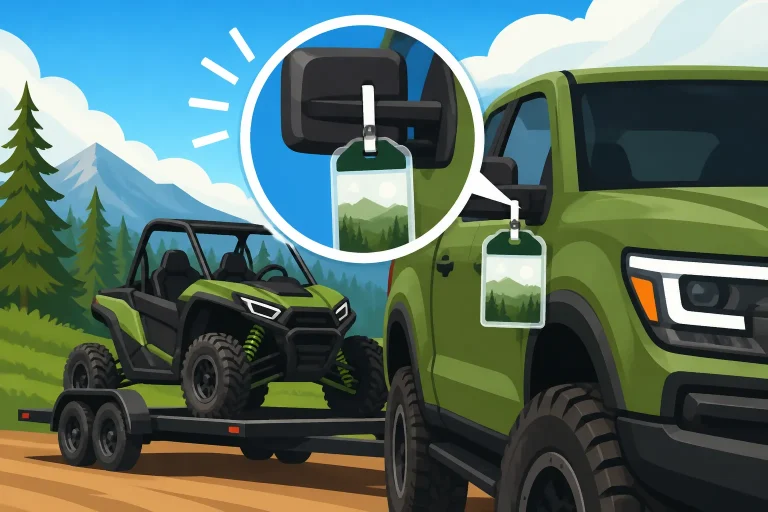
Oregon’s ATV operating permit is connected to the machine, not just to the person who rented it. Renting a machine does not, by itself, make it exempt from permit requirements. Before riding, look for the required decal and ask the rental company whether the machine is permitted for your intended riding area.
Do not assume that a decal on one machine covers another. If your group rents several ATVs or side-by-sides, check each machine. If you switch vehicles during the rental, ask whether the new machine has the required permit and whether anything in the paperwork changes.
The decal should be attached in the location required for that kind of machine, where it can be seen and read. If it is missing, badly damaged, or covered by equipment, stop and ask the rental company to resolve the issue before departing. You can learn more about general placement in Oregon ATV Permit Decal Placement.
A permit is not the same as permission to ride anywhere
An operating permit does not open every road or trail to every kind of ATV. The land manager’s rules still control access. A site may restrict vehicles by class, width, or other characteristics, or close routes for safety, weather, wildlife, fire, maintenance, or seasonal reasons.
This matters especially if the rental counter is some distance from your destination. A machine that is suitable for one riding area may not be allowed on a route you were planning to use elsewhere. Confirm the riding area and machine class with the rental company, then check current information from the land manager before setting out.
Site fees may be separate
A valid machine permit usually does not settle every access cost. Some riding areas charge a separate day-use or parking fee, or require a pass for the vehicle used to reach the site. These charges are distinct from the machine’s operating permit and from your rental agreement. See Oregon Day Use Fees Separate From the Permit before treating a permit decal as an all-in access pass.
If a rental shop says that a machine is “ready to ride,” ask what that means. It may mean the machine has its required equipment and permit, not that your day-use fee is paid, every route is open, or all riders in your group have met their individual requirements.
Safety cards and the rental-company checklist
Oregon’s ATV safety education rules can depend on the machine class and the operator. A rental does not automatically waive those rules. At the same time, Oregon has a rental process that can help some customers meet the applicable safety requirement through instruction and a rental checklist.
That distinction is worth sorting out at the counter instead of guessing. Ask what the company provides, who in your group must complete it, and what proof you should keep with you. For a broader explanation of the rule, see Oregon ATV Safety Card Requirements.
What the 30-day rental process is for
Oregon’s rental safety-card process is commonly described as a 30-day rental card or temporary safety-card arrangement. It is intended to connect the safety instruction and checklist completed through a rental to the renter’s operation of a rented machine. It is not a general substitute for learning the rules, nor should you assume it works as a permanent card or applies to every vehicle you might ride later.
The exact procedure matters. Ask the rental business whether it will provide the required instruction, what form or record you will receive, and how long that document applies. Keep the document available while riding, whether the company gives it to you on paper or tells you how to access it electronically. Do not rely on a verbal “you’re all set” if you are unsure what you are supposed to show during a check.
For the rental-specific details, read Oregon’s 30-Day Rental Safety Card Explained. The company should also be able to explain its own process in plain language before you sign or depart.
One rider’s completion may not cover the group
If several people in your party expect to operate, do not assume one person’s card, checklist, or briefing covers everyone. Ask the rental company which operators must complete the process and whether each person needs to sign or receive their own proof.
This is particularly important when adults and children are riding together, or when you plan to trade drivers during the rental. A passenger may be subject to different rules from an operator, but someone who takes the controls becomes an operator. Confirm requirements for the actual machine class and each person’s age rather than assuming the group’s paperwork is interchangeable.
If you already hold an Oregon safety card or a card from another jurisdiction, show it to the rental company and ask whether it meets the requirement for that machine and trip. Oregon has specific reciprocity rules; a card that is accepted in one situation may not necessarily settle every requirement in another. Does Oregon Accept an Out-of-State Safety Card? covers that separate issue.
Visitors, out-of-state permits, and reciprocity
Visitors often assume that a permit or registration from home automatically works in Oregon. Sometimes Oregon recognizes an out-of-state permit under its reciprocity rules, but the recognition depends on the relevant list and conditions. It is not safe to assume that any sticker, plate, or registration from another state is enough.
There are two separate questions to check:
- Does Oregon recognize the permit or registration on the rented machine?
- Does Oregon recognize the safety card held by the person operating it?
Those questions can have different answers. A state may appear on one reciprocity list but not another, and the limits that apply to an out-of-state visitor may also matter. Review Oregon Permit Reciprocity List and Oregon Safety Card Reciprocity List rather than treating “reciprocity” as one blanket rule.
For most renters, the simplest approach is to ask the rental company whether its machine is set up for the Oregon riding area and whether you need any additional document as the operator. If you are visiting with your own card or permit, show the company what you have and confirm that it applies to the planned ride. See Oregon Rules for a Visiting Rider for the wider visitor picture.
If you are renting locally as a visitor
A locally rented machine may simplify the vehicle-permit part of the trip, because the rental business can provide a machine prepared for the area. It does not necessarily resolve your personal safety-card requirement. Complete the rental company’s required instruction and paperwork, and keep proof available.
If you plan to ride beyond the area the rental company recommended, ask first. A machine that is properly permitted for Oregon is not automatically allowed on every route, and an out-of-state card or permit does not override site-specific closures.
If the rental is from outside Oregon
If you bring a rented machine across the state line, do not assume the rental company’s paperwork satisfies Oregon requirements. Contact the company before the trip and ask whether the vehicle’s permit or registration is recognized for the Oregon riding area you intend to visit. Also check the operator’s safety-card status and any time limits or other conditions that apply to visitors.
A rental contract may restrict travel across state lines even where the machine could otherwise be operated legally. Get the company’s permission in writing if you are planning to cross a border or use the machine somewhere other than the designated rental area.
The machine’s class, your age, and who may operate
Oregon groups off-highway vehicles into classes. The class affects how a machine is described and can influence applicable safety, equipment, access, and operating rules. A quad, dirt bike, side-by-side, dune buggy, and Jeep-style vehicle are not automatically treated alike just because a rental counter calls them all “ATVs.”
Ask the rental company for the machine’s Oregon class, especially if your plans involve trail access or a group with different ages. A side-by-side may fall into a different class from a quad, for example, and a vehicle’s seating arrangement, width, controls, and design can matter. Which Oregon ATV Class Your Machine Falls Into explains the distinctions.
Age and supervision are not just rental-company policies
A rental business may set its own age, license, or supervision limits, and those limits can be stricter than the minimum rule that applies under state law. The rental contract may also prohibit a person from operating even if that person would otherwise meet a legal requirement.
Before booking, ask:
- What is the minimum age to rent and to operate this machine?
- Does the operator need a driver’s license?
- Can a younger rider operate, or only ride as a passenger?
- Must a parent or guardian sign for a minor?
- Does the rental company require an adult to ride in the same machine or group?
- Who is allowed to take over as driver during the rental?
For younger riders, read Oregon Rules for Riders Under 16 and [Oregon Minimum Age to Ride an ATV]. If the machine is a side-by-side, passenger and seat-belt rules matter too; a vehicle that has extra seats does not mean every person can ride in any position or without the proper restraint.
Only authorized drivers should take the controls
Rental agreements commonly identify who is permitted to operate the machine. If someone else in your group wants a turn, make sure that person is authorized by the rental company and has completed any required instruction or paperwork. Do not hand over the controls simply because the person is an experienced rider or has an out-of-state permit.
An unauthorized driver can create problems beyond a citation. If there is a crash or mechanical damage, the company may treat the unauthorized operation as a contract violation, which can affect how the incident is handled. Read the driver section of the agreement before leaving.
What to check before you sign and ride
A few minutes at the counter can prevent a frustrating day—or a safety problem—later. Ask the rental staff to explain the machine’s controls and show you the paperwork you are expected to carry. If anything is unclear, get an answer before departing rather than trying to sort it out at a trailhead.
Confirm the documents and equipment
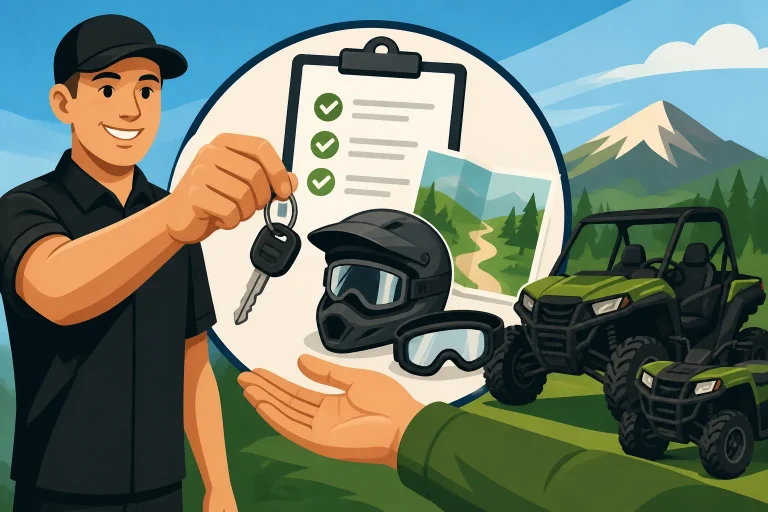
Use this checklist before you leave:
- Check the machine’s permit decal. Make sure it is present and readable, and ask whether it is valid for your intended riding area.
- Confirm each operator’s safety requirement. Ask who needs a card or rental checklist, complete the required steps, and keep the proof.
- Review the rental agreement. Confirm authorized drivers, permitted destinations, return time, fuel expectations, and what to do if the machine breaks down.
- Ask what equipment is included. Find out whether helmets, goggles, communication equipment, and other required or recommended items are supplied.
- Get the route and closure information. Ask which routes are open to the machine class and where you should not ride.
- Save the rental company’s contact details. Know how to reach the business if you get lost, stuck, or have a mechanical problem.
- Inspect the machine together. Take note of existing damage and report it before departure, following the company’s process.
A rental business may provide a safety briefing and checklist, but the quality of the briefing depends on whether you listen, ask questions, and understand the controls. A short demonstration is not a substitute for taking the ride within your ability. If you are new to off-road driving, ask for beginner-friendly terrain and avoid following faster riders into unfamiliar areas.
Bring personal gear that fits
Rental equipment may be available, but you should ask about fit, condition, and what is included rather than assuming. A properly fitting helmet and eye protection are especially important. If you prefer to bring your own, make sure it is suitable for the type of ride and complies with the rules that apply. Some riders shop for basic items such as goggles or gloves through Amazon; check product specifications and fit carefully, and do not assume a listing’s description proves that an item meets a required standard.
Weather on the Oregon coast can change quickly, and dusty or wet conditions can affect visibility and comfort. A spare layer, eye protection that fits well, and a secure way to carry small essentials can make the ride easier. Amazon may be convenient for finding general riding accessories, but consider trying safety gear in person when fit or certification is important.
Keep items secured so they cannot fall off, interfere with controls, or become trail litter. A phone should be protected from dust and water, but do not mount or handle it in a way that distracts the driver. If you need navigation, set it up before moving and stop safely before making changes. For items you do not want exposed to sand or rain, compare a dry bag from Amazon with a local outdoor shop’s options and choose one that closes securely.
Where you ride still controls what is allowed
The rental counter is not the final authority on every trail, road, or recreation site. Rules may differ by land manager, and a route that is open to one class may not be open to another. Signs, gates, posted notices, and current land-manager information matter. If the area has a temporary closure, a valid permit and a signed rental contract do not allow you to ride through it.
Road use deserves special attention. An off-highway machine is not automatically street legal, and a rental company’s permission to leave its lot does not authorize you to ride on any public road. Oregon has limited, specific circumstances for road access, and the rules depend on the route and vehicle. Read Are ATVs Street Legal in Oregon? before planning a ride that includes a town street, county road, or highway crossing.
At a minimum:
- Stay on routes open to your machine class.
- Follow posted closures and seasonal restrictions.
- Do not pass a locked gate or ride around a closure sign.
- Do not assume a road shown on a map is open to OHVs.
- Ask before crossing private land or an industrial road.
- Use designated staging areas and observe their parking and fee rules.
- Turn around when conditions or visibility make the route unsafe.
The rental company may be able to recommend familiar routes, but closures can change. Check current information for the riding area shortly before your trip and again at the staging area. If signs and an old map appear to conflict, do not treat the map as permission to continue.
Returning the machine and handling problems
The rules and responsibilities do not end when you finish riding. Follow the contract’s return instructions, report damage promptly, and ask the rental company what to do if you have a breakdown or incident. Do not attempt a repair that could make the machine less safe or violate the agreement.
If the machine becomes stuck, overheats, or stops running, get yourself and your passengers to a safe location first. Contact the rental company using the number you saved. Recovery charges, towing, cleaning, or damage procedures depend on the agreement, so read those terms before the ride rather than trying to interpret them after something goes wrong.
Before returning the machine:
- Refuel it if the agreement requires that.
- Remove personal gear and check storage compartments.
- Tell the staff about any collision, damage, warning light, or unusual noise.
- Follow the company’s cleaning and parking instructions.
- Keep a copy of any incident report or written communication.
If you were given a rental checklist or temporary safety document, keep it for the period the rental company or applicable rule requires. Do not assume the document can be reused for a later rental, a different machine, or your own ATV. Ask the rental company what it covers and when it stops applying.
For a broader explanation of what businesses may provide as part of a rental, see What an Oregon ATV Rental Includes. The most useful habit is to leave the counter knowing exactly which machine you have, who may operate it, what paperwork you need, and where you are allowed to ride.
Disclaimer
This article is for general informational purposes only and does not constitute professional advice. Laws, prices and regulations vary by location and change over time. Consult a qualified professional for guidance on your specific situation.