Class I and Class III Card Rules in Oregon
An Oregon ATV permit decal does not replace the rider’s safety card, and the card rule is not the same for every machine class. If you ride a Class I quad or a Class III off-road motorcycle, the key question is whether the person operating it has the required card—not how old they are or who owns the machine. Here’s how the rule works and what to check before you ride.
The Class I and Class III rule is about the rider
Oregon requires a safety education card for operators of Class I and Class III all-terrain vehicles. The requirement applies to riders of any age. A parent’s card, a vehicle owner’s card, or a permit decal attached to the machine does not meet the requirement for someone else operating it.
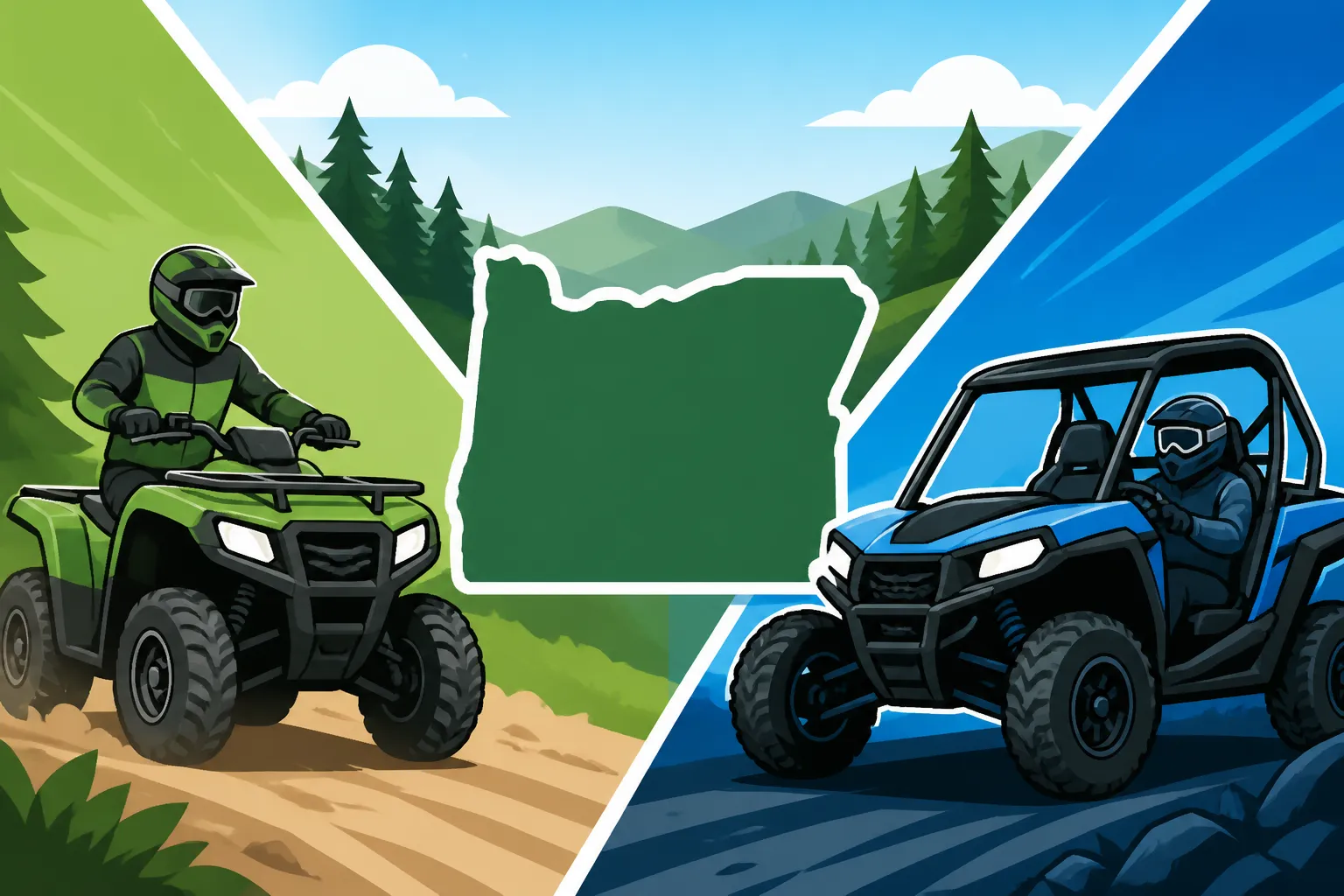
Class I generally covers ATVs designed for straddle seating and handlebars, such as many quads. Class III covers off-road motorcycles, including dirt bikes. If you are not sure which class your machine falls into, check its features and classification before relying on a rule for another kind of ATV. These guides explain the distinctions: Oregon’s Four ATV Classes Explained, Oregon’s Class I Under ORS 801.190 and Class III Off-Road Motorcycles in Oregon.
The practical rule is simple:
- If you operate a Class I or Class III ATV in a place where Oregon’s ATV safety-card requirement applies, have the required card or a qualifying accepted alternative.
- Do not assume that being an adult, holding a driver’s license, or having years of riding experience automatically removes the requirement.
- Do not confuse the safety card with the vehicle’s Oregon operating permit. They serve different purposes.
The card requirement is tied to operating certain classes, while the permit is tied to the machine and its use. A machine may have a current Oregon permit decal even when the person riding it has not met the safety-card requirement. The reverse is also possible: a rider can have a valid safety card but still be riding a machine without the required permit.
That distinction matters at the staging area, on a trail, or during a stop. A card proves the rider has met the applicable education requirement. A permit decal shows that the vehicle has met the separate operating-permit requirement. For details on the decal, see Oregon’s ATV Operating Permit. For a broader overview of the education requirement, see Oregon ATV Safety Card Requirements.
Why age does not create an exemption for these classes
It is easy to assume that safety-card rules are mainly for children. Oregon’s Class I and Class III rule does not work that way: the operator requirement applies across ages. An adult who bought a quad recently and a teenager learning on a dirt bike should both check that they have the appropriate card before riding.
This is different from the rule commonly associated with Class IV machines, where the safety-card requirement is limited to younger operators. Don’t transfer that age-based exception to a quad or off-road motorcycle. The categories are not interchangeable, and the class of the machine matters. Class IV Cards Only for Riders Under 16 explains that separate rule.
A driver’s license also should not be treated as a universal substitute. Oregon has specific rules for different classes and situations. Check whether the card or an alternative is required for the exact vehicle you will operate rather than relying on the fact that you can legally drive a car. The related guide When an Oregon Driver’s License Replaces a Safety Card covers that distinction.
A card is not a vehicle permit
The safety card and operating permit are easy to mix up because both may come up when preparing for a ride. Think of them as two different checks:
| Requirement | What it applies to | What it demonstrates |
|---|---|---|
| Oregon ATV safety education card | The operator, for classes and circumstances covered by the education rules | The rider has met the required safety education standard |
| Oregon ATV operating permit | The machine, when the permit rule applies | The vehicle has the required operating permit |
| Site or day-use fee | The ride location or parking use, where charged | The required site access fee has been paid |
Paying a site fee does not satisfy the card rule, and completing a safety course does not put a permit decal on the ATV. Before leaving home, check each requirement independently. A useful checklist is: correct class, qualifying rider card, valid vehicle permit, open riding area, and any site-specific fee or pass.
How to get the required card
Oregon’s ATV safety education process includes an education and testing component. Class I and Class III riders should follow the current state-approved process and any training step required for their class. The exact process and available course options should be confirmed through Oregon’s official ATV safety education program before relying on a card or temporary document.
Start with How to Get an Oregon ATV Safety Card for the general process. The following steps help avoid the common mistake of stopping after one part of the course.
- Identify the machine class. Confirm whether you are preparing for a Class I quad, a Class III off-road motorcycle, or a different class. The class determines which education and operating rules apply.
- Use the official course route. Take the course or exam recognized by Oregon, rather than assuming that an unrelated online course or a manufacturer’s orientation will count.
- Complete each required component. If the process for your class includes hands-on training after online study, finishing the online material alone may not complete the requirement for a permanent card.
- Keep proof of every completed step. Save the completion record, card, or temporary authorization provided by the program. Check the document for any restrictions and expiration date.
- Carry or be ready to show proof while riding. A card stored at home cannot help if you need to demonstrate compliance on the trail.
The state program may allow an instructional permit while a rider completes the remaining training. That is a limited bridge, not a reason to assume you can ride without conditions. Read the permit’s terms carefully, including the validity period, supervision requirements, and what training remains. The guide Oregon’s 180-Day Instructional Permit explains the temporary-permit issue, while Oregon Hands-On Training Within Six Months focuses on completing the practical component.
Experienced riders still need to follow the process
Experience can make the course more familiar, but it does not automatically create an exemption. Oregon has an equivalency route for some experienced riders, but eligibility and testing details matter. Check the official requirements before planning on an equivalency exam instead of the standard course. The article Taking Oregon’s Equivalency Exam as an Experienced Rider can help you understand what to investigate.
If you have ridden for years, take particular care not to confuse skill with documentation. A rider may be highly capable and still need to complete the state’s required process. Conversely, someone who has completed the required education should not assume that the card gives them permission to operate any class of machine under any circumstances. Other rules can still apply, including age, supervision, passenger, helmet, and site restrictions.
Keep a usable record
The safest approach is to keep the official card or proof in a place where it is accessible and protected. If you carry a paper copy, a basic waterproof document sleeve can help prevent it from getting soaked or torn. Amazon and outdoor retailers sell clear sleeves, but the product is only for protecting your copy; it is not an official card or proof of completion by itself.
If you ride in wet or sandy conditions, store the document somewhere it will not be crushed by tools or exposed to grit. A sealed pouch from Amazon may be useful for keeping several ride documents together, such as the safety-card proof and vehicle paperwork. Keep originals or digital backups as appropriate, and make sure a phone screenshot is an acceptable way to show the document before relying on it.
For a card that has faded, been damaged, or gone missing, use the state’s replacement process rather than trying to recreate an official-looking card yourself. Oregon Safety Card Replacement covers what to do if you need another copy.
What visitors and out-of-state riders should check
A card issued elsewhere may be accepted in Oregon, but acceptance depends on Oregon’s reciprocity rules. Do not assume that every state’s ATV course, registration, sticker, or permit automatically meets Oregon’s card requirement. The safety-card reciprocity list and the vehicle-permit reciprocity list are separate questions.
If you already have a card from another state, check whether Oregon recognizes that state’s credential for the class you plan to ride. If you do not have an accepted card, find out whether you need to complete Oregon’s education process before operating. A card that was accepted for a previous trip or a different kind of machine is not necessarily enough for every situation.
The distinction between safety-card reciprocity and permit reciprocity is especially important for visitors. A state may be treated one way for a vehicle permit and another way for rider education. Check both lists independently. Oregon Safety Card Reciprocity List and Oregon Permit Reciprocity List address those separate issues.
Do not rely on a sticker as proof of training
Out-of-state riders sometimes arrive with a registration sticker or operating permit from home and assume it covers all Oregon requirements. It may address the vehicle-permit question, but that does not automatically establish that the operator has met Oregon’s education requirement. Likewise, an Oregon safety card does not automatically settle whether the vehicle’s out-of-state permit is accepted.
Before travelling, write down the answers to these questions:
- What class is the machine?
- Does Oregon accept the rider’s safety credential for that class?
- Does Oregon accept the vehicle’s permit or registration?
- Is the rider subject to any age or supervision restrictions?
- Does the riding area require a separate day-use payment or pass?
If any answer is unclear, resolve it before unloading the machine. It is far easier to check a rule at home than to discover a problem when you are already at a trailhead or staging area.
Renting or borrowing a machine does not transfer the rider’s qualification
A rental company or vehicle owner may provide a properly permitted machine, but that does not necessarily satisfy the operator’s personal education requirement. A borrowed quad with a current decal does not transfer its owner’s card to the person borrowing it.
Renters should ask the business what documents or training it supplies and what the rider must provide. Rental rules can include an orientation, safety checklist, age limits, and a temporary safety-card arrangement, but those details should be checked directly with the rental provider and against Oregon’s current requirements. For related guidance, see Oregon Rules for a Rented Machine and Does Your Rental Come With a Safety Card?.
If a family member is lending you a Class I ATV or Class III motorcycle, ask about the card before making plans. This avoids the awkward assumption that “the machine is already legal” means “every rider is ready to operate it.” The owner can help identify the class and locate the vehicle paperwork, but each operator needs to meet the rule that applies to them.
A pre-ride check for Class I and Class III operators
A short check before the ride can prevent a paperwork problem from turning into a lost day. These steps are useful whether you own the machine, borrow it, rent it, or bring it into Oregon from another state.
Confirm the class first
Start with the vehicle’s design, not its nickname. A quad is commonly Class I, while an off-road motorcycle is Class III, but modified, unusual, or specially built machines may not fit the assumption you have in mind. Check the classification rules if the machine’s seating, controls, dimensions, or construction make it unclear.
The class can change which rider requirements apply. It also affects permit, equipment, and operating rules. If you are unsure, compare the machine with Which Oregon ATV Class Your Machine Falls Into before you rely on advice meant for a different type of ATV.
Check the operator’s card and any conditions
Make sure the person who will actually operate the Class I or Class III machine has the required card or an accepted alternative. If the person is still completing the training process, read the temporary document closely. Do not assume that it is valid indefinitely or that it permits unsupervised riding.
For a group, check every operator individually. A parent or group leader cannot satisfy the requirement for all the riders by carrying one card. A passenger who is not operating the ATV is a different case, but passenger rules still matter and should be checked separately.
Check the machine’s permit and decal
Look at the vehicle separately from the rider. Confirm that the machine has the permit required for its use and that the decal is in the correct location and readable. A decal that has peeled off, become obscured, or expired can create a separate issue even when the rider has completed safety education. See Oregon ATV Permit Decal Placement for the placement rules.
If you recently bought the vehicle, do not assume that a previous owner’s documents settle your obligations. Verify whether the permit is valid for the current machine and use. For ownership paperwork, Oregon ATV Title Requirements explains why title and permit questions are separate.
Confirm that the route is open and suitable
A valid card and permit do not authorize riding everywhere. Land managers can close trails, restrict access, or impose area-specific conditions. Check the current map, signs, and notices for the place you plan to ride. A road or trail shown open in an old screenshot may have changed.
For Class III riders, pay attention to routes intended for off-road motorcycles and any class-specific restrictions. For Class I riders, confirm that the route permits the machine’s size and type. Also check for closures related to weather, fire, wildlife, maintenance, or active work. A safety card is education proof, not a substitute for checking access.
Protect the document without confusing it for authorization
A card sleeve can help on a muddy or wet ride, but it does not replace the official record. Amazon and similar retailers offer small waterproof holders that can keep a paper copy legible; choose one that closes securely and does not interfere with any required vehicle equipment. Keep the card separate from loose tools, fuel containers, and items that can damage it.
If you ride with a phone, store a digital copy only if the official program’s instructions or enforcement guidance allow that method. A photo that is blurry, cropped, or missing identifying details may be difficult to use. A compact gear organizer from Amazon can keep paperwork, a pen, and other essentials together, but confirm the card format and the accepted way to present it before relying on a particular storage setup.
Common misunderstandings to avoid
“I’m an adult, so I don’t need a card.” For Class I and Class III operation, age does not remove the card requirement. Check the rules for your machine class.
“The ATV has a decal, so the rider is covered.” The decal is associated with the vehicle permit. The safety card is an operator requirement. One does not substitute for the other.
“My driver’s license is enough.” Do not assume a driver’s license replaces the required card for Class I or Class III. Oregon has class-specific rules and limited alternatives. Confirm that the exact credential you hold is accepted.
“I passed an online course, so I’m done.” Some riders may have an additional training step. Check the state program’s requirements for your class and make sure you have the final card or a valid temporary authorization.
“My home-state sticker proves my training is recognized.” A permit or registration sticker concerns the machine. Reciprocity for rider education is a different question.
“The owner has a card, so I can ride their machine.” The operator must meet the requirement. The owner’s qualification does not transfer.
“A card means I can ride any route.” The card addresses education. It does not override machine-class restrictions, road rules, closures, land access rules, or site fees.
If you remember one thing, make it this: check the operator’s card, the vehicle’s permit, and the riding area as three separate items. For Class I and Class III machines, do not use age, experience, a driver’s license, or a decal as a substitute for checking the safety-card rule. When the course process or an out-of-state credential is involved, verify the current requirements through Oregon’s official ATV safety education program before riding.
Disclaimer
This article is for general informational purposes only and does not constitute professional advice. Laws, prices and regulations vary by location and change over time. Consult a qualified professional for guidance on your specific situation.