Oregon Permit Reciprocity List
Oregon permit reciprocity can save a visiting rider from buying a separate Oregon permit—but only if the machine’s home-state permit qualifies. The tricky part is that permit reciprocity is not the same as safety-card reciprocity, and neither one grants access to every trail. Here’s how to check what applies before you unload.
What Oregon’s permit reciprocity list means
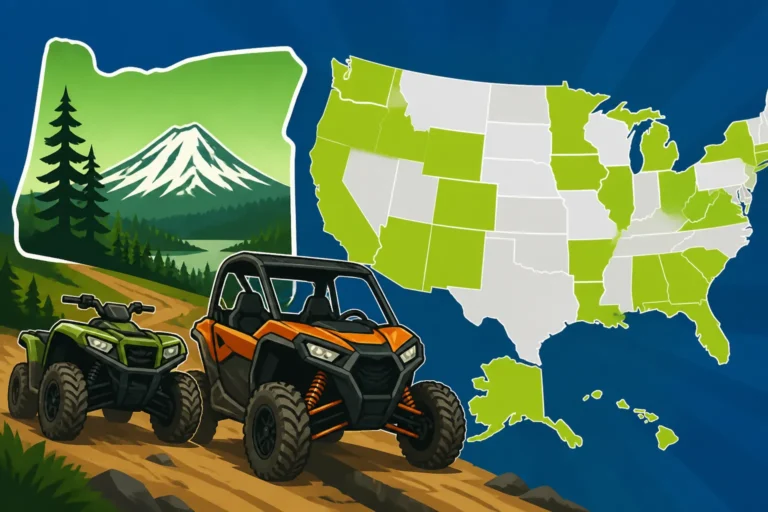
Oregon recognizes qualifying off-highway vehicle permits from a list of other states. The state’s published permit reciprocity roster covers 18 states, but an out-of-state decal is not automatically valid just because it comes from a neighboring state or looks similar to an Oregon permit.
The key question is whether the permit issued for your machine by its home state is one Oregon recognizes. If it is, a visiting rider may be able to operate without buying Oregon’s regular ATV operating permit for a limited period. Oregon’s reciprocity period is capped at 60 consecutive days. After that, you may need to obtain an Oregon permit to continue riding.
Because the roster and conditions are state-specific, check Oregon’s current official permit reciprocity information before your trip. Don’t rely on an old forum post, a retailer’s general advice, or the assumption that a permit accepted in one state will be accepted in Oregon. The related explanation of Oregon Permit Reciprocity List is not available as a separate topic, but Oregon Permit Reciprocity List would be a circular link, so use Oregon’s official information directly.
Actually internal link self not allowed. remove. Need actual links relevant. Continue.
Reciprocity applies to the permit requirement, not every rule involved in riding. You still need to use a machine that fits the relevant Oregon class, carry any required safety education credential, follow land-manager restrictions, and pay any separate day-use or parking fee. A valid out-of-state permit does not open a closed trail or authorize travel on a road where OHVs are prohibited.
| Your situation | What to check | Likely next step |
|---|---|---|
| You have an OHV permit from another state | Whether Oregon recognizes that state’s permit for your machine | Confirm acceptance on Oregon’s current reciprocity roster |
| Your permit state is not on Oregon’s roster | Whether Oregon offers another exemption that applies to you | Buy an Oregon permit before riding where one is required |
| You plan to ride in Oregon beyond the reciprocity period | How long you have already ridden in Oregon during the visit | Confirm whether you need an Oregon permit before continuing |
| You have an out-of-state safety card | Whether Oregon recognizes the card separately from the permit | Check the safety-card reciprocity rules too |
| You are renting a machine | Whether the rental has its own permit and what credentials you need | Ask the rental provider before departure |
The reciprocity question is easiest to handle before you travel. Keep your home-state permit information available, and make sure the decal is attached as required by the state that issued it. If you cannot confirm that Oregon recognizes it, buying an Oregon permit in advance may be the simpler option. The general permit rules are covered in [Oregon ATV Permits Explained], while Oregon Rules for a Visiting Rider focuses on visitors’ obligations.
Permit reciprocity is not safety-card reciprocity
Oregon’s ATV operating permit and an ATV safety education card serve different purposes. The permit is tied to the machine and its authorization to operate in covered areas. A safety card concerns the rider and whether that person has completed or qualifies for the required safety education.
That distinction matters because Oregon maintains separate reciprocity rules for permits and safety cards. A state may appear on one list but not the other. Having a recognized out-of-state permit does not prove that your safety card is accepted, and having an accepted safety card does not make your machine’s permit valid.
For a quick comparison:
| Credential | Usually relates to | What reciprocity may establish |
|---|---|---|
| OHV permit or registration | The machine | Whether Oregon accepts the home-state authorization instead of requiring an Oregon permit |
| ATV safety education card | The rider | Whether Oregon accepts the rider’s out-of-state training credential |
| Driver’s license | The operator, for certain machine types or uses | Whether the operator meets a separate licensing requirement |
| Site pass or day-use payment | The vehicle or visit, depending on the site | Whether a separate recreation-site charge has been paid |
Oregon has its own safety-card requirements, and acceptance of out-of-state credentials is addressed separately from permit reciprocity. Review Oregon ATV Safety Card Requirements and Oregon Safety Card Reciprocity List rather than assuming the permit rules answer both questions. Riders under 16 should take particular care to confirm the rules that apply to their age, machine class, supervision, and training. Oregon Rules for Riders Under 16 provides more detail.
A useful pre-trip check is to make a short list for each person and machine:
- Identify the machine’s class under Oregon’s system. Oregon classifies ATVs by design features such as width, seating, and controls, not just by the name used in an advertisement. Use Which Oregon ATV Class Your Machine Falls Into if you are unsure.
- Confirm whether the machine has a current home-state permit or registration.
- Check whether Oregon recognizes that specific state credential for the machine.
- Check whether each rider needs a safety card and whether Oregon accepts the card they hold.
- Confirm any separate site fee, trail closure, or access restriction for the destination.
This avoids a common mix-up: arriving with the right machine paperwork but no accepted rider credential, or having the right card while the machine still needs an Oregon permit.
How to check whether your out-of-state permit qualifies
Start with the state that issued the credential, not the place where you bought the machine. A machine purchased in one state may be registered or permitted in another, and its purchase location does not by itself establish reciprocity. The state shown on the current permit or registration is the one to compare with Oregon’s roster.
Then check that the credential is still valid and applies to the machine you are bringing. A permit that has expired, is for a different vehicle, or does not authorize the type of OHV use you plan may not solve the Oregon requirement. If you have questions about an out-of-state machine, Oregon Rules for an Out-of-State Machine explains the broader considerations.
Keep documentation available while riding. A decal may be displayed on the machine, but having the supporting permit or registration details accessible can help if a ranger asks what credential the decal represents. Carry the rider’s safety card separately if one is required. A phone image may be convenient, but do not assume a picture will substitute for a credential when the issuing agency or Oregon requires something else.
If the home-state credential does not qualify, or you cannot verify that it does, the practical alternative is to obtain an Oregon permit before riding in places where one is required. Oregon permits are issued through the state’s available sales channels; see Where to Buy an Oregon ATV Permit for the purchase options. For certain short-term situations, Oregon’s Thirty-Day Temporary Permit explains the temporary option. Check the current conditions and validity before choosing it.
Remember that the permit’s period of validity and reciprocity’s time limit are separate questions. Your out-of-state permit may remain valid in its home state for longer than the period Oregon allows a qualifying visitor to rely on it. Track the days you ride in Oregon rather than assuming that the home-state expiration date controls the Oregon limit.
What reciprocity does not cover
Reciprocity answers a narrow question: whether Oregon accepts a qualifying out-of-state OHV permit in place of an Oregon permit for a limited period. It does not resolve every access, equipment, or rider requirement.
It does not grant permission to ride anywhere
An accepted permit does not authorize riding on closed trails, private property without permission, or roads that are not open to OHV use. Land managers may impose seasonal closures, route-specific rules, or other restrictions. Check the rules for the area you plan to visit, and obey signs even if a map or online post appears to show a route as open.
It does not replace site fees
A permit is not the same as a parking pass or day-use payment. Some riding areas have separate fees or pass requirements. Check the specific site before leaving, especially if you are visiting federal recreation land or a managed staging area. Oregon Day Use Fees Explained covers the distinction between an operating permit and site charges.
It does not change Oregon’s machine-class rules
A state’s category or registration label may not match Oregon’s ATV classes. Oregon classifies machines using its own definitions. A side-by-side, quad, dirt bike, or sand rail may have different requirements depending on its design. If the class affects a permit, safety-card, or operating rule, confirm the Oregon classification rather than relying only on the label printed on your home-state paperwork.
It does not make a machine street legal
An OHV permit is for off-highway operation where permitted; it is not a license plate or general authorization to drive on public roads. Rules for road access depend on the machine, route, and local authorization. For a broader explanation, see Are ATVs Street Legal in Oregon?.
It does not guarantee acceptance of an out-of-state safety card
As noted above, safety-card recognition has its own rules and list. Verify both credentials independently. This is particularly important for family trips, where riders may have different ages, cards, or training histories.
When reciprocity is uncertain, it is safer to resolve the question before the ride than to discover the issue at a staging area. Confirm the state credential, the machine class, the rider’s education requirements, and any site-specific conditions. If Oregon’s official information does not clearly show that your permit qualifies, contact the relevant state program or obtain an Oregon permit before riding.
Disclaimer
This article is for general informational purposes only and does not constitute professional advice. Laws, prices and regulations vary by location and change over time. Consult a qualified professional for guidance on your specific situation.