Oregon Rules for Riding Into Town
It's a dream many of us share: you're out riding the trails, the sun is shining, and suddenly you realize you're low on gas, or maybe you're craving a burger and a cold drink. You see a small town just down the road and think, "Wouldn't it be great if I could just cruise right into town on my quad or side-by-side?" Unfortunately, for many off-road enthusiasts in Oregon, that dream often crashes into the concrete wall of reality. Oregon's rules around riding ATVs and UTVs into town are, to put it mildly, complex and highly restrictive, often leading to frustration and confusion. This guide is here to untangle those rules, explain why they exist, and show you the very limited scenarios where it's even possible to take your machine on paved town roads.
The Fundamental Challenge: Are ATVs Truly Street Legal in Oregon?
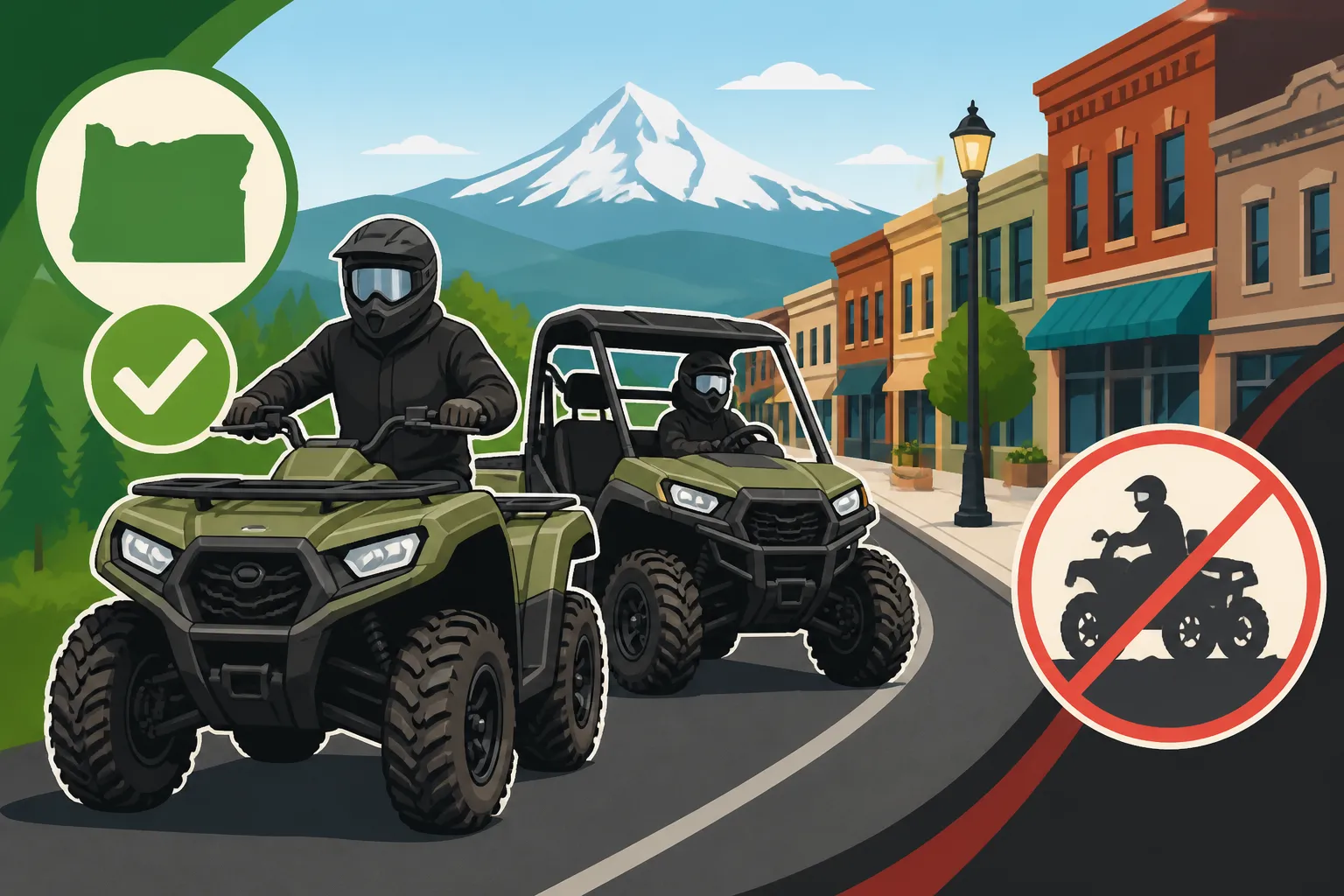
Let's just rip the band-aid off right away: for the vast majority of people with a typical quad, dirt bike, or side-by-side, riding directly into most Oregon towns on public paved roads is simply not allowed. It's a tough pill to swallow, especially when you see folks in other states doing it, but Oregon has a very specific framework for what counts as street legal and where these machines can operate. This often leads to a lot of head-scratching and disappointment, especially for riders new to the state or those coming from areas with more permissive laws.
The General Rule: Off-Road Means Off-Road
Most ATVs, dirt bikes (Class III off-road motorcycles), and side-by-sides (Class IV machines) are manufactured and intended for off-road use only. They lack the full suite of safety equipment required for public road travel, such as appropriate lighting, mirrors, or even the basic certification for highway speeds. Because of this fundamental design, Oregon's Department of Motor Vehicles (DMV) generally does not register these machines for street use. Trying to take a standard trail machine onto a city street, even for a short hop, can land you a citation for an unregistered vehicle, among other things. It's a common misconception that if you just go slow or stay on the shoulder, it's okay. That's simply not true; the distinction is often black and white. You might be able to ride legally on a county gravel road, but the moment you hit that "Welcome to [Town Name]" sign and the asphalt starts, your legal access usually ends abruptly. It's really important to understand that distinction to avoid a costly lesson. [Are ATVs Street Legal in Oregon?] delves into this in more detail.
Oregon's Class II Exception and Street-Legal Conversion
Now, here's where a small glimmer of hope appears for some. Oregon does have a specific classification, Class II, that can be registered for street-legal use. What exactly is a Class II machine? Think of a sand rail, dune buggy, or even a modified Jeep-like vehicle. These are generally off-highway vehicles that are designed to carry multiple passengers, have a steering wheel (not handlebars), and typically weigh more than a standard quad. They also tend to be wider and longer. The key differentiator is their original design and the ability to meet specific safety standards.
If you own a Class II machine, you might be able to get it registered and plated by the Oregon DMV for street use. This isn't a simple process, though. It requires ensuring your vehicle meets all the federal motor vehicle safety standards (FMVSS) and specific Oregon state requirements. This includes things like proper headlights (high and low beam), taillights, brake lights, turn signals, horn, rearview mirrors, a windshield (if applicable), seatbelts, and DOT-approved tires. It's a significant undertaking, and it often involves aftermarket parts and modifications. Companies like SuperATV offer a range of accessories that can help Class II owners meet these stringent requirements, from wiring kits for turn signals to street-legal mirror setups. It's not just about bolting on a few parts; it's about making sure everything functions correctly and is street-legal compliant. [Class II Machines That Can Be Plated in Oregon] provides further explanation of this unique category.
Designated Routes: Oregon's Limited Gateway to Town
Even if your ATV or UTV isn't a Class II machine, there are two very specific and highly publicized exceptions in Oregon where certain OHVs are permitted to operate on public streets within designated routes. These are rare instances, born out of local community need and specific state legislation, and they are not a blanket permission to ride into any town.
Lakeside and Sumpter: The Only Two
Currently, Oregon has only two towns with designated ATV highway access routes: Lakeside on the coast and Sumpter in Eastern Oregon. These routes are meticulously mapped and signed, creating a narrow corridor where off-highway vehicles can travel on specific city streets to access services like gas stations, restaurants, or lodging, or to connect to other trail systems.
Imagine you're riding the Oregon Dunes near Lakeside. You've spent hours tearing up the sand, your fuel gauge is looking grim, and your stomach is rumbling. Instead of loading your quad back onto the trailer and driving your truck into town, the designated route in Lakeside allows you to legally drive your permitted OHV on certain streets. This means you can pull right up to a gas pump, grab a bite to eat, or even check into a motel without needing to haul your machine. It's incredibly convenient for riders in those specific areas and a direct answer to the practical needs of the riding community. The same concept applies in Sumpter, allowing riders to enjoy the local amenities while still out on their machines. [Oregon's Only Two Designated ATV Routes: Lakeside and Sumpter] details these specific locations.
Understanding Designated Route Rules
It's crucial to understand that even on these designated routes, you're not entirely free to roam. There are still rules to follow. You must obey all traffic laws, including speed limits, stop signs, and signals. You're sharing the road with regular vehicle traffic, so courtesy and caution are paramount. All riders must still have their valid Oregon ATV Operating Permit (or a valid out-of-state permit if applicable) displayed, and youth riders (under 16) must possess their Oregon ATV Safety Education Card. While the routes offer convenience, they are still public roads, and the responsibilities of a driver apply.
Furthermore, these routes are often very specific. You can't just deviate and start exploring side streets. You must stick to the marked route. If you're riding through Lakeside, you'll see clear signage indicating where you can and cannot go. Deviating from these routes can lead to fines, so it’s essential to pay close attention to the signage. Think of it as a carefully drawn line you must follow precisely. [Riding an ATV Through Lakeside] gives you a deeper dive into the specifics of navigating one of these routes.
Navigating County and Forest Roads Leading to Communities
Beyond the very specific designated routes, many riders find themselves on county or Forest Service roads that seem to lead directly into or through a town. This is where the distinction between "road open to OHVs" and "street legal in town" becomes incredibly important.
Riding Legally on Unpaved Public Roads
Oregon has an extensive network of county roads and Forest Service roads, many of which are unpaved and open to OHV use. These roads are fantastic for connecting trails, accessing remote camping spots, or simply enjoying a scenic drive on your machine. However, the critical point is that these are not town streets. They might get you close to a community, but they rarely take you into the commercial or residential areas of a town. The rules for riding on these unpaved roads are different than those for paved, maintained city streets.
For instance, you might be legally riding on a gravel county road heading towards Florence or Powers. This is fine, provided you have your permit, observe speed limits, and adhere to all other OHV regulations. But the moment that gravel turns to pavement and you see the municipal limits sign, your legal ability to continue riding your standard ATV or UTV typically vanishes. It’s like hitting an invisible wall. You'll need to load your machine onto a trailer or find an authorized staging area outside of town. Many communities have specific ordinances prohibiting OHVs on their paved streets precisely because they aren't designed for that environment and can pose safety and noise concerns. [Oregon Rules for Riding a County Gravel Road] offers more information on these types of roads.
Equipment and Rider Requirements for Road Use
Even for legal road use, whether it's on a designated route or a permissible county road, your machine and you as a rider have requirements. Every OHV operating on public land, including these specific roads, must have a spark arrester that is approved by the U.S. Forest Service. This is a critical safety measure to prevent wildfires. Your machine also needs adequate lighting, especially if you plan to be out at dawn, dusk, or night. While a standard quad's headlights might be okay for the trail, on a road, you need to be highly visible to other traffic. Many riders opt for upgraded LED lighting, often available from brands like SuperATV, to ensure maximum visibility and safety when operating on roads that are also used by cars and trucks.
As for the rider, if you're under 16, you absolutely need to wear an approved helmet and have your [Oregon ATV Safety Education Card]. While adults are not always legally required to wear a helmet on certain Class I or IV machines, it is always recommended for safety, especially when sharing roads with vehicles. If you're operating a Class II machine, mandatory insurance is also a requirement, along with a valid driver's license. Always carry your permit card and any other necessary documentation with you, perhaps in a waterproof bag, as rangers or law enforcement can and do check these at staging areas or roadside. [Oregon Helmet Law for ATV Riders] goes into detail about what you need to know to protect your head.
The "Why Not" Behind Broader Street Legality in Oregon
It's easy to get frustrated with all the restrictions, especially when you feel like your powerful off-road machine should be able to handle a short jaunt into town. However, Oregon's strict stance on street legality for most OHVs stems from a combination of safety concerns, infrastructure limitations, and the desire to balance recreational access with community well-being.
Safety Concerns and Infrastructure Limitations
The primary reason most ATVs and UTVs aren't street legal is safety. These machines are designed for varied, uneven terrain, not smooth, high-speed pavement. Their suspension systems, tire compounds, and braking capabilities are optimized for off-road performance. When you put them on a paved road with cars, trucks, and motorcycles, several issues arise:
- Handling: ATVs can be unstable on pavement, especially during sharp turns or sudden braking. Their narrow track width compared to their height, especially with higher ground clearance, makes them prone to tipping on hard surfaces if not handled carefully.
- Visibility: Many OHVs are smaller and lower profile than typical vehicles, making them harder for drivers of cars and trucks to spot, particularly in busy traffic or at intersections.
- Protection: Riders of ATVs and many UTVs are much more exposed than occupants in a car. In the event of a collision, the risk of serious injury is significantly higher.
- Speed Differentials: While some UTVs can reach highway speeds, many ATVs are slower, creating dangerous speed differentials with other traffic and increasing the risk of rear-end collisions.
Beyond individual machine characteristics, most town roads and urban infrastructure simply aren't designed to safely accommodate a mix of off-road vehicles and traditional traffic. Imagine a busy main street with kids on bikes, pedestrians, and cars all trying to navigate alongside slow-moving, exposed OHVs. It creates a recipe for potential accidents and congestion.
Balancing Recreation with Community Needs
Another significant factor is the impact on communities. While riders love the thrill and convenience of their machines, towns must consider the quality of life for their residents and visitors. Noise is a huge concern; many aftermarket exhausts, while fun on the trail, can be quite loud in residential areas, leading to noise complaints. Dust from unpaved sections of roads leading into town, or even exhaust fumes, can be an issue.
Then there's the question of enforcement. If ATVs and UTVs were broadly allowed on city streets, it would place an enormous burden on local law enforcement to monitor compliance, address reckless riding, and manage noise and safety issues. Designated routes like Lakeside and Sumpter are specific exceptions precisely because local governments worked with the state to create tightly controlled areas where the benefits to recreation and local businesses outweigh these concerns, and where enforcement can be focused. This is why you'll often find that towns might allow certain low-speed vehicles like golf carts on specific streets, but draw a hard line at ATVs, recognizing the fundamental differences in design and impact. [Golf Cart Rules on Manzanita's Streets] highlights this distinction. It's a constant balancing act between fostering outdoor recreation and ensuring peace and safety for everyone in a community.
| Oregon ATV Class | General Description | Designed for Street Use? | Plateable/Street Legal? | Common Examples |
|---|---|---|---|---|
| Class I | Quads, ATVs, usually under 50 inches wide | No | No (Off-highway use only) | Most recreational ATVs |
| Class II | Dune buggies, sand rails, large custom OHVs, steering wheel | No (but can be converted) | Yes (with modifications and DMV approval) | Sand rails, custom buggies, older Jeeps |
| Class III | Off-road motorcycles (dirt bikes) | No | No (Off-highway use only) | Motocross bikes, trail bikes |
| Class IV | Side-by-sides, UTVs (often wider than 50 inches) | No | No (Off-highway use only) | Polaris RZR, Can-Am Maverick, John Deere Gator (recreational) |
So, while the idea of rolling into town on your off-road machine is appealing, Oregon's rules make it a rare exception rather than the norm. Your best bet is to understand the specific limitations of your machine and the areas where you're legally allowed to operate. Always prioritize safety, respect local ordinances, and ensure your machine is properly permitted for the type of riding you're doing.
Disclaimer
This article is for general informational purposes only and does not constitute professional advice. Laws, prices and regulations vary by location and change over time. Consult a qualified professional for guidance on your specific situation.