What a Trooper Asks for at a Roadside Stop
Picture this: you're out enjoying a fantastic day, whether it's tearing up the dunes on the Oregon Coast or cruising down a designated access route in the High Desert, when suddenly, flashing lights appear in your rearview. That little knot of anxiety in your stomach is a totally normal reaction; getting pulled over can be unnerving for anyone, and it’s especially so if you're not quite sure what an Oregon State Trooper or county deputy is looking for when it comes to your ATV or UTV. This guide is designed to ease that worry, breaking down exactly what they'll ask for and check, so you can ride with confidence and compliance.
The Initial Approach: What Happens When You Get Pulled Over?
A roadside stop, even for an OHV (Off-Highway Vehicle), typically follows a similar protocol to any other vehicle stop. It usually starts with an officer observing something that warrants a closer look, often related to compliance with local or state regulations. Understanding why you might be stopped and how to respond can make the experience far less stressful.
Common Reasons for an OHV Roadside Stop
Oregon's OHV laws are designed to keep everyone safe and preserve our beautiful riding areas. Troopers and deputies are out there enforcing these rules, not just to issue citations, but to ensure that riders are operating responsibly. Common reasons for pulling over an ATV or UTV often revolve around visible compliance issues. This could include a missing [Oregon's ATV Operating Permit] decal, which should be prominently displayed on your machine. Maybe they observe you riding in an area that isn't designated for OHV use, or perhaps you're crossing a highway without following the proper protocol for [Oregon Rules for Crossing a State Highway].
They might also be looking for visible safety violations, like riders not wearing helmets where required, or carrying too many passengers. Sometimes, a stop might be prompted by something as simple as your machine's exhaust sounding particularly loud, prompting a check for proper sound limits and a spark arrester. They're just making sure everyone is playing by the rules that keep our trails open and safe for all to enjoy.
Your Rights and Responsibilities During a Stop
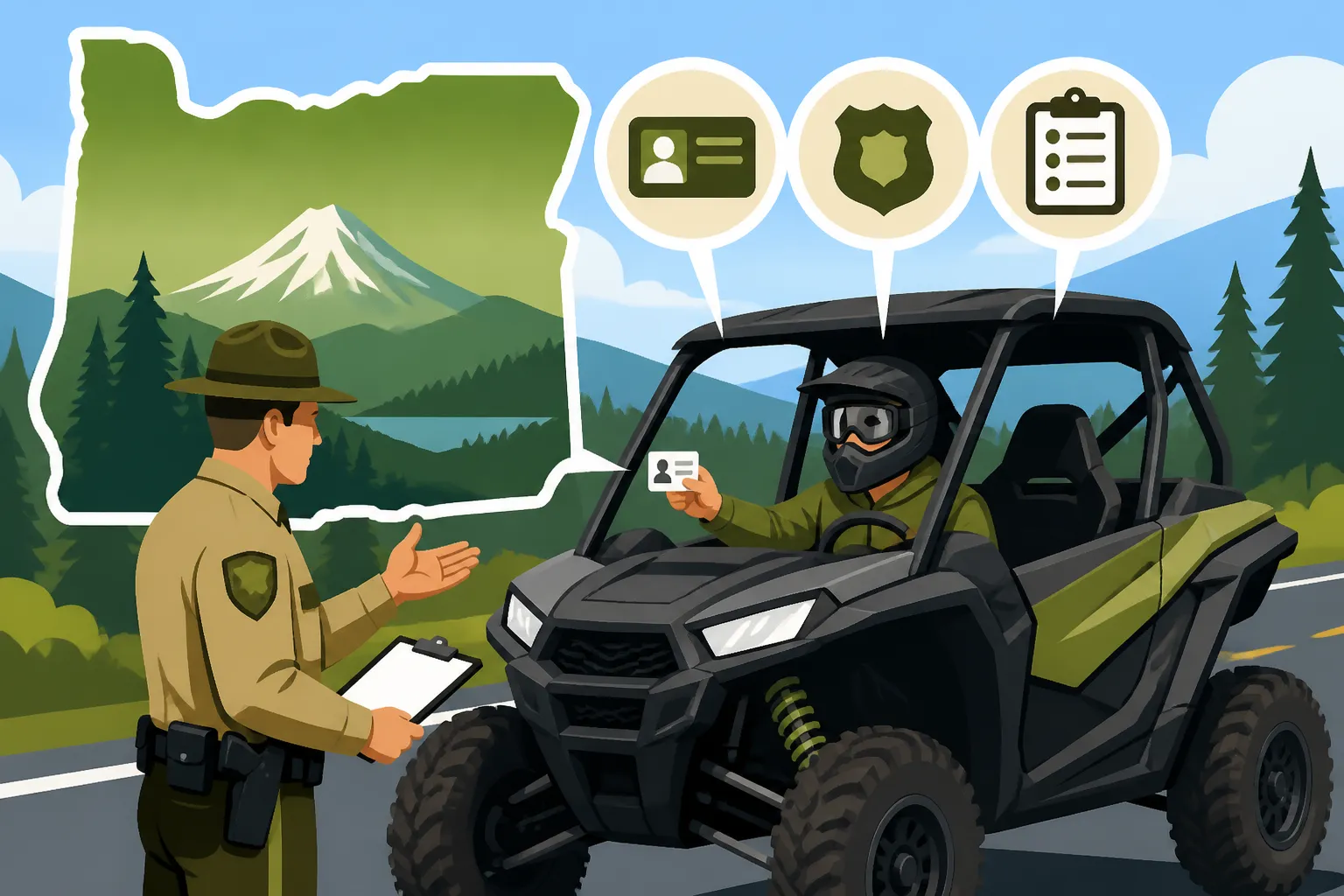
When those lights come on, the first thing to do is remain calm and pull over safely. Find a secure spot off the main thoroughfare, if possible, and turn off your engine. Keep your hands visible, perhaps on the handlebars or steering wheel. An officer will typically approach your machine, introduce themselves, and state the reason for the stop.
At this point, you have the right to ask why you've been stopped. You are required to provide your identification, and if requested, your machine's documentation. Remember to be polite and cooperative. While you have the right to remain silent regarding questions that might incriminate you, you are generally expected to answer basic questions related to your identity and the operation of your vehicle. Keep any essential documents readily accessible, perhaps in a waterproof bag, to avoid fumbling around and prolonging the stop.
The Documents Every Oregon Rider Needs to Have on Hand
When a trooper asks for your "papers," they're referring to a few key pieces of documentation that prove you're legally allowed to operate your OHV in Oregon. Being prepared with these items not only makes the stop quicker but also demonstrates your commitment to responsible riding.
Proof of Permit: The All-Important Decal and Card
The most crucial document for nearly all OHV riders in Oregon is proof of your [Oregon's ATV Operating Permit]. This permit is mandatory for riding on public lands, and it's visible as a sticker (decal) on your machine. However, the physical permit card that comes with it is also essential to have with you. A trooper will want to see this card to verify that the decal matches your machine and that it's current.
Think of the decal as your vehicle's license plate and the card as its registration. They work together. Even if your decal is perfectly affixed to the right side of your quad, as specified in the rules for [Decal Placement on a Quad's Right Side], or on the left side of your UTV, you'll still need that card. Having it readily available, perhaps laminated and stored in a secure, waterproof pocket or box on your machine, shows you're prepared. This card also contains vital information that helps identify you as the permitted operator, or at least shows it's been permitted for use on public lands under [The Oregon Parks and Recreation Department's Role].
The Oregon ATV Safety Education Card
Beyond the permit itself, if you're operating an OHV, you'll almost certainly need an [Oregon ATV Safety Card Requirements]. This card proves you've completed the necessary safety education course, which is a requirement for nearly all riders, regardless of age, on public lands in Oregon. There are some exceptions, like for certain Class IV drivers over 16 with a valid driver's license, but generally, assume you need one.
A trooper will likely ask to see this card. For riders under 16, it's absolutely non-negotiable. For adults, while you might feel you're an experienced rider, the state still requires the safety education. [The Free Oregon Safety Card Online] makes it easy to obtain. If you're riding a Class IV side-by-side and have a valid driver's license, you might be exempt from the card requirement, but always be ready to show that license. This card is a testament to your understanding of safe riding practices and the rules of the trail, which is something officers take very seriously.
Driver's License and Vehicle Registration (If Applicable)
While Oregon does not generally register ATVs or UTVs with the DMV for off-road use, there are specific circumstances where a standard driver's license and vehicle registration might be requested. If you are operating a Class II machine that has been made street-legal and is registered for road use, such as some sand rails or dune buggies, then your driver's license and that vehicle's registration are absolutely necessary. For most other OHV operations, your state-issued driver's license or ID card will suffice for identification purposes.
Even if your OHV isn't street legal, an officer will always ask for your personal identification. This helps them verify who you are and whether you're legally able to operate a motorized vehicle. If you're riding an OHV that doesn't require a driver's license (like a youth on a small ATV on an OHV trail), then a state ID card or other valid form of identification might be required to verify identity and age.
Insurance for Your Class II Machine
Here's a specific one that often surprises riders: if you're operating a Class II ATV, which primarily includes vehicles like dune buggies and sand rails, Oregon law mandates that you carry liability insurance. This is separate from other OHV classes. A trooper who pulls over a Class II machine will almost certainly ask for proof of insurance, just like they would for a regular car or truck on the road.
This requirement stems from the fact that Class II machines can sometimes be registered for limited street use in certain designated areas, making them subject to traditional vehicle insurance laws. Failing to provide proof of insurance for a Class II machine can lead to a citation. [Oregon Insurance Requirements for Class II] are very clear on this, so don't get caught off guard. For other OHV classes, while insurance isn't legally required, it's always a good idea for personal protection.
| Document/Item | Required for All OHVs? | Specific OHV Class/Use | Where to Keep It | Purpose |
|---|---|---|---|---|
| ATV Operating Permit Card | Yes (for public lands) | All classes | On rider/machine | Proof of valid use on public lands |
| ATV Operating Permit Decal | Yes (for public lands) | All classes | Affixed to machine | Visual proof of valid permit |
| ATV Safety Education Card | Yes (most riders) | All classes | On rider | Proof of safety course completion |
| Driver's License/State ID | Yes | All riders | On rider | Personal identification |
| Vehicle Registration | No | Class II street-legal | On rider/machine | Proof of street legality (Class II only) |
| Liability Insurance Card | No | Class II street-legal | On rider/machine | Proof of financial responsibility (Class II only) |
Machine-Specific Checks a Trooper Might Perform
Beyond your personal documents, a trooper will also visually inspect your OHV to ensure it meets Oregon's safety and environmental standards. These checks are about ensuring your machine isn't posing a risk to others or to the environment.
Spark Arresters and Sound Compliance
One of the first things an officer might check, especially if they stopped you due to noise, is your machine's exhaust system. All OHVs operating on public lands in Oregon must be equipped with a U.S. Forest Service approved spark arrester. This device prevents hot carbon particles from escaping your exhaust and potentially starting a wildfire, which is a massive concern in Oregon's dry seasons. A missing or non-compliant spark arrester is a definite red flag.
Beyond that, [Oregon Sound Limits for ATVs] are strictly enforced. Aftermarket exhausts from companies like SuperATV can sometimes push a machine over these limits, even if they have a spark arrester. Troopers carry decibel meters and can perform a sound check roadside. If your machine is too loud, you could face a citation. It's not just about being a nuisance; excessive noise can also disturb wildlife and other trail users, leading to stricter regulations or closures if not managed. Ensure your exhaust system is not only intact but also within legal sound limits to avoid issues.
Lights, Mirrors, and Safety Gear for Road Use
If you're operating your OHV on an [Oregon ATV Highway Access Route Map] or crossing a paved road, specific equipment requirements kick in. Your machine will need functional headlights, taillights, and brake lights. While side-by-sides often come equipped with these, some ATVs might only have a single headlight, which isn't sufficient for road crossings. Mirrors are also typically required for any road-legal operation, to ensure you have adequate rearward visibility.
For example, if you're riding through Lakeside or Sumpter on their designated OHV routes, or even just crossing a state highway at a right angle, these lighting and mirror requirements are paramount. Companies like SuperATV offer various aftermarket lighting kits and mirrors that can help riders meet these stipulations, but it's crucial to ensure they are properly installed and function correctly. Troopers are looking for compliance that ensures you're as visible and aware as any other vehicle on the road.
Helmet Requirements for All Riders
This one is pretty straightforward and often a primary focus for officers: Oregon has a very strict [Oregon Helmet Law for ATV Riders]. Everyone, regardless of age, operating or riding as a passenger on an ATV or Class III off-road motorcycle must wear a DOT or Snell-approved helmet, securely fastened with a chin strap. For Class IV (side-by-sides) and Class II machines, riders under 18 must wear helmets.
While many side-by-sides offer robust roll cages and seatbelts, these do not always exempt adult drivers or passengers from helmet laws, especially in specific OHV park rules. A trooper will quickly check to ensure all riders are properly helmeted. It's a critical safety measure, and non-compliance is an easy and direct violation. This law is in place because head injuries are a leading cause of fatalities in OHV accidents, and helmets are proven life-savers.
Passenger Rules and Safe Operation
Oregon also has clear rules regarding passengers. On a Class I ATV (the typical quad), passengers are generally not allowed unless the machine is specifically designed by the manufacturer for two riders, with designated seating and footrests. Carrying a second person on a single-rider quad is a common violation. A trooper will check for appropriate seating and [Oregon Passenger Rules on a Quad].
For side-by-sides (Class IV), passengers must be seated in the designated seating positions and use seatbelts. Children must be properly restrained, and youth riders have age and supervision requirements. Troopers want to see that everyone is riding safely and that the machine isn't overloaded or being operated in a reckless manner. This includes checking for things like open containers of alcohol or signs of impairment, which could lead to a DUI charge, just like with a regular vehicle.
What Happens if You're Not in Compliance?
Discovering you're not fully compliant during a roadside stop can range from a minor inconvenience to a significant problem, depending on the severity of the violation. It's important to understand the potential consequences.
Understanding Oregon's Fines and Penalties
If you're found to be in violation of Oregon's OHV laws, the most common outcome is a citation. This is typically issued as a Class C traffic violation for offenses like riding without a permit or a safety education card. [Oregon's Class C Traffic Violation for No Permit] can carry a substantial fine, and these costs can add up quickly if you have multiple infractions. These fines are not meant to punish you unnecessarily, but rather to deter unsafe and non-compliant riding that can jeopardize access to trails for everyone.
For example, being caught without an [Oregon Fines for Riding Without a Permit] or an [Oregon Fines for Riding Without a Safety Card] will likely result in a direct penalty. The amount can vary, but it's always more expensive than the cost of simply getting compliant in the first place. These violations also go on your record, and repeated offenses could lead to more serious consequences.
Getting Your Machine Impounded
While less common for minor infractions, severe or repeat violations can lead to your machine being impounded. This is particularly true if your OHV is found to be stolen, heavily modified in an unsafe or illegal way, or if you are operating it under the influence. If your machine is impounded, you're looking at significant costs beyond the fine, including towing fees, storage fees, and administrative fees to get it released.
Imagine a situation where you're caught riding a closed trail due to environmental concerns or fire restrictions, and you're also missing your permit and safety card. This accumulation of violations could easily push a trooper to impound your machine. Recovering an impounded OHV can be a lengthy and expensive process, often requiring proof of ownership, payment of all outstanding fees, and ensuring the machine is brought into compliance before it can be released.
Steps to Take After Receiving a Citation
If you do receive a citation, the first step is to read it carefully and understand the charges. The citation will usually include information on how to pay the fine or how to contest it in court. If you believe the citation was issued in error, or if you can demonstrate that you were compliant at the time (e.g., your permit card was just overlooked), you might have grounds to appeal.
It's wise to contact the court listed on your citation or seek legal advice if you're unsure how to proceed. Often, addressing the underlying issue (like getting your safety card or permit) before your court date can sometimes result in reduced penalties, although this is at the discretion of the court. Ultimately, the best approach is always to ride prepared, stay compliant, and be respectful of the laws and the officers who enforce them, ensuring a smooth experience both on and off the trail.
Disclaimer
This article is for general informational purposes only and does not constitute professional advice. Laws, prices and regulations vary by location and change over time. Consult a qualified professional for guidance on your specific situation.