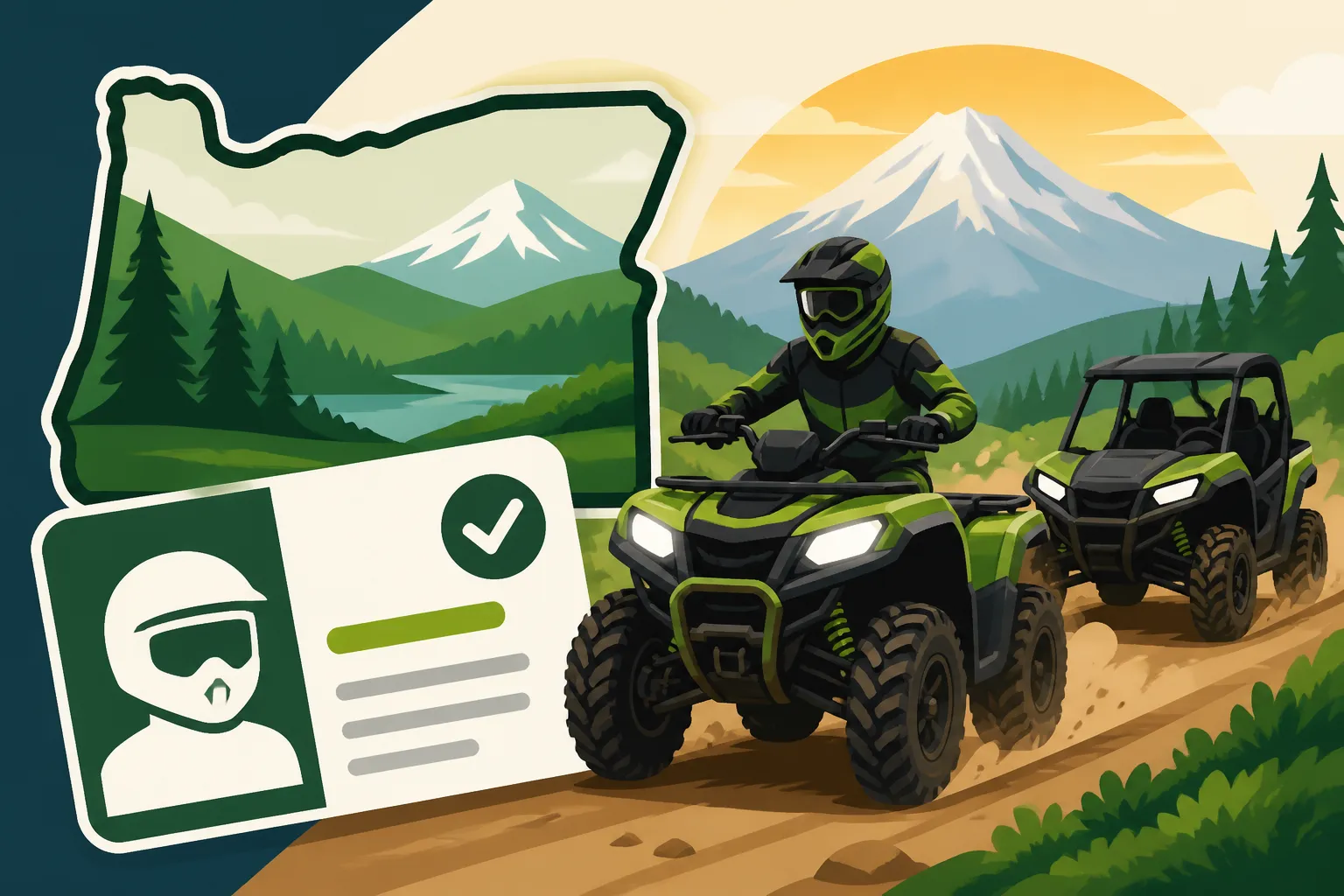
Oregon’s ATV Safety Education Card
Oregon’s ATV safety education card can be easy to confuse with an operating permit, especially when you’re getting ready for a ride and trying to sort out paperwork for different machines or riders. This guide explains who needs the card, how to get and carry it, what it does not replace, and why visitors should check reciprocity rules before riding.
What the Oregon ATV safety education card is
A rider education credential, not a machine permit
The Oregon ATV Safety Education Card shows that a rider has completed the required safety education for the kind of ATV they operate. It is a credential for the person—not a registration document, title, insurance policy, or permit decal for a machine. That distinction matters when a family has several ATVs but only some of its riders use them.
The card is also different from an Oregon ATV operating permit. The operating permit is connected to a machine and is generally displayed as a decal. The safety card is connected to the rider, so a cardholder may use it when operating another eligible machine, subject to the rules for that machine and the place where it is being ridden. For a closer look at the permit side of the paperwork, see [Oregon ATV Permits Explained].
It helps to think of these as two separate checks. One asks whether the machine has the required operating permit; the other asks whether the rider has the required safety education credential. Having one does not automatically satisfy the other. If you’re packing for a weekend trip, check both rather than assuming that a permit decal on the quad covers the person riding it.
Why Oregon requires safety education
Riding off-road can involve changing terrain, limited visibility, loose gravel, steep slopes, other riders, and unexpected obstacles. A safety course gives riders a chance to learn basic operating habits and recognize situations that can become dangerous before they’re out on a crowded trail or dune area.
For a new rider, the course can make the first outing feel less intimidating. Someone who has only ridden around a yard, for example, may not yet know how quickly a quad can behave differently on a side slope or in soft sand. A card does not make anyone an expert, but the education behind it can provide a more useful starting point than learning only through trial and error.
The course is relevant for experienced riders, too. Familiarity with one machine or riding area does not guarantee that someone understands Oregon’s rules or how another vehicle class handles. A longtime dirt-bike rider who borrows a quad, or a visitor bringing a side-by-side into Oregon, may have practical experience but still need to check the state’s card requirements and operating rules.
How the card relates to other Oregon rules
A safety card is only one part of being ready to ride legally. Depending on the vehicle class and location, riders may also need to meet age and supervision requirements, carry or display an operating permit, use required safety equipment, and stay on routes or areas open to that machine.
That’s why a card should not be treated as a general permission slip. It does not authorize riding on a closed trail, make an ATV street legal, or replace a required machine permit. The rules for riders under 16 are particularly important: completing a course does not necessarily remove limits on where, how, or with whom a young rider may operate a machine.
A practical pre-ride check is to identify the machine’s class, confirm the rider’s card requirement, review age and supervision rules, and verify the area’s access conditions. If you’re still working out what type of machine you have, Which Oregon ATV Class Your Machine Falls Into can help you understand why the vehicle’s design matters to the rules that apply.
Who needs an Oregon ATV safety education card
Class I, Class II, and Class III operators
Oregon’s card requirements depend on the ATV class. Operators of Class I, Class II, and Class III machines generally need the appropriate ATV safety education credential when riding in places where Oregon’s OHV rules apply. The requirement is not limited to children: an adult operating one of these classes should not assume that age or years of experience exempt them.
Class I machines include many quads and similar straddle-seat vehicles. Class III machines are off-road motorcycles, while Class II machines include qualifying larger vehicles such as some jeeps and trucks used off-road. The categories are based on the vehicle’s design and characteristics, not merely on what the owner calls it or how it is used on a particular day.
If your household has a mix of machines, don’t assume one rider’s experience on a side-by-side answers the question for a dirt bike or quad. Check the class first, then confirm which card rule applies. The related guidance in Class I and Class III Card Rules in Oregon explains the distinction for two classes that many riders encounter.
Class IV operators and riders under 16
Class IV machines, including many side-by-sides, have a different card rule from Classes I, II, and III. In general, the safety card requirement for Class IV applies to operators under 16. That does not mean a younger rider can simply take the course and drive any side-by-side; age, supervision, seat-belt use, passenger rules, and the machine’s own design still matter.
For an adult operating a Class IV vehicle, the card requirement may be different from the requirement for an adult on a quad or off-road motorcycle. This is one reason broad statements such as “every ATV rider needs a card” or “adults don’t need a card” can mislead. The answer depends on both the vehicle class and the rider’s age.
If a child is riding as a passenger rather than operating the machine, do not confuse passenger rules with operator-card rules. A passenger’s age and seating position can raise separate safety and legal questions. Review the specific rules for the machine, and use Class IV Cards Only for Riders Under 16 for a focused explanation of how the Class IV distinction works.
What to check for young riders
Parents and guardians often have several questions at once: Is the child old enough for this machine? Is an adult required to supervise? Does the child need a card? Are there limits on engine size or where the child can ride? These questions are related, but the answer to one does not automatically settle the others.
A safety card is not an age waiver. A child who has completed the course still has to meet any applicable minimum-age and supervision rules. Likewise, having an experienced adult nearby does not necessarily remove a requirement for the young operator to complete safety education or carry proof of it.
Before a young rider’s first outing, check the vehicle class, the child’s age, any machine-size limits, and the riding area’s rules. Talk through basic expectations before the vehicle is started: where the child may ride, how to signal for help, what to do if separated from the group, and when to stop. For more detail, see Oregon Rules for Riders Under 16 and Oregon Supervision Rules for Young Riders.
How to get the card
Complete the required safety education
Oregon offers ATV safety education through a course designed to teach riders the basics of safe operation and responsible trail use. The course is an important step toward obtaining a card, but riders should follow the current instructions provided through Oregon’s ATV safety education program so they understand which course and completion steps apply to them.
Set aside enough time to work through the material thoughtfully. It can be tempting to click through lessons quickly when a trip is coming up, but the useful part is not merely reaching the end of the course. Pay attention to material about terrain, vehicle control, protective gear, other trail users, and the responsibilities that come with operating an OHV.
The course is available online, making it possible to complete the learning before a ride rather than trying to sort it out at a staging area. For the process and access details, see How to Get an Oregon ATV Safety Card and The Free Oregon Safety Card Online. A short planning window can prevent the frustrating last-minute scramble of discovering that a rider’s card is still unfinished on departure day.
Complete any additional training that applies
Some riders may need more than an online course to satisfy the applicable education requirements. Oregon’s rules include hands-on training provisions in certain circumstances, so do not assume that an online completion record always ends the process—particularly for younger riders or someone using an instructional permit.
If a hands-on course is required, treat it as part of the riding preparation, not an optional extra to postpone indefinitely. Practical instruction can help a learner build habits under supervision, including how to handle the controls, respond to changing terrain, and make safer decisions around other riders.
Keep the course completion information and any training records together until you have confirmed the card has been issued and can be accessed. If you are unsure whether a hands-on component applies, consult the official Oregon ATV safety education instructions before the ride. Oregon Hands-On Training Requirements and Booking a Hands-On Course cover this part of the process.
Take the course seriously even if you have ridden for years
Experienced riders sometimes expect a safety course to feel basic. Some material may be familiar, but the course can still help clarify Oregon-specific expectations and prompt a useful review of habits that have become automatic. Years of riding do not make someone immune to distraction, fatigue, overconfidence, or a sudden change in trail conditions.
For example, a rider who has spent years on open desert routes may be comfortable with speed and visibility but less familiar with crowded coastal staging areas or soft dune sand. Someone who usually rides with a small group may not have a plan for what to do if a companion gets separated. The course is a chance to consider these situations before they happen.
If you have taken a course in another state, don’t rely on memory or assume that an old certificate automatically meets Oregon’s requirements. The course, card, and reciprocity rules are separate questions. Check the details for your specific credential and vehicle class before leaving home.
Card, permit, and proof of ownership compared
The paperwork can feel like a jumble because several documents may be relevant to one ride. This table separates the main purposes. Requirements can depend on vehicle class, age, land manager, and where you ride, so use it as a starting point rather than a substitute for checking the applicable rules.
| Item | What it relates to | What it generally demonstrates | What it does not replace |
|---|---|---|---|
| ATV safety education card | The rider | The rider has completed required safety education for the applicable class and situation | A machine operating permit, title, or permission to use a closed route |
| Oregon ATV operating permit | The machine | The machine has the applicable Oregon operating permit | The operator’s safety education card or proof of ownership |
| Title or ownership records | The machine and owner | Evidence of ownership or a record of the machine | A safety card or operating permit |
| Out-of-state card or credential | The rider | May satisfy Oregon rules if the credential is recognized for that requirement | Automatic recognition for every Oregon permit or every vehicle class |
| Day-use or site pass | The rider, vehicle, or visit depending on the site | Payment or authorization for a particular site or parking area | An ATV safety card or Oregon operating permit |
Why a card does not replace the operating permit
A rider can have a valid safety card and still be operating a machine without the required permit. The reverse can also happen: a machine can display a permit decal while the person riding it lacks a required safety card. These are separate compliance checks, and both may matter during the same outing.
Think of a family trip where the quad has its Oregon permit decal, but an adult relative borrows it and has not checked the card rules. The machine’s paperwork does not transfer the rider’s education credential. Before anyone takes a turn, make sure the operator has whatever proof the rules require for that vehicle class.
The distinction also matters when a machine is rented or borrowed. Ask about the machine’s permit status, then check the operator’s own card requirement. Rental paperwork, a signed safety checklist, or a rental company’s verbal assurance should not be mistaken for a personal education card unless it specifically provides what Oregon requires.
Why a card does not prove ownership
A safety education card identifies an educated rider; it is not evidence that the rider owns the ATV. If you buy a used quad, keep the sale paperwork and any ownership records separate from your safety education documents. A card cannot resolve a dispute about the machine’s VIN, seller, or ownership history.
This can become confusing when someone purchases a used machine and is eager to ride it immediately. They may have completed the safety course and received their card, but still need to confirm the machine’s permit and ownership paperwork. Keep each task on its own checklist so that completing one does not create a false sense that everything is finished.
For ownership questions, see Oregon ATV Title Requirements and Proving Ownership Without a Title. Those records can matter during a sale or transfer, while the safety card remains a rider credential.
Don’t confuse the card with site fees
A safety card does not pay parking or day-use fees. Some riding areas require a separate pass or fee, and those arrangements can vary by land manager and site. A rider who has completed the course and obtained the machine’s permit may still need to pay for access or parking.
This is a common source of frustration on a trip: the group arrives at a staging area, checks the machine decals, and then discovers that the parking or day-use requirement is separate. Build the site check into trip planning rather than assuming the operating permit covers every cost or access condition. Oregon Day Use Fees Explained describes how those fees differ from an ATV permit.
Carrying and showing your card
Use a format you can access when asked
Once you have the card, make sure you know how to show proof of it while riding. Depending on the program’s available options and the applicable rules, that may mean carrying a physical card or having an accepted digital version accessible on your phone. Confirm that your proof is readable and that you can retrieve it without fumbling through a stack of unrelated files.
Phones are convenient until the battery is low, the screen is wet, or there is no easy way to unlock the device with gloves on. If you rely on a digital card, save it somewhere you can reach offline and keep your phone protected. A screenshot or downloaded document may be more dependable than relying on a web page that needs a strong connection.
Some riders choose to carry a printed backup in a small waterproof sleeve. You can find basic document sleeves through retailers such as Amazon, but the important point is not where you buy one—it is keeping the card legible and protected. Do not let a storage accessory become a substitute for checking that the card itself is valid and accepted.
Protect paper and digital copies from trail conditions
Oregon riding conditions can be rough on paperwork. Rain, mud, sand, and condensation can turn a folded paper card into an unreadable scrap, especially if it is loose in a jacket pocket or toolbox. Store it with other essential documents in a closed, waterproof pouch rather than leaving it where it can slide around or get soaked.
A phone needs a little planning, too. Save the card or proof where you can access it without an internet connection, charge the device before the ride, and consider keeping it in a protective case. On a wet coastal ride, a working touchscreen can be difficult to use with gloves or damp fingers, so know your backup option before you need it.
If you ride frequently, keep the safety card separate from documents that are likely to be handled often, such as a vehicle permit card or a trail map. A simple waterproof organizer—available from general outdoor retailers and Amazon—can help keep documents together without making them easy to lose in a vehicle or trailer.
Make the card easy to find during a roadside check
A card is more useful when you can produce it calmly. Choose one consistent place for it, tell anyone who borrows your machine where their own proof is stored, and avoid mixing several riders’ cards in one unmarked bag. During a stop, searching through a phone gallery or digging under riding gear can add avoidable stress.
For a group ride, each rider should be able to access their own proof rather than expecting the group leader to carry everyone’s documents. A leader may have a route plan and emergency contacts, but each operator is responsible for knowing which requirements apply to them and being able to show the relevant credential.
You do not need elaborate storage. A phone folder, wallet sleeve, or small waterproof pouch is enough if it works for your routine. The best option is the one you will actually use every time, including on short local rides when it is easy to think, “I’ll bring it next time.”
Oregon card requirements for visitors and out-of-state riders
Check card reciprocity separately from permit reciprocity
Visitors often assume that an out-of-state credential covers every Oregon requirement. That is not a safe assumption. Oregon’s rules for recognizing another state’s safety education card are not necessarily the same as its rules for recognizing another state’s ATV permit, registration, or decal.
A rider could have an out-of-state card that Oregon recognizes for safety education but still need to follow a separate rule for the machine permit. Another rider might have a machine decal recognized under a permit agreement while needing to check whether their safety card meets Oregon’s education requirement. Treat each document as a separate question.
Before traveling, confirm both lists: the states whose rider safety credentials Oregon recognizes and the states whose machine permits or registrations Oregon recognizes. Oregon Safety Card Reciprocity List and Oregon Permit Reciprocity List address these two issues separately. That distinction is especially helpful for riders planning a multi-state trip.
Plan for a visit that lasts more than a short trip
A visitor’s plans can change. Someone may arrive for a long weekend, enjoy the riding area, and decide to stay through a longer vacation or return repeatedly over the season. Oregon’s visitor rules can include time limits and conditions, so do not assume that one out-of-state credential provides unlimited riding access.
Make a note of when the relevant period begins and what document it applies to. The safety card question and the permit question may have different answers or different time limits. If you are extending a visit, check the rule before the original period ends rather than waiting until you are already at the trailhead.
For visitors, this is also a good time to check the local land manager’s requirements. An Oregon-recognized safety card does not guarantee that every trail is open, and a valid permit does not cover a site fee or authorize use of a closed area. A quick pre-trip review can prevent an expensive or disappointing detour.
Don’t assume a neighboring state’s sticker is enough
Riders from Washington, Idaho, California, and Nevada may be familiar with their home state’s system, but Oregon does not necessarily treat every neighboring credential the same way. A sticker or registration that looks official may apply to a different rule, a different machine class, or a different riding jurisdiction.
For example, a rider may have a state-issued document that proves registration or permit status but not that they completed safety education. Another state’s safety certificate may not automatically be equivalent to Oregon’s card for every class or circumstance. Check the exact credential—not just its color, appearance, or name.
If you regularly cross state lines to ride, keep a short travel checklist with separate entries for safety education, machine permit, day-use fees, and route access. Related guidance such as Does Oregon Accept an Out-of-State Safety Card? and Riding Oregon With an Out-of-State Permit can help you avoid treating these documents as interchangeable.
Common mistakes and how to avoid them
Assuming adults never need a card
One of the most common misunderstandings is that safety education applies only to children. That may be true for a particular vehicle class, but it is not a rule you can safely apply across every ATV. Adult operators of Classes I, II, and III should check the requirement for their machine rather than relying on their age.
A second version of this mistake is assuming that decades of riding count as a substitute for a card. Experience can be valuable, but it does not automatically satisfy a formal education requirement. If the rules call for a card, having ridden since childhood does not take the place of the credential.
The easiest way to avoid confusion is to ask two questions before the ride: What class is the machine? How old is the operator? Then use those answers to check the card rule. If a group is bringing multiple machine types, repeat the check for each type instead of applying one person’s answer to the entire group.
Thinking a side-by-side rule applies to every ATV
Some people hear that an adult operating a Class IV side-by-side may not need a card and conclude that an adult on any ATV is exempt. That conclusion mixes up a class-specific rule with a general rule. A quad, dirt bike, and side-by-side can fall into different classes, even when they are being used at the same riding area.
Vehicle design features help determine the class. Seating position, handlebars or steering wheel, and other defining characteristics can matter. A machine’s marketing name or the label a seller used is not always enough to establish which rule applies.
If the vehicle has been modified or its classification is unclear, resolve that question before the trip. A wrong assumption can affect more than the card: class may also influence permit decals, passenger rules, equipment requirements, and where the vehicle can be operated. Use the class information, not a guess based on appearance alone.
Treating a completed course as permission to ride anywhere
Completing safety education can feel like the final hurdle, especially when a rider has put off the course until just before a trip. But the card is not a permit to ride any road, trail, or parcel of land. Access rules still apply, and routes can be closed for weather, habitat protection, maintenance, or other reasons.
A rider may also need to meet age, supervision, equipment, and permit requirements. Carrying a card does not make a closed trail open or grant permission to cross private land. Before setting out, confirm the riding area is open to your machine and that the route is designated for your type of vehicle.
It helps to treat the card as one box on a larger pre-ride checklist. Check rider credentials, machine permit, site fees, vehicle class, protective gear, and route conditions. That approach is less exciting than loading the trailer and leaving, but it is far better than discovering a missing requirement at the staging area.
A practical pre-ride checklist
Before the trip
Start by identifying each machine’s class and each operator’s age. This step catches many problems early, especially when a group includes quads, dirt bikes, and side-by-sides. Confirm which riders need a safety card, and make sure any required education or hands-on training is completed before the travel day.
Next, check the machine’s permit status and any separate site access requirements. Make a note of which documents belong to the rider and which belong to the machine. If someone is borrowing or renting a vehicle, ask specifically about the machine permit and do not assume that the rental or loan arrangement settles the rider’s card requirement.
For a visitor coming from another state, check card reciprocity and permit reciprocity independently. If you will ride more than one area, check each land manager’s access rules as well. The time spent on these checks is usually minor compared with the time and cost of having to change plans after arriving.
On the day of the ride
Before unloading, confirm that each operator can access their safety card or accepted proof. Make sure a digital version opens without a data connection, or put a physical card somewhere dry and easy to reach. If a young rider is involved, review supervision arrangements and make sure the responsible adult understands the plan.
Check the permit decal and the machine’s basic condition. A safety card does not compensate for a missing permit, a loose component, a damaged tire, or equipment that is not working properly. Look at the riding area’s notices before heading out, because access restrictions can change and a route that was open on a previous visit may not be open today.
Give everyone a quick reminder about the ride plan: where the group will meet if separated, who is leading, and what to do if a machine becomes disabled. These conversations are particularly helpful for newer riders, who may be focused on excitement and forget practical details once the engine starts.
After the ride
Keep the card in its usual protected place rather than leaving it in wet gear or a vehicle that will be used by someone else. If the card is digital, confirm that you know how to access it again and consider keeping a secure backup. If the card has been damaged or misplaced, follow the program’s replacement instructions before the next ride rather than waiting until the group is ready to leave.
Take a moment to note any paperwork questions that came up. Perhaps the class of a borrowed machine was unclear, a visitor’s credential needed confirmation, or a staging-area fee was separate from what you expected. Resolve those details before the next outing, while the trip is still fresh in your mind.
Most importantly, keep the education practical. Discuss what went well and what felt unfamiliar, especially if a child or new rider was involved. A card proves completion of safety education, but good riding habits are reinforced every time the group chooses a safe speed, respects closures, and looks out for other trail users.
Disclaimer
This article is for general informational purposes only and does not constitute professional advice. Laws, prices and regulations vary by location and change over time. Consult a qualified professional for guidance on your specific situation.