Oregon’s 80 Percent Pass Mark
Oregon’s 80 percent pass mark can sound like a small detail, but it matters when you’re trying to finish the ATV safety course and get ready to ride. Here’s what the score means, how to prepare without overcomplicating it, what to do if you fall short, and how the safety card fits alongside permits and reciprocity rules.
What Oregon’s 80 Percent Pass Mark Means
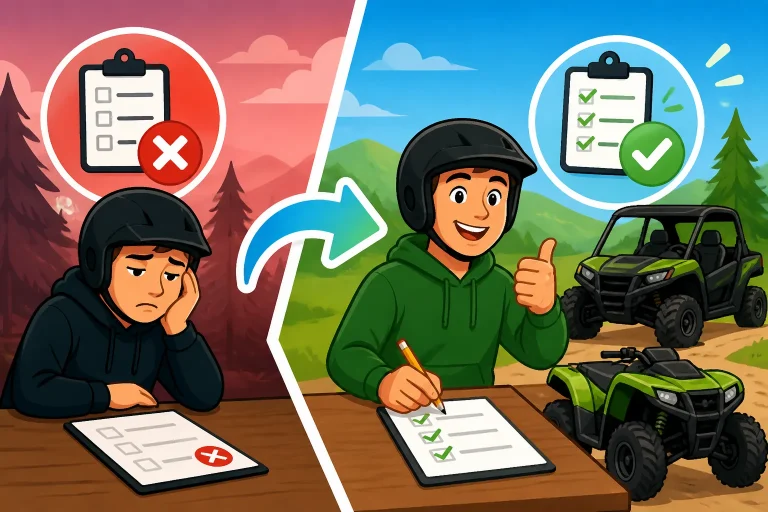
The 80 percent pass mark is the minimum score needed to pass the applicable Oregon ATV safety course assessment. In practical terms, you need to answer enough questions correctly to meet that threshold. It is not a requirement to score perfectly, and it does not mean you need to complete the course with a certain number of riding hours.
The assessment is part of safety education—not a test of whether you already own a machine or have years of experience. It checks your understanding of safe operation and Oregon’s rules. A strong rider can still miss questions if they assume the rules match another state’s, while a new rider can pass by paying attention to the material and reading questions carefully.
The score is also separate from whether you have all the other items needed for a ride. Passing the course does not, by itself, provide the operating permit decal for a machine, prove ownership, or authorize you to ride on a closed trail or road. Think of the safety card as one part of your preparation, not an all-purpose riding document. For the broader picture, see Oregon ATV Safety Card Requirements.
Is 80 percent the same as passing each section?
A required overall score does not necessarily mean each topic has its own separate pass threshold. Follow the instructions shown in the course or exam system you are using. If it reports a final score, rely on that result rather than trying to calculate separate scores from individual topics.
Do not assume that a quiz you take while working through a lesson is the final assessment. Some courses use practice questions to reinforce a topic, then give a separate assessment at the end. Read the course instructions so you know which questions count toward completion and what happens after you submit your answers.
Why Oregon’s own material matters
ATV rules can differ between states and between machine classes. A course that explains general riding skills may not explain Oregon’s specific safety-card requirements, age-related rules, or class distinctions. That is why Oregon-specific material is important even if you have completed safety training elsewhere.
If you already have an ATV guide purchased through Amazon, it can be useful as supplementary reading, but check that it covers Oregon rules and treat the official Oregon course as the source for the required assessment. An Amazon listing does not issue an Oregon safety card, and you do not need to buy a guide from Amazon to take the course. Be cautious of any Amazon product that suggests buying a book or card alone satisfies the state requirement.
How to Prepare Without Turning It Into a Big Project
Most people do not need a long study schedule to approach the assessment with confidence. The more reliable approach is to take the lessons seriously, pause when a rule is unfamiliar, and make sure you understand the distinction rather than memorizing a phrase for one question.
A quick review is especially helpful if you are an experienced rider. Experience builds useful instincts, but it can also encourage assumptions: that a rule is the same as the one in your home state, that a passenger is allowed because a machine has a seat, or that a permit decal covers every requirement. The course is a chance to check those assumptions.
Use the course as your study guide
Start with the required course rather than searching for a set of answer keys. Questions may be worded differently from the material, and memorizing answers without understanding the rule can leave you unsure when you encounter a real situation on the trail.
As you work through it:
- Read each lesson rather than skipping directly to the assessment.
- Pause at rules that depend on the machine class, the rider’s age, or the place where you plan to ride.
- Note confusing terms and return to the related lesson before submitting an answer.
- Read each question and all its answer choices before selecting one.
- Review the final result and follow the system’s instructions for completing or repeating the assessment.
A small set of notes can help if you are trying to keep several different requirements straight. Focus on distinctions that affect what you may do, such as a safety card versus a machine permit, or a rider requirement versus a machine requirement. There is no need to copy the entire course.
Avoid rushing through tricky wording
Test questions sometimes turn on a word such as “must,” “may,” “under,” or “only.” Read those carefully. A question about what a rider must do in a particular situation is different from one asking what is generally recommended. If a question mentions an age, class, road, or type of machine, make sure your answer addresses that detail.
If you are taking the course on a small screen, take your time scrolling and make sure you have read the whole question before answering. You can also use a larger screen if that is more comfortable. The practical tips in Taking the Course on a Phone can help if a phone is your only convenient option.
Do not rely on someone else’s memory of the test. A friend may have taken a course for a different class or under different circumstances, and an old answer sheet may omit rules that matter to you. A current course and its instructions are a more dependable way to prepare.
What to do if the course feels unfamiliar
If a lesson introduces a term you do not recognize, look for its explanation in the course before moving on. Oregon divides off-highway vehicles into classes, and some rules apply differently depending on the class. A quad, dirt bike, and side-by-side are not necessarily treated alike. You can get a class overview in Oregon’s Four ATV Classes Explained.
If you are not sure which class describes your machine, do not guess based only on its name or how it looks. Width, weight, seating, controls, and design can matter. Which Oregon ATV Class Your Machine Falls Into is a useful companion when you need to identify the category before sorting out the rules that apply.
What to Do If You Do Not Reach 80 Percent
Not reaching the pass mark does not mean you are permanently barred from getting a safety card. It means you need to follow the course system’s directions for what comes next. Depending on the format, that may involve reviewing material and trying the assessment again. Read the result page carefully instead of assuming you need to start from the beginning or, conversely, that the course marked you complete.
If the system does not make the next step clear, return to the course provider’s instructions or contact the appropriate support channel. Avoid taking a second attempt immediately if you are unsure what you missed and the system provides a way to review the material. A short review is often more useful than clicking through the same questions while frustrated.
Find the point of confusion
After a failed attempt, think about which type of question caused trouble. Did you confuse a safety card with an operating permit? Were you unsure about a class distinction? Did you misread a condition in the question? Identifying the problem helps you review the right material instead of repeating the whole course without a plan.
If you can review the lesson material, revisit the sections related to the missed concepts. If the assessment does not show which answers were wrong, use the course outline to identify topics that felt uncertain. Do not assume that a wrong answer means you are unsafe to ride; it means you need to learn or clarify the information being tested before completing the requirement.
For details focused on unsuccessful attempts, see Failing the Course and Retaking It. Follow the instructions in the course you actually took, since the process may depend on its format.
When an accessibility or technology issue affects the test
Sometimes the problem is not the material but the way the course works on a device. A page may not load correctly, a screen may be hard to read, or a connection may drop before a result is recorded. If that happens, save any confirmation or error information you can, then follow the provider’s support instructions. Do not assume a partially completed screen means you passed.
If reading or using the course is difficult because of a disability, language barrier, or another access need, check what accommodations or alternate formats are available before repeatedly attempting the assessment. It is better to ask about an appropriate way to complete the requirement than to struggle with a setup that is not working.
The Safety Card Is Not the ATV Permit
The most common paperwork mix-up is treating the safety card and the operating permit as if they were the same thing. They serve different purposes. The safety card relates to rider education. The permit is associated with operating a machine where Oregon requires an ATV permit, and its decal is displayed on that machine as instructed.
Passing the assessment does not automatically put the required decal on your machine. Likewise, having a decal does not prove that every rider has met applicable safety education requirements. Before heading out, check both the rider’s documents and the machine’s paperwork.
| Requirement | What it relates to | What to check |
|---|---|---|
| Safety education card | The rider’s training requirement | Whether the rider needs a card, has completed the course, and can show proof |
| ATV operating permit | The machine’s permit requirement | Whether the machine needs an Oregon permit and whether its decal is valid and properly displayed |
| Site or day-use pass | Access or parking at some riding areas | Whether the specific site requires a separate pass or fee |
| Trail or road access | Where the machine may legally travel | Whether the route is open to that machine and rider |
For help with the card process itself, read How to Get an Oregon ATV Safety Card. If you have passed but need to keep or print evidence of completion, Printing a Card After You Pass covers that practical step. Do not wait until you are at a staging area to find out that you cannot access your proof.
A separate permit is not the only possible site requirement. Some riding areas have day-use or parking rules that are separate from Oregon’s machine permit. Check the rules for the place you intend to ride, particularly if you are traveling to a new area.
Who Needs the Card and How Reciprocity Fits In
Do not assume that the 80 percent pass mark applies only to children or only to first-time riders. Oregon’s safety-card rules are tied to the applicable requirements for the rider and machine, and a person’s age or the vehicle class can affect what is required. The safe approach is to check the rule that matches the rider and the machine rather than relying on a broad statement such as “adults are exempt” or “side-by-sides do not need training.”
Some class-specific rules differ. For example, the rules for Class I and Class III machines are not identical to those for Class IV machines. Start with Class I and Class III Card Rules in Oregon or Class IV Cards Only for Riders Under 16 if you need to sort out a particular vehicle category. If you have a valid driver’s license and think it may change your requirement, check When an Oregon Driver’s License Replaces a Safety Card rather than assuming the license replaces every safety-card obligation.
A card from another state is a separate question
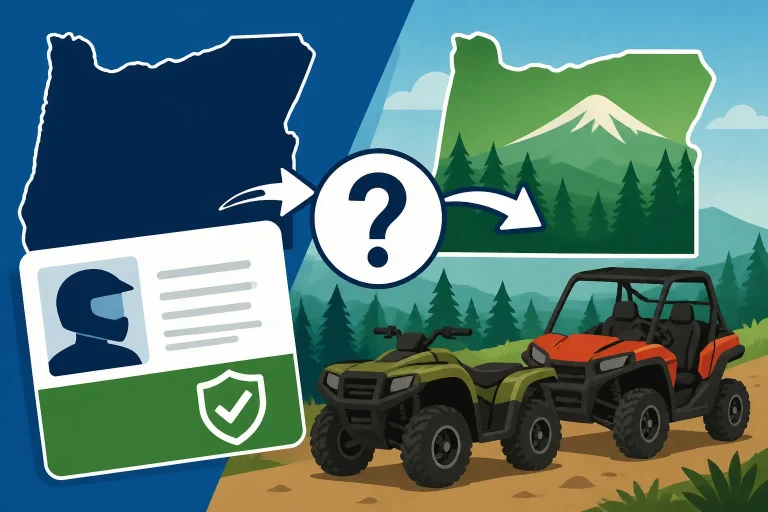
Passing an Oregon course and getting credit for training completed elsewhere are different situations. Oregon has separate reciprocity considerations for safety cards and for machine permits. A visitor may have an out-of-state registration or decal that helps with one requirement but not meet the rules for another.
Before traveling, check Oregon Safety Card Reciprocity List and Oregon Permit Reciprocity List separately. Do not assume that because Oregon accepts a particular out-of-state permit, it also accepts that state’s safety card—or the reverse. The two lists can differ, so check the list that matches what you are trying to prove.
If you are visiting, confirm the rules before your trip and carry the documents or proof that apply to your situation. If you are moving to Oregon or expect to ride here often, it may be simpler to understand and complete Oregon’s requirements rather than relying on an exemption that may have limits. For a more specific question about a card from another state, see Does Oregon Accept an Out-of-State Safety Card?.
Rental machines have their own practical wrinkle
Renting a machine does not automatically mean you can skip the rider requirements. A rental business may provide information, equipment, or a process that applies to its customers, but you should confirm exactly what it provides and what you must do yourself. Ask before booking, not after arriving at the counter.
Oregon has a rental-related safety-card provision with its own scope and limits. Read Oregon’s 30-Day Rental Safety Card Explained and confirm the details with the rental provider. Do not confuse that provision with a permanent card earned by completing the regular course, and do not assume a rental company’s machine permit satisfies the rider’s education requirement.
Before You Head Out
Treat the 80 percent mark as a manageable course requirement, not as a reason to cram or panic. Read the lessons, give yourself time to understand Oregon-specific rules, and follow the course directions if you need another attempt. If you pass, keep proof available and make sure you understand what else is required for the machine and riding area.
A quick pre-ride check can prevent a frustrating trip:
- Confirm that each rider has the required safety-card proof or meets an applicable exception.
- Confirm that the machine has the correct Oregon permit when one is required.
- Check decal placement and make sure the decal is readable and attached as instructed.
- Check whether the destination charges a separate day-use or parking fee.
- Verify that the trail, road, or riding area is open to your machine.
- Carry the documents you may need to show during the ride.
Rules and access conditions can depend on the machine class, the rider, and the location. If any of those details are uncertain, resolve the question before unloading at the trailhead. A passing score is an important step, but it works best when paired with the right permit, current access information, and a clear understanding of the rules.
Disclaimer
This article is for general informational purposes only and does not constitute professional advice. Laws, prices and regulations vary by location and change over time. Consult a qualified professional for guidance on your specific situation.