Failing the Course and Retaking It
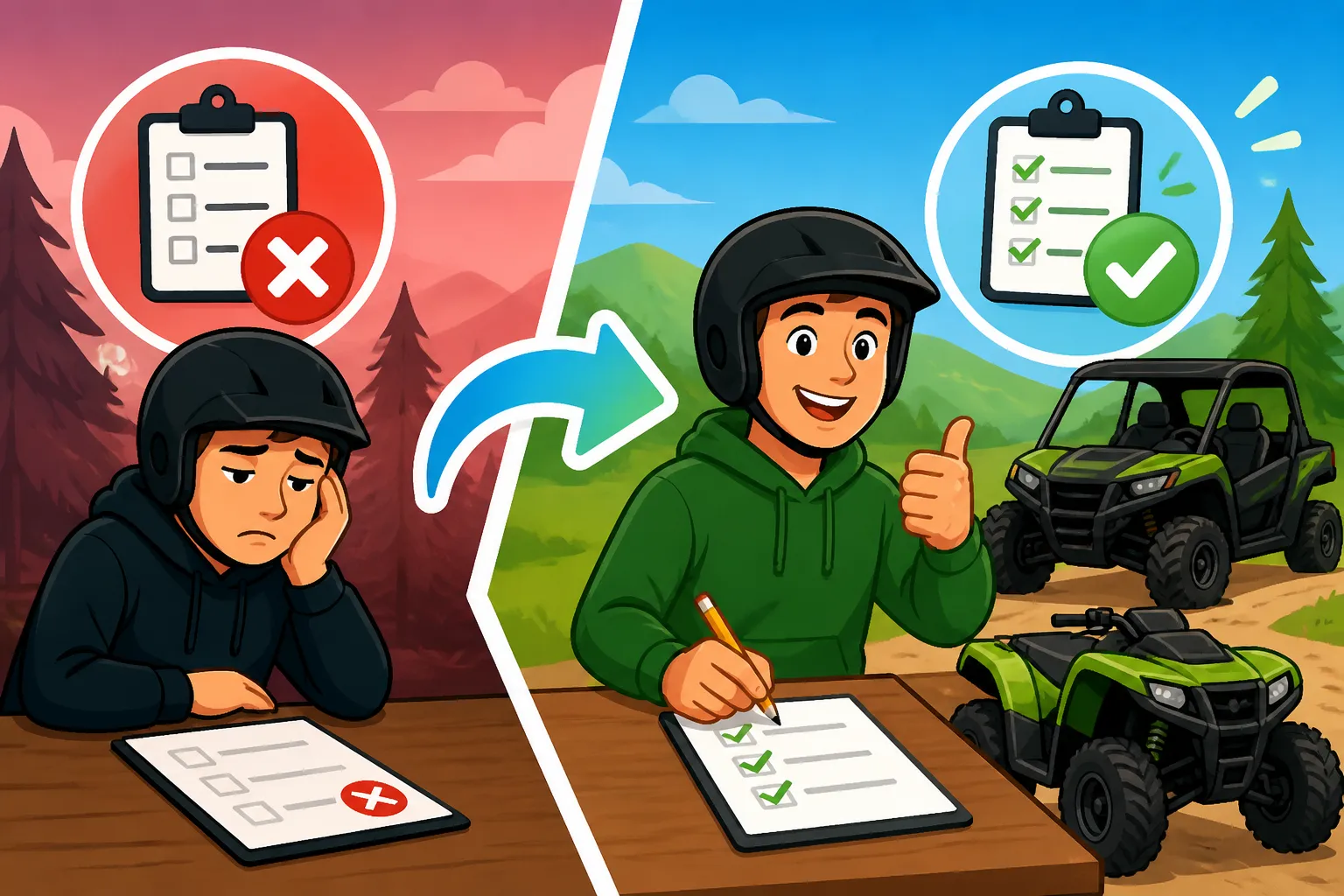
Failing Oregon’s ATV safety course can be frustrating, especially if you need a safety card before riding. A failed attempt does not mean you are permanently barred from completing the course. The practical next steps are to check your result, review the material you missed, follow the course provider’s retake instructions, and wait to rely on a card until you have passed.
What a failed course result means
Oregon’s ATV safety education course is intended to teach riders how to operate responsibly and understand basic safety rules. Passing the course assessment is part of earning the safety card when one is required. If your result says you did not pass, you should treat the course as incomplete: do not assume that finishing the lessons alone qualifies you to ride where a card is required.
The stated pass mark for Oregon’s course is 80 percent. That means a score below the required mark does not count as a pass, even if you were close. Review Oregon ATV Course Pass Mark to understand how the passing standard fits into the course and card process.
A failed score is not the same as having your card suspended, and it does not necessarily mean you must start over from the beginning. What happens next depends on how the course platform handles retakes and saves progress. Some platforms show which sections need attention; others may ask you to review course material before another attempt. Follow the instructions on the screen or in your account rather than assuming that a particular waiting period or number of retakes applies.
If you completed the course through a provider and cannot find a retake option, check the account you used to enroll and look for course support or help information. Make sure you are signed in to the same account and have opened the correct course. If the result appears wrong, or a technical problem interrupted the assessment, contact the provider before enrolling again or paying for anything. Keep a screenshot or note of the result and the error message so you can explain what happened.
A failed test also does not automatically tell you whether you need an additional practical training component. Course completion, the written or online assessment, and any hands-on requirement are separate pieces to verify. Review Oregon ATV Safety Card Requirements for who needs a card, and check Oregon Hands-On Training Requirements if your age or machine class may make practical training relevant.
| If your result says… | What to do next |
|---|---|
| You did not reach the pass mark | Review the material and follow the platform’s retake instructions. |
| You passed, but no card is visible | Check the account, completion status, and card-printing steps. |
| Your progress or score appears missing | Confirm you are in the right account, then contact the course provider. |
| You are unsure whether you need a card | Check the rules for your age and ATV class before riding. |
| You may need hands-on training | Verify the requirement separately; do not treat the online score as proof of practical completion. |
How to prepare for a retake
A retake is most useful when you address the reason you missed the pass mark. Repeating the assessment immediately without reviewing anything may lead to the same result, especially if questions cover unfamiliar rules or safety decisions rather than simple definitions.
Start with any feedback the course provides. If it identifies missed topics, return to those lessons first. If it does not show which answers were incorrect, review the full course rather than trying to guess what appeared on the test. Pay particular attention to rules that affect your machine, rider age, and riding location. A general understanding of safe riding is valuable, but passing also requires understanding the course material as it is presented.
A practical review routine can help:
- Check your completion status. Confirm that all required lessons are marked complete and that you are looking at the final assessment result, not a practice activity.
- Read the missed-topic feedback. If the platform identifies areas to revisit, make a short list and return to those sections.
- Review safety decisions, not just vocabulary. Think through why a rule applies, what risk it addresses, and what a rider should do in a real situation.
- Use the course material as your reference. Outside summaries may explain a rule differently or describe requirements that do not apply to Oregon.
- Take the retake when you can concentrate. Avoid rushing through questions while distracted or trying to finish on a phone with a poor connection.
- Read each question carefully. Watch for words that change the meaning, such as “must,” “may,” “before,” or “only.”
- Check the result before leaving the account. Confirm that the platform records the attempt and clearly shows whether you passed.
It is reasonable to use your own notes to organize concepts, but don’t rely on a random quiz, a social media post, or an old printout as a substitute for the current course content. Oregon rules are specific, and information about another state’s safety card or permit may not apply. For example, a rider with substantial experience may still need to complete Oregon’s course and meet Oregon’s requirements. The article Taking the Exam After Five Years of Riding explains why experience and course completion are not always interchangeable.
If the course seems to mark an answer wrong when you believe it is correct, first check the lesson wording and whether the question is asking about an Oregon requirement or a broader safety recommendation. If it still appears to be a mistake, save the question wording and contact the provider. Do not repeatedly create new accounts or enroll again to work around a result; that can make it harder to find your progress and may not resolve the underlying issue.
Retaking the assessment and confirming your card
Use the retake option provided in the course account. The exact steps can differ by platform, so follow the prompts shown there. The course provider is the best place to confirm whether you can retry immediately, whether you need to revisit lessons, and how a completed score will be recorded. Avoid relying on a specific retake limit, waiting period, or fee unless the provider confirms it for your course.
Once you pass, make sure the course shows a completed status rather than only displaying a passing score on one screen. Follow the instructions to access or print your card, and save a digital copy if the system offers one. The process for obtaining the card is separate from simply finishing the assessment; Printing a Card After You Pass covers the next step.
Before a ride, check that you have the right documentation for the rider and machine. A safety card is not the same as an ATV operating permit, and one does not replace the other. Oregon’s permit rules and safety-card rules serve different purposes. If you are sorting out both, [Oregon ATV Permits Explained] gives an overview of the permit side, while The Free Oregon Safety Card Online covers the course and card process.
If you pass the online course but have a separate hands-on requirement, passing the assessment may not finish everything you need to do. Check whether the hands-on component applies to your situation and how completion is recorded. Keep proof of both parts if you complete them separately. When in doubt, confirm requirements through the course provider or the appropriate Oregon program before riding.
A course card also does not guarantee that every machine or every rider is covered by the same rules. Requirements can vary by class, age, and circumstances. For instance, a rule that applies to a young rider on one class of machine may not apply in the same way to an adult on another class. Verify your specific situation rather than assuming that a card earned for one person or machine settles the requirements for everyone in your group.
Avoiding problems before your next ride
The safest approach is to finish the course and confirm your records before the day you plan to ride. Last-minute access issues can be stressful, particularly if you are relying on a phone connection at a staging area. Download or print the card if the program allows it, and keep a copy somewhere you can reach without depending on cell service. Do not alter the card or rely on a screenshot that cuts off key information.
If your card is not available after you pass, check the course account for an incomplete profile field, an unfinished module, or a separate card-printing step. If those checks do not solve it, contact the provider and retain any confirmation that shows your pass. Do not assume a payment receipt or course enrollment email proves that you completed the course.
Before riding, make a short checklist:
- Confirm that the course account shows a passing, completed result.
- Retrieve or print the card according to the program’s instructions.
- Check whether your age and machine class require additional hands-on training.
- Confirm that the machine has the required operating permit for the place you plan to ride.
- Carry the required documentation in a way that keeps it readable and accessible.
If you are planning to ride with family or friends, check each rider’s status individually. One person’s card does not cover the rest of the group, and a parent’s or rental operator’s completion does not automatically satisfy another rider’s requirement. For a rented machine, ask the rental provider what documentation is included and what remains your responsibility; do not assume that the machine’s permit covers the rider’s safety-card obligation.
A failed attempt is a cue to pause, review, and try again through the proper account—not a reason to ride without confirming your eligibility. Once you have passed and completed any separate requirements that apply, keep your proof available and turn your attention to the other rules for your riding area.
Disclaimer
This article is for general informational purposes only and does not constitute professional advice. Laws, prices and regulations vary by location and change over time. Consult a qualified professional for guidance on your specific situation.