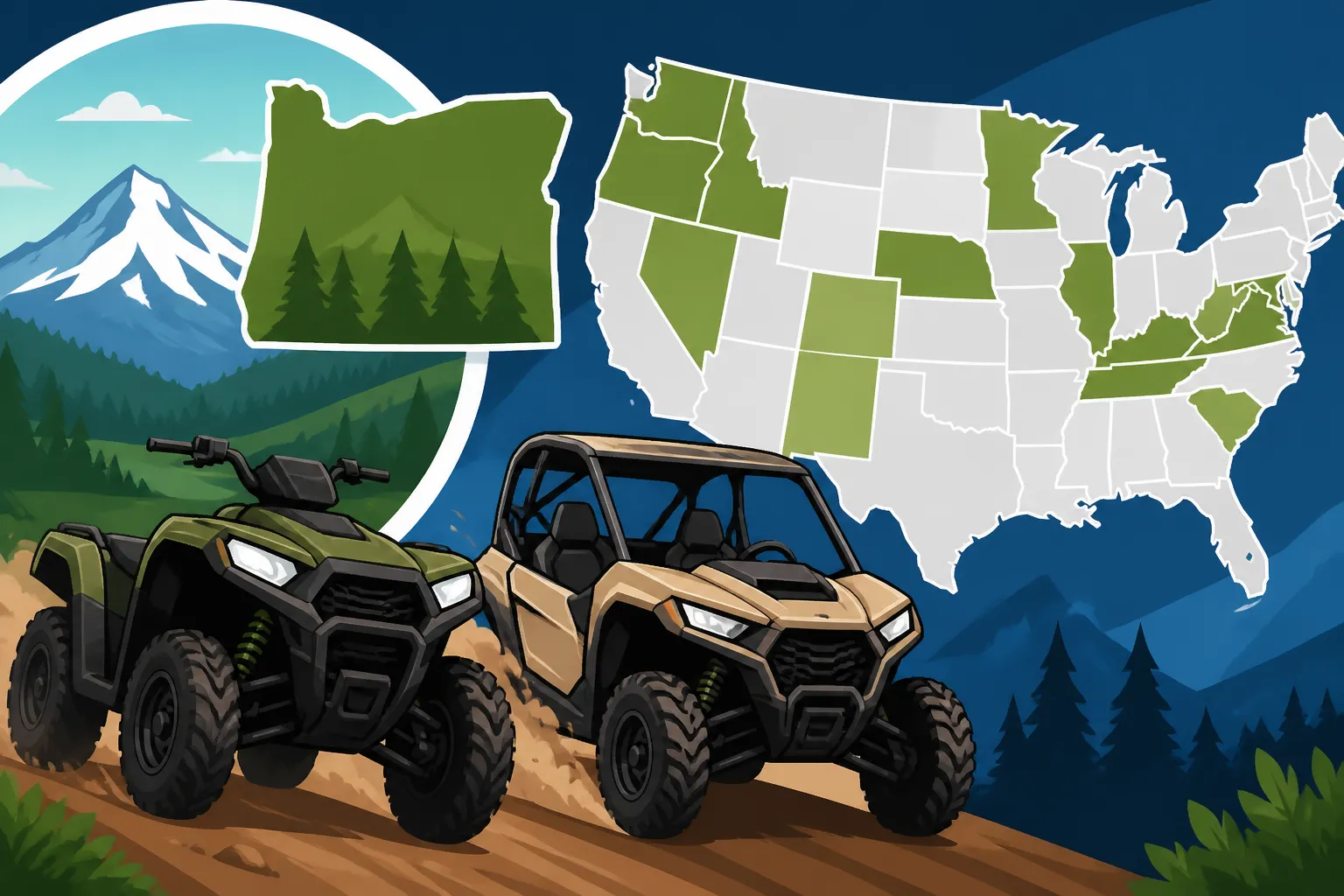
Eighteen States on One List
Oregon’s reciprocity with other states can save a visitor from buying another riding permit, but “reciprocity” does not mean every out-of-state document works for every purpose. The key is to separate an ATV operating permit from safety education and highway registration, then check which rule applies to your machine and ride.
What Oregon’s 18-state reciprocity means
Oregon recognizes ATV permit reciprocity with 18 states, according to the Oregon Parks and Recreation Department (OPRD). That recognition can matter when you bring a machine from another state to ride on Oregon lands open to ATV use. It does not automatically mean that every permit, card, sticker, or vehicle plate from another state is accepted.
The practical question is not simply, “Is my home state on the list?” It is, “Does the document I have meet Oregon’s rule for this specific ride?” A valid permit from a state with reciprocity may satisfy Oregon’s operating-permit requirement, but that does not by itself settle safety education requirements or permission to ride on a road.
Oregon requires an ATV operating permit for operating a machine on lands open to ATV use, according to OPRD. Oregon ATV permits are issued by OPRD, not by the DMV. The DMV may title an ATV, but it does not register ATVs, according to the Oregon Department of Transportation. That distinction matters because a title or registration document is not automatically the same thing as an off-road operating permit.
It also helps to distinguish permit reciprocity from safety education. OPRD says non-residents operating Class I and Class III vehicles in Oregon must take the online ATV safety course and carry an ATV Safety Education Card unless exempt. In other words, having a permit accepted through reciprocity does not automatically establish that you meet the safety-card rule.
| Document or rule | What it concerns | What to check before riding |
|---|---|---|
| Out-of-state ATV permit | Permission to operate on lands open to ATV use | Whether Oregon recognizes your permit and whether it is current and appropriate for your machine |
| ATV Safety Education Card | Rider education requirements | Whether you need an Oregon card, have an accepted exemption, or must complete Oregon’s course |
| Title or registration | Ownership or vehicle status under another jurisdiction | Whether it has any relevance to the particular Oregon riding area or road |
| Street-use approval | Whether a machine may be operated on a public road | The applicable road rules, rather than assuming off-road permit reciprocity covers road use |
For a visitor, the important takeaway is that reciprocity applies to a particular requirement, not to every rule that might come up during a ride. Read Oregon Permit Reciprocity List and Oregon ATV Safety Card Reciprocity List as separate questions, and use Why Oregon’s Two Reciprocity Lists Differ to understand why those checks should not be treated as interchangeable.
Check the permit and the safety rule separately
Start with the permit. OPRD’s reciprocity recognition concerns ATV permits, while its safety education requirements address the rider. Even if your permit qualifies, your rider credentials may still need attention. The category of your machine matters, too: Oregon groups ATVs into Class I, Class II, Class III, and Class IV, according to Oregon law and OPRD.
For non-residents, OPRD specifically identifies Class I and Class III riders as needing to take Oregon’s online safety course and carry an ATV Safety Education Card unless exempt. Class I generally includes quads and three-wheelers, while Class III refers to off-road motorcycles; confirm your machine’s class rather than relying only on its nickname or appearance. If you are unsure how Oregon categorizes it, Oregon’s Four ATV Classes Explained can help you narrow it down.
Do not assume that your home state’s general off-road credential is an Oregon ATV Safety Education Card. Check whether Oregon accepts the particular card or permit you hold, and whether an exemption applies to your situation. The safest approach is to verify both questions before leaving home: whether Oregon recognizes your operating permit, and whether you meet the safety education requirement for your machine and rider status.
A useful way to think about this is to separate the paperwork by purpose:
- Permit: Does the document cover operation on the Oregon lands where you plan to ride?
- Safety education: Does the rider meet Oregon’s training or card requirement for the machine class?
- Ownership documents: Do you have proof of ownership if you need it? Oregon allows an ATV to be titled, but a title is not the same as an ATV operating permit.
- Road use: Are you planning to use a public road? An off-road permit or safety card does not, by itself, make a machine street legal.
This last distinction can be easy to miss. OPRD says plates issued by other states for ATVs and side-by-sides are not valid for highway use in Oregon. An out-of-state plate should not be treated as a substitute for checking Oregon road access rules. If your trip includes roads, review Riding Oregon With an Out-of-State Permit alongside Oregon Rules for Visiting Riders before planning a route.
How to verify your paperwork before traveling
Because reciprocity depends on the document and its purpose, a quick check before a trip can prevent a frustrating problem at a staging area. Keep the questions specific: what machine are you bringing, where will you ride, and which permit or rider card do you already have?
A practical pre-trip check looks like this:
- Identify your ATV class. Oregon recognizes four ATV classes, according to OPRD. If you are uncertain, verify the class using the machine’s design and Oregon’s class definitions.
- Confirm the permit’s status. Check that your out-of-state permit is current and ask whether it qualifies under Oregon’s reciprocity rules. Do not infer acceptance from a decal that merely looks similar to Oregon’s.
- Check rider education independently. If you will ride a Class I or Class III machine, review OPRD’s non-resident safety education rule and confirm whether an exemption applies.
- Consider every rider in the group. A permit for the machine does not automatically satisfy each operator’s education requirements. Young riders have additional requirements, so check those directly rather than assuming an adult’s paperwork covers them.
- Separate trail access from road access. A permit that works on an off-road area does not authorize use on a public road. Confirm local and statewide road rules for the exact route.
- Keep proof accessible. Carry the documents you may need to show, and store them somewhere protected from water, sand, or damage.
If the permit does not qualify, or you cannot verify that it does, the conservative option is to obtain an Oregon permit before riding. OPRD allows visitors to buy an Oregon ATV permit online or through an onsite agent. An online purchase includes a temporary permit valid for 30 days, according to OPRD. For steps and purchase options, see Buying an Oregon Permit Online and Where to Buy an Oregon ATV Permit.
OPRD says Oregon’s permit is valid for two years. That duration may make it a practical alternative for someone who expects to ride in Oregon repeatedly, but decide based on your own travel plans and confirm current details with OPRD before purchasing. For occasional visitors, checking reciprocity first may avoid buying a duplicate permit; for a longer stay, obtaining an Oregon permit can simplify the permit question. Either way, it does not remove the need to check safety education, land access, or road rules.
Common mistakes visitors can avoid
The most common mistake is treating the word “reciprocity” as a blanket approval. It is better to think of it as a limited recognition rule: one state may accept a specific kind of document from another state for a specific purpose. That does not make the machine eligible for every riding area or every road, and it does not necessarily resolve rider education requirements.
Another mistake is relying on a plate, title, or sales document as proof of an off-road permit. The Oregon Department of Transportation says the DMV does not issue ATV registration, while OPRD issues ATV permits. A title may help document ownership, but it should not be presented as a replacement for an operating permit.
Visitors can also overlook the difference between machine classes. A quad, off-road motorcycle, side-by-side, and larger off-road vehicle may fall under different Oregon rules. If your group has different machine types, confirm each one rather than assuming the permit or training rule for one vehicle applies to the others. Which Oregon ATV Class Your Machine Falls Into is a useful starting point.
Finally, do not leave the safety-card question until arrival. OPRD’s rule for non-resident Class I and Class III operators is specific, and “my state has a course” is not the same as confirming that Oregon accepts the resulting credential. Check the rule before travel, and keep proof of any card or exemption with your trip documents.
The simplest plan is to verify the operating permit and the safety card as two separate items, then check road access separately if you expect to ride beyond designated off-road areas. Oregon’s recognition of permits from 18 states can help visitors, but it works best when you know exactly which document is being recognized and what it does not cover.
Sources
- Oregon Parks and Recreation Department — Oregon Parks and Recreation : ATV Permits : Ride ATVs : State of Oregon (checked November 3, 2026)
- Oregon Parks and Recreation Department — Oregon Parks and Recreation : ATV Permits : Ride ATVs : State of Oregon (checked November 3, 2026)
- Oregon Parks and Recreation Department — Oregon Parks and Recreation : ATV Safety Card : Ride ATVs : State of Oregon (checked November 3, 2026)
- Oregon Parks and Recreation Department — Oregon Parks and Recreation : Places to Ride : Ride ATVs : State of Oregon (checked November 3, 2026)
- Oregon Parks and Recreation Department — Oregon Parks and Recreation : Places to Ride : Ride ATVs : State of Oregon (checked November 3, 2026)
- DEPARTMENT OF TRANSPORTATION DRIVER AND MOTOR VEHICLE SERVICES — 463.pdf (checked November 3, 2026)
- Oregon Parks and Recreation Department — Oregon Parks and Recreation : ATV Safety Card : Ride ATVs : State of Oregon (checked November 3, 2026)
- Oregon Parks and Recreation — Oregon Parks and Recreation : Youth Riders : Ride ATVs : State of Oregon (checked November 3, 2026)
- Oregon Parks and Recreation Department — Oregon Parks and Recreation : Types of ATVs : Ride ATVs : State of Oregon (checked November 3, 2026)
- Oregon Parks and Recreation Department — Oregon Parks and Recreation : FAQ : Ride ATVs : State of Oregon (checked November 3, 2026)
Disclaimer
This article is for general informational purposes only and does not constitute professional advice. Laws, prices and regulations vary by location and change over time. Consult a qualified professional for guidance on your specific situation.