What a Rental Agency Must Hand You
Renting an ATV or UTV in Oregon can involve more than signing a waiver and taking the keys. You may need safety information and a rental-specific safety credential before riding, and the rules differ from the paperwork that applies to your own machine. Here’s what to expect from the rental agency, what to check before leaving, and what you may still need to arrange yourself.
The key paperwork: safety information and a rental card
Oregon’s ATV safety education rules apply to rental rides, but the rental process has a special provision. A rental agency can provide a temporary safety card for a renter after completing the required safety steps. The card is commonly described as a 30-day rental safety card. It is different from a permanent Oregon ATV safety education card, which riders can obtain through Oregon’s regular safety education process.
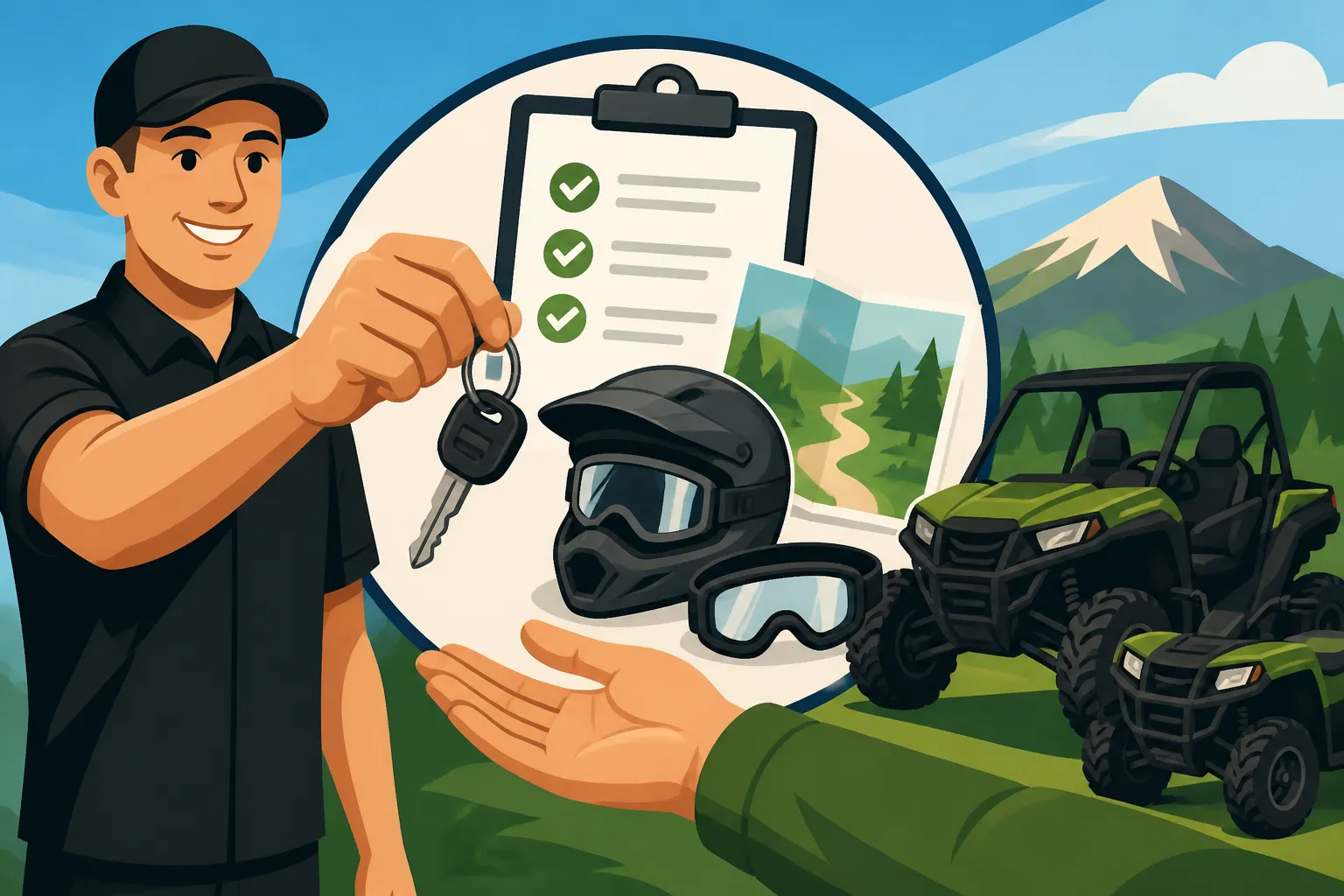
The agency should explain the machine’s controls and basic operating rules, provide the rental safety checklist, and tell you what you need to do to receive the temporary card. Read and complete the checklist rather than assuming the reservation confirmation or rental agreement serves the same purpose. A signed waiver addresses legal responsibilities between you and the business; it does not automatically replace safety education paperwork.
Before you ride, make sure you know what document the business has issued and whether you must carry it. Ask if it is provided on paper, electronically, or both. If you receive a card or document, keep it accessible during the ride. A phone can be useful, but it may not be usable if the battery dies, there is no signal, or the device gets wet. Ask the agency what form of proof it expects you to have with you.
| Item | What it is for | What to check |
|---|---|---|
| Rental safety checklist | Documents that safety information and instructions were covered | Complete it honestly, and ask questions about anything unclear |
| Temporary rental safety card | Provides rental-specific proof connected to Oregon’s safety-card rules | Confirm it was issued to you and ask how to carry or show it |
| Rental agreement | Sets out the business’s terms for use, damage, return, and other responsibilities | Read the rules for where you may ride and what happens if the machine is damaged |
| Permit decal on the machine | Shows that the machine has the required Oregon operating permit when one applies | Look for a decal before departure; ask the agency if it is missing or unreadable |
| Site or day-use pass | Covers access or parking fees at some riding areas | Check separately; the ATV permit does not necessarily cover site fees |
The precise steps may vary between agencies and machine types. If you are unsure whether your rental includes the required safety document, ask before paying or signing. For more background, see Oregon’s ATV Safety Card Requirements and Oregon’s 30-Day Rental Safety Card Explained.
A temporary rental card should not be treated as a permanent safety card for future rides on other machines. If you expect to ride again after the rental, check whether you need a regular card for your class of ATV. The requirements can depend on the machine class and rider’s age. Oregon Rules for Riders Under 16 explains why a child’s requirements may differ from an adult’s.
What to review before signing or leaving
A counter can be busy, especially on a summer weekend. Still, take a few minutes to verify the basics before the machine leaves the lot. A quick check can prevent an avoidable problem at a staging area or later on the trail.
- Confirm the machine and its class. Ask what class the rental is and whether it is an ATV, side-by-side, or another type of off-road vehicle. Oregon’s classes are based on vehicle characteristics, not just the name used in a rental advertisement. If you want to understand the distinctions, see Oregon’s Four ATV Classes Explained.
- Complete the safety checklist. Make sure the instructions cover starting, stopping, steering, braking, shifting if applicable, and emergency procedures. Do not initial or sign that you understand something you have not been shown.
- Ask how the temporary safety card works. Find out whether the agency issues one to each operator, what proof you should carry, and how long it applies. If several people will drive, do not assume one operator’s card covers everyone.
- Check the permit decal. Ask the agency whether the machine has the required operating permit for Oregon riding. A rental customer should not assume the business’s rental paperwork replaces a permit for the machine. See Oregon Rules for a Rented Machine for the broader rental requirements.
- Confirm where the rental may go. The allowed area may be limited by the rental agreement, the machine, land-manager rules, or closures. A rental agreement allowing use in one area does not give permission to ride on every nearby road or trail.
- Check what is included. Ask about helmets, goggles, fuel, recovery help, and any required safety equipment. The list of included items is not the same as the state safety paperwork, and equipment policies vary by business.
- Get a copy of what you sign. Keep the rental agreement, checklist, and any temporary card or instructions in a safe place. If the agency sends documents electronically, save them somewhere accessible without relying on a live connection.
The checklist is a useful chance to make sure the machine is appropriate for the person who will operate it. Ask the agency about age restrictions, passenger rules, and supervision requirements. A passenger’s permission to ride does not necessarily mean they can operate the machine, and one rental group may include people with different legal requirements.
If you are renting a side-by-side, ask about seat belts, doors or restraints, and how passengers should be secured. If you are renting a quad, ask whether it is designed for a passenger. Don’t assume that a passenger can ride safely just because there is room on the seat. The rental agency should be clear about the machine’s intended use and its own restrictions.
The permit decal and riding-area fees are separate issues
The safety card is about the operator. The operating permit is associated with the machine. These are separate requirements, and neither should be confused with a fee charged to enter or park at a riding site.
Before setting off, look for the permit decal and ask the agency to confirm that it is current and placed where it can be seen. If it is absent, damaged, or unreadable, pause and get an explanation before riding. A rental receipt or safety checklist is not a substitute for the machine’s required permit decal. More on the distinction is available in [Oregon ATV Permits Explained] and Oregon ATV Permit Decal Placement.
You may also need to pay a separate day-use or parking fee at the site. The business may include this in the rental package, collect it separately, or leave it to you. Confirm the arrangement before you drive to the staging area. Don’t assume that paying for the rental, or seeing a permit decal on the machine, covers parking or access charges. Oregon Day Use Fees Explained covers that separate cost.
Location matters, too. The rental shop may tell you where customers commonly ride, but access rules are set by the land manager and can change with closures or conditions. Check current signs and official site information before entering a trail or road. An open-looking route is not necessarily open to your machine, and permission to ride a designated OHV area does not automatically permit travel through nearby communities or onto public roads.
If a rental employee gives directions verbally, ask for the route or riding-area name and confirm it against current maps and signs. Be especially careful when a route connects a staging area to a road, beach, campground, or town. The machine’s permit does not grant blanket road access. Oregon Rules for Riding a Forest Road and Oregon Rules for Crossing a State Highway explain why off-highway use and road use are not interchangeable.
If the agency does not provide the paperwork
If the staff cannot explain the safety-card process or does not provide the checklist or temporary document they say is required, resolve the issue before riding. Ask to speak with a manager, and state plainly that you need to know what safety credential applies to your rental and how to carry proof. Do not rely on a verbal assurance that “the rental covers it” if nobody can explain what that means.
Use this short check before leaving:
- You know who is allowed to operate the machine.
- Each operator has completed the required safety steps.
- You know what safety card or proof the agency has provided and how to show it.
- The machine has the required operating permit decal, if applicable.
- You understand the rental boundaries, return instructions, and emergency contact process.
- You know whether site access or day-use fees are separate.
- You have the safety gear required for the machine and riding area.
If you already have a permanent Oregon ATV safety card, bring it or keep accessible proof of it. Still follow the rental agency’s instructions and complete any required rental checklist. Your own card does not replace the rental contract, machine permit, site rules, or safety briefing.
A visitor with an out-of-state credential should not assume it automatically meets Oregon’s requirements. Reciprocity depends on the credential and the applicable rules, not simply the state where the rider lives. Ask the agency what Oregon accepts for your situation, and review Does Oregon Accept an Out-of-State Safety Card? before your trip.
If the rental counter is unable to resolve a question about current rules, confirm the requirement with the appropriate Oregon ATV safety or permit authority before riding. That extra check is easier than trying to sort out missing paperwork at a trailhead or during a roadside stop.
Disclaimer
This article is for general informational purposes only and does not constitute professional advice. Laws, prices and regulations vary by location and change over time. Consult a qualified professional for guidance on your specific situation.