Oregon Federal Site Fees for Riders
Oregon riders may need to budget for more than an ATV permit when they use a federal staging area. A state permit covers a different requirement from a federal day-use fee, and passes are not accepted everywhere. Knowing what each charge pays for—and checking the site’s rules before you leave—helps prevent surprises at the trailhead.
Federal site fees are separate from Oregon ATV permits
An Oregon ATV operating permit and a federal recreation-site fee serve different purposes. The permit relates to operating an off-highway vehicle in Oregon. A federal fee, when one applies, generally relates to using or parking at a particular recreation site. Paying one does not automatically satisfy the other.
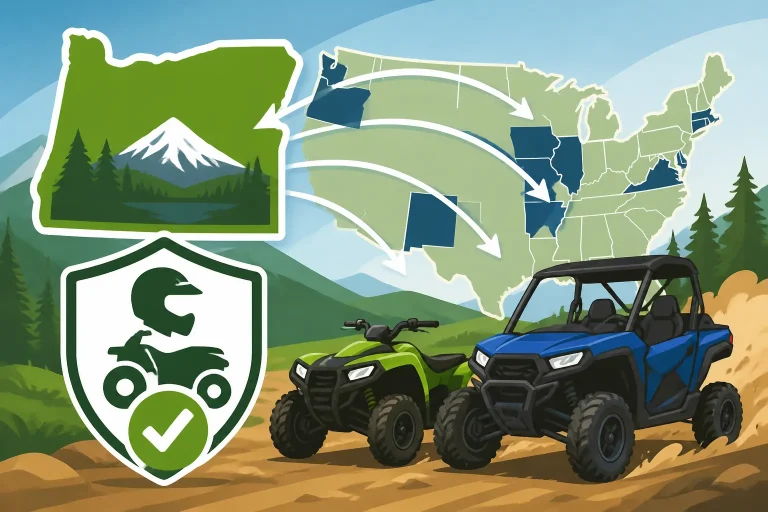
The difference matters even if your machine has a valid Oregon permit decal or an out-of-state permit Oregon recognizes. Reciprocity can affect whether your machine needs a separate Oregon permit, but it does not necessarily waive a fee charged to use a federal site. Check Oregon Permit Reciprocity List before riding, and verify the fee rules for the specific place where you plan to stage.
A fee may apply at a developed day-use area, parking lot, or other managed recreation site. It is not necessarily charged simply because you ride on federal land. Fee rules depend on the site and land manager, so two riding areas in the same region may have different payment requirements.
| What you are paying for | What it generally covers | What it does not automatically cover |
|---|---|---|
| Oregon ATV operating permit | The state off-highway vehicle permit requirement | Parking or day use at a federal recreation site |
| Federal day-use fee | Use of a particular fee-designated site, according to its rules | An Oregon ATV permit or access to every nearby riding area |
| Federal recreation pass | Entry or day use at participating federal sites, subject to the pass terms | Every fee, including charges that are excluded by the site |
| Camping charge | A campsite or overnight stay where a fee applies | Day-use access or an ATV permit, unless the site says otherwise |
Think of these as separate checks: Is the machine permitted? Is the rider meeting applicable safety requirements? Does this specific staging site charge a fee? Does the pass you have count there? That approach is more reliable than assuming one sticker, card, or receipt covers the whole trip.
For a broader overview of how these charges differ, see Oregon Day Use Fees Explained. It also helps to know Why the Permit Does Not Cover Parking before relying on an ATV permit as proof that a staging fee has been paid.
How federal fees and passes work at Oregon riding areas
Federal recreation sites may be managed by agencies such as the U.S. Forest Service or the Bureau of Land Management. A fee may be collected at a designated site, while nearby roads or riding areas may have different access rules. The agency, site designation, and posted instructions all matter.
At a fee site, payment may be tied to the vehicle using the parking area rather than to each ATV. But do not assume that is always the arrangement. Read the fee notice for the site you are actually using. It should explain what the charge covers, whether it is per vehicle or another unit, and how to display or keep proof of payment.
A federal recreation pass can be useful, but its acceptance is site-specific. The Northwest Forest Pass is relevant at participating Forest Service fee sites; it is not a universal pass for every federal recreation area in Oregon. Likewise, an interagency pass may cover certain federal entrance or day-use fees but not every charge a site collects. Camping, special activities, or other services may be treated separately.
At Oregon Dunes National Recreation Area locations, for example, check the current instructions for the exact staging area rather than assuming a pass accepted at one location will work at another. The Northwest Forest Pass and Oregon Sites explains the pass distinction, while Using an Interagency Pass on the Oregon Coast is useful if you already carry an interagency pass and want to check whether it fits your coastal plans.
A pass also may have display or proof-of-payment requirements. If a site asks for a pass to be displayed in the tow vehicle, having the pass somewhere in a gear bag may not be enough. If payment is made through a machine or online system, follow the site’s directions for displaying a receipt or retaining confirmation. Keep a photo or other proof only as a backup; it does not replace any required physical display.
When planning around a federal fee, use this sequence:
- Identify the exact staging area or recreation site, not just the broader forest, dunes, or riding region.
- Check the managing agency’s current page and any signs or notices for that site.
- Confirm whether a day-use fee applies, what it covers, and how payment is accepted.
- Check whether your pass is accepted there and whether it covers the vehicle or activity you plan to use.
- Save or display payment proof as instructed, and keep your ATV permit information separate.
This is especially helpful when a trip includes multiple staging areas. A pass or receipt that works at one site may not cover a second location, even if both are part of the same outing. Day Use Fees at Oregon Federal Sites offers more context on why riders should verify the specific site rather than relying on a general assumption.
What to check before heading to a federal staging area
The most useful check is the official information for the exact parking or staging location. Search by the name on the trail map or sign, then confirm that the page refers to the same place. A nearby campground, trailhead, or day-use area may have separate rules.
Look for these details:
- Whether a fee applies. Some federal recreation sites charge for day use; others may not. Do not assume all federal land has a fee or that all sites are free.
- What the fee covers. It may apply to parking or use of a developed site, not to every riding opportunity in the surrounding area.
- How the fee is calculated. Check whether it is charged per vehicle, per day, or another way. Do not infer the unit from the amount posted.
- Which passes are accepted. Confirm the exact pass type, as well as any exclusions.
- Where payment proof goes. A site may ask for a pass or receipt to be displayed in a vehicle, or for confirmation to be retained.
- How to pay. Check for current payment options before relying on cash, a phone signal, or an automated pay station.
- Whether the site is open. Closures, maintenance, seasonal restrictions, or other notices can affect access independently of fees.
If you plan to ride the Oregon Dunes, it can help to check the staging-area details alongside the broader riding-area information in The Oregon Dunes National Recreation Area. For a practical look at paying at a staging area, see Paying the Day Use Fee at a Staging Area. Neither general information nor an older receipt should override signs posted at the site on the day you arrive.
Build a little flexibility into the plan. A payment machine may be unavailable, an access point may be closed, or the agency may have updated its instructions. If the site directs visitors to another payment method, follow that direction rather than assuming a pass or an earlier payment still applies. When the rules are unclear, ask the managing agency before unloading.
Also check any separate costs that apply to the trip. A day-use fee is not the same as a campground reservation, overnight charge, or optional pass. If you will camp, confirm camping fees and reservation rules independently. If you will use more than one staging area, check each one rather than assuming the first payment covers the whole day.
A simple way to budget and avoid paying twice
Start with the state requirement, then add any site charges. First determine whether your machine needs an Oregon permit or qualifies under applicable reciprocity rules. Then check the federal site where you expect to park or stage. This separates two questions that often get mixed together: permission to operate the machine and payment for using the site.
Next, decide whether a pass you already own is likely to help. Compare the pass terms with the site’s current fee notice. A pass can reduce or satisfy an eligible day-use charge, but only where it is accepted and only for the uses described by its terms. If acceptance is unclear, contact the agency instead of buying another pass or assuming the charge is waived.
Keep payment records organized for the trip. Store the ATV permit information and the site-fee receipt separately, and make sure each is accessible when needed. If the pass must be displayed in the tow vehicle, place it as instructed. If payment is electronic, retain the confirmation in a way you can retrieve without depending on a strong signal at the trailhead.
For example, a rider with a valid Oregon permit may still need to pay a fee at a particular federal day-use site. Another rider might have a pass that covers that site’s eligible day-use charge but still needs a valid ATV permit. In both cases, the permit and fee answer different questions; having one does not prove the other requirement has been met.
If you are unsure whether the planned stop is fee-designated, do not rely only on a map pin or what another rider paid on a previous visit. Fees and access instructions can vary by location and change. Confirm the current details with the land manager, then follow the posted signs when you arrive.
Disclaimer
This article is for general informational purposes only and does not constitute professional advice. Laws, prices and regulations vary by location and change over time. Consult a qualified professional for guidance on your specific situation.