Oregon Hands-On Training Requirements
Oregon’s hands-on ATV training requirement can be confusing: an online safety course may not be the last step for a young rider. The key is knowing which machine class the rider will operate, when practical training is required, and how the temporary instructional permit fits in. Here’s how to plan the training without mistaking a temporary credential for a completed safety card.
Who needs hands-on training in Oregon
Oregon’s hands-on training requirement is mainly relevant to younger riders who need an ATV safety card to operate a Class I or Class III machine. These classes cover many quads and off-road motorcycles. The requirement is not a blanket rule that every adult must complete practical training before riding.
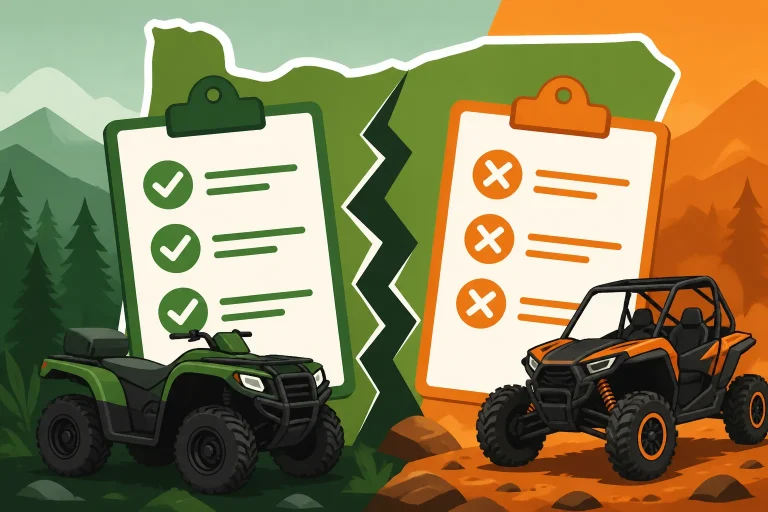
The rules depend on both the rider’s age and the machine’s class. Class IV machines, including many side-by-sides, have different safety-card requirements for young riders than Class I and Class III machines. Check the class before enrolling: a course or card requirement that applies to a quad may not apply in the same way to a side-by-side.
| Situation | What to check |
|---|---|
| Rider under 16 on a Class I or Class III ATV | Whether the rider must complete hands-on training after the online safety course |
| Rider under 16 on a Class IV machine | Whether the rider needs a safety card for that machine class |
| Rider 16 or older | Whether the rider’s class and circumstances require a card, or whether another credential qualifies |
| Visitor with training or a card from another state | Whether Oregon accepts that particular card or credential |
The online course and the practical component serve different purposes. The online material covers rules, safety concepts and decision-making. Hands-on training gives the rider supervised practice with the machine. Completing one should not be assumed to satisfy the other when practical training is required.
For a fuller overview of the age and class rules, see Oregon ATV Safety Card Requirements. The details for younger operators are also covered in Oregon Rules for Riders Under 16, while Class I and Class III Card Rules in Oregon and Class IV Cards Only for Riders Under 16 help explain why identifying the machine’s class matters.
Identify the machine first
Before signing up, confirm which Oregon ATV class applies to the machine. A quad, dirt bike, side-by-side, dune buggy and other off-highway vehicles do not all fall into the same category. Width, weight, seating and steering configuration can affect classification. If the machine’s class is unclear, use Which Oregon ATV Class Your Machine Falls Into rather than guessing from its brand name or model.
This step prevents a common planning problem: arranging the wrong training or assuming the rider has met a requirement that applies to a different class. If the family uses more than one type of machine, check the requirements for each one.
The permit rules are separate from other riding rules, too. A safety card does not automatically authorize riding on every road or trail, and it does not replace a permit decal where one is required. For a wider explanation of operating credentials, start with How to Get an Oregon ATV Safety Card.
Age does not erase the class distinction
A rider’s age affects the safety-card rules, but age alone does not tell you whether hands-on training is required. First identify the class, then check the rider’s age against the requirement for that class. In particular, do not assume the rules for a Class I quad also apply unchanged to a Class IV side-by-side.
A driver’s license or out-of-state credential may also affect what a rider needs to carry, but it is not a reason to skip checking the practical-training rule. Oregon treats training, proof of eligibility and machine-class requirements as related but distinct questions.
How the online course and instructional permit fit together
For a young rider who needs practical training, the usual sequence involves completing the required online safety education and then arranging the hands-on component. Oregon provides an instructional permit for a limited period while the rider completes the process. The permit is commonly described as valid for 180 days; confirm its conditions and expiration information through the state program when it is issued.
Think of the instructional permit as a temporary stage in the training process, not as proof that the rider has completed every requirement. It is not a permanent card, and its conditions matter. Read the instructions that come with it and make sure the rider follows any supervision or operating restrictions. Do not assume that being able to print or display a temporary document means the rider can operate without those conditions.
The six-month period is important for scheduling. If hands-on training is required, plan to finish it within the permit’s validity period rather than waiting until the end. Course availability may vary by location and season, so a family that waits to book may have fewer convenient options.
For the step-by-step sequence, see Oregon’s 180-Day Instructional Permit and How to Get an Oregon ATV Safety Card. The online course can be taken before practical training, but completing it does not mean the practical component has been waived.
Keep the records from each step
Save confirmation of the online course, the instructional permit and the practical-training completion. Keep the final card or proof of completion accessible during rides, and make sure the information is legible. If the state program provides a digital card, check that it can be opened on the device you plan to bring; service may not be available at a remote staging area.
A simple checklist helps:
- Confirm the machine’s class.
- Check the age-specific safety-card and hands-on requirements.
- Complete the appropriate online course.
- Read the instructional permit’s restrictions and expiration information.
- Book practical training early if it is required.
- Keep completion records and the final credential available.
If the rider completes a course but cannot find the card afterward, use [Oregon Safety Card Replacement] rather than relying only on a course-completion email. For carrying proof on a ride, see Showing an Oregon Safety Card on Your Phone.
What to expect at a hands-on course
A hands-on course is practical instruction under the direction of a qualified provider. Its purpose is to help a rider apply safe operating habits on an actual machine, not simply repeat the online material. The provider will explain what equipment and machine are needed, how the session is organized and what the rider must do to complete it.
Practical instruction commonly includes getting familiar with the controls, checking the machine before riding, starting and stopping, turning, managing speed and responding to changing terrain. The exact exercises and course format can vary. Follow the provider’s instructions rather than treating a generic list of skills as a substitute for the assigned course.
The hands-on portion is also a useful opportunity to notice whether the rider is comfortable with the machine’s size and controls. A rider who can answer online questions may still need practice with braking, steering, balance or looking ahead. If the machine feels too large or powerful, pause and discuss a better fit with the course provider and an experienced adult before riding independently.
Prepare before the appointment
Ask the provider what to bring. Requirements can differ, but it is sensible to confirm whether the course supplies a training machine or expects the rider to bring one, and whether protective gear is provided or must be supplied. If the rider brings a personal machine, check that it is in safe working condition and is appropriate for the course.
Give yourself enough time to arrive, complete any paperwork and listen to the safety briefing. A rushed arrival can make it harder for a young rider to focus. The rider should be rested, dressed for the weather and ready to follow instructions.
Parents or guardians should ask practical questions before booking, such as:
- Is the course approved for the training requirement the rider needs to satisfy?
- Does the rider need to bring a machine, helmet or other gear?
- What happens if weather or a mechanical issue interrupts the session?
- What documentation will the provider give after successful completion?
- How will the completion be recorded or submitted?
These questions are especially useful when enrolling through a club, training provider or local program. A course that is generally about ATV safety is not necessarily the right course for every rider or every credential.
Use Booking a Hands-On Course to plan the appointment. The state’s Oregon Course Providers and Where They Teach information can help with finding an appropriate option, but confirm the provider’s current schedule and course details directly.
Practical training is not a substitute for supervision
Completing hands-on training is an important milestone, but it does not make a young rider ready for every terrain or riding situation. Continue to match the machine to the rider’s size and ability, provide appropriate supervision and start with manageable conditions. A steep slope, deep sand, crowded trail or unfamiliar machine can create challenges that a training session cannot eliminate.
The same goes for equipment and site rules. Riders still need the required protective gear, permit and safety credentials, and must follow the rules for the land where they ride. Review Oregon’s ATV Safety Education Card alongside the rules for the intended riding area.
Planning around the deadline and riding outside Oregon
The safest approach is to treat the instructional period as a real deadline, not a broad window that can be ignored until the family is ready to ride. After completing the online portion, find an eligible hands-on course and reserve a place as soon as practical. Keep a note of the permit’s expiration date and ask the provider what to do if the available course dates fall close to it.
If the rider misses the deadline or the permit expires before training is complete, do not assume the temporary credential remains valid. Check the state program for the next required step before the rider operates. The right solution may depend on the rider’s records and current program instructions; guessing can leave the rider without the required credential.
The same caution applies if a rider has training from another state. Oregon’s acceptance of another state’s safety card is not automatically the same as accepting its permit, registration or practical-training record. Check the specific credential and the rider’s circumstances. Does Oregon Accept an Out-of-State Safety Card? explains the distinction, and Oregon Safety Card Reciprocity List covers the reciprocity question.
Visitors and families with more than one rider
A visitor should not assume that a home-state card settles every Oregon requirement. A rider may need to consider the type of credential held, the machine class, age and how long the rider will operate in Oregon. See Oregon Rules for a Visiting Rider and How Long a Visitor Can Ride Oregon before planning a longer stay.
For families, make a separate checklist for each rider. Siblings of different ages may face different requirements, even if they ride together or use similar machines. A household with a quad and a side-by-side should also verify the rules for each class rather than treating all machines as interchangeable.
If the rider has completed training but is waiting for the final card, keep the completion evidence and follow the program’s directions about acceptable proof. Do not rely on a verbal assurance or an unreadable phone screenshot if the program provides a more definitive credential.
Hands-on training can take advance planning, but the process is manageable when the family verifies the machine class first, checks the rider’s age-specific rule, and books the practical component early. The essential point is simple: when Oregon requires hands-on training, an online course or temporary instructional permit alone does not complete that requirement.
Disclaimer
This article is for general informational purposes only and does not constitute professional advice. Laws, prices and regulations vary by location and change over time. Consult a qualified professional for guidance on your specific situation.