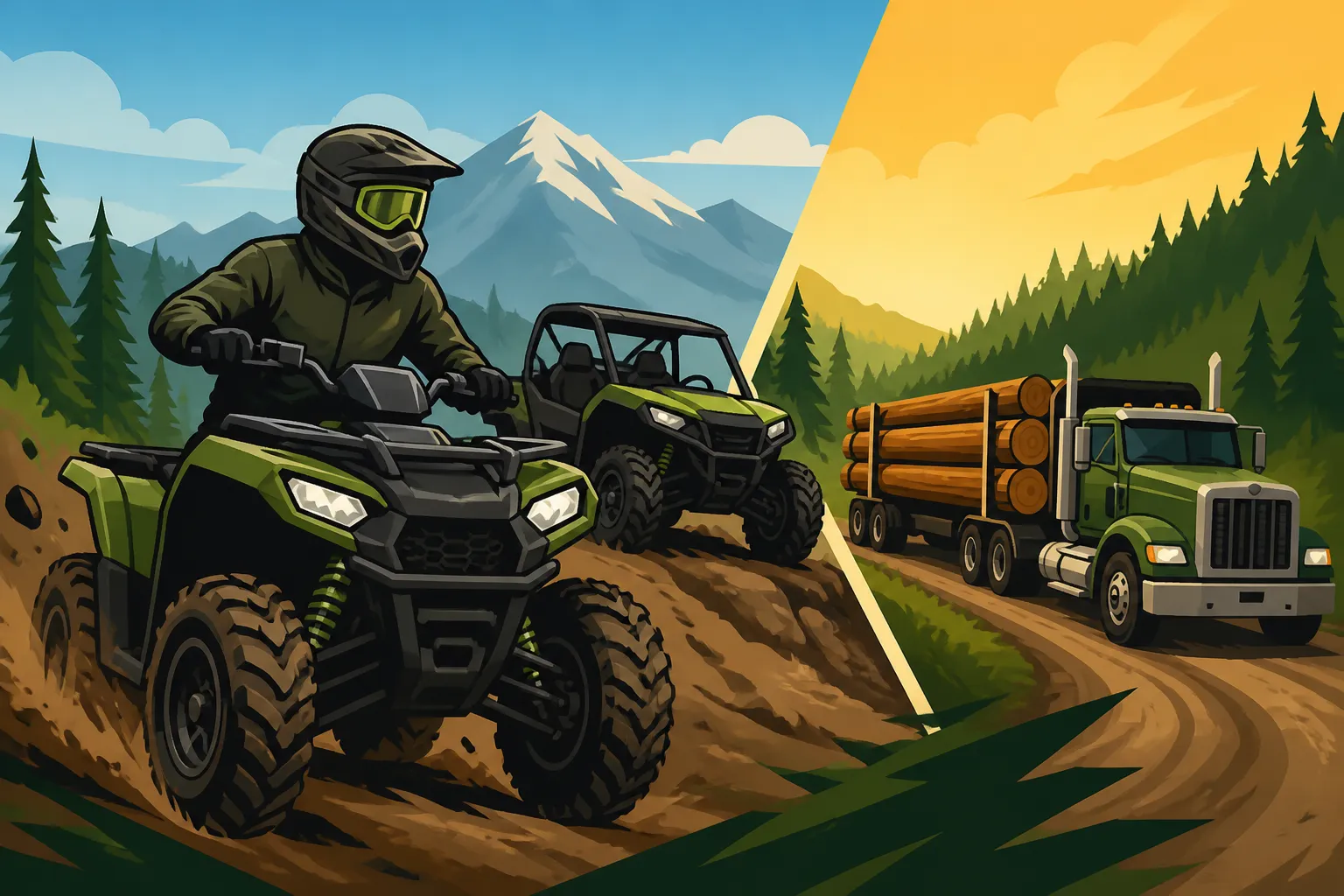
Log Trucks and Weekday Riding
A quiet weekday ride in Oregon can change quickly when a loaded log truck appears around a blind corner. Narrow forest roads, loose gravel, dust, and active hauling all call for a different kind of planning than a marked OHV trail. This guide explains how to check access, prepare for truck traffic, and share logging roads more safely on an ATV or UTV.
Check road access before you ride
A visible road is not automatically open to ATVs
Oregon has forest roads managed by different landowners and agencies, including the U.S. Forest Service, the Bureau of Land Management, the Oregon Department of Forestry, counties, and private timber companies. A road may pass through public land but still cross private property, or it may be closed to recreational traffic even when it looks usable. Don’t assume that a gate left open, tire tracks in the gravel, or a line on a map means you’re allowed to ride there.
Before heading out, identify who manages the route and look for current access information. Check signs at the entrance and at junctions, since a closure or restriction may apply only to a particular spur or section. If you’re exploring unfamiliar roads, Who Owns the Road You Are Riding and BLM Roads Versus Forest Service Roads can help you understand why the managing agency matters.
This is especially important around logging operations. A road may be open to the public while still being used for commercial hauling, but access rules can change with conditions or work schedules. A sign indicating a closure or restriction should take precedence over a route that appears on your navigation app.
Plan around land management and changing conditions
A map is a planning tool, not permission to ride. Apps such as onX Offroad can help you trace a route, identify nearby roads, and prepare for junctions, but map information may not reflect a temporary closure or a sign posted at the road entrance. Use the map to plan, then confirm that the specific road is open before you ride.
For routes in the Coast Range, check access information for the area you intend to visit, such as Tillamook Forest Road Access. Roads can also be affected by seasonal closures, storms, maintenance, or active timber work. If a route crosses several types of land, don’t assume the rules remain the same from one parcel to the next.
It helps to download or save your planned route before leaving an area with reliable service. Carry a second way to navigate, such as an offline map or paper map, and mark a few safe turnaround points. The advice in Oregon Trail Maps Worth Carrying is useful even when your ride includes roads rather than designated trails.
Treat weekday access as a reason to check twice
Weekdays can mean less recreational traffic, but they may also mean more active hauling. A road that feels empty on a Sunday could be busy with work vehicles on a Tuesday morning. Don’t use “quiet road” as a substitute for checking signs or asking the managing agency about current conditions.
If the area has active logging, consider choosing another route or riding at a different time. You can also shorten your plan so you’re not committed to a long stretch of road with limited places to turn around. For a closer look at what can change during the workweek, see Riding an Oregon Logging Road Midweek and Timber Roads With Active Hauling.
Share the road with log trucks
Expect trucks to need more room than you do
A loaded log truck is long, heavy, and slower to stop than an ATV or UTV. The driver may need much of the road to make a turn, avoid a soft shoulder, or keep the load stable. A narrow road that appears wide enough for two vehicles can become a tight squeeze when the truck is moving around a bend.
When you hear or see a truck, slow down early and look for a safe place to pull completely out of its path. Choose a wide, firm spot with good visibility; avoid soft shoulders, steep banks, and places where your machine could slide or tip. If there isn’t a safe pullout, don’t force a pass. Stop where you can be seen, stay out of the travel line, and wait for the driver to direct you or for a safer opportunity.
On a shared gravel road, it’s often better to give the truck extra space than to try to judge the exact amount it needs. Sharing a Gravel Road With Log Trucks covers the practical challenge of making room, while Oregon Rules for Riding a Forest Road is a useful companion for understanding that forest-road access has its own rules.
Don’t rely on the driver seeing you
A truck driver may have limited visibility around the cab, along the sides of a trailer, and behind a load. Dust, vegetation, terrain, and a sharp curve can make a small vehicle difficult to spot. A driver who hasn’t reacted to you may not have seen you at all.
Make your movements predictable. Slow down well before a meeting point, avoid darting into a narrow turnout at the last second, and don’t ride beside or close behind a truck. If you pull over, stay clear of the road and wait until the entire truck and trailer have passed before moving again. Keep other riders in your group together and make sure they know where you’ve stopped.
Extra caution matters when a truck is backing, turning, or entering the road from a landing or side road. Give it space and don’t try to slip around the back or through a gap. You can’t reliably judge where the driver’s blind spots are from the seat of an ATV.
Watch for more than the truck itself
A logging operation can involve pickups, service vehicles, equipment, and workers on foot as well as log trucks. There may also be fresh gravel, uneven surfaces, debris, or temporary signs. Slow down near active work areas and be ready to stop; don’t assume a road is clear just because you haven’t seen a truck yet.
Dust can make it difficult to see a vehicle ahead or spot one approaching. Leave a generous gap from other riders, and don’t follow so closely that you ride into dust without a clear view. On a winding road, a truck can appear suddenly around a bend, especially if the road rises or drops out of sight. The related guide Dust and Blind Corners on a Logging Road explains why these conditions deserve particular care.
Adjust your riding to the road
Slow down for blind corners and loose surfaces
Gravel roads often have a crown, loose rock, potholes, washboard, or a soft edge. The surface may change abruptly from firm gravel to mud or freshly graded material. Reduce speed before corners and hills, where you have less time to react to an oncoming vehicle or an unexpected obstacle.
Keep to a predictable line and avoid hugging the edge of the road, where gravel may be loose or the shoulder may give way. On a narrow road, don’t cut across the centerline on a blind corner. If you can’t see far enough ahead to stop safely, ride at a speed that gives you room to react.
After rain, the road may be slick even if it doesn’t look muddy. On dry days, dust may hide ruts or gravel. Conditions can vary between shaded sections, exposed slopes, and areas recently used by heavy equipment, so reassess as you go rather than assuming the whole route is consistent.
Make your group easy to manage
A group ride needs a plan for what happens when someone meets a truck, loses sight of the rider ahead, or reaches a confusing junction. Agree on a pace, a stopping signal, and a rule that everyone waits at major turns. Keep enough distance between machines to see and react, but don’t let the group stretch so far that the last rider is left to make decisions alone.
Before setting off, tell the group that work traffic may be present and that anyone can call for a stop if visibility or road conditions feel uncomfortable. Carry basic communication equipment, but don’t rely on a phone signal in remote areas. If a rider has to stop, make sure the rest of the group knows where and why, without blocking the road.
Consider turning around if trucks are moving frequently, if there’s no safe place to yield, or if the road is too narrow for you to pass safely. A shorter ride is better than committing to a route that leaves you feeling pressured to squeeze by heavy equipment.
Prepare for dust, weather, and limited services
Bring water, a first-aid kit, a charged phone, and the tools or supplies you’d need for a minor problem. Let someone know where you plan to ride and when you expect to return. A route that looks close to town on a map may still have poor service and few easy exits.
Dusty conditions can irritate your eyes and make it harder to see, so use suitable eye protection and keep it clean. If visibility drops, slow down and pull over only at a safe location. After a wet spell, be especially cautious around ruts and soft edges; heavy trucks can change the road surface quickly.
Keep your map available offline, including a clear view of the route back to your starting point. onX Offroad can be useful for tracking a planned route, but confirm access at road entrances and follow posted signs. If the app’s route conflicts with a closure sign or current direction from land managers, follow the closure or direction.
Make a safer weekday riding plan
A good plan starts with the road, not just the destination. Before you leave, use this checklist to decide whether a logging-road ride makes sense:
| Before the ride | What to check |
|---|---|
| Access | Confirm the road is open to recreational riding and note the land manager |
| Work activity | Look for logging notices, closure signs, and current access updates |
| Route | Mark junctions, turnaround options, and a route back to your starting point |
| Conditions | Consider recent rain, dust, grading, and visibility |
| Group plan | Agree on a pace, stopping signals, and what to do when a truck approaches |
| Gear | Carry water, eye protection, basic repair items, and offline navigation |
Know when to turn around
Turning around isn’t a failure; it’s a sensible decision when the conditions don’t match your experience or equipment. A road may be technically open but still uncomfortable for a new rider if trucks are moving quickly, the surface is rutted, or there are no safe pullouts.
Choose a turnaround point before the ride, especially if the route narrows or climbs into an area with limited visibility. Don’t continue simply because you’ve already traveled a long way. If you encounter active hauling, repeated truck traffic, a fresh closure, or workers who ask you to leave, stop and reassess.
A plan can also change when weather shifts. Rain may make a road slick, while sun and wind can create heavy dust. If your group is struggling to see or safely share the road, head back using the safest route available rather than pressing on to reach a planned destination.
Keep the ride respectful and low-impact
Logging roads are workplaces as well as travel routes. Give workers and equipment room, obey signs, and don’t block landings, gates, or access points. Avoid kicking up dust around people, parked vehicles, homes, or work areas when you can reduce speed or choose a different line.
Stay on roads where riding is permitted. Don’t create a shortcut around a gate, ride into a closed spur, or assume that a nearby trail is open because the main road is. When you’re unsure, stop somewhere safe and verify access rather than continuing farther into an uncertain area.
A weekday ride can still be enjoyable when you plan for the possibility of work traffic. Check access, expect limited visibility, make room early, and be willing to choose another route. Those habits help protect you, the people working in the forest, and the chance to keep recreational access available.
Disclaimer
This article is for general informational purposes only and does not constitute professional advice. Laws, prices and regulations vary by location and change over time. Consult a qualified professional for guidance on your specific situation.